




Software development outsourcing gives businesses access to additional engineering capacity, specialized skills, and more flexible delivery options. However, choosing an outsourcing provider is only part of the decision. Companies must also decide where the team should be located.
Onshore, nearshore, and offshore outsourcing differ in cost, time-zone alignment, talent availability, cultural compatibility, and management complexity. No model is universally better than the others. The right choice depends on the project’s priorities, internal capabilities, and tolerance for operational risk.
This guide compares the three outsourcing models and explains how to select the most suitable approach for your software project.
What Is Onshore Software Development?
Onshore software development means outsourcing work to a provider located in the same country as the client.
For example, a US company working with a software development agency in another US state is using an onshore model. The development team may operate remotely, but it works within the same national business and legal environment.
Advantages of onshore outsourcing
Onshore teams usually provide:
- Minimal language and cultural barriers
- Similar working hours
- Easier real-time communication
- Familiar legal and regulatory frameworks
- Simpler in-person meetings
- Better understanding of the domestic market
- Fewer concerns about cross-border data transfers
These advantages can be important when a project requires frequent stakeholder involvement, detailed domain knowledge, or close collaboration between business and engineering teams.
Limitations of Onshore Outsourcing
The main disadvantage is cost. Onshore development rates are generally higher because providers operate within the same labor market as the client.
Businesses may also encounter:
- Smaller technical talent pools
- Longer recruitment timelines
- Limited access to niche specialists
- Reduced cost savings compared with other models
Onshore outsourcing can still be more economical than building an internal team because the client avoids some recruitment, employment, infrastructure, and administrative costs. However, it is rarely selected primarily for labor-cost reduction.
When Onshore Development Makes Sense
Onshore outsourcing may be appropriate when:
- The project involves sensitive or highly regulated data
- Stakeholders require frequent real-time communication
- Local market knowledge is essential
- The product requirements are still evolving rapidly
- The client prefers occasional in-person workshops
- Legal simplicity is more important than cost reduction
- The internal team has limited experience managing distributed developers
It can also be useful during early discovery, when product requirements require intensive discussion and rapid clarification.
What Is Nearshore Software Development?
Nearshore software development means outsourcing to a neighboring country or a country within a nearby region.
A US company may work with a team in Latin America, while a Western European company may partner with developers in Central or Eastern Europe. The exact definition depends on the client’s location, but the main characteristic is geographic and time-zone proximity.
Advantages of Nearshore Outsourcing
Nearshore development attempts to balance cost efficiency with convenient collaboration.
Common benefits include:
- Partial or full working-hour overlap
- Lower rates than many onshore providers
- Relatively short travel distances
- Strong cultural and business compatibility
- Access to a broader engineering talent pool
- Faster communication than widely distributed offshore teams
- Easier coordination of Agile development activities
Because teams can communicate during the same working day, nearshore outsourcing is often suitable for projects that require frequent feedback and changing priorities.
Limitations of Nearshore Outsourcing
Nearshore providers are not always significantly less expensive than onshore teams. Rates vary by country, technical specialty, provider maturity, and market demand.
Other potential limitations include:
- Smaller talent pools than major offshore destinations
- Competition for experienced developers
- Differences in employment and data protection laws
- Regional economic or political risks
- Fewer provider options for highly specialized technologies
Nearshore should not automatically be treated as the middle-priced option. A highly experienced nearshore agency may charge more than an offshore provider but may also require less management and deliver faster.
When Nearshore Development Makes Sense
Nearshore outsourcing may be a strong choice when:
- The project requires regular collaboration
- The budget cannot support a fully onshore team
- The client wants several shared working hours each day
- Product priorities are likely to change
- The team follows Agile or iterative delivery
- Occasional in-person meetings are valuable
- The client wants to reduce the complexity of managing a distant team
It is commonly used for long-term product development, dedicated teams, and staff augmentation.
What Is Offshore Software Development?
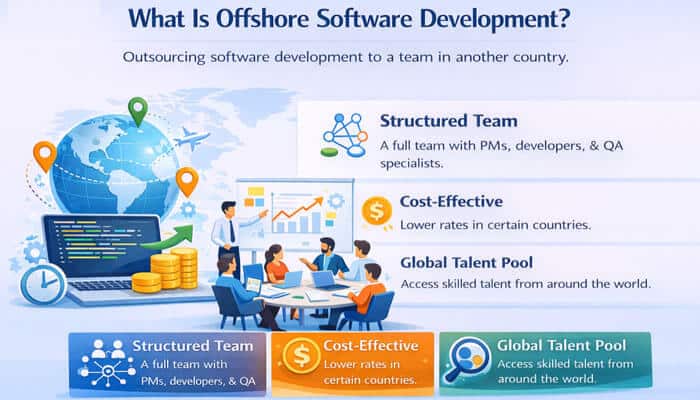
Offshore software development means outsourcing to a provider in a distant country, often with a substantial time-zone difference.
Companies in North America or Western Europe frequently work with offshore teams in Asia, Eastern Europe, Africa, or other global delivery markets.
Advantages Of Offshore Outsourcing
Offshore development provides access to a large international talent pool.
Its potential benefits include:
- Lower development costs
- Access to specialized technical skills
- Large and scalable engineering teams
- Faster team expansion
- Extended development or support coverage
- Availability of mature outsourcing providers
- Reduced pressure on domestic recruitment
Offshore markets may offer experienced developers in areas such as cloud engineering, artificial intelligence, mobile development, enterprise software, cybersecurity, quality assurance, and DevOps.
Time-zone differences can also create a continuous delivery cycle. For example, an offshore team may continue development or testing after the client’s internal team finishes its workday.
Limitations of Offshore Outsourcing
The offshore model introduces greater operational complexity.
Potential challenges include:
- Limited real-time working-hour overlap
- Slower clarification of requirements
- Language and cultural differences
- More complicated project coordination
- International data protection requirements
- Longer travel times
- Increased dependence on documentation
- Greater risk when vendor evaluation is weak
These risks do not mean offshore development produces lower-quality results. Many offshore providers operate mature engineering organizations and deliver complex international projects. However, the model requires clear governance, strong communication processes, and reliable technical leadership.
When Offshore Development Makes Sense
Working with offshore software development companies is suitable when:
- Cost efficiency is a major priority
- The project requires a large or scalable team
- The client needs skills that are difficult to recruit locally
- Requirements can be documented clearly
- The client has experience managing distributed teams
- Daily real-time communication is not required
- The engagement is expected to continue long enough to justify onboarding
- The provider has proven processes and technical leadership
Offshore development is often effective for product engineering, application modernization, quality assurance, maintenance, cloud migration, and long-term dedicated teams.
Onshore vs Nearshore vs Offshore: Key Differences
The three models can be compared across several practical factors.
| Factor | Onshore | Nearshore | Offshore |
| Location | Same country | Nearby country or region | Distant country or region |
| Typical cost | Highest | Moderate | Often lowest |
| Time-zone overlap | High | Moderate to high | Limited to moderate |
| Talent pool | Local | Regional | Global |
| Travel convenience | High | Moderate to high | Low |
| Cultural alignment | Usually high | Often relatively high | Varies by location |
| Communication complexity | Low | Moderate | Potentially high |
| Scalability | Depends on local market | Moderate | Often high |
| Legal simplicity | Usually highest | Moderate | More complex |
| Management requirements | Lower | Moderate | Higher |
These are general patterns rather than fixed rules. A well-managed offshore team may communicate more effectively than a poorly managed onshore provider. Similarly, a mature nearshore company may charge more than some domestic agencies.
The quality of the provider and the structure of the engagement often matter more than geography alone.
How to Choose the Right Outsourcing Model
Choosing between onshore, nearshore, and offshore development requires more than comparing hourly rates. Businesses should evaluate the complete operating model and determine which trade-offs are acceptable.
1. Define the primary reason for outsourcing
Start by identifying what the business is trying to achieve.
Common objectives include:
- Reducing development costs
- Increasing delivery capacity
- Finding specialized expertise
- Launching a product faster
- Supporting an internal engineering team
- Extending operational coverage
- Avoiding long recruitment processes
- Building a long-term external team
The location model should support the main objective.
A business focused on close stakeholder collaboration may prefer an onshore or nearshore team. A company seeking a large engineering team at a more competitive cost may consider offshore development.
Without a clear objective, businesses may select the cheapest model even when it does not support the way the project needs to operate.
2. Evaluate the project’s communication needs
Some projects require intensive daily interaction, while others can progress through well-defined tasks and asynchronous updates.
Consider:
- How often will requirements change?
- How quickly must questions be answered?
- Will developers work directly with business stakeholders?
- How many shared working hours are necessary?
- Does the team need to participate in customer meetings?
- Can technical decisions be documented and reviewed asynchronously?
Projects in an early discovery phase often benefit from greater time-zone overlap. Projects with stable requirements, clear architecture, and mature documentation may be easier to distribute across distant locations.
Time-zone differences should be evaluated in terms of workflow rather than distance alone. An offshore provider willing to adjust part of its schedule may offer sufficient overlap for daily coordination.
3. Compare total cost, not just hourly rates
Hourly rates provide only a partial view of outsourcing cost.
The total cost may also include:
- Vendor management
- Product discovery
- Knowledge transfer
- Travel
- Communication overhead
- Rework
- Quality assurance
- Security and legal reviews
- Infrastructure
- Post-launch support
- Replacing team members
- Delays caused by unclear requirements
A lower hourly rate may not create meaningful savings if the team requires extensive supervision or produces software that needs significant rework.
Businesses comparing software development companies should examine each provider’s delivery model, technical capabilities, location, typical pricing, quality controls, and relevant project experience, not price in isolation.
A more expensive team may deliver better overall value if it works independently, identifies risks early, and produces maintainable software.
4. Assess internal management capabilities
The client’s internal team affects which outsourcing model will work best.
Ask whether the business has:
- An experienced product owner
- Technical leadership
- Clear requirements
- Established development standards
- A structured backlog
- Reliable documentation
- Experience with remote collaboration
- Capacity to review architecture and code
- Defined escalation procedures
Offshore development generally requires stronger written communication and more deliberate project governance. A company with limited outsourcing experience may find onshore or nearshore collaboration easier initially.
This does not mean inexperienced companies should avoid offshore providers. Instead, they should select a partner that can provide project management, business analysis, technical leadership, and transparent reporting.
5. Consider the complexity and maturity of the project
The project stage should influence the location decision.
Early-stage discovery
Early discovery involves frequent questions, rapid changes, stakeholder workshops, and product validation. Onshore or nearshore teams may provide easier collaboration during this phase.
Defined development project
When requirements, architecture, and priorities are clear, any of the three models may work. Provider capability becomes more important than location.
Long-term product development
Nearshore and offshore dedicated teams can provide scalable capacity for products that will evolve over several years. Strong onboarding and knowledge retention are essential.
Maintenance and support
Offshore teams can be effective for application maintenance, testing, monitoring, and extended support coverage. Clear service levels and escalation paths are required.
Highly regulated systems
Onshore development may simplify legal and compliance management, but offshore and nearshore providers can also support regulated projects if they have the necessary certifications, controls, and contractual arrangements.
6. Review security and regulatory requirements
Location can affect how business and customer data must be handled.
Before selecting a model, review:
- Data residency requirements
- Cross-border data transfer restrictions
- Industry-specific regulations
- Intellectual property protections
- Privacy laws
- Security certification requirements
- Subcontractor access
- Government or client contractual restrictions
The provider’s actual security controls are more important than location alone.
Evaluate whether the vendor uses:
- Multi-factor authentication
- Role-based access
- Managed devices
- Secure development practices
- Audit logging
- Data encryption
- Regular security assessments
- Incident response procedures
- Employee security training
Contracts should define intellectual property ownership, confidentiality, data handling, breach notification, subcontracting, and project termination procedures.
7. Examine the available talent pool
A location may appear cost-effective but still lack the specialists required for the project.
Assess availability in areas such as:
- Cloud architecture
- Artificial intelligence and machine learning
- Cybersecurity
- DevOps and platform engineering
- Mobile development
- Legacy system modernization
- Data engineering
- Enterprise integration
- Quality automation
- Industry-specific platforms
Do not evaluate only the number of developers available. Consider seniority, employee retention, English proficiency, leadership capability, and experience working with international clients.
The provider should also explain how quickly it can replace or expand team members when project needs change.
8. Consider travel and in-person collaboration
Remote software development does not always require physical meetings. However, in-person collaboration may be useful for:
- Project kickoff
- Product discovery
- Architecture workshops
- Major roadmap planning
- Team integration
- Complex problem-solving
- Quarterly or annual reviews
Onshore teams are usually easiest to meet in person. Nearshore teams may still be accessible through short regional flights, while offshore travel requires more time and expense.
For long-term offshore engagements, occasional in-person meetings can improve trust and product understanding. Travel costs should therefore be included in the total operating model.
9. Evaluate the provider, not only the region
Businesses sometimes choose a country first and assume all providers in that market offer similar capabilities. This approach can result in poor vendor selection.
Within the same location, providers may differ significantly in:
- Technical expertise
- Communication quality
- Engineering standards
- Security maturity
- Employee retention
- Industry experience
- Pricing structure
- Project governance
- Financial stability
- Use of subcontractors
Using a research and software outsourcing company directory platform such as Software Outsourcing Journal can make initial market research faster and more efficient. The platform combines practical research, expert analysis, and industry experience with curated listings of software development firms worldwide, organized by service and location for easier comparison and evaluation.
Directories can help create an initial shortlist, but they should not replace direct due diligence. Businesses should still interview the proposed team, review relevant work, check references, evaluate security controls, and clarify contract terms.
Questions to Ask Potential Outsourcing Providers
Regardless of location, ask each provider the same core questions.
About the company
- How long have you delivered outsourced software projects?
- Which industries and technologies do you specialize in?
- What percentage of your team is directly employed?
- How do you retain experienced engineers?
- Can you provide relevant client references?
About the proposed team
- Who will work on the project?
- Can we interview the technical lead and key developers?
- How much time will senior specialists dedicate?
- How are team replacements handled?
- Will any work be subcontracted?
About communication
- How many working hours will overlap?
- Which communication tools will be used?
- How often will progress be reported?
- Who manages escalations?
- How are important decisions documented?
About engineering quality
- What coding and review standards do you follow?
- How do you approach automated testing?
- Will the client have access to repositories and pipelines?
- How do you manage technical debt?
- What is included in your definition of done?
About security and ownership
- Who owns the source code and documentation?
- Where will project data be stored?
- How is system access controlled?
- What happens to data when the contract ends?
- Which security standards or certifications do you follow?
Clear answers are more valuable than broad claims about quality, agility, or innovation.
Should You Use a Hybrid Outsourcing Model?
Businesses do not always need to choose only one location model.
A hybrid structure may combine:
- Onshore product management with offshore engineering
- Nearshore technical leadership with offshore delivery
- An internal architecture team with an external development team
- Onshore discovery followed by offshore implementation
- Nearshore developers for collaboration-intensive work and offshore teams for testing or maintenance
For example, an onshore product owner may work directly with business stakeholders, while an offshore engineering team handles development. A nearshore technical lead may provide daily coordination across both groups.
Hybrid models can provide a balance of communication, expertise, scalability, and cost. However, they also require clearly defined responsibilities.
Businesses should establish:
- Who owns product priorities
- Who approves architecture
- Who coordinates delivery
- Which team handles testing
- Who manages deployments
- How information moves between locations
- How performance is measured
Without clear ownership, a hybrid model can create more communication layers rather than better collaboration.
Common Mistakes When Selecting an Outsourcing Model
Businesses often focus too heavily on geography and overlook the way the engagement will operate.
Common mistakes include:
- Choosing offshore development solely for the lowest rate
- Assuming onshore providers require no management
- Treating all vendors in one country as equivalent
- Ignoring time-zone overlap requirements
- Failing to evaluate the proposed team
- Underestimating communication overhead
- Starting without clear product ownership
- Overlooking data transfer and compliance requirements
- Comparing estimates with different scopes
- Failing to plan for knowledge transfer and handover
The outsourcing location should support the project strategy. It cannot compensate for unclear requirements, weak leadership, or an unsuitable provider.
Final Thoughts
Onshore, nearshore, and offshore development each offer a different balance of cost, collaboration, talent access, and operational complexity.
Onshore outsourcing is often suitable when close communication, local knowledge, and legal simplicity are the highest priorities. Nearshore development can provide a practical balance between cost and working-hour alignment. Offshore outsourcing offers access to large global talent pools and competitive rates but usually requires stronger documentation and management processes.
The best model depends on the project rather than a general ranking. Businesses should define their objectives, assess internal management capabilities, review security requirements, and calculate the total cost of delivery.
Ultimately, provider quality matters more than distance. A capable partner with transparent processes, strong technical leadership, and relevant experience can make any of the three models successful.
