


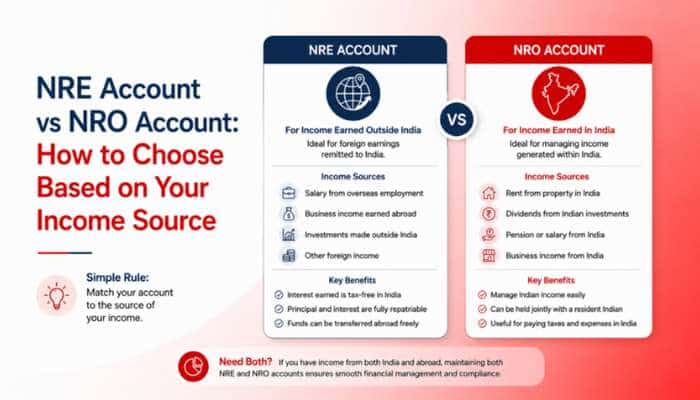

Being an NRI, choosing the right bank account in India is important to cater to your specific financial requirements. You have two major options to choose from the NRE account (Non-Resident External) and the NRO account (Non-Resident Ordinary). With different streams of income and serving different financial needs, choosing between the two is critical to your cross-border financial management.
Understanding Your Income Source Determines Your Account Choice
The most critical factor in choosing between an NRE account and an NRO account is identifying where your income originates. This distinction forms the foundation of your banking strategy as an NRI.
Foreign Income Points to NRE Account
If your primary income is outside India, then you should go for an NRE account (Non-Resident External). An NRE account is a rupee-denominated account that helps NRIs to park their foreign income in India. This account is subject to conversion into Indian Rupees as per the prevailing exchange rate at the time of deposit, as determined by your bank, if you deposit foreign currency.
The NRE account has major benefits for those earning abroad. Interest earned on funds in this account is tax-free in India, so this account provides a tax-free way to save and grow your foreign income without tax liabilities. Moreover, the principal amount and the accrued interest are completely repatriable, i.e., you can send your funds to your overseas account without any restrictions.
There is no limit on the amount of money that can be sent from abroad to an NRE account in India, making it ideal for long-term savings and investments. That’s why NRI account opening for an NRE account is particularly useful if you wish to remit your foreign income to India without facing taxation liabilities.
Repatriation Differences Impact Your Decision

Repatriation flexibility is another crucial consideration when opening an NRI account online. An NRE account offers complete repatriation benefits for both principal and interest, allowing unrestricted transfer to foreign accounts.
NRO accounts also offer repatriation, but with important limitations. You can remit up to USD 1 million per financial year from the principal amount, and you must submit a certificate from a chartered accountant declaring that all necessary taxes have been paid. The interest amount can be repatriated freely, but the principal amount has restrictions.
Joint Account Considerations
Your joint account also needs influence which NRI account to choose. An NRE account can be opened only jointly with another NRI, while an NRO account can be opened jointly with an NRI or a resident Indian. This difference is important if you want family members living in India to have easy access to your account
Exchange Rate Risk Considerations
Currency fluctuations create different risk profiles for each account type. In an NRE account, you are also susceptible to exchange rate risk as deposits are made in foreign currency and converted to rupees. But if it is an NRO account, then there is no risk of exchange rate, if both deposit and withdrawal are in INR.
Making the Right Choice for Your Situation
The decision ultimately depends on your income structure. If your total income includes income earned in India and you want to manage it within the country, opt for an NRO account. If you want to keep your savings in India from foreign income and benefit from tax-free interest and flexible repatriation, an NRE account is useful.
Knowing these differences between an NRE account and NRO account helps you choose the right NRI account online that matches your income structure and financial goals.
