


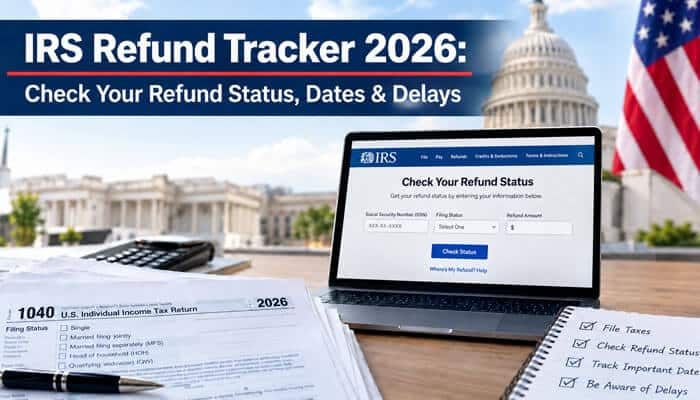

The IRS refund tracker is the official and most reliable way to check what is happening with your federal income tax refund. The IRS calls its primary tracking service Where’s My Refund?, which allows taxpayers to see whether their return has been received, whether their refund has been approved, and when the payment has been sent.
The 2026 federal tax filing season opened on January 26, 2026, for 2025 individual income tax returns. The regular federal filing deadline was April 15, 2026. Taxpayers with a valid extension generally have until October 15, 2026, to file, although an extension to file does not extend the original deadline to pay taxes due.
For most taxpayers, using the IRS refund tracker 2026 is straightforward. However, refunds may take longer because of errors, identity verification, EITC or ACTC claims, missing bank information, rejected direct deposits, amended returns, injured-spouse claims, refund offsets, or additional IRS review.
This guide explains how to use the IRS refund tracker, how long refunds normally take, what different IRS refund statuses mean, why refunds become delayed, and what you should do if your refund does not arrive as expected.
Quick Answer: How Do You Use the IRS Refund Tracker?
To check your federal refund, use the official IRS refund tracker known as Where’s My Refund?
You generally need:
- Social Security number or ITIN
- Filing status
- Exact whole-dollar refund amount
- Tax year you want to check
Refund status can generally become available:
- Within 24 hours after e-filing a current-year return
- Within 3 to 4 days after e-filing a prior-year return
- About 4 weeks after filing a paper return
The IRS refund tracker then follows your refund through three main stages:
- Return Received
- Refund Approved
- Refund Sent
Key Takeaways
- The official IRS refund tracker is called Where’s My Refund?
- Most federal refunds are issued in fewer than 21 days, although some take longer.
- The IRS refund status system normally updates once per day.
- An accepted return is not the same as an approved refund.
- Direct deposit generally provides the fastest refund delivery.
- EITC and ACTC refunds can be affected by statutory timing rules.
- Missing or rejected banking information can trigger Notice CP53E.
- Amended returns must be checked using Where’s My Amended Return?
- Refund offsets, identity verification, errors, and Form 8379 can delay payment.
- Calling the IRS usually does not speed up ordinary refund processing.
IRS Refund Tracker 2026 at a Glance
| Situation | Typical Guidance |
|---|---|
| Current-year return e-filed | Status may appear within 24 hours |
| Prior-year return e-filed | Status may appear in 3–4 days |
| Paper return filed | Status may appear after about 4 weeks |
| Most federal refunds | Issued in fewer than 21 days |
| IRS refund tracker updates | Usually once per day |
| Amended return appears | About 3 weeks |
| Typical amended-return processing | Around 8–12 weeks |
| Some amended returns | Up to 16 weeks |
| Form 8379 with e-filed joint return | About 11 weeks |
| Form 8379 with paper joint return | About 14 weeks |
| Form 8379 filed separately | About 8 weeks |
| Individual refund tracker | Where’s My Refund? |
| Amended-return tracker | Where’s My Amended Return? |
These are general processing estimates rather than guaranteed refund dates.
What Is the IRS Refund Tracker?
The IRS refund tracker is the commonly used name for Where’s My Refund?, an official IRS service for checking individual federal income tax refunds.
Instead of estimating your payment only from the date you filed, the IRS refund tracker uses information connected with your actual tax-return processing.
It displays three primary refund stages.
Return Received
The IRS has received your tax return and is processing it.
This does not mean the refund has been approved.
Refund Approved
The IRS has approved your refund.
The IRS refund tracker may now provide an expected payment date.
Refund Sent
The IRS has released your refund for payment.
Your bank or other financial institution may still require additional time to post the money to your account.
How to Use the IRS Refund Tracker Step by Step
Using the IRS refund tracker takes only a few minutes if you have your filed tax return available.
Step 1: Find Your Filed Tax Return
Use the final return that was actually submitted to the IRS.
Have these details ready:
- Social Security number or ITIN
- Filing status
- Exact federal refund amount
- Tax year
Step 2: Open Where’s My Refund?
Go directly to IRS.gov and access Where’s My Refund?
Avoid refund-tracking links sent through suspicious emails, text messages, advertisements, or unfamiliar websites.
Step 3: Enter Your Information
Enter the details exactly as they appear on your filed return. Even a small difference in your refund amount or filing status may prevent the IRS refund tracker from locating your information.
Step 4: Review Your Status
The tracker will display the current stage of your refund or provide additional instructions. If the IRS refund tracker says you need to contact the IRS or respond to a notice, follow that instruction rather than filing another return.
IRS Return Accepted vs. Refund Approved
- One of the most common refund questions involves the difference between an accepted return and an approved refund.
- When tax software says your electronically filed return was accepted, it generally means the submission passed the initial electronic-filing checks and entered IRS processing.
- It does not mean the refund has already been approved.
- Your return can therefore be accepted while the IRS refund tracker still shows Return Received or another processing message.
The normal progression is:
- Return Received
- Refund Approved
- Refund Sent
When Can You Check the IRS Refund Tracker?
- You usually do not need to check immediately after filing.
- For a current-year e-filed return, the IRS refund tracker may have information available within about 24 hours.
- For prior-year electronically filed returns, status information may take approximately 3 to 4 days.
- For paper returns, taxpayers may need to wait approximately 4 weeks before information appears.
- If you filed only a few hours ago and the tracker shows no information, that does not automatically indicate a problem.
How Often Does the IRS Refund Tracker Update?
The IRS refund tracker generally updates once per day, usually overnight. Checking it many times during the same day will normally not provide new information.
A refund status can also remain unchanged for several days while your return continues through ordinary IRS processing. For most taxpayers, checking the IRS refund tracker once each day is enough.
How Long Does an IRS Refund Take in 2026?
The IRS says most refunds are issued in fewer than 21 days. Electronic filing combined with direct deposit generally provides the fastest process.
| Filing Method | General Refund Timing |
|---|---|
| Electronic filing | About 3 weeks for many refunds |
| Paper return | Often 6 weeks or longer |
| Amended return | Usually 8–12 weeks |
| Return requiring review | Timing varies |
The 21-day period is not a guaranteed deadline.
A refund can take longer because of:
- Errors
- Missing information
- Identity verification
- Refundable tax-credit review
- Fraud screening
- Paper processing
- Incorrect bank information
- Form 8379
- Amended returns
- Refund offsets
- Manual review
Is There an Exact IRS Refund Schedule for 2026?
No official universal refund calendar guarantees that taxpayers who file on a certain date will receive their refund on another specific date. Unofficial refund calendars often estimate a date by adding roughly three weeks to an acceptance date.
Those schedules cannot account for individual processing differences. Two people who file on the same day can receive refunds at completely different times. For your own tax return, the personalized date shown by the IRS refund tracker after approval is more useful than a generic refund calendar.
What Does Return Received Mean on the IRS Refund Tracker?
Return Received means the IRS has received your tax return and is processing it.
During this stage, IRS systems may review:
- Income
- Tax withholding
- Filing status
- Dependents
- Refundable credits
- Taxpayer identification information
- Other return details
A return can remain at this stage for several days. Return Received does not mean that your refund amount is already approved.
What Does Refund Approved Mean on the IRS Refund Tracker?
When the IRS refund tracker changes to Refund Approved, the IRS has approved your refund. The tracker may then display an estimated refund date.
This personalized date is normally more useful than unofficial tax-refund calendars because it is linked to your actual return.
What Does Refund Sent Mean on the IRS Refund Tracker?
Refund Sent means the IRS has released your refund. However, your bank may not display the deposit immediately.
Processing time can vary depending on:
- Your financial institution
- Weekends
- Federal holidays
- Deposit-processing procedures
Therefore, Refund Sent does not always mean that the money is already available for spending.
What Does “Still Being Processed” Mean?
If the IRS refund tracker says your tax return is still being processed, the IRS has not completed the review.
This does not automatically mean you are being audited.
Possible causes include:
- Math errors
- Missing information
- Income discrepancies
- Refundable-credit verification
- Identity verification
- Fraud screening
- Manual review
If the IRS needs additional information from you, it may provide instructions in the tracker or send an official notice.
Why Is My IRS Refund Delayed?
A refund delay can occur for many reasons.
| Reason | What Can Happen |
|---|---|
| Math error | IRS may correct or review the return |
| Missing information | Manual processing may be needed |
| Income mismatch | IRS may compare third-party information |
| EITC or ACTC | Legal refund hold may apply |
| Identity verification | Processing can pause |
| Amended return | Additional review is required |
| Injured-spouse claim | Manual allocation may be needed |
| Invalid bank information | Refund delivery can be delayed |
| Refund offset | Some or all of the refund may be redirected |
| Suspected fraud | Security review may be required |
| Paper filing | Processing usually takes longer |
If the IRS refund tracker remains unchanged beyond the normal processing period, review the status message carefully before taking additional action.
IRS Refund Tracker 2026 and Direct Deposit Changes
Electronic refund delivery is especially important in 2026. The IRS began phasing out most individual paper refund checks after September 30, 2025, as the federal government expanded electronic payment methods.
Direct deposit remains the fastest general way to receive most refunds. The shift also means that accurate banking information matters more than ever when using the IRS refund tracker 2026.
What Happens If Your Bank Information Is Missing?
A tax return can still be processed even if usable direct-deposit information is unavailable. However, refund delivery can be delayed.
In some situations, the IRS may send Notice CP53E asking the taxpayer to add or update bank information.
What Is IRS Notice CP53E?
CP53E is an important notice for taxpayers using the IRS refund tracker in 2026.
The IRS may issue CP53E when:
- A refund is due, but banking information is missing
- The bank information is invalid
- A financial institution rejects the direct deposit
- An IRS correction creates a refund
Taxpayers receiving CP53E generally have 30 days to add or update eligible banking information or choose an available exception.
How to Update Bank Information After CP53E

If CP53E applies, taxpayers generally use their IRS Individual Online Account.
The process typically involves:
- Signing in to your IRS Online Account
- Opening Notifications
- Selecting the relevant bank-account notification
- Entering valid banking information
- Completing the requested verification
After the update, allow approximately 2 to 5 business days for the IRS refund tracker to reflect new information.
Can You Change Your Bank Information After Filing?
- Normally, taxpayers cannot simply change their refund bank account after the return has already entered IRS processing.
- However, the CP53E process provides an important exception in certain 2026 situations.
- If you receive CP53E, you may be able to provide new eligible banking information through your IRS Online Account.
- Do not assume you can make a change simply because your refund has not arrived.
Can an IRS Employee Change Your Bank Details?
- Generally, IRS representatives do not update CP53E banking information over the phone.
- Taxpayers should use the official Online Account procedure when instructed.
- This is important because scammers may claim they can update bank details to “release” your refund.
- Never give banking information to an unexpected caller claiming to be fixing your IRS refund tracker status.
What Happens If You Ignore CP53E?
If no response is provided within the required period, a paper-check process may eventually apply according to current IRS procedures. Responding promptly can help prevent unnecessary additional delays. Always follow the instructions printed on your actual IRS notice because individual circumstances can differ.
EITC and ACTC Refund Dates in 2026
Taxpayers who claimed the Earned Income Tax Credit or Additional Child Tax Credit can face special refund timing. Federal law prevents the IRS from issuing refunds containing these credits before mid-February. The hold applies to the entire refund, not only the EITC or ACTC portion.
For many early 2026 filers who:
- Filed electronically
- Chose direct deposit
- Filed an accurate return
- Had no other processing issue
The IRS expected refunds by approximately March 2, 2026. For affected taxpayers, the IRS refund tracker provides a more useful personalized status than unofficial refund calendars.
Identity Verification and the IRS Refund Tracker
The IRS sometimes delays refunds while verifying that the taxpayer actually filed the return.
Identity verification can be triggered by:
- Potential identity theft
- Duplicate tax returns
- Inconsistent information
- Fraud-prevention systems
If you receive an official identity-verification notice, follow its instructions. Do not attempt identity verification merely because the IRS refund tracker has not changed. A delay alone does not mean identity verification is required.
IRS Refund Tracker vs. IRS Online Account vs. IRS2Go
Taxpayers can use several official IRS services.
| Tool | Best Use |
|---|---|
| IRS refund tracker / Where’s My Refund? | Quick refund status |
| IRS2Go | Mobile refund-status checking |
| IRS Individual Online Account | Refund status plus tax-account information |
| Where’s My Amended Return? | Form 1040-X tracking |
Where’s My Refund? is usually the simplest choice if you only want to know where your refund stands.
Can You Get IRS Refund Status Updates by Email?
Yes.
The IRS Individual Online Account provides an option for taxpayers to receive email notifications when their refund status changes.
This can reduce the need to check the IRS refund tracker manually every day.
Where’s My Refund? remains available for taxpayers who prefer not to sign in.
IRS Refund Tracker for Amended Returns
The normal IRS refund tracker should not be used for Form 1040-X amended tax returns.
Instead, use Where’s My Amended Return?
An amended return generally may take approximately three weeks to appear in the tracking system. Normal processing can take around 8 to 12 weeks, while some cases can take up to 16 weeks.
What Do Amended Return Statuses Mean?
Where’s My Amended Return? follows three basic stages.
| Status | Meaning |
|---|---|
| Received | IRS received the amended return |
| Adjusted | IRS made an adjustment |
| Completed | Processing has been completed |
Amended returns typically take much longer than normal refunds because the IRS must review changes made to an existing tax return.
Injured Spouse Refund Processing Times
Form 8379, Injured Spouse Allocation, can also delay a refund.
| Form 8379 Filing Method | Approximate Processing |
|---|---|
| Electronically with joint return | 11 weeks |
| Paper filing with joint return | 14 weeks |
| Separately after joint return | 8 weeks |
An injured-spouse claim may be relevant when a joint refund is used to pay certain debts legally owed by the other spouse.
This type of claim should not be confused with the standard IRS refund tracker processing timeline.
Why Is My IRS Refund Smaller Than Expected?
Sometimes the refund arrives, but the amount is lower than what the tax return originally showed.
Two common causes are IRS adjustments and Treasury offsets.
IRS Adjustment
The IRS may change your refund because of:
- Math errors
- Incorrect tax credits
- Incorrect deductions
- Previous federal tax liabilities
- Other adjustments
Refund Offset
Some or all of a refund may be applied to qualifying debts such as:
- Past-due child support
- Certain federal non-tax debts
- State income-tax obligations
- Certain unemployment-compensation debts
If your refund amount changes, review the official notice you receive.
What If the IRS Refund Tracker Says Refund Sent but No Money Arrived?
If the IRS refund tracker says Refund Sent but you cannot find your deposit, check:
- The payment date displayed
- Your bank account number
- Whether the bank has posted the payment
- Weekend or holiday timing
- Whether you used a refund-transfer product
- Whether enough time has passed for a refund trace
Do not immediately file another tax return.
How to Request an IRS Refund Trace
A refund trace can help locate a refund the IRS says was issued but was never received.
Depending on your filing status and refund method, taxpayers may be able to begin the process through:
- Where’s My Refund?
- IRS2Go
- IRS automated refund services
- Form 3911
A refund trace is different from simply checking the IRS refund tracker. It is intended for refunds that have actually been issued but are missing.
What If a Paper Refund Check Is Lost?
Although most refunds are moving toward electronic payment, paper checks may still be issued in certain circumstances.
If a refund check was mailed but did not arrive, the IRS refund tracker may provide instructions for requesting a replacement.
Generally, taxpayers should allow the expected mail-delivery period before starting a trace or replacement request.
Should You Call the IRS About a Delayed Refund?
Calling the IRS generally does not make ordinary refund processing faster.
Consider contacting the IRS when:
- The IRS refund tracker tells you to call
- The normal processing period has passed
- You received an IRS notice requiring action
- Your refund was issued but never received
- Identity verification is required
- You need assistance with a refund trace
For a routine refund still within the expected processing period, the IRS refund tracker is usually the better first option.
Can a Tax Transcript Show Your Refund Date?
- IRS account transcripts contain useful processing information.
- Some taxpayers use transcript transaction codes to estimate refund timing.
- However, transcript codes should not automatically be treated as a guaranteed bank-deposit date.
- The IRS refund tracker remains easier for most taxpayers because it is specifically designed to answer refund-status questions.
Does the IRS Refund Tracker Work for Business Refunds?
No.
Where’s My Refund? is designed for individual Form 1040 refunds.
Business tax refunds and other federal return types may require different IRS contact procedures.
Business owners should therefore make sure they are using the appropriate IRS service rather than the standard IRS refund tracker.
IRS Refund Tracker vs. State Refund Tracker
The IRS refund tracker only covers federal individual income tax refunds.
It does not track state refunds.
Federal and state returns are processed independently.
That means:
- Your federal refund may arrive first
- Your state refund may arrive first
- One can be delayed while the other processes normally
- State refund rules vary
Use your state’s official tax or revenue department website to track a state refund.
IRS Refund Tracker Not Working? Try These Fixes
If the IRS refund tracker cannot find your return, check these common issues.
You Checked Too Soon
Wait approximately:
- 24 hours after e-filing a current-year return
- 3 to 4 days after e-filing a prior-year return
- 4 weeks after filing a paper return
Business owners
Enter the exact whole-dollar amount shown on the submitted return.
Your Filing Status Does Not Match
Use the filing status shown on the return you actually filed.
You Selected the Wrong Tax Year
Make sure you are checking the correct year.
You Filed an Amended Return
Use Where’s My Amended Return? instead of the standard IRS refund tracker.
You Are Checking a Business Refund
Where’s My Refund? does not provide standard business-return refund tracking.
IRS Refund Tracker Troubleshooting Table
| Problem | Best Next Step |
|---|---|
| Recently filed and no status appears | Wait for normal tracker availability |
| Return Received | Continue monitoring |
| Return accepted but not approved | Allow processing to continue |
| Refund Approved | Review expected payment date |
| Refund Sent but no money | Check bank processing |
| Still being processed | Watch for IRS instructions |
| Missing bank information | Watch for CP53E |
| CP53E received | Respond within the required period |
| EITC/ACTC delay | Consider statutory timing |
| Identity verification requested | Follow the official IRS notice |
| Amended return | Use Where’s My Amended Return? |
| Form 8379 filed | Allow additional processing time |
| Refund reduced | Review IRS or Treasury notice |
| Refund issued but missing | Consider a refund trace |
| Business refund | Use appropriate IRS business procedures |
How to Avoid IRS Refund Delays
You cannot prevent every refund delay, but you can reduce common problems.
File Electronically
Electronic filing usually provides faster processing than paper filing.
Choose Direct Deposit
Direct deposit remains the fastest general refund-delivery method.
Verify Your Banking Information
Double-check every digit before submitting your return.
Report Income Correctly
Compare your return with:
- Forms W-2
- Forms 1099
- Investment tax documents
- Other income statements
Verify Personal Details
Check:
- Names
- Social Security numbers
- ITINs
- Filing status
- Dependent information
Claim Tax Credits Carefully
Make sure you meet the eligibility requirements for credits such as EITC and ACTC.
Respond Quickly to IRS Notices
If the IRS requests information, responding promptly can prevent additional delays.
Do Not File a Duplicate Return
Submitting another return simply because the IRS refund tracker has not changed can create additional processing problems.
How Long Do You Have to Claim an IRS Refund?
Federal refund claims are generally subject to time limits.
For many refund claims, the deadline is generally the later of:
- Three years after the original tax return was filed, or
- Two years after the tax was paid
Special circumstances can change these rules.
Taxpayers who think they are entitled to an older refund should check the applicable IRS deadline rather than assuming it can be claimed indefinitely.
Beware of IRS Refund Tracker Scams
Tax-refund delays can make people vulnerable to scams.
Fraudulent messages may say:
- “Your IRS refund is frozen”
- “Your refund expires today”
- “Pay a fee to release your refund”
- “Verify your bank account immediately”
- “Click here to update direct deposit”
Never provide sensitive personal or banking information through an unexpected message.
Instead, independently visit IRS.gov and check the IRS refund tracker or your IRS Individual Online Account. Be especially cautious of messages mentioning CP53E or banking updates because scammers may imitate legitimate IRS procedures.
Important 2026 Federal Tax Dates
| Date | Event |
|---|---|
| January 26, 2026 | IRS began accepting 2025 individual federal returns |
| April 15, 2026 | Regular federal filing deadline |
| October 15, 2026 | General filing deadline for taxpayers with valid extensions |
Remember that an extension provides additional time to file a return, not additional time to pay tax originally due.
Conclusion
The IRS refund tracker is the best official tool for finding out what is happening with an individual federal income tax refund in 2026. Where’s My Refund? lets taxpayers see whether their return has been received, whether their refund has been approved, and when the payment has been sent.
Most refunds are issued in fewer than 21 days, but that timeframe is not guaranteed. EITC and ACTC rules, identity verification, refund offsets, bank problems, amended returns, injured-spouse claims, fraud screening, filing mistakes, and manual reviews can all lead to delays.
The IRS refund tracker 2026 is also increasingly important because federal refunds are moving toward electronic payment. Taxpayers with missing, invalid, or rejected banking information may receive CP53E and need to provide eligible account details through their IRS Individual Online Account.
For the most reliable information, use the official IRS refund tracker, IRS2Go, or your IRS Online Account instead of depending on unofficial refund schedules or social-media predictions. If the tracker or an IRS notice tells you to take action, follow those instructions promptly.
IRS Refund Tracker FAQs
1. What is the IRS refund tracker and how does it work?
The IRS refund tracker is the official IRS tool known as Where’s My Refund? It helps taxpayers check the status of their federal income tax refund. The tracker shows three main stages: Return Received, Refund Approved, and Refund Sent. Taxpayers need their Social Security number or ITIN, filing status, tax year, and exact refund amount to check their status.
2. How soon can I check my refund using the IRS refund tracker?
You can usually check your refund status through the IRS refund tracker after your return has been processed into the IRS system. Current-year electronically filed returns may appear within about 24 hours, prior-year e-filed returns may take around 3 to 4 days, and paper returns may require approximately 4 weeks before tracking information becomes available.
3. Why does my IRS refund tracker show “Return Received” but no refund date?
If the IRS refund tracker shows Return Received, it means the IRS has received your tax return and is reviewing it. This status does not mean your refund has been approved yet. The IRS may still review income details, tax credits, identity information, and other return details before moving the refund to the approval stage.
4. How long does the IRS refund tracker take to show my refund in 2026?
The IRS refund tracker 2026 may show refund information based on your filing method and return details. Most federal refunds are issued in fewer than 21 days, especially when taxpayers file electronically and choose direct deposit. However, refunds may take longer because of errors, identity verification, tax-credit reviews, amended returns, refund offsets, or additional IRS processing.
5. How often does the IRS refund tracker update?
The IRS refund tracker usually updates about once per day, often overnight. Checking multiple times throughout the same day normally will not provide new information. If your status remains unchanged for several days, it may simply mean your return is still going through normal IRS processing.
