




You can transfer gil between FFXIV characters, but there is no simple “send to my alt” button. The best method depends on whether both characters can be online, share a Free Company, or can reach the same World.
If your real problem is funding a new character and you don’t
have enough free gil to transfer, you can simply buy FFXIV gil on the Marketplace. If you already have gil on another character, use one of the in-game methods listed below.
Can You Trade Gil Directly Between Characters?
Direct trade is the simplest method when both characters can be online. Open a trade and add gil. The current limit is 1,000,000 gil per trade, so larger amounts require several trades.
This works between two players, or between characters on separate service accounts. It does not work directly between two alts on one service account because only one can be logged in at a time. A trusted friend can act as an intermediary: give the gil to the friend, switch characters, then receive it on the alt.
Moogle Delivery is not a shortcut for your own alts. The official manual allows gil and item mail to friends on the same Home World, but characters on one account cannot normally add each other as friends because they cannot be online together to accept the request.
Using a Free Company Chest
A Free Company Chest is one of the easiest ways to move gil between alts on the same Home World. Both characters must be in the same FC, and their ranks need permission to deposit and withdraw gil.
Deposit the gil on your main, log out, enter on the alt, and withdraw it from the chest.
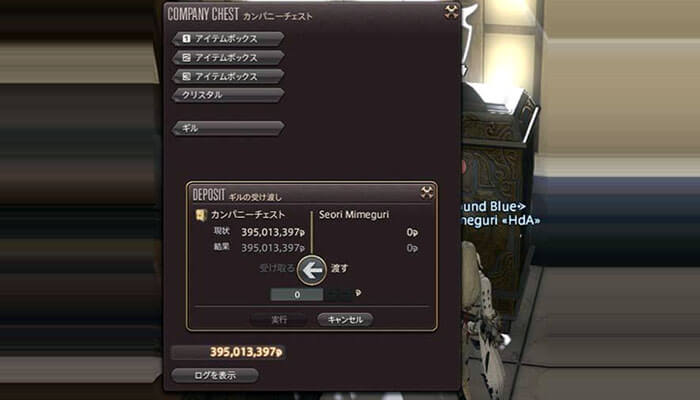
There is no Market Board tax, and no other player needs to hold the money. The main limit is access: Free Companies are tied to a Home World, and many FCs restrict gil withdrawals by rank. Do not use a shared chest for a large transfer unless you know who can access the funds.
Using the Market Board to Transfer Gil
The Market Board works when your characters cannot trade directly. On the character that needs gil, list a cheap, easy-to-identify item for the amount you want to receive. Switch characters, find that exact listing, and buy it.
The downside is fees. Market Board purchases have a 5% buyer fee. The seller can also lose 0% to 5%, depending on the city where the retainer is registered. Large transfers can therefore waste a noticeable amount of gil.
There is also a small risk that another player buys the overpriced item first. Use an uncommon item and check the retainer name before paying.
This method can work across Worlds. Official World Visit rules allow visitors to buy from the destination Market Board, while listings can only be created on the seller’s Home World. The receiving alt lists the item at home; the paying character travels there and buys it.
Using a Mannequin to Avoid Market Board Fees
A mannequin is useful if the receiving alt has access to an apartment, private chamber, or estate. The alt places a mannequin, assigns a retainer as merchant, and lists a sellable gear item at the transfer price. The paying character visits the mannequin and buys the item directly.
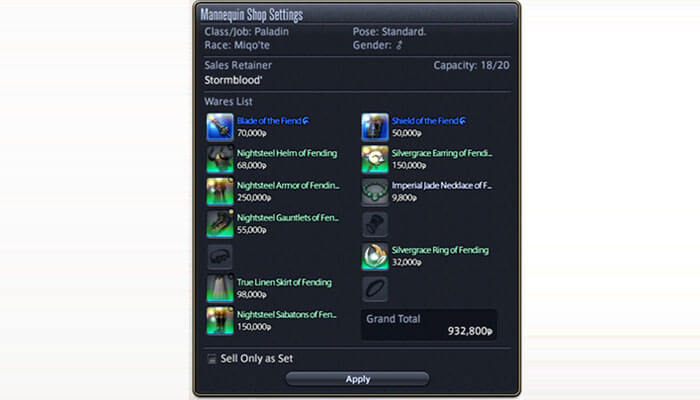
The key advantage is cost. Square Enix states that purchases made directly from a mannequin do not incur the extra Market Board fees. This makes the method useful for repeated or larger transfers.
The setup is less convenient. You need housing access, a mannequin, a retainer, and a sellable piece of equipment. For a small one-time transfer, the normal Market Board may be easier even with the fee.
What Changes If the Characters Are on Different Worlds?
The important question is whether the characters can reach the same World. A visiting character can buy from that World’s Market Board, so the Market Board method works for many cross-World transfers.
Direct trade can also work if two separately logged-in characters meet on the same World. Two alts on one service account still need an intermediary because they cannot be online together.
Free Company Chest transfers are more limited because FC membership is tied to the Home World. Moogle Delivery also requires friends on the same Home World. These methods do not bridge unrelated regions where travel is unavailable.
Can Free Trial Characters Transfer Gil?
In practice, no. Square Enix’s current Free Trial rules block player trading, the Market Board, Moogle Delivery, retainers, and Free Companies. Free Trial characters also have a 300,000 gil cap, removing the normal transfer methods above.
Which Gil Transfer Method Should You Use?
For two different players, use direct trade. For your own alts on the same Home World, an FC Chest is usually the easiest option if both characters have access. Use a mannequin when you want to avoid Market Board fees and have housing available. Use the Market Board when you need the most flexible self-service method, especially across Worlds.
If you are building a larger cash reserve rather than only funding one alt, our FFXIV gil farming guide covers the main ways to earn more through combat, gathering, crafting, Market Board trading, and repeatable activities.
Avoid old guides that recommend friend-list disconnect tricks to mail gil to your own alt. Those workarounds were patched years ago. Use a current in-game method instead.
