


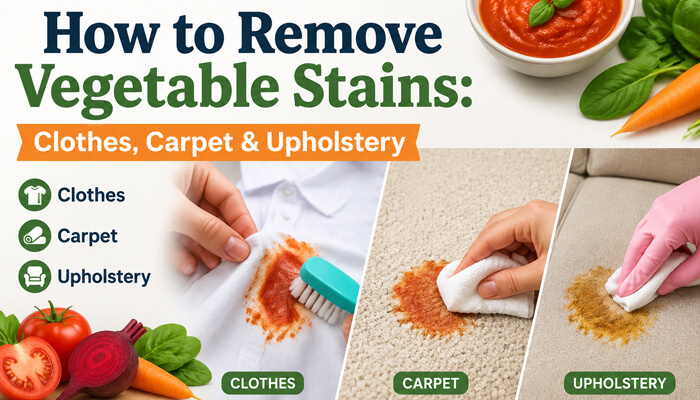

How to Remove Vegetable Stains is a common question because vegetable stains can look minor when they first appear, yet beet juice, tomato sauce, carrot puree, spinach, pumpkin, curry, salad dressing, and vegetable cooking oil can leave stubborn marks. The correct treatment depends on the stained surface, the vegetable involved, whether the spill contains grease or protein, and whether the stain is fresh or dry.
Learning how to remove vegetable stains is easier when you treat the spill in stages: lift away solids, blot or rinse the residue, remove grease when present, treat the remaining pigment, and avoid heat until the mark is gone. This guide explains safe methods for washable clothes, delicate fabrics, carpet, wool rugs, upholstery, removable cushion covers, and leather.
Always follow the garment care label, carpet manufacturer’s instructions, upholstery cleaning code, and cleaning-product label. Test any cleaner on a hidden area first.
Quick Answer: How Do You Remove Vegetable Stains?
Remove solid food with a spoon, then blot the liquid with a clean white cloth. For washable clothing, rinse the stain from the back with cool water, apply liquid laundry detergent, wash according to the care label, and air-dry before checking the result. For carpet or water-safe upholstery, blot with a small amount of approved cleaning solution, work from the outside toward the center, lightly rinse, and absorb as much moisture as possible.
Oily sauces and vegetable-oil stains need a grease-cutting pretreatment before the remaining color is treated. Never machine-dry, iron, or apply strong heat while the stain is still visible.
Fastest Way to Remove Vegetable Stains
For most washable fabrics:
- Remove excess vegetable residue with a spoon.
- Rinse the stain from the back with cool water.
- Apply liquid laundry detergent directly to the stain.
- Let it sit according to product instructions.
- Wash according to the care label.
- Air-dry and inspect before using heat.
Fresh stains are usually much easier to remove than dried or heat-set stains.
Key Takeaways
The quickest way to understand how to remove vegetable stains is to match the treatment to the stain type and surface.
- Act quickly because fresh stains are usually easier to remove.
- Lift solid food instead of pushing it deeper into the fibers.
- Blot carpet and upholstery; do not scrub.
- Rinse washable clothing from the reverse side of the stain.
- Treat grease separately from vegetable pigment.
- Use cool water first when the full ingredients are unknown.
- Test stain removers on a hidden area before visible use.
- Follow W, S, WS, or X upholstery codes.
- Avoid overwetting carpet and furniture.
- Do not use dryer heat until the stain and oily residue are gone.
- Never mix chlorine bleach with vinegar, ammonia, acids, or other cleaners.
Vegetable Stain Removal at a Glance
This table summarizes how to remove vegetable stains from the most common household materials.
| Surface or stain | First action | Suitable next step | Avoid |
| Washable clothes | Scrape and rinse from the back | Liquid laundry detergent | Drying before inspection |
| Deep-colored stain | Rinse promptly | Fabric-safe oxygen treatment | Strong bleach without checking |
| Vegetable-oil stain | Blot excess grease | Grease-cutting pretreatment | Water-only treatment |
| Carpet | Lift solids and blot | Carpet-approved spotter | Scrubbing or saturation |
| W-coded upholstery | Blot carefully | Tested water-based cleaner | Pouring cleaner onto fabric |
| S-coded upholstery | Remove solids and blot | Approved upholstery solvent | Water-based mixtures |
| X-coded upholstery | Vacuum or brush gently | Professional cleaning | Household liquids or solvents |
| Wool or silk | Blot and check the label | Fiber-specific or professional care | General stain-removal hacks |
Are Vegetable Stains Permanent?
Most vegetable stains are not permanent if treated promptly and correctly.
However, stains can become much harder to remove when:
- Allowed to dry completely
- Exposed to dryer heat
- Ironed before treatment
- Mixed with grease or protein
- Left untreated for long periods
Early treatment significantly improves removal success.
Why Vegetables Leave Stains
Understanding the stain’s ingredients makes it easier to decide how to remove vegetable stains safely.
Vegetables contain natural pigments, water, plant particles, starches, and sugars. Cooking can add other ingredients that make a stain more complicated, including:
- Vegetable oil
- Butter
- Cheese
- Milk or cream
- Egg
- Meat juices
- Sugar
- Tomato sauce
- Turmeric and other spices
- Salad dressing
A raw cucumber or celery spill may be mostly water-based. Pasta sauce may contain tomato pigment, oil, sugar, herbs, cheese, and meat. Removing only the red color can leave an invisible or dark, greasy patch that attracts soil.
Why the Color Matters
Color is a useful clue when deciding how to remove vegetable stains, although it should never replace the care label.
Different vegetables contain different natural pigments:
| Stain color | Common examples | Typical challenge |
| Red or purple | Beetroot, red cabbage | Strong visible color |
| Red-orange | Tomato, salsa, ketchup | Pigment plus sugar or oil |
| Orange | Carrot, pumpkin, sweet potato | Dense puree and color |
| Green | Spinach, kale, peas | Plant particles and green pigment |
| Dark or translucent | Vegetable cooking oil | Grease rather than a strong color |
The color can provide a clue, but it does not determine the entire treatment. The fabric type, added ingredients, stain age, and previous exposure to heat are equally important.
Which Vegetable Stains Are Hardest to Remove?
Some vegetable stains are more challenging because of their natural pigments or added ingredients.
Beetroot
Produces intense red-purple staining.
Tomato Sauce
Contains pigment, sugar, and often grease.
Curry
May include turmeric, oil, and multiple food dyes.
Pumpkin and Carrot Puree
Can leave concentrated orange pigment.
Spinach and Leafy Greens
May leave green pigment combined with plant residue
Vegetable Stains vs. Vegetable-Oil Stains
The phrase how to remove vegetable stains can describe two different problems:
- Food stains caused by vegetables such as tomato, beetroot, spinach, carrot, or pumpkin
- Greasy marks caused by vegetable cooking oil
Vegetable-food stains usually contain pigment, juice, starch, sugar, and plant matter. Vegetable-oil stains are grease-based and often look dark or translucent without a strong color.
| Type of stain | Typical appearance | Best first treatment |
| Plain vegetable juice | Colored damp mark | Cool-water rinse and detergent |
| Vegetable puree | Thick colored residue | Scrape, rinse, and pretreat |
| Cooked vegetable sauce | Colored and possibly greasy | Treat grease and color in stages |
| Vegetable cooking oil | Dark or translucent patch | Grease-cutting detergent |
| Salad dressing | Oily mark with herbs or color | Blot and pretreat the grease |
Water alone does not remove oil effectively. When a stain contains both grease and pigment, remove the oily component first, then assess the remaining color.
Identify the Stain Before Cleaning
Before deciding how to remove vegetable stains, identify both the food ingredients and the affected material.
Before choosing a method, answer these questions:
- Which vegetable or dish caused the stain?
- Is the spill fresh, dried, or already washed?
- Was the vegetable raw, cooked, pureed, or served in sauce?
- Does it contain oil, butter, dairy, egg, meat, or spices?
- Is the stained item washable?
- What does the care label or upholstery code allow?
| Stain category | Examples | Main challenge | Starting approach |
| Watery vegetable stain | Peas, cucumber, celery | Moisture and light color | Rinse or blot |
| Deep pigment | Beetroot, carrot, red cabbage | Strong color | Detergent, then approved oxygen treatment |
| Green plant stain | Spinach, kale, herbs | Fine plant particles | Remove solids, rinse, and pretreat |
| Tomato-based stain | Tomato, ketchup, salsa | Color, acidity, sugar | Cool rinse and liquid detergent |
| Greasy food stain | Roasted vegetables, dressing | Oil in the fibers | Grease pretreatment |
| Mixed sauce | Curry, soup, pasta sauce | Oil, pigment, protein, spices | Treat in stages |
| Old dried stain | Any vegetable food | Hardened residue | Rehydrate gently and repeat |
Best Products for Removing Vegetable Stains
The most effective product depends on the stain type.
Liquid Laundry Detergent
Often the best first treatment for washable fabrics.
Color-Safe Oxygen Bleach
Useful for persistent pigment stains when permitted.
Grease-Cutting Detergent
Important for vegetable-oil and salad-dressing stains.
Carpet Spot Remover
Preferred for many carpet applications.
Upholstery Cleaner
Must match the furniture cleaning code.
Supplies You May Need
The products needed for how to remove vegetable stains vary according to the fabric, surface, and stain composition.
Choose products only when they are allowed by the stained material and product label.
Basic Supplies
- Dull spoon or blunt scraper
- Clean white cloths or white paper towels
- Cool or lukewarm water
- Heavy-duty liquid laundry detergent
- Mild clear dishwashing liquid
- Fabric-safe prewash stain remover
- Color-safe oxygen bleach
- Soft-bristled brush for sturdy washable fabric
- Small bowl and measuring spoon
- Clean absorbent towels
- Wet-and-dry vacuum or carpet extractor, when appropriate
Specialized Products
- Wool-approved detergent
- Carpet-manufacturer-approved spot cleaner
- Upholstery cleaner compatible with the cleaning code
- Dry-cleaning solvent made for upholstery
- Leather cleaner approved for the exact leather type
- Professional cleaning service
Do not use a colored towel when blotting. Its dye may transfer to the stained surface, and a white cloth makes it easier to see whether the color is lifting.
Essential Safety Checks
Any method explaining how to remove vegetable stains should begin with label checks, testing, and chemical safety.
Read the Care Instructions
A care label is the first source to consult before using water, bleach, stain remover, a washing machine, or heat. A garment marked Dry Clean Only should not be soaked or washed at home.
Test Every Cleaner
Apply a small amount in an inconspicuous location. Allow it to dry, then check for:
- Color loss
- Dye transfer
- Texture change
- Water rings
- Shrinkage
- Stiffness
- Surface damage
Never Mix Cleaning Chemicals
Do not mix chlorine bleach with vinegar, ammonia, acidic products, rust remover, toilet cleaner, or other household cleaners. Rinse one treatment away fully before applying a different product.
Use Ventilation When Required
Open windows and follow the label when using solvent-based cleaners. Keep solvents away from flames, heat, children, and pets.
Avoid Excessive Moisture
Too much liquid can damage carpet backing, loosen adhesives, wet upholstery filling, produce rings, and slow drying.
What to Do in the First Five Minutes
Immediate action is one of the most important parts of how to remove vegetable stains before they dry or spread.
The same four actions work for most fresh vegetable spills:
1. Lift Away Solid Food
Use a spoon or blunt edge. Scoop upward rather than pressing the food into the fibers.
2. Blot the Moisture
Press a white absorbent cloth onto the area. Rotate it as the stain transfers. Do not wipe outward.
3. Check the Surface
Determine whether the item is washable, dry-clean-only, water-safe, solvent-safe, or professional-clean-only.
4. Begin the Correct Treatment
Use the clothing, carpet, or upholstery method below. Several gentle applications are safer than one aggressive treatment.
How to Remove Vegetable Stains from Clothes
Washable garments are generally easier to treat because the stain can be flushed from both sides and the item can be fully laundered.
Standard Seven-Step Method for Washable Clothes
This practical method shows how to remove vegetable stains from most washable garments without using unnecessary heat.
Step 1: Remove the Excess
Lift vegetable pieces, puree, or thick sauce with a spoon. Avoid smearing the stain.
Step 2: Rinse from the Back
Hold the reverse side under cool running water. This helps push residue out instead of driving it farther through the fabric.
Step 3: Pretreat with Liquid Detergent
Apply a small amount of liquid laundry detergent. Gently work it into sturdy fabric with your fingers or a soft brush.
Leave it for the time stated on the detergent label. Ten to fifteen minutes is common, but the product instructions should take priority.
Step 4: Rinse and Inspect
Rinse thoroughly. If a dark or translucent patch remains, treat the area as grease before addressing the color.
Step 5: Apply an Approved Stain Remover
Use a prewash remover compatible with the fabric and dye. Do not let it dry on the garment unless its instructions allow this.
Step 6: Wash According to the Label
Use the warmest water allowed by both the garment label and cleaning-product instructions.
Step 7: Air-Dry and Recheck
Do not use a dryer or iron until the stain is gone. Air-drying prevents heat from making the remaining residue harder to remove.
How to Remove Fresh Vegetable Stains from Clothes
When learning how to remove vegetable stains, remember that fresh marks usually respond faster than dried ones.
For a fresh stain:
- Lift away solids.
- Rinse from the reverse side with cool water.
- Apply liquid laundry detergent.
- Wait, according to the product label.
- Rinse thoroughly.
- Apply a fabric-safe prewash remover if color remains.
- Launder according to the care label.
- Air-dry and inspect.
Prompt rinsing and detergent may be enough for a small, water-based spill.
How to Remove Dried or Set Vegetable Stains
A slower, repeated approach is usually best for how to remove vegetable stains that have dried or gone through a wash cycle.
Older stains usually need repeated treatment rather than stronger scrubbing.
- Brush or scrape away loose dried material.
- Rehydrate the area in cool or lukewarm water when the label permits.
- Apply heavy-duty liquid detergent.
- Allow it to work according to its directions.
- Rinse and inspect.
- Soak in a color-safe oxygen solution if approved.
- Wash according to the care label.
- Air-dry.
- Repeat if the mark is lighter but still visible.
A stain that lightens is responding. Repeating a safe process is preferable to using an incompatible chemical.
White Clothes
White fabric may allow more treatment options, but white does not automatically mean chlorine bleach is safe. Wool, silk, spandex, some blends, and special finishes can be damaged.
For washable white clothing:
- Rinse promptly.
- Pretreat with liquid detergent.
- Use an oxygen-based laundry product when permitted.
- Use chlorine bleach only when the garment and bleach labels both allow it.
- Dilute bleach exactly as directed.
- Air-dry and inspect before using heat.
Colored Clothes
To protect the dye:
- Test the cleaner on an inside seam.
- Rinse the stain from the reverse side.
- Apply liquid detergent.
- Use only a color-safe stain remover.
- Wash according to the care label.
- Avoid chlorine bleach unless explicitly permitted.
Stop if color transfers to the test cloth.
How Fabric Type Changes the Method
Fabric construction directly affects how to remove vegetable stains without causing shrinkage, fading, or distortion.
| Fabric | Recommended approach | Main caution |
| Cotton | Rinse, pretreat, and wash as labeled | Test colored cotton for dye loss |
| Linen | Rinse gently and use fabric-safe detergent | Avoid hard rubbing and excessive heat |
| Polyester | Pretreat oil and pigment thoroughly | Synthetic fibers may hold grease |
| Nylon | Use mild detergent | Strong chemicals may discolor or weaken it |
| Spandex blend | Use gentle color-safe treatment | Chlorine bleach can damage elasticity |
| Wool | Dab with diluted wool-approved detergent | Do not scrub or use chlorine bleach |
| Silk | Blot and seek professional care | Water may cause rings or color loss |
| Rayon or viscose | Follow the label with little agitation | Wet fibers may weaken or distort |
| Embellished fabric | Blot and consult a professional | Glue, trim, and decorations may react differently |
Delicate and Dry-Clean-Only Garments
Professional care may be the safest answer to how to remove vegetable stains from delicate or structured garments.
For silk, structured clothing, velvet, embellished garments, or items marked Dry Clean Only:
- Lift away solids.
- Blot with a clean white cloth.
- Do not soak.
- Do not apply an unapproved stain remover.
- Take the item to a professional cleaner promptly.
- Explain what caused the stain and which products, if any, have already been used.
Mention oil, dairy, egg, meat, turmeric, and other ingredients because they can change the treatment.
Vegetable-Specific Stain Removal
The following examples show how to remove vegetable stains based on the food’s pigment, texture, and added ingredients.
Beetroot Stains
Beetroot is one of the most difficult examples of how to remove vegetable stains because its red-purple color is highly visible.
Beet juice can leave a vivid red or purple mark.
Washable Clothing
- Rinse promptly from the back with cool water.
- Apply liquid laundry detergent.
- Rinse thoroughly.
- Use a color-safe oxygen product when allowed.
- Wash according to the label.
- Air-dry and inspect.
Carpet or Upholstery
Blot immediately. Use only a tested cleaner appropriate for the surface, work from the outside inward, rinse lightly when allowed, and dry thoroughly. Pale natural fibers, silk, wool, antiques, and valuable items may require professional care.
Tomato, Ketchup, Salsa, and Pasta Sauce
Tomato-based foods demonstrate why how to remove vegetable stains often requires separate treatment for grease and color.
Plain tomato juice is mostly a colored water-based stain. Pasta sauce may also contain oil, cheese, meat, and sugar.
Fresh Tomato on Clothes
- Remove the solids.
- Rinse from the reverse side.
- Apply liquid detergent.
- Wash according to the label.
- Air-dry and inspect.
Oily Tomato Sauce
- Scrape away the sauce.
- Rinse with cool water.
- Apply a grease-cutting laundry detergent.
- Rinse.
- Treat any remaining red color with a compatible stain remover.
- Wash and air-dry.
Carrot, Pumpkin, Squash, and Sweet Potato
Orange purees are a common concern for parents researching how to remove vegetable stains from clothes and soft furnishings.
These orange purees often stain baby clothes, bibs, table linens, carpet, and dining chairs.
For washable fabric:
- Remove thick puree with a spoon.
- Rinse with cool water.
- Pretreat with liquid detergent.
- Wash according to the label.
- Use a color-safe oxygen treatment when permitted.
- Air-dry and inspect.
Sunlight may make some color appear lighter, but it is not a substitute for removing oil, sugar, or food residue and may fade fabric unevenly.
Spinach, Kale, Pea, and Leafy-Green Stains
Removing fine plant particles first is essential when deciding how to remove vegetable stains from leafy greens.
Green foods may leave both pigment and tiny plant particles.
- Lift away solids.
- Rinse washable clothing from the back.
- Apply liquid detergent.
- Work it lightly into sturdy material.
- Rinse and launder.
- Repeat before drying if the green color remains.
For a dry carpet stain, vacuum loose particles before adding liquid. Wetting first can turn dried plant matter into a paste.
Vegetable Baby-Food Stains
Parents searching for how to remove vegetable stains should check whether the puree also contains milk, cereal, meat, or oil.
Baby-food stains may include formula, milk, cereal, meat, or oil in addition to vegetable pigment.
Baby Clothes and Washable Bibs
- Scrape away puree.
- Rinse from the back with cool water.
- Apply garment-safe detergent.
- Wash at the warmest temperature permitted by the label.
- Air-dry before checking.
- Repeat with an approved oxygen treatment when necessary.
Do not leave damp, food-stained garments in a closed hamper. Follow the manufacturer’s cleaning directions for silicone bibs, plastic trays, and other food-contact surfaces.
Vegetable Curry Stains
Curry is a useful example of how to remove vegetable stains that combine oil, tomato, dairy, and strong spices.
Curry is a combination stain that may include vegetable pigment, tomato, oil, coconut milk, dairy, and strongly colored spices such as turmeric.
- Lift away solids.
- Blot grease without spreading it.
- Rinse washable fabric from the back with cool water.
- Apply grease-cutting liquid detergent.
- Rinse fully.
- Treat the remaining color with a compatible stain remover.
- Wash according to the label.
- Air-dry and repeat if needed.
Do not assume chlorine bleach is suitable. It may damage the fiber or remove the garment’s original dye.
Vegetable-Oil and Salad-Dressing Stains
Grease pretreatment is central to how to remove vegetable stains caused by cooking oil or salad dressing.
For a grease-based mark on washable clothes:
- Blot excess oil with a white cloth.
- Apply heavy-duty liquid laundry detergent or a fabric-safe grease pretreatment.
- Allow it to work according to the product label.
- Rinse.
- Treat any remaining vegetable color.
- Wash at the permitted temperature.
- Air-dry and check for a dark ring.
Do not machine-dry the garment until both the mark and oily odor are gone.
Stains Containing Dairy, Egg, or Meat
Mixed ingredients change how to remove vegetable stains because protein and grease may need treatment before the remaining pigment.
Creamed vegetables, quiche, casseroles, cheesy sauce, and soup may contain protein and grease.
Treat them in this order:
- Remove solids.
- Rinse washable fabric with cool water.
- Treat protein residue gently.
- Apply grease-cutting detergent to oily areas.
- Treat the remaining vegetable pigment.
- Wash according to the label.
- Air-dry and inspect.
Very hot water may make some protein-containing residues harder to remove, so cool water is a safer starting point when the ingredients are uncertain.
How to Remove Vegetable Stains from Carpet
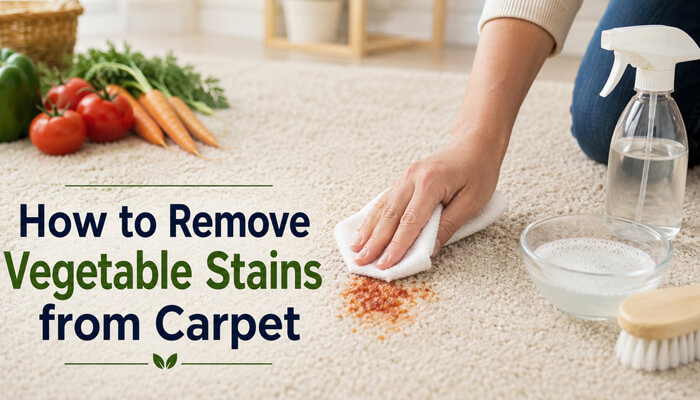
Carpet requires controlled cleaning because it cannot be freely rinsed. The goal is to remove the stain without spreading it, changing the pile, leaving sticky residue, or soaking the backing.
Carpet Cleaning Solution
Use minimal moisture when following any method for how to remove vegetable stains from carpet.
Whenever possible, use a carpet-manufacturer-approved or Carpet and Rug Institute-approved spot remover.
For compatible, colorfast synthetic carpet, a mild detergent solution can be made with:
- 1 cup cool or lukewarm water
- ¼ teaspoon clear, non-bleach, non-lanolin dishwashing liquid
Do not substitute laundry detergent. Some laundry products contain ingredients that are difficult to rinse from carpet or may affect its appearance.
Step-by-Step Carpet Method
- Lift solid food with a spoon.
- Blot liquid with a dry white towel.
- Test the cleaning solution in a hidden location.
- Apply a small amount to a white cloth, not directly to the carpet.
- Blot from the outer edge toward the center.
- Rotate the cloth as the stain transfers.
- Repeat while the color continues to lift.
- Blot with a second cloth lightly dampened with clean water.
- Press dry towels onto the area to remove moisture.
- Allow the carpet to air-dry completely.
- Vacuum to restore the pile.
Do not scrub, pour cleaner onto the spot, or saturate the backing.
Dried Vegetable Stains on Carpet
Rehydrating the residue carefully is an important part of how to remove vegetable stains from carpet after they have dried.
- Vacuum or scrape away dry residue.
- Apply a small amount of the tested solution.
- Let it soften the stain briefly.
- Blot gently.
- Repeat as needed.
- Lightly rinse when the carpet instructions permit.
- Extract or blot moisture.
- Dry completely.
If the stain returns after drying, residue may be wicking upward from the backing or padding. Professional extraction may be necessary.
Wool Rugs and Natural-Fiber Carpet
Extra caution is required when determining how to remove vegetable stains from wool, silk, jute, or other natural fibers.
Wool, silk, jute, hemp, sisal, handmade rugs, and naturally dyed carpet need extra care.
- Follow the manufacturer’s instructions.
- Use a fiber-approved cleaner.
- Avoid chlorine bleach.
- Avoid strong alkaline products.
- Do not scrub or overwet.
- Blot and dry promptly.
Use a professional cleaner for valuable, antique, hand-knotted, silk, or unstable-dye rugs.
How to Remove Vegetable Stains from Upholstery
Find the upholstery cleaning code before applying water or solvent. It may be printed beneath a cushion or on a label under the furniture.
Upholstery Cleaning Codes
The cleaning code determines how to remove vegetable stains from a sofa or chair without causing avoidable water or solvent damage.
| Code | Meaning | Appropriate approach |
| W | Water-based cleaning permitted | Approved water-based upholstery cleaner |
| S | Water-free solvent cleaning | Upholstery dry-cleaning solvent |
| WS or SW | Water-based or solvent cleaner permitted | Use an approved option after testing |
| X | Vacuuming or light brushing only | Professional cleaning for visible stains |
A W code does not mean the fabric can be soaked. Manufacturer instructions always take priority.
W-Coded Upholstery
- Lift away solid food.
- Blot moisture with a white cloth.
- Test the water-based cleaner.
- Apply a small amount to a cloth rather than the furniture.
- Blot from the edge toward the center.
- Rotate the cloth as the color transfers.
- Lightly blot-rinse when permitted.
- Absorb moisture with dry towels.
- Allow the area to dry fully with good airflow.
Do not sit on the furniture until it is completely dry.
S-Coded Upholstery
Do not use water or homemade water-based mixtures. Use only a solvent designed for upholstery and follow its label. Ventilate the area and keep the product away from flame or heat.
Professional cleaning is safer for large, old, valuable, or heavily colored stains.
WS- or SW-Coded Upholstery
Either an approved water-based cleaner or upholstery solvent may be allowed. Test first, use very little product, and follow the furniture manufacturer’s directions.
X-Coded Upholstery
Do not apply water, detergent, vinegar, peroxide, or solvent. Gently remove dry residue, vacuum with an upholstery attachment, and contact a professional for a visible stain.
Removable Sofa and Cushion Covers
A removable cover does not automatically simplify how to remove vegetable stains because some zippered covers are not washable.
A zippered cover is not automatically machine-washable.
Before removing it:
- Check the sewn-in label.
- Read the furniture manufacturer’s instructions.
- Confirm whether shrinkage or color variation is possible.
When washing is permitted:
- Pretreat the stain.
- Close zippers and fasteners.
- Use the specified cycle and temperature.
- Reshape the cover while damp when directed.
- Dry it as instructed.
- Refit it only when both the cover and cushion are completely dry.
Cleaning a single cover may produce a different shade or texture from the remaining set. Some manufacturers recommend cleaning matching covers together.
Leather, Suede, and Nubuck
Do not treat leather like fabric upholstery. Household detergent, vinegar, peroxide, and excess water may damage the finish or change the color.
For finished leather:
- Lift away solid food.
- Blot immediately.
- Follow the furniture maker’s instructions.
- Use a cleaner intended for the exact leather type.
- Condition only when recommended.
Use a leather-care professional for suede, nubuck, aniline leather, unfinished leather, vintage furniture, or persistent colored stains.
Do Vinegar and Baking Soda Remove Vegetable Stains?
Many people use vinegar and baking soda for stain removal, but they are not universal solutions.
Vinegar
May help in limited situations when compatible with the material, but it can affect some dyes and finishes.
Baking Soda
Can absorb moisture and some grease but is generally less effective against deep vegetable pigments.
Detergent Usually Works Better
For most vegetable stains, a quality detergent and proper stain-removal process are more reliable than homemade mixtures.
Do Homemade Stain Removers Work?
Home remedies may appear in advice about how to remove vegetable stains, but they are not universally safe or effective.
Home ingredients can help in limited situations, but no mixture is safe for every fiber, dye, finish, or furniture code.
Clear Dishwashing Liquid
A small amount can loosen food and grease on compatible water-safe carpet or upholstery. Dilute it, test first, and rinse lightly so residue does not attract soil.
Oxygen Bleach
An oxygen-based laundry product may reduce beet, tomato, carrot, pumpkin, or green-vegetable discoloration on compatible washable fabrics.
Before use:
- Check the care label.
- Confirm that bleaching is permitted.
- Test a hidden area.
- Follow the exact concentration and soaking time.
- Rinse or wash as directed.
“Color-safe” does not guarantee safety for every dye or fiber.
White Vinegar
Vinegar appears in some traditional stain-removal methods, but its acidity can affect dyes, natural fibers, and finishes. Use it only when the material and product guidance allow it.
Never combine vinegar with chlorine bleach.
Baking Soda
Dry baking soda may absorb some fresh oil or moisture, but it does not reliably remove deep vegetable pigment. Powder can also be difficult to remove from carpet and upholstery.
Baking soda and vinegar fizz because they react with each other; the bubbles do not prove that the combination is an effective universal stain remover.
Hydrogen Peroxide and Lemon Juice
Both may lighten some discoloration, but they can also fade dye or alter finishes. Use them only when the manufacturer permits them and after testing a hidden area.
Should You Use Hot or Cold Water?
Water temperature can strongly influence how to remove vegetable stains, especially when sauces contain dairy, egg, or meat.
Cool water is the safest starting point for many fresh vegetable stains, especially when the full ingredients are unknown. It can help flush food without exposing protein or pigment to unnecessary heat.
After pretreatment, washable clothing may be laundered at the warmest temperature allowed by the garment and cleaning-product labels.
Do not choose hot water simply because the stain looks difficult. Dairy, egg, and meat residues may respond poorly to early heat, and heat can make remaining oil or pigment harder to address.
Common Mistakes That Make Vegetable Stains Worse
Knowing what to avoid is just as important as knowing how to remove vegetable stains correctly.
- Scrubbing Instead of Blotting
Scrubbing spreads pigment, pushes residue deeper, frays carpet, and may distort upholstery.
- Treating Every Spill as Water-Based
Vegetable oil, salad dressing, butter, cheese, and sauce require grease treatment.
- Applying Heat Before Checking
A dryer or iron can make residual color and oil more difficult to remove.
- Using Too Much Detergent
Excess cleaner can leave carpet or furniture sticky and attract soil.
- Overwetting Carpet or Upholstery
Moisture can reach backing, adhesive, filling, or wood and create rings, odor, or prolonged drying.
- Ignoring Labels and Cleaning Codes
A method that works on cotton may damage silk, wool, rayon, leather, or solvent-only upholstery.
- Combining Cleaning Products
Mixing chemicals can damage materials and create dangerous fumes.
- Using Colored Towels
Towel dye may transfer to the surface.
Using Laundry Detergent on Carpet
Laundry products can be difficult to rinse and may contain optical brighteners. Use a carpet-approved product or the recommended mild, clear dishwashing solution.
Troubleshooting Vegetable Stains
Troubleshooting how to remove vegetable stains means identifying whether the remaining problem is pigment, grease, detergent residue, or moisture.
| Problem | Likely cause | What to do |
| Color remains after washing | Pigment was not fully removed | Pretreat again and air-dry |
| Dark translucent ring remains | Grease is still present | Repeat the grease treatment |
| Carpet feels sticky | Too much cleaner remains | Blot-rinse and extract moisture |
| Carpet spot returns | Residue is wicking upward | Repeat extraction or call a professional |
| Fabric dye is fading | Cleaner is incompatible | Stop, rinse if allowed, and seek help |
| Upholstery has a water ring | Area was overwet or dried unevenly | Stop home treatment |
| Old stain will not lift | Residue was heat-set or bonded | Repeat safe treatment or seek professional care |
| Stain spreads | Too much liquid or outward wiping | Use less solution and work inward |
| Garment smells oily | Grease remains | Retreat before drying |
| Texture changes | Chemical or mechanical damage | Stop rubbing and consult a specialist |
When to Call a Professional Cleaner
Professional help is sometimes the safest solution for how to remove vegetable stains from valuable or unstable materials.
Professional care is advisable when:
- The garment is Dry Clean Only.
- The item is silk, velvet, rayon, suede, nubuck, or delicate wool.
- The carpet is antique, handmade, silk, naturally dyed, or valuable.
- Upholstery carries an X code.
- The stain covers a large area.
- Liquid has reached carpet padding or furniture filling.
- Color transfers during testing.
- Rings, fading, stiffness, or distortion appear.
- Repeated safe treatment has failed.
- The item is valuable or irreplaceable.
- A strong odor remains after the visible mark is gone.
Tell the cleaner what caused the stain, when it occurred, and what products have already been applied.
How to Prevent Vegetable Stains
In the Kitchen
- Wear an apron when handling beets, tomatoes, and colorful purees.
- Use stable nonslip cutting boards.
- Carry soups and sauces on a tray.
- Use containers with secure lids.
- Keep white absorbent cloths nearby.
Around Babies and Children
- Use washable bibs and high-chair covers.
- Place a washable mat below the chair.
- Serve strongly colored food in smaller portions.
- Treat stained clothes before putting them in a hamper.
- Store laundry products out of children’s reach.
In Dining Areas
- Use washable tablecloths or placemats.
- Avoid overfilling bowls and serving dishes.
- Check furniture cleaning codes before spills occur.
- Clean chair-cover stains promptly.
For Clothing
- Do not store damp, stained garments in a pile.
- Inspect clothes before transferring them to the dryer.
- Keep stain products in their original labeled containers.
Final Thoughts
Knowing how to remove vegetable stains requires more than applying a single household remedy. A plain vegetable-juice mark, oily pasta sauce, curry, baby-food puree, and vegetable cooking oil can contain different combinations of pigment, grease, starch, sugar, and protein. Understanding how to remove vegetable stains starts with identifying the type of stain, checking the care label, and choosing a treatment that matches both the stain and the material.
For washable clothing, lift solids, rinse from the back, pretreat, wash as directed, and avoid heat until the stain is completely gone. For carpet and upholstery, use a tested surface-safe product in small amounts, blot from the outside toward the center, remove residue, and dry thoroughly. Delicate, valuable, dry-clean-only, X-coded, or unstable materials are best handled by a professional cleaner to reduce the risk of damage.
How to Remove Vegetable Stains FAQs
1. What is the best method for how to remove vegetable stains from clothing?
The best method for how to remove vegetable stains from clothing is to remove excess food, rinse the stain from the back with cool water, apply liquid laundry detergent, and wash according to the care label before air-drying.
2. How do you remove old vegetable stains that have already dried?
When learning how to remove vegetable stains, dried stains should be rehydrated first, treated with a heavy-duty detergent, and cleaned repeatedly if necessary before exposing the fabric to heat.
3. How do you remove vegetable stains from carpet safely?
For how to remove vegetable stains from carpet, lift away solids, blot the area with a clean white cloth, use a carpet-safe cleaner, and avoid scrubbing or over-wetting the fibers.
4. Can vegetable stains become permanent?
Yes, vegetable stains can become harder to remove if they are left untreated or exposed to dryer heat. Knowing how to remove vegetable stains quickly improves the chances of complete removal.
5. Does baking soda work for how to remove vegetable stains?
Baking soda may help absorb moisture or grease, but for how to remove vegetable stains, detergent and fabric-safe stain removers are generally more effective at removing both pigment and oily residue.
