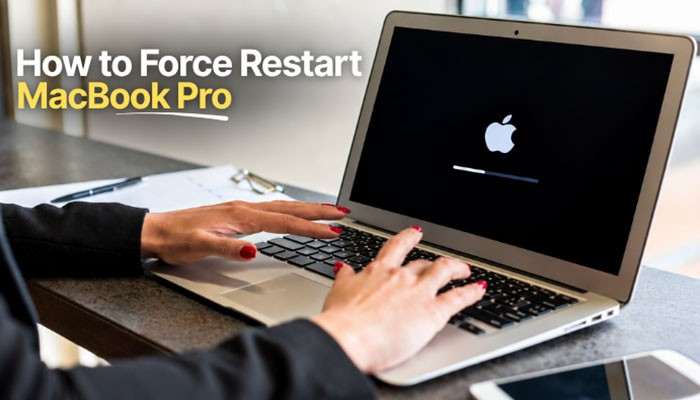

Knowing How to Force Restart MacBook Pro can save you from a stressful situation when your Mac freezes, shows a black screen, or stops responding to the keyboard and trackpad. The basic method is simple: press and hold the power button for up to 10 seconds until the Mac turns off, then press the power button again to start it. On MacBook Pro models with Touch ID, the Touch ID button is also the power button.
A force restart should not be your first response to every slow Mac. If macOS still responds, save your work and use Apple menu > Restart instead. If only one application has frozen, try Force Quit before restarting the entire computer. A forced shutdown can cause you to lose changes that have not been saved.
This guide explains How to Force Restart MacBook Pro safely across Apple silicon and older Intel models. It also covers Touch ID models, frozen screens, keyboard options, startup problems, Recovery Mode, Safe Mode, and what to do when a MacBook Pro repeatedly freezes.
How to Force Restart MacBook Pro
If your MacBook Pro is completely frozen:
- Locate the power button. On models with Touch ID, use the Touch ID/power button in the upper-right area of the keyboard
- Press and hold the button for up to 10 seconds
- Release it when the Mac turns off and the screen becomes blank
- Wait a few seconds
- Press and release the power button normally
- Allow macOS to start
Apple recommends this forced-shutdown approach when a Mac is unresponsive and cannot be shut down normally.
Important: Unsaved changes can be lost. Use this method when normal options are unavailable.
Normal Restart vs. Force Restart: What Is the Difference?
Understanding the difference can prevent unnecessary data loss.
| Method | When to use it | What happens | Unsaved work |
| Normal restart | Mac is responding | macOS closes processes and restarts | Apps may give you a chance to save |
| Force Quit | One app is frozen | Closes the problem app | Unsaved work in that app may be lost |
| Force shutdown/restart | Entire Mac is frozen | Power is forcibly turned off before restarting | Unsaved changes may be lost |
| Recovery startup | Mac will not boot correctly | Opens recovery tools | Does not itself erase your files |
A forced restart is therefore an emergency troubleshooting step, not a replacement for the regular Restart command.
When Should You Force Restart a MacBook Pro?
You may need to learn How to Force Restart MacBook Pro when the computer becomes completely unresponsive.
Common situations include:
- The pointer will not move
- The trackpad and keyboard stop responding
- The screen is frozen
- An app freezes the entire system
- The Mac is stuck on a black or blank screen
- The Apple menu cannot be opened
- A normal restart does nothing
- The computer appears powered on but will not respond
However, a progress bar during startup does not always mean the Mac has frozen. macOS can sometimes take additional time while checking a disk, installing an update, or completing startup work. Apple notes that disk checking during startup can take some time.
Try These Steps Before a Force Restart
Before cutting power to the Mac, check whether macOS still responds.
1. Wait Briefly
A demanding application, system update, large file operation, or memory-intensive task can temporarily make the Mac appear frozen. Give the computer a short time to respond before forcing it off, especially during an update.
2. Try to Quit the Frozen App
If only one application is causing trouble, press:
Command (⌘) + Q
This asks the current application to quit normally.
3. Force Quit an Unresponsive App
If the application will not close, press:
Option (⌥) + Command (⌘) + Esc
Select the frozen application and choose Force Quit.
Apple specifically recommends trying to quit normally before forcing an app to quit because a normal quit gives the application an opportunity to save changes.
4. Restart Normally
If the Apple menu still works, choose:
Apple menu > Restart
This is safer than forcing the MacBook Pro off.
How to Force Restart MacBook Pro With Apple Silicon
Modern MacBook Pro generations use Apple silicon rather than Intel processors.
If an Apple silicon MacBook Pro becomes completely unresponsive:
- Find the Touch ID/power button
- Press and hold it for up to 10 seconds
- Wait until the Mac turns off
- Release the button
- Wait several seconds
- Press and release the power button to turn the Mac back on
The essential process remains the same across current Apple silicon MacBook Pro generations: the power button provides the hardware-level way to turn off an unresponsive Mac.
Do You Need a Special M-Series Key Combination?
No special M-series force-restart combination is required for the standard frozen-Mac procedure. The safest universal approach is to hold the power button until the machine turns off, then start it normally.
How to Force Restart MacBook Pro With Touch ID
One reason users have difficulty with How to Force Restart MacBook Pro is that the power button is not always obvious.
On MacBook Pro models equipped with Touch ID, the Touch ID sensor also functions as the power button. Apple explicitly identifies Touch ID as the button to hold when forcing off a Mac laptop.
To force the Mac off:
- Find Touch ID at the upper-right of the keyboard area
- Press the button down rather than simply resting your finger on it
- Keep holding for up to 10 seconds
- Release when the Mac shuts off
- Press it again normally to start the computer
This distinction has caused confusion on Touch Bar-era models because Touch ID may look more like a fingerprint sensor than a traditional power switch. OWC’s guide highlights the same issue on Touch Bar MacBook Pro models.
How to Force Restart an Older Intel MacBook Pro
The basic power-button method also works when an older Intel MacBook Pro becomes completely frozen.
- Locate the physical power button
- Hold it until the Mac turns off
- Release it
- Wait several seconds
- Press the power button again to start the Mac
Some older built-in Mac keyboards without Touch ID also support:
Control + Command + Power
Apple documents this shortcut as a way to force a Mac to restart without prompting to save open and unsaved documents. Importantly, Apple’s current shortcut documentation specifies this for built-in keyboards without Touch ID.
For a completely frozen computer, holding the power button remains the simplest method to remember.
MacBook Pro Force Restart by Model Type
| MacBook Pro type | Button to use | Recommended emergency method |
| Apple silicon MacBook Pro | Touch ID/power | Hold power for up to 10 seconds |
| Intel MacBook Pro with Touch ID | Touch ID/power | Hold power for up to 10 seconds |
| Touch Bar MacBook Pro | Touch ID/power | Hold button until Mac turns off |
| Older Intel MacBook Pro | Physical power button | Hold power until shutdown |
| Built-in keyboard without Touch ID | Power button | Control + Command + Power can force restart |
The exact appearance of the keyboard has changed over the years, but every Mac has a power button.
What Happens When You Force Restart a MacBook Pro?
A normal restart gives macOS time to close applications and system processes in an orderly way.
A forced shutdown is different. You are telling the computer to turn off even though macOS has not completed its normal shutdown process.
As a result:
- Unsaved document changes may disappear
- Open applications are closed
- Active processes are interrupted
- Downloads or file operations can stop
- macOS starts fresh when the Mac is turned on again
That is why How to Force Restart MacBook Pro should be treated as a recovery technique rather than routine maintenance.
Will Force Restarting Damage a MacBook Pro?
An occasional forced restart used to recover a genuinely frozen Mac should not be confused with physically damaging the computer.
The more practical concern is data loss. If an application has unsaved changes, those changes may disappear when power is forcibly removed.
There is also a reason not to make forced shutdowns a habit. Interrupting the computer during important disk activity or software installation is undesirable.
Whenever possible:
Save > Quit apps > Restart normally
Use a force restart only when those choices are unavailable.
How to Force Restart MacBook Pro With a Black Screen

A black screen creates another problem: you may not know whether the Mac is frozen, sleeping, or powered off.
Try this sequence:
- Press a key or click the trackpad
- Check whether the charger is connected
- Increase the display brightness
- Disconnect unnecessary USB, Thunderbolt, and external-display accessories
- Hold the power button for up to 10 seconds
- Release it
- Press the power button again normally
Apple recommends the same forced-off-and-on procedure when a Mac appears to be running but remains stuck on a blank screen. If the problem continues, Recovery may be needed.
What If the MacBook Pro Will Not Turn Back On?
If you followed the How to Force Restart MacBook Pro procedure but nothing happens afterward, the problem may extend beyond a simple frozen application.
Check the Power Connection
Make sure:
- The charger is securely connected
- The electrical outlet works
- The charging cable is not visibly damaged
- A compatible power adapter is being used
Disconnect Accessories
Remove unnecessary devices such as:
- USB hubs
- External drives
- Printers
- Phones
- Thunderbolt accessories
- External adapters
Then try the power button again. Apple specifically recommends disconnecting accessories when troubleshooting a Mac that will not turn on.
Use macOS Recovery When Restarting Does Not Fix the Problem
If the Mac powers on but macOS will not start correctly, macOS Recovery provides built-in repair tools.
Apple Silicon MacBook Pro
- Shut down the Mac
- Press and continue holding the power button
- Wait for Loading startup options or the Options icon
- Release the button
- Select Options
- Click Continue
From Recovery, you can access tools that can repair the startup disk or reinstall macOS.
Intel MacBook Pro: For an Intel-based Mac, shut it down and then start it while holding:
Command (⌘) + R: This opens the built-in macOS Recovery system on supported Intel Macs.
Try Safe Mode If Your MacBook Pro Keeps Freezing
A Mac that starts normally but repeatedly freezes may have a deeper software problem. Safe Mode can help determine whether software loaded during startup contributes to the issue.
Apple Silicon
- Shut down the Mac
- Press and hold the power button until startup options appear
- Select your startup volume
- Hold Shift
- Choose the option to continue in Safe Mode
Intel Mac
- Restart or turn on the Mac
- Immediately hold Shift
- Continue through the login process
Safe Mode is especially useful when freezes appear shortly after login or after installing new software.
Why Does My MacBook Pro Keep Freezing?

Knowing How to Force Restart MacBook Pro solves the immediate problem, but repeated freezes deserve investigation. Possible causes include:
1. Too Many Demanding Apps
Video editors, browsers with many tabs, development tools, games, and other demanding programs can place heavy pressure on memory and processor resources. Open Activity Monitor to identify applications consuming unusually high CPU or memory.
2. Low Available Storage
macOS needs working space for temporary files, updates, caches, and other operations.
Check:
Apple menu > System Settings > General > Storage
Remove unnecessary large files or applications if available storage is very low.
3. Problematic Software
If freezing began after installing a new application, extension, utility, or system modification, check whether that software is responsible.
4. macOS or App Problems
Install appropriate macOS and application updates, particularly when release notes address crashes, compatibility, security, or stability.
5. Connected Accessories
A faulty drive, hub, adapter, or peripheral can sometimes interfere with startup or normal operation. Disconnect nonessential devices and test the Mac again. Apple also recommends this approach when diagnosing startup problems.
6. Hardware Problems
Persistent freezes, unexpected shutdowns, startup failures, or other recurring problems can also indicate a hardware issue. If basic troubleshooting does not solve the problem, use Apple Diagnostics or seek professional service rather than repeatedly forcing the computer off.
Common Mistakes to Avoid
When learning How to Force Restart MacBook Pro, avoid these common errors.
- Force restarting when only one app is frozen: Try Force Quit first
- Tapping Touch ID instead of pressing it: Touch ID must be physically pressed when used as the power button
- Turning the Mac off during an update too quickly: Updates can sometimes remain on one screen for an extended period
- Repeating forced shutdowns: Frequent freezing needs troubleshooting
- Ignoring unsaved work: A force restart can erase unsaved changes
- Using old keyboard shortcuts on every model: Apple notes that some power-button shortcuts apply specifically to built-in keyboards without Touch ID
- Confusing restart with a factory reset: A force restart does not erase the Mac or return it to factory settings
Force Restart vs. Hard Reset vs. Factory Reset
These terms are often mixed together online.
1. Force Restart: Used when the computer stops responding. The Mac is forcibly powered off and then restarted
2. Hard Reset: People often use “hard reset” as another name for a forced restart. The term can be ambiguous, so force restart or force shutdown is clearer
3. Factory Reset: A factory reset is completely different. It involves removing user data/settings and preparing or restoring the Mac to a clean state
Do not erase your Mac simply because an application has frozen.
Quick Troubleshooting Checklist
If your MacBook Pro freezes, work through these steps in order:
- Wait briefly to see whether it recovers
- Try Command + Q
- Try Option + Command + Esc to Force Quit the frozen app
- Use Apple menu > Restart if macOS still responds
- If the entire Mac is frozen, hold the power/Touch ID button for up to 10 seconds
- Wait a few seconds
- Turn the Mac on normally
- Disconnect accessories if startup fails
- Try Safe Mode if freezing returns
- Use macOS Recovery if macOS will not start
- Investigate recurring freezes instead of relying on repeated forced restarts
Conclusion
Learning How to Force Restart MacBook Pro is useful when macOS becomes completely frozen. For most MacBook Pro models, the safest emergency procedure is straightforward: press and hold the power button for up to 10 seconds, release it after the Mac turns off, wait briefly, and press the power button again. On models with Touch ID, Touch ID doubles as the power button.
A force restart should still be a last resort. Try quitting a frozen application, using Force Quit, or restarting normally whenever the Mac remains responsive. This reduces the risk of losing unsaved work.
Most importantly, do not treat repeated force restarts as the solution to recurring freezes. If your MacBook Pro regularly stops responding, investigate storage, software, accessories, macOS updates, Safe Mode, Recovery, and possible hardware problems. The goal is not simply to get the Mac running again, it is to identify why it froze in the first place.
How to Force Restart MacBook Pro FAQs
1. How do I force restart my MacBook Pro when it is frozen?
Press and hold the power button for up to 10 seconds until the Mac turns off. On MacBook Pro models with Touch ID, press and hold the Touch ID/power button. Wait several seconds, then press the button again to turn on the Mac.
2. How do I force restart a MacBook Pro with Touch ID?
Press and hold the Touch ID button in the upper-right area of the keyboard for up to 10 seconds until the Mac turns off. Touch ID also serves as the power button on these Mac laptops.
3. What keys force restart a MacBook Pro?
Apple documents Control + Command + Power as a forced-restart shortcut on built-in Mac keyboards without Touch ID. For a frozen modern MacBook Pro, the straightforward method is to hold its power/Touch ID button until it shuts down, then turn it on again.
4. Will force restarting my MacBook Pro delete my files?
A force restart does not erase the Mac or perform a factory reset. However, changes that were not saved before the forced shutdown may be lost.
5. What should I do if my MacBook Pro screen is black?
Hold the power button for up to 10 seconds, release it, and then turn the Mac on again. If the blank screen returns, Apple recommends trying macOS Recovery and using Disk Utility to repair the startup disk.
6. Why is my MacBook Pro not responding to the power button?
Check the charger and power connection, disconnect accessories, hold the power button for about 10 seconds, then release it and press it normally. If the Mac still does not power on, it may require additional troubleshooting or service.
7. Is Force Quit the same as force restarting a MacBook Pro?
No. Force Quit closes an unresponsive application, while a force restart shuts down the entire computer. If only one app is frozen, Force Quit is usually the better first step.
8. Can I force restart an M-series MacBook Pro?
Yes. On an Apple silicon MacBook Pro, hold the power/Touch ID button until the computer turns off, then press the button normally to start it again.
9. Should I force restart my MacBook Pro during an update?
Avoid doing so unless the Mac is clearly unresponsive and other options have failed. Interrupting an operating-system update unnecessarily can create additional startup problems.
10. What should I do if my MacBook Pro keeps freezing after restarting?
Check available storage, update macOS and applications, disconnect unnecessary accessories, test in Safe Mode, and investigate recently installed software. If startup problems continue, macOS Recovery and Apple Diagnostics can help determine whether the issue is software- or hardware-related.