



Choosing the surface for a new or refurbished basketball court affects player safety, ball response, upfront cost, and long-term maintenance. Working with a trusted basketball floor supplier helps ensure the court delivers the performance, durability, and quality needed for every level of play. A good court quietly shapes every game played on it, from a school lunchtime match to the arenas that hosted basketball’s greatest dynasties.
You do not need to be a materials expert. Use this checklist in supplier meetings to compare options by safety, play quality, budget, and day-to-day upkeep without getting lost in technical language.
Start With How The Court Will Actually Be Used
Before you talk to suppliers, get clear on the job the floor has to do. That single step narrows your options quickly.
- Surface types: hardwood sprung timber, resilient vinyl or polyurethane, and modular tiles each perform differently. Timber is the traditional choice for competition play, resilient surfaces often suit busy multi-use venues, and tiles can work for some flexible or temporary setups.
- Indoor or outdoor: weather exposure changes what will last and how the surface must be maintained.
- Single sport or multi-use: a school hall that hosts assemblies and exams asks more of a floor than a dedicated court.
- Permanent or temporary: some venues need a surface that can be removed, stored, or replaced in sections.
Write down your level of play and your weekly schedule first. It will make every later answer easier to judge.
The 10 Questions To Ask Before You Commit
Ask these in order. Each one tells you something about the surface and about the supplier behind it.
1. Which Standards Will Our Floor Be Tested Against?
Two names come up often. ASTM F2772 is the active standard for the athletic performance of indoor sports floor systems. EN 14904 is the European standard widely used as a benchmark. Ask for recent lab or field test reports that show shock absorption, ball bounce, friction, and vertical deformation. If you are planning for competition play, connect this question to FIBA requirements from the start.
2. What Surface Types Do You Supply, And Why Is That The Right Pick For Us?
A good supplier should offer a side-by-side view rather than push one product. Ask them to match each option to your level of play, multi-use needs, and any seating or equipment loads. Keep in mind that Victoria’s school building handbook specifies timber sprung floors compliant with FIBA and EN 14904 for indoor competition-level spaces, and does not permit synthetic floors for those competition areas.
3. Can You Show Recent Projects Like Ours And A Contact We Can Call?
Ask for local school or community references, photos of line-marking quality, and a short conversation with a facilities lead who lives with the floor every day. How the surface plays and holds up after a year tells you more than a brochure.
4. How Will You Handle The Subfloor And The Room Environment?
For timber, ask about moisture testing and how heating and cooling affect the floor. Maple gym guidance points to keeping the room around 55 to 75 degrees Fahrenheit and 35 to 50 percent relative humidity to reduce gaps and damage. A serious supplier will talk about acclimation before installation, not just delivery dates.
5. What Is The Maintenance Plan And Downtime Over The First Three To Five Years?
For maple courts, an annual screen-and-recoat is a common expectation for most gyms. For resilient floors, ask about routine cleaning, slip-resistance checks, and resurfacing intervals. Request a written cleaning guide and a list of suitable products so your custodial team is not guessing.
6. What Do Your Test Results Say About Ball Bounce And Traction?
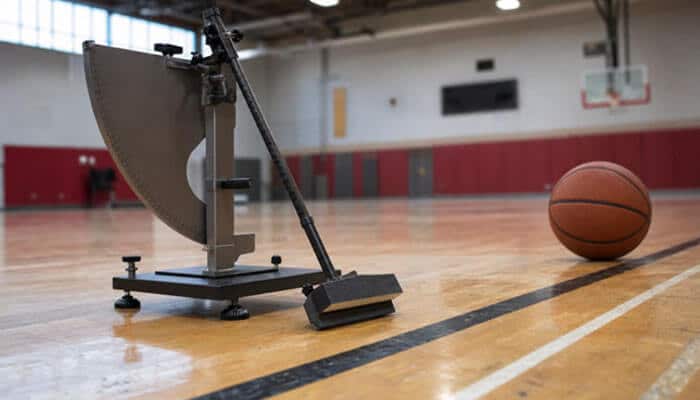
This is central to play quality. Ask for the latest test certificates. Under EN 14904 classes A3 and A4, floors are expected to reach at least 90 percent ball bounce with a friction value between 80 and 110, alongside defined shock-absorption ranges. When you compare any basketball floor supplier, ask how they balance friction, ball rebound, and shock absorption, and request the reports that map to EN 14904 or ASTM F2772. Also ask how they keep performance even across the whole court and how they deal with dusty or slippery patches.
7. How Will The Court Support Other Activities?
Most halls do double duty. Ask about durability under assemblies, exams, and events, plus protection covers, rolling loads, and cleaning rules when seating or equipment sits on the floor. If a supplier describes a surface as low-maintenance, ask what that means in practice for your weekly use, cleaning schedule, and staffing.
8. What Certifications And Warranties Come With The Surface?
Ask for relevant environmental listings and any FIBA certificates where competition plays matters. As an example of the detail worth requesting, one published Taraflex Surface listing shows FloorScore certification with total volatile organic compound emissions below 0.5 milligrams per cubic metre. Just as important, ask plainly what actions void the warranty.
9. What Is The Install Timeline, And Who Signs Off Compliance?
Clarify lead times, what site readiness looks like, and who handles post-install testing and handover. You want documented sign-off and maintenance training for your team, not a handshake.
10. What Does Your Quote Include, And What Is Excluded?
Insist on a line-item scope: subfloor preparation, line marking, edge transitions, protection covers, and post-install support. A clear scope is the only way to compare bids fairly instead of guessing what a low number leaves out.
Build A Simple Scoring Rubric

Once you have answers from two or three suppliers, turn them into numbers. A short rubric keeps the decision calm and defensible when you have to explain it to a board or council.
Pick four categories that matter most: standards compliance, maintenance realities, quality of references, and total cost of ownership over five years rather than the sticker price alone. Score each supplier from one to five in every category, and weight the categories to match your venue. A competition space might weigh standards heavily, while a busy community hall might lean on maintenance and multi-use durability.
If you want a structured way to run this side by side, adapt this {{LINK_SLOT:questions to ask before you sign}} approach so every bidder answers the same prompts in the same order. That consistency makes the comparison fair. The supplier who scores well on evidence and upkeep, not just the cheapest quote, is usually the safer long-term choice.
What Good Looks Like: Quick Red Flags And Green Lights
After a few conversations, patterns appear. Watch for these.
- Red flags: no test reports on hand, vague answers about maintenance, reluctance to name local references, or promises that sound too good to be true.
- Green lights: clear mapping to a named standard, readable technical sheets, local case studies you can visit or call, and training offered for your custodial team.
Conclusion
The right supplier does more than sell a surface. They prove safety and play quality with current test results, and they give you a maintenance plan your team can follow. Use the ten questions to interview, use the rubric to compare, and let the evidence guide you. A floor is a long commitment, so choose the partner who answers plainly and backs it up in writing.
