



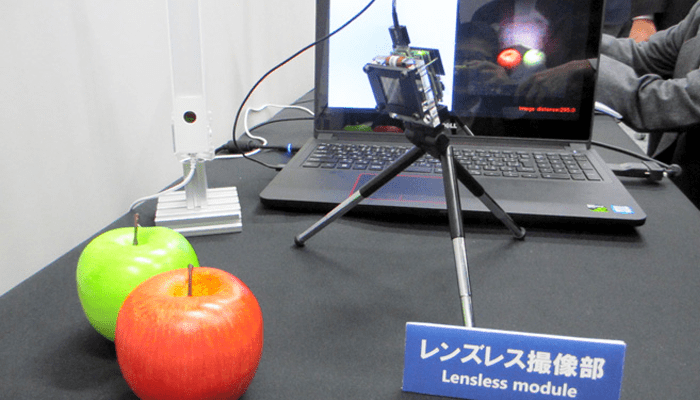

Hitachi Ltd. says it has developed camera technology that can capture video images without a lens and adjust its focal position afterward, becoming the first Japanese firm to do so. Generally, conventional cameras contain an image sensor and a lens. The lens is used to collect light to create an image of the captured subject, which is then projected onto the image sensor for the final image.
On the other hand, the technology using a special thin film will allow cameras to be lighter and thinner than conventional units, Hitachi said Tuesday. Unlike the lens, thin film is used to project the shadow created when the light passes through it. Since the photographed images are seen as fringe patterns, the technology will do signal processing to turn the shadows into images that the human eyes can recognize.
In other words, the newly-developed ‘lensless’ camera technology uses optical technology to project shadows and signal processing to convert shadows into beautiful images. That said, Hitachi is ready to launch the technology in the market. In fact, the company aims to commercialize it around 2018.
With Hitachi’s first ‘lensless’ camera technology, thin films have become an essential part of the comforts that technologies provide to people. Aside from the camera industry, thin film technology has helped various industries to create more innovative products. You can learn more applications of thin films at Korvus Technology.
On the other hand, the thin films in cameras can be used in several ways. For instance, Hitachi said the technology can be used in cars and robots, and in situations like autonomous driving, as the industrial conglomerate is putting its focus on the internet of things, a concept under which everything from electronic devices to cars and factories is connected.
Moreover, the ‘lensless’ camera technology can also open the possibility of new thinner smartphones. With the current efforts to improve the camera design, the technology will make the creation of slimmer smartphones possible.
With these potential applications, the ‘lensless’ camera technology is bound to change how the camera and photography industry works. The technology captures images through a film on which a concentric circle pattern is printed. The film is placed between an object and an image sensor.
Another key feature is that the technology can gather planar as well as depth information, enabling users to adjust the focal position of captured footage. When the face of a person is blurred in surveillance camera footage, for instance, its focal position can be changed after taking a shot.
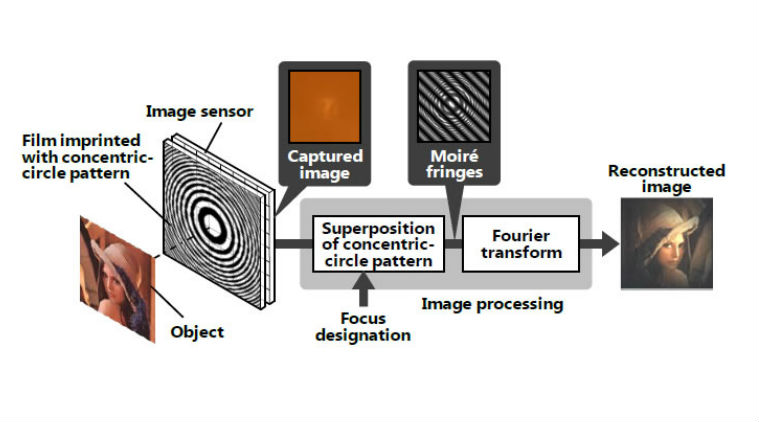
Under the new method, Hitachi focuses on Moire fringes that are created by the superposition of concentric circles.
The image sensor captures a shadow projected through the film patterned with a concentric circle. Another concentric circle pattern is superimposed on the shadow during image processing to get images. The processing speed is 300 times faster than traditional methods, according to Hitachi.
