



1. Introduction
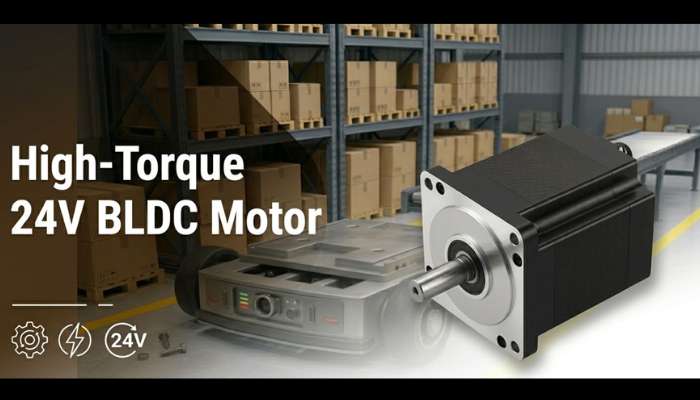
Low-voltage automation is growing fast in North America, driving demand for the High-Torque 24V BLDC Motor across industries. AGVs, AMRs, mobile robots, and compact industrial machines are now everywhere—in warehouses, factories, and hospitals. These systems share a common demand: they need power, precision, and safety in a small footprint. A High-Torque 24V BLDC Motor delivers the efficiency, reliability, and compact performance required to keep these advanced applications running smoothly while minimizing energy consumption and maintenance.
24V DC systems have become the go-to standard for many of these applications. They meet stringent electrical safety codes, simplify battery integration, and reduce wiring complexity. For engineers and procurement teams, 24V is not a compromise — it is a deliberate, smart choice.
2. How to Achieve High Torque with a 24V BLDC Motor?
Achieving high torque at 24V isn’t a single recipe. There are two distinct engineering paths, and picking the wrong one early creates problems that are expensive to fix later.
Path 1: Direct Drive High-Torque BLDC
A bare motor with a high pole count generates more torque per amp by packing more magnetic poles into the stator. Output RPM is naturally lower, peak torque is higher — no gearbox needed. It is compact, efficient, and mechanically simple. It suits applications where speed is low, space is tight, and mechanical complexity must be minimized.
Path 2: Modular Gearmotor System
This combines a standard BLDC motor with a reduction gearbox. The gearbox multiplies torque and reduces output speed. It is the preferred approach when the required torque exceeds what the bare motor can deliver within a 24V power budget. Optional add-ons — such as electromagnetic brakes and encoders — make it a fully integrated drive module. Manufacturers like Brushless.com have standardized this modular approach, allowing engineers to configure tailored drive units without redesigning the core motor.
Both paths have clear use cases. The right choice depends on torque target, space constraints, duty cycle, and safety requirements. We’ll explore each in more detail below.
3. Core Electrical and Mechanical Characteristics
Before adding a gearbox, it’s worth understanding what a 24V BLDC motor brings to the table on its own.
- High efficiency (85–92%) — less heat generated per watt of output, which directly extends battery runtime and reduces thermal management overhead.
- Low rotor inertia — fast dynamic response that matters every time an AGV accelerates out of a stop or a positioning axis needs to reverse direction quickly.
- Stator-side heat dissipation — heat stays in the fixed outer housing, not the rotating core, making thermal management far more predictable in enclosed enclosures.
- No brushes or commutators — no scheduled replacements, no gradual performance degradation. Service intervals shrink to near zero.
The constraint is current. A 300W motor at 24V draws 12–15A continuously — through every connector, wire run, and controller in the system. In enclosed housings or high ambient-temperature environments, thermal management stops being an afterthought and becomes a core design requirement.
4. Modular Integration: Breaking Through Physical Limits
This is where the real engineering value lies. A modular gearmotor system turns a capable motor into a high-performance drive solution. The two key decisions are gearbox type and brake integration.
The Gearbox as a Torque Lever
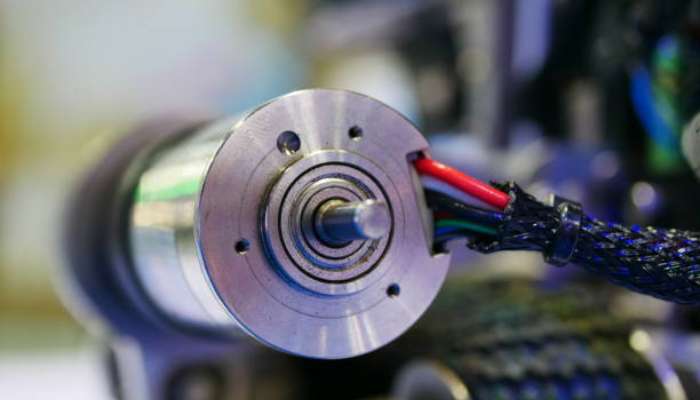
A small 24V BLDC motor paired with a reduction gearhead can multiply output torque by tens of times — without increasing motor size, voltage, or current draw. A bare motor demanding high torque output requires a proportionally large physical footprint; add a 50:1 gearhead, and that same compact motor can deliver enough torque for an AGV drive wheel or a robot joint. This is the core advantage of the gearmotor approach, and it explains why the two configurations covered below — planetary and worm — dominate compact industrial and mobile applications.
4.1 Gearbox Selection: Planetary vs. Worm
Two gearbox types dominate 24V BLDC gearmotor applications. Each has clear strengths and real trade-offs. The table below makes the comparison concrete:
| Feature | Planetary Gearbox | Worm Gearbox | Advantage | Best For |
| Efficiency | 90–97% | 50–85% | Planetary | High-duty cycles |
| Backlash | Low (arcmin) | Moderate | Planetary | Precision positioning |
| Torque Density | High | Very High | Worm | Space-constrained |
| Output Axis | Coaxial (inline) | 90° offset | Worm | Right-angle mounting |
| Self-Locking | No | Yes | Worm | Vertical/inclined loads |
| Noise Level | Low–Moderate | Low | Worm | Quiet environments |
| Cost | Moderate | Lower | Worm | Budget-sensitive builds |
Planetary gearboxes suit AGV and precision drives well — coaxial output, efficiency above 90%, and low backlash for closed-loop positioning. The limitation is equally clear: no self-locking, and coaxial output only. If the load needs to hold position without power, or the layout requires a 90-degree drive, a planetary gearbox won’t work.
Worm gearboxes give up efficiency for two specific advantages: 90-degree output and inherent self-locking. On a vertical lift or inclined conveyor, self-locking isn’t optional — it’s what keeps the load from dropping when power is cut. The cost is real: 50–85% efficiency versus the planetary’s 90%+. In a battery-powered, continuous-duty system, that gap shows up in runtime. In an intermittent-duty or AC-powered application, it rarely matters.
4.2 Electromagnetic Brake System
An electromagnetic brake adds fail-safe stopping capability. When power is cut — intentionally or due to a fault — the brake engages immediately. This is critical in:
- Vertical lifting systems (prevent free-fall on power loss)
- Inclined conveyor drives (prevent load rollback)
- AGVs operating on ramps or uneven surfaces
Compared to relying on motor back-EMF or electronic braking alone, an electromagnetic brake provides a deterministic, hardware-level safety guarantee. For applications subject to safety certifications or risk assessments, this is often non-negotiable.
5. Selection Guide
Choosing the right high-torque 24V BLDC motor configuration starts with a short list of critical questions:
- What is the required output torque (N·m) and speed (RPM) at the load?
- What is the available 24V current budget, and what is the duty cycle?
- Is coaxial or right-angle output required by the mechanical design?
- Does the application involve vertical or inclined loads that require self-locking or braking?
- Is position feedback (encoder) needed for closed-loop control?
- What are the ambient temperature and IP rating requirements?
As a general guideline: choose a direct-drive high-pole BLDC when torque requirements are modest and mechanical simplicity is a priority. Choose a planetary gearmotor when torque exceeds bare-motor capacity and efficiency matters. Choose a worm gearmotor when right-angle mounting or self-locking is required.
One mistake worth calling out specifically: sizing for peak torque without accounting for thermal limits during sustained operation. At 24V, continuous current draw is the real constraint. Always verify the motor’s continuous torque rating — not just its peak — against your actual duty cycle.
6. Real Application Case Analysis
6.1 AGV/AMR Drive Wheel Systems
AGVs need precise speed control, smooth acceleration, and reliable stopping across long operational cycles. A high torque 24V BLDC motor paired with a planetary gearbox delivers exactly this. The planetary unit provides high torque density in a compact, coaxial package that integrates cleanly into wheel hub assemblies.
Typical results: 30–40% reduction in drive unit volume compared to AC motor alternatives, with 15–20% lower energy consumption per shift. Adding a magnetic encoder closes the loop for accurate odometry — essential for the navigation precision modern AMR fleets demand.
6.2 Vertical Lifts, Conveyors, and Sorting Equipment
These applications share a common risk: uncontrolled motion on power loss. A worm gearmotor naturally resists back-driving. For vertical lifts, combining a worm gearbox with an electromagnetic brake creates a two-layer safety architecture — the worm holds position mechanically, while the brake provides positive locking under fault conditions.
This approach eliminates the need for external mechanical backstops, simplifying the overall machine design while meeting safety requirements for personnel-adjacent equipment.
6.3 Mobile Equipment and Light Material Handling
Motorized carts, mobile workstations, and light-duty conveyor systems have simpler requirements — but they still benefit from the right motor selection. Here, weight and form factor matter as much as torque. A modular 24V gearmotor sized with a mid-ratio planetary gearbox delivers the required torque without unnecessary bulk.
Battery-powered operation becomes genuinely practical. The motor’s efficiency directly extends run time per charge — reducing downtime and improving operator productivity across a full workday.
7. Conclusion
The bare motor is a strong starting point. But the real capability comes from modular integration — the right gearbox to multiply torque into a compact envelope, the right brake to guarantee safety under fault conditions, the right encoder to close the control loop. Together, these components transform a motor into a complete drive solution tailored to the application.
Select thoughtfully. Size for the duty cycle, not just the peak. And let the modular architecture work for you.
