


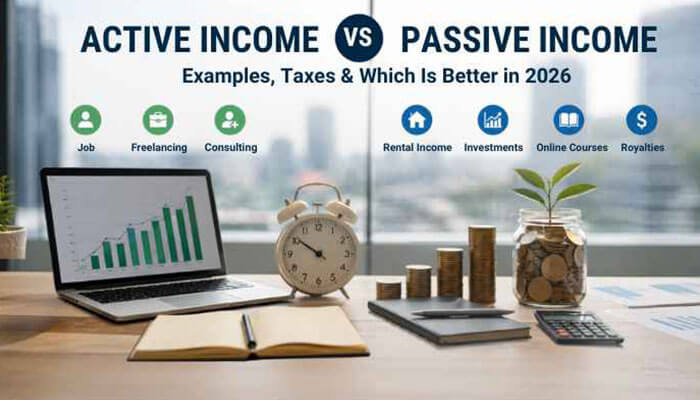

Understanding the difference between active and passive income is one of the most important steps toward smarter money management, long-term wealth building, and financial independence. Most people begin by earning active income through a job, salary, hourly wages, freelancing, consulting, sales commissions, or a hands-on business. Others try to build passive income through rental properties, dividends, royalties, digital products, affiliate marketing, investment income, or automated business systems.
The main difference is simple: active income usually requires your direct time and effort, while passive income can continue with less day-to-day involvement after the initial setup. However, passive income is often misunderstood. It is not always “easy money.” Most passive income streams require upfront work, capital, research, risk, patience, maintenance, or professional guidance.
In 2026, this topic matters even more because people are looking for multiple income streams, better job security, flexible work, and long-term financial freedom. Relying on only one paycheck can be risky, but chasing passive income without understanding taxes, effort, and risk can also create problems.
This guide explains the difference between active and passive income, gives real-world examples, compares tax treatment, explains passive activity rules, discusses portfolio income, and helps you decide which income type is better for your financial goals.
Many people spend years increasing their income without realizing that earning more money and building wealth are not always the same thing. That is why understanding how different income streams work has become more important than ever.
Quick Answer: What Is the Difference Between Active and Passive Income?
The difference between active and passive income is how the money is earned. Active income requires your direct time, effort, and participation, while passive income is generated through assets, investments, or systems that can continue producing income with less ongoing involvement.
Active income is money earned by actively working. Common examples include salaries, wages, freelancing, consulting, commissions, tips, coaching, and business income from activities you directly manage.
Passive income is money earned from assets or investments that generate revenue over time. Examples include rental income, dividends, interest, royalties, affiliate marketing income, digital product sales, and certain business investments where you do not materially participate.
Understanding the difference between active and passive income is important because both income types play different roles in building wealth, achieving financial freedom, and creating long-term financial security.
| Income Type | Simple Meaning | Common Examples |
| Active Income | You work directly to earn money | Salary, wages, freelancing, consulting, commissions |
| Passive Income | Your asset, system, or investment earns money | Rental income, royalties, digital products, affiliate income |
| Portfolio Income | Investments generate returns | Dividends, interest, capital gains, stock sales |
In simple words, active income depends mostly on your time. Passive income depends more on assets, systems, ownership, or investments.
At first glance, passive income may seem far more attractive. However, most passive income streams are built using money, skills, or systems that originally came from active income.
Active Income vs Passive Income vs Portfolio Income
To fully understand the difference between active and passive income, you should also understand portfolio income. Many beginners confuse passive income with investment income, but they are not always treated the same way, especially for tax purposes.
| Income Type | Meaning | Examples |
| Active Income | Money earned from direct work | Salary, wages, freelancing, consulting, commissions |
| Passive Income | Money earned from activities where you do not materially participate | Rental income, limited partnerships, and some business ownership income |
| Portfolio Income | Money earned from investments | Dividends, interest, capital gains, stock sales |
In personal finance, people often call dividends and interest “passive income” because they do not require daily work. However, for tax purposes, portfolio income may be treated differently from passive activity income. This distinction matters because tax rates, deductions, loss rules, and reporting requirements can change depending on the income type.
For example, a salary is active income. A rental property may be passive income. Dividends and capital gains are usually portfolio income, even though many people casually describe them as passive income.
What Is Active Income?
Active income is money earned when you trade your time, skills, labor, or services for payment. It is the most common type of income because most people earn money by working for an employer, serving clients, selling services, or running a hands-on business.
If you stop working, active income usually stops too. For example, if you work a full-time job, you receive a salary because you perform tasks and provide value to your employer. If you are a freelancer, you earn when you complete projects. If you are a consultant, you earn when you advise clients.
Active income can be stable, predictable, and high-paying. It helps you pay bills, build savings, reduce debt, invest, and qualify for loans. However, active income is usually limited by time, energy, job availability, and market demand.
Common Active Income Examples
| Active Income Source | How It Works |
| Salary | Fixed income from employment |
| Hourly wages | Paid based on hours worked |
| Freelancing | Paid per project, hour, or contract |
| Consulting | Paid for expert advice or strategy |
| Sales commissions | Earned when sales are closed |
| Tips | Earned from service-based work |
| Bonuses | Performance-based employee income |
| Business owner’s salary | Income from actively running a business |
| Gig work | Delivery, rideshare, or task-based income |
| Coaching | Paid for live sessions or direct support |
Active income is powerful because it gives you immediate cash flow. But if you want long-term wealth, active income alone may not be enough. Many people use active income as the foundation to buy assets that later generate passive income.
What Is Passive Income?
Passive income is money earned from assets, investments, intellectual property, or business systems that can generate income without constant direct work.
A lot of people imagine passive income as money arriving automatically with little effort. In reality, most passive income streams require significant upfront work, patience, consistency, and risk before they become reliable. Most passive income sources require one or more of the following:
- Upfront money
- Upfront work
- Specialized knowledge
- Risk-taking
- Marketing
- Maintenance
- Legal or tax planning
- Regular monitoring
- Long-term consistency
For example, a rental property may generate monthly rent, but the owner may still need to handle repairs, vacancies, taxes, insurance, and tenant issues. A blog may earn affiliate income, but it requires SEO, content updates, traffic, trust, and compliance. A dividend portfolio may pay dividends, but it requires capital, research, and risk tolerance.
For U.S. tax purposes, IRS Publication 925 explains that passive activities generally include trade or business activities where you do not materially participate, plus rental activities unless specific exceptions apply.
Common Passive Income Examples
| Passive Income Source | How It Works |
| Rental income | The property earns monthly rent |
| Royalties | Books, music, patents, or licensing generate income |
| Affiliate income | You earn commissions from product referrals |
| Digital products | Courses, templates, ebooks, or software sell repeatedly |
| REITs | Real estate investment trusts distribute income |
| Limited partnerships | An investor earns from a business without daily management |
| Automated online business | Systems generate sales with limited daily work |
| Interest income | Savings accounts, bonds, or deposits pay interest |
| Dividend income | Stocks or funds pay shareholders |
Passive income can create financial flexibility because it is not always tied directly to your working hours. However, it often takes months or years to build meaningful passive income.
Active Income vs Passive Income: Main Comparison Table
| Factor | Active Income | Passive Income |
| Main requirement | Time, effort, skill, labor | Asset, investment, system, or ownership |
| Speed of earning | Usually faster | Usually slower at the beginning |
| Predictability | Often more predictable | Can be unpredictable |
| Scalability | Limited by time and capacity | More scalable if built well |
| Upfront cost | Often low | Can be medium to high |
| Upfront effort | Direct ongoing effort | Heavy upfront effort, less daily work later |
| Tax treatment | Often, ordinary income, payroll tax, or self-employment tax | Varies by income type |
| Risk level | Depends on the job or business | Depends on asset, market, or investment |
| Best for | Stability and immediate cash flow | Long-term wealth and flexibility |
| Main weakness | Income stops when work stops | Requires capital, systems, time, or maintenance |
Key Difference Between Active and Passive Income
The biggest difference between active and passive income is the relationship between your time and your earnings.
With active income, your income is closely connected to your direct work. You earn because you work. With passive income, your money, assets, systems, or intellectual property can earn even when you are not working every hour.
1. Time Requirement
Active income requires direct time and effort. A teacher, software engineer, writer, doctor, freelancer, salesperson, consultant, or business owner must actively perform work to earn money.
Passive income may require time upfront, but the goal is to reduce daily involvement. For example, writing a book takes active work at first, but royalties may continue after publication.
2. Income Speed
Active income is usually faster. If you get a job or a freelance client, you can start earning soon.
Passive income is usually slower. It can take months or years to build rental cash flow, dividend income, online business traffic, royalty income, or a profitable digital product.
3. Scalability
Active income is limited by your time, energy, and availability. Even if you earn a high hourly rate, you can only work so many hours.
Passive income can be more scalable. A digital course can sell to thousands of people. A rental portfolio can grow. A dividend portfolio can compound. A software product can serve many users without requiring one-on-one work.
4. Risk
Active income may feel safer because it produces regular cash flow, especially through stable employment. But it also has risks, including job loss, burnout, skill obsolescence, health issues, and business failure.
Passive income has different risks. Rental properties may face vacancies. Stocks may fall. Affiliate income can drop after algorithm changes. Digital products may stop selling. Interest rates may change.
5. Control
Active income gives you more direct control over your work output. You can learn skills, apply for better jobs, raise rates, increase hours, or start freelancing.
Passive income depends more on assets, systems, markets, customers, platforms, and long-term strategy. You may have less daily control over tenant behavior, stock dividends, search rankings, or market returns.
Real-Life Examples of Active Income
1. Salary from a Full-Time Job
A salary is one of the most common active income sources. You work for an employer and receive regular pay. It is predictable and useful for budgeting, but it depends on continued employment.
2. Hourly Wages
Hourly workers earn based on the time worked. This includes retail employees, warehouse workers, hospitality workers, healthcare workers, service staff, and many operational roles.
3. Freelance Writing, Design, or Marketing
Freelancers earn by completing client work. A writer may charge per article, a designer may charge per project, and a marketer may charge monthly retainers. Freelancing offers flexibility but still depends on active work.
4. Consulting
Consultants earn by selling expertise. A business consultant, marketing consultant, tax consultant, technology consultant, or operations consultant may earn high active income, but they must serve clients directly.
5. Sales Commissions
Sales professionals earn commissions when they close deals. This can create high income, but it may fluctuate based on performance, company policy, and market conditions.
6. Gig Economy Work
Delivery driving, rideshare work, online task work, and temporary labor are active income because payment depends on completing specific tasks.
7. Running a Service Business
If you own a business but work in it daily, the income is still active. For example, a salon owner who cuts hair, manages customers, handles operations, and supervises staff is actively earning income.
Real-Life Examples of Passive Income
1. Rental Income
Rental income is one of the most popular passive income examples. A property owner rents out residential or commercial space and earns income from tenants.
The IRS explains that rental income generally includes cash or fair market value received for the use of real estate or personal property, and rental expenses can generally be deducted from rental income.
Is Rental Income Really Passive?
Rental income is often called passive income, but it is not always effortless. A rental property may require tenant screening, repairs, legal compliance, accounting, insurance, property taxes, vacancy planning, and maintenance.
This means rental income can be passive from a cash-flow perspective but active from a management perspective. A landlord should calculate true profit after mortgage payments, repairs, property management fees, insurance, taxes, vacancies, and depreciation.
Rental income can be powerful, but it is not automatically easy. A property that looks profitable on paper can become stressful if repair costs increase, vacancies rise, or tenants fail to pay on time.
2. Dividend Income
Dividend income comes from owning shares in companies or funds that distribute profits. Dividends can create recurring investment income, but they depend on company performance, fund policy, and market conditions.
The IRS explains that dividends may be ordinary or qualified. Ordinary dividends are included in ordinary income, while qualified dividends may qualify for lower capital gain tax rates.
Are Dividends Passive Income?
Dividends are commonly described as passive income because investors can receive payments without working for the company. However, for tax purposes, dividends are not always treated the same as passive activity income.
This distinction is important. In personal finance, dividend income feels passive. In tax planning, dividend income may fall under portfolio income rules. Investors should understand whether dividends are ordinary, qualified, or part of another distribution type.
For many long-term investors, dividend income becomes more meaningful after years of consistent investing and reinvesting rather than overnight success.
3. Interest Income
Interest income can come from savings accounts, certificates of deposit, treasury securities, bonds, or lending platforms. It is usually easier to understand than other passive income sources, but returns may be lower depending on interest rates and inflation.
4. Royalties
Royalties are payments from intellectual property. Authors, musicians, photographers, inventors, software creators, and designers may earn royalties when their work is sold, licensed, streamed, downloaded, or reused.
5. Affiliate Marketing
Affiliate marketing income is earned when you refer customers to a product or service and receive a commission. It can become semi-passive if your content ranks in search engines, but it still requires traffic, trust, content updates, compliance, and audience building.
6. Digital Products
Digital products include ebooks, templates, online courses, stock photos, software tools, spreadsheets, printable planners, and downloadable resources. These products can be created once and sold repeatedly, but they still need marketing, updates, customer support, and conversion optimization.
7. REIT Income
A real estate investment trust allows investors to earn income from real estate without directly owning property. REITs can generate dividends, but they also carry market risk, real estate sector risk, and interest rate risk.
8. Business Ownership Without Daily Management
If you own part of a business but do not materially participate in daily operations, income may be considered passive depending on tax rules, business structure, and your role in the company.
Tax Difference Between Active and Passive Income
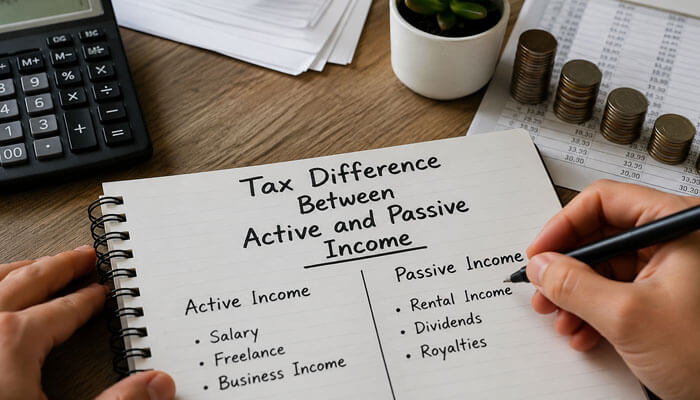
Taxes are one of the most important parts of the difference between active and passive income. Tax treatment depends on your country, income type, legal structure, participation level, and personal situation.
The examples below focus mainly on U.S. tax concepts because the IRS provides clear classifications for wages, self-employment income, rental income, dividends, estimated taxes, and passive activity rules.
Active Income Tax Basics
Active income is usually taxed as ordinary income. This includes wages, salary, bonuses, tips, commissions, freelance income, and business income where you actively participate.
For employees, taxes are often withheld from paychecks. For self-employed people, taxes are more complex because they may need to pay income tax and self-employment tax.
The IRS states that the self-employment tax rate is 15.3%, consisting of 12.4% for Social Security and 2.9% for Medicare.
Passive Income Tax Basics
Passive income is not taxed the same way in every situation. Rental income, dividends, interest, royalties, capital gains, and business distributions may all have different tax rules.
| Passive Income Type | Common Tax Treatment |
| Rental income | Taxable, but expenses may be deductible |
| Ordinary dividends | Taxed as ordinary income |
| Qualified dividends | May receive lower capital gain tax rates |
| Interest income | Usually taxed as ordinary income |
| Royalties | Often taxable as income |
| Long-term capital gains | May be taxed at lower rates |
| Limited partnership income | Depends on structure and participation |
High-income taxpayers may also owe the Net Investment Income Tax. The IRS states that a 3.8% Net Investment Income Tax applies to certain individuals, estates, and trusts with net investment income above applicable threshold amounts.
Material Participation: Why It Matters for Taxes
One of the most important tax-related points in the difference between active and passive income is material participation. In simple terms, material participation means you are regularly, continuously, and substantially involved in an income-producing activity.
For example, if you actively run a business every day, the income is usually active business income. If you invest in a business but do not help manage it, the income may be passive.
IRS Publication 925 explains passive activity and at-risk rules that may limit deductible losses from trade, business, rental, or other income-producing activities.
Passive Activity Loss Rules
Passive income can be powerful, but passive losses are not always easy to deduct. In many cases, if your passive activity produces a loss, you cannot simply use that loss to reduce your salary, wages, or active business income.
For example, if you earn $90,000 from a job and have a $10,000 loss from a passive investment, you may not automatically be able to deduct that full passive loss against your salary. The rules depend on your participation, income level, activity type, and tax situation.
This makes the tax difference between active and passive income more complex than many beginners expect.
Estimated Taxes
Both active and passive income can require estimated tax payments if enough tax is not withheld. IRS Form 1040-ES explains that estimated tax is used to pay tax on income that is not subject to withholding, including self-employment earnings, interest, dividends, rents, and other income.
This matters for freelancers, landlords, investors, creators, and business owners because income may arrive without automatic tax withholding.
Tax Records to Keep for Active and Passive Income
Good recordkeeping is important for both active and passive income. Freelancers, business owners, landlords, investors, and creators should track income, expenses, contracts, invoices, receipts, bank statements, investment documents, and tax forms.
| Income Source | Records to Keep |
| Salary | W-2 or salary slips, tax withholding records |
| Freelancing | Invoices, payment records, expenses, contracts |
| Consulting | Client agreements, invoices, business expenses |
| Rental income | Rent receipts, repair bills, insurance, mortgage interest, property tax records |
| Dividends | Brokerage statements, dividend reports, Form 1099-DIV if in the U.S. |
| Interest | Bank statements and interest reports |
| Digital products | Sales reports, payment processor records, software expenses |
| Affiliate income | Commission reports, website costs, advertising expenses |
Good records help you understand true profit, claim eligible deductions, prepare tax returns, and avoid confusion during audits or financial reviews.
Active Income Tax Example
Imagine you earn $80,000 from a full-time job. Your employer withholds federal income tax, Social Security tax, Medicare tax, and possibly state tax. You receive your net pay after withholding.
If you earn $80,000 as a self-employed consultant, the situation is different. You may need to pay income tax, self-employment tax, and estimated quarterly taxes. You may also deduct eligible business expenses.
This is why two people earning the same gross income may have different tax outcomes.
Passive Income Tax Example
Imagine you own a rental property that earns $24,000 per year in rent. You may be able to deduct mortgage interest, repairs, insurance, property taxes, management fees, depreciation, and other rental expenses.
If your rental property produces a tax loss, passive activity rules may limit whether you can deduct that loss against active income. This is why passive income can be tax-efficient in some situations but complicated in others.
Is Passive Income Always Better Than Active Income?
No. Passive income is not always better than active income. The better choice depends on your stage of life, financial needs, skills, savings, risk tolerance, and long-term goals.
Active income is usually better when you need money now. Passive income is usually better when you want long-term flexibility.
Active Income Is Better When:
- You need stable monthly cash flow
- You are building your emergency fund
- You are paying off debt
- You are early in your career
- You need predictable income
- You want to build skills
- You do not have much capital yet
- You want faster earning potential
Passive Income Is Better When:
- You already have stable income
- You have savings to invest
- You want long-term financial independence
- You want income beyond working hours
- You can tolerate market or business risk
- You are willing to wait for results
- You want to build wealth over time
- You can reinvest profits consistently
The smartest strategy is often not active income versus passive income. It is active income plus passive income.
For example, a software engineer may use their salary to invest monthly into dividend funds and later create a digital course that generates recurring income. Over time, these additional income streams may reduce dependence on a single paycheck.
2026 Income Trends: Why This Topic Matters Now
In 2026, understanding the difference between active and passive income is more important because the way people earn money is changing. Remote work, AI tools, automation, creator businesses, online learning, digital products, freelance platforms, and investment apps have made it easier to build multiple income streams.
However, competition has also increased. A blog, YouTube channel, digital product, newsletter, or affiliate website is not automatically passive. These income streams require trust, traffic, content quality, marketing, updates, and strong user value.
For beginners, the best 2026 strategy is not to chase “easy passive income.” A smarter plan is to increase active income first, then use that money to build long-term income-producing assets.
Which Is Better in 2026: Active or Passive Income?
In 2026, the better option for most people is a combination of both.
Active income helps you survive and grow today. Passive income helps you build freedom for tomorrow.
The modern economy offers more income opportunities than ever, but it also requires more discipline. Many passive income ideas are crowded, and many active income jobs are changing because of technology and automation.
For most beginners, the best path is:
- Increase active income through skills, career growth, freelancing, or business.
- Save a portion of that income.
- Build emergency savings.
- Pay off high-interest debt.
- Invest consistently.
- Create one or two passive or semi-passive income streams.
- Reinvest profits into assets.
This approach is more realistic than trying to quit your job immediately to chase passive income.
Best Active Income Ideas in 2026
1. High-Income Skills
Learning high-income skills can increase active income quickly. Examples include:
- AI tool implementation
- Data analysis
- Digital marketing
- Copywriting
- Sales
- Cybersecurity
- Software development
- UX design
- Video editing
- Business consulting
High-income skills are valuable because they can raise your salary, freelance rates, or business revenue.
2. Freelancing
Freelancing is one of the fastest ways to increase active income. Popular freelance services include:
- Content writing
- Graphic design
- Web development
- SEO
- Social media management
- Paid ads
- Video editing
- Email marketing
- Virtual assistance
- Bookkeeping
Freelancing is active income, but it can later turn into a business system if you hire a team or create repeatable processes.
3. Consulting
Consulting works well for people with expertise. You can consult in marketing, finance, operations, human resources, technology, legal processes, business strategy, or personal branding.
4. Sales and Commission-Based Work
Sales can create high active income because pay is often tied to results. Real estate agents, software sales representatives, insurance agents, and business development professionals can earn strong commissions.
5. Small Service Business
A service business can generate high income if demand is consistent. Examples include cleaning, repair, landscaping, tutoring, coaching, local marketing, and accounting services.
Active and Passive Income Ideas by Startup Cost and Time
| Income Idea | Income Type | Startup Cost | Time Needed | Risk Level |
| Full-time job | Active | Low | High | Low to medium |
| Freelancing | Active | Low | High | Medium |
| Consulting | Active | Low | Medium to high | Medium |
| Sales commissions | Active | Low | High | Medium to high |
| Rental property | Passive / semi-passive | High | Medium | Medium to high |
| Dividend investing | Passive / portfolio | Medium to high | Low | Medium |
| Digital products | Semi-passive | Low to medium | High upfront | Medium |
| Affiliate website | Semi-passive | Low to medium | High upfront | Medium to high |
| Royalties | Passive / semi-passive | Low to medium | High upfront | Medium |
| REITs | Passive / portfolio | Medium | Low | Medium |
This table shows the practical difference between active and passive income. Active income usually requires more time. Passive income often requires more capital, patience, or upfront work.
Best Passive Income Ideas in 2026
1. Dividend Investing
Dividend investing can generate recurring income, but it requires capital. A small portfolio may produce only modest income at first. Over time, reinvested dividends and consistent investing can increase cash flow.
2. Rental Property
Rental property can generate cash flow and long-term appreciation. However, it requires capital, financing, management, maintenance, and risk control.
3. Digital Products
Digital products are attractive because they can be sold repeatedly. Examples include:
- Ebooks
- Online courses
- Templates
- Spreadsheets
- Design assets
- Notion templates
- Printable planners
- Software tools
This income is not fully passive at the beginning. You need to create the product, build traffic, and support customers.
For example, a creator may spend months building an online course, template bundle, or software tool before generating consistent sales. Once the product gains trust and visibility, the income can become more scalable over time.
4. Affiliate Websites
Affiliate websites can earn income from product recommendations. SEO, trust, content quality, and compliance are essential. Low-quality affiliate content is unlikely to succeed because users want helpful, expert-driven recommendations.
Many affiliate websites fail because they focus too heavily on search rankings instead of genuinely helping readers solve problems or make informed decisions.
5. YouTube or Content Royalties
Videos, podcasts, and articles can earn ad revenue, sponsorships, or affiliate income over time. However, content income is usually active first and passive later.
6. Royalties from Books or Creative Work
Books, music, photography, software, and licensed designs can produce royalties. The challenge is creating something valuable and distributing it effectively.
7. REITs and Index Funds
REITs and dividend-focused funds can provide investment income without direct property management. However, market values can fluctuate.
Active Income vs Passive Income: Pros and Cons
Active Income Pros
- Faster to earn
- Easier to understand
- More predictable
- Builds career skills
- Can grow through promotions
- Helps qualify for loans
- Useful for budgeting
- Requires less upfront capital
Active Income Cons
- Depends on your time
- Can stop after job loss
- Limited scalability
- May cause burnout
- Less flexible
- Requires continuous effort
- May be affected by layoffs or industry changes
Passive Income Pros
- Can earn beyond work hours
- Can support financial freedom
- More scalable
- Helps diversify income
- Can build wealth over time
- May continue after retirement
- Can be reinvested
- Can reduce dependence on one job
Passive Income Cons
- Takes time to build
- May require capital
- Can be risky
- Not always predictable
- Requires maintenance
- Tax rules can be complex
- Many passive income claims are exaggerated
- Returns are not guaranteed
Risk Comparison: Active Income vs Passive Income
Both income types have risks. Active income may feel safer because it provides predictable paychecks, but it can disappear after layoffs, illness, burnout, or business failure. Passive income may feel more flexible, but it can be affected by market crashes, vacancies, algorithm updates, interest rate changes, and poor investment choices.
| Risk Type | Active Income Risk | Passive Income Risk |
| Job loss | High | Low |
| Market changes | Medium | High |
| Cash flow delay | Low to medium | Medium to high |
| Skill obsolescence | High | Medium |
| Capital loss | Low | Medium to high |
| Burnout | High | Low to medium |
| Tax complexity | Medium | Medium to high |
| Maintenance | Medium | Medium |
| Inflation risk | Medium | Medium |
| Platform risk | Medium | High for online income |
This makes the difference between active and passive income more balanced. Passive income is not automatically safer. Active income is not automatically worse. Each has strengths and weaknesses.
Neither income type is completely safe. A stable salary can disappear after layoffs, while passive income can decline because of market conditions, platform changes, or poor investment decisions.
Active Income vs Passive Income: Which Builds Wealth Faster?
Active income often builds wealth faster at the beginning because it gives you immediate cash flow. A high-paying job, strong freelance business, or profitable active business can generate more money than a small passive income stream.
Passive income builds wealth more effectively over the long term when profits are reinvested. Dividend reinvestment, rental property equity, business systems, and digital products can compound over time.
The best wealth-building formula is:
High active income + controlled expenses + consistent investing + passive income growth = long-term wealth
Many wealthy people first use active income to buy passive income assets. They do not usually start with passive income. They build skills, earn money, save capital, and then invest.
Common Myths About Passive Income
Myth 1: Passive Income Requires No Work
Passive income usually requires work upfront. Even investment income requires research, risk management, and patience.
Social media often makes passive income look simple, but sustainable recurring income usually takes much longer to build than most people expect.
Myth 2: Passive Income Is Always Safe
Passive income can be risky. Stocks can fall, tenants can leave, digital products can stop selling, and businesses can fail.
Myth 3: You Need to Be Rich to Build Passive Income
You do not always need to be rich, but capital helps. Some passive income streams, like digital products or affiliate content, require more time than money. Others, like real estate and dividend investing, require more capital.
Myth 4: Passive Income Replaces a Job Quickly
Most passive income streams take time. Replacing a full-time salary may take years.
Myth 5: All Investment Income Is Passive Income
For tax purposes, not all investment income is treated the same as passive activity income. Dividends, interest, capital gains, rental income, and business income may have different tax classifications.
Common Mistakes Beginners Make
1. Chasing Passive Income Before Building Active Income
If you do not have a stable income, emergency savings, or basic financial discipline, passive income may be difficult to build.
2. Believing “Get Rich Quick” Claims
Many online programs exaggerate passive income. If someone promises easy income with no work, no risk, and guaranteed returns, be careful.
One of the biggest mistakes beginners make is expecting passive income to replace a full-time salary within a few months.
3. Ignoring Taxes
Taxes can reduce both active and passive income. Freelancers, landlords, investors, and business owners should plan for taxes early.
4. Not Reinvesting
Passive income grows faster when reinvested. Spending every dollar of passive income can slow long-term wealth.
5. Choosing Too Many Income Streams
Trying too many ideas at once often leads to poor results. Beginners should focus on one active income improvement and one passive income strategy at a time.
6. Underestimating Maintenance
Rental properties, websites, courses, and businesses all require updates and management.
7. Taking Too Much Risk
Do not invest money you cannot afford to lose. Avoid high-risk schemes, unverified platforms, and unrealistic returns.
How to Build Active and Passive Income Together
Step 1: Strengthen Your Main Active Income
Before chasing passive income, improve your primary income source. Ask:
- Can I learn a higher-paying skill?
- Can I negotiate a raise?
- Can I switch to a better role?
- Can I freelance on the side?
- Can I start a service business?
- Can I improve my professional network?
In many cases, strong passive income is built on top of strong active income. Higher earnings create more opportunities to invest, experiment, and build long-term assets.
Step 2: Build an Emergency Fund
An emergency fund protects you from job loss, medical costs, repairs, or business slowdowns. Without savings, you may be forced to sell investments at the wrong time.
Step 3: Pay Off High-Interest Debt
High-interest debt can destroy wealth. Paying off expensive credit card debt may give you a better return than many investments.
Step 4: Choose One Passive Income Path
Pick one passive income stream based on your strengths.
| Your Strength | Good Passive Income Option |
| Writing | Books, blogs, newsletters, affiliate content |
| Teaching | Online courses, templates, ebooks |
| Capital | Dividends, REITs, rental property |
| Design | Digital assets, templates, printables |
| Tech skills | Software, apps, automation tools |
| Business experience | Equity, partnerships, systems-based business |
Step 5: Reinvest Earnings
Reinvesting helps passive income grow. You can reinvest dividends, rental profits, business profits, or digital product revenue.
Step 6: Track Results
Track income, expenses, taxes, time spent, and return on investment. A passive income stream is only useful if it produces profit after costs.
Active Income to Passive Income: Practical Example
Imagine a person earns $70,000 per year from a job. They save 20% of their income and use it to build passive income.
| Year | Active Income Strategy | Passive Income Strategy |
| Year 1 | Improve skills and increase salary | Build emergency fund |
| Year 2 | Start freelancing | Invest monthly in funds |
| Year 3 | Raise freelance rates | Create digital product |
| Year 4 | Build small service team | Buy dividend stocks or REITs |
| Year 5 | Move into higher-paying role | Use passive income to reinvest |
This strategy does not depend on luck. It uses active income as the engine and passive income as the long-term wealth builder.
Active Business Income vs Passive Business Income
A business can create active income or passive income depending on your role.
If you run the business daily, handle customers, manage employees, make decisions, and perform services, the income is active.
If you own part of a business but do not materially participate in daily operations, the income may be passive depending on legal and tax rules.
| Business Situation | Income Type |
| You run a bakery every day | Active income |
| You own a bakery, but managers run it | Potentially passive or semi-passive |
| You freelance as a designer | Active income |
| You sell design templates online | Semi-passive income |
| You manage rental units yourself | Passive for many tax purposes, but operationally active |
| You invest in a limited partnership | Usually passive |
This is why the difference between active and passive income is not always black and white. Some income is semi-passive.
What Is Semi-Passive Income?
Semi-passive income sits between active and passive income. It does not require full-time work, but it still needs regular attention.
In reality, semi-passive income is often more achievable than completely passive income because most businesses, investments, and digital assets still require occasional updates or management.
Examples include:
- A blog that earns affiliate income
- A YouTube channel with old videos generating ad revenue
- A rental property managed by a property manager
- A digital course with occasional updates
- A vending machine business
- A dropshipping store with automation
- A membership website
- A newsletter with sponsorships
Semi-passive income is common because most income streams need some maintenance. It is more realistic than expecting completely passive income.
Best Income Type by Financial Goal
| Financial Goal | Better Income Type | Why |
| Pay monthly bills | Active income | More predictable |
| Build emergency savings | Active income | Faster cash flow |
| Pay off debt | Active income | More controllable |
| Build retirement wealth | Passive income | Long-term compounding |
| Achieve financial freedom | Both | Active income funds passive assets |
| Reduce work hours | Passive income | Less tied to time |
| Start from zero | Active income | Requires less capital |
| Diversify risk | Both | Multiple income sources |
How Much Passive Income Do You Need?
The amount of passive income you need depends on your expenses.
A simple formula is:
Monthly passive income ÷ monthly expenses × 100 = percentage of expenses covered
| Monthly Expenses | Monthly Passive Income | Expenses Covered |
| $3,000 | $300 | 10% |
| $3,000 | $1,500 | 50% |
| $3,000 | $3,000 | 100% |
| $5,000 | $2,500 | 50% |
| $5,000 | $5,000 | 100% |
If your passive income covers 25% of expenses, you have more flexibility. If it covers 100%, you may have financial independence. But taxes, inflation, emergencies, and market risk must be considered.
How to Decide Which Income Type Is Best for You
Ask these questions:
- Do I need money immediately?
- Do I have savings?
- Do I have high-interest debt?
- Do I have capital to invest?
- Do I have skills I can monetize?
- How much risk can I handle?
- Do I want stability or flexibility?
- Am I willing to wait years for results?
- Do I understand the tax rules?
- Can I maintain the income stream long term?
If you need money quickly, focus on active income. If you have a stable income and savings, start building passive income.
Active Income and Passive Income in Retirement Planning
Passive income becomes especially important in retirement planning. When people stop working, active income often decreases or disappears. Retirement income may come from:
- Pension income
- Social Security
- Retirement accounts
- Dividends
- Interest
- Rental income
- Business distributions
- Annuities
- Royalties
A strong retirement plan usually includes both savings and income-producing assets. Active income helps build those assets during working years. Passive income helps support life after work.
Active Income and Passive Income for Entrepreneurs
Entrepreneurs should understand the difference between active and passive income because many businesses start as active income and later become more passive.
At first, the founder handles everything: sales, marketing, operations, hiring, customer support, finance, and product development. The business depends heavily on the founder’s time.
Over time, the entrepreneur can create systems:
- Hire employees
- Build standard operating procedures
- Automate marketing
- Create recurring revenue
- Delegate operations
- Build digital products
- License intellectual property
- Sell subscriptions
- Develop management teams
When a business can operate without the founder’s daily involvement, it becomes more passive.
Active Income and Passive Income for Investors
Investors use active income to buy assets. Those assets may later produce passive income.
| Active Income Source | Passive Asset Purchased |
| Salary | Index funds |
| Freelance income | Dividend stocks |
| Consulting income | Rental property |
| Business profit | REITs |
| Commission income | Bonds or fixed-income products |
This is one of the most reliable wealth-building strategies: earn actively, invest consistently, and let assets grow.
Active Income and Passive Income for Creators
Creators often combine active and passive income.
Active creator income includes:
- Sponsored posts
- Client content
- Brand campaigns
- Freelance writing
- Paid speaking
- Live coaching
Passive or semi-passive creator income includes:
- Digital products
- Affiliate links
- YouTube ad revenue
- Course sales
- Membership archives
- Book royalties
- Licensing content
Creators should not rely only on platform algorithms. A strong creator business usually includes email lists, owned websites, products, and diversified income sources.
Active Income and Passive Income for Beginners
If you are a beginner, do not start with complicated investments or expensive passive income strategies. Start simple.
| Stage | Focus |
| Stage 1 | Build active income |
| Stage 2 | Save emergency fund |
| Stage 3 | Pay off expensive debt |
| Stage 4 | Learn investing basics |
| Stage 5 | Start small passive income stream |
| Stage 6 | Reinvest and scale |
Good beginner passive income options may include interest income, dividend funds, digital templates, affiliate content, or small online products. Rental property and business ownership can be powerful but require more capital and knowledge.
5-Step Roadmap to Move from Active Income to Passive Income
A practical way to build wealth is to use active income as the foundation and passive income as the long-term goal.
Step 1: Increase Your Active Income
Start by improving your main income source. This may include getting a higher-paying job, learning a better skill, freelancing, consulting, or starting a service business.
Step 2: Control Expenses
Higher income alone does not create wealth if spending rises at the same speed. Track expenses, reduce unnecessary costs, and avoid lifestyle inflation.
Step 3: Build Emergency Savings
Before investing aggressively, create an emergency fund. This protects you from job loss, medical costs, business slowdowns, or unexpected repairs.
Step 4: Invest in Income-Producing Assets
Use part of your active income to build passive or semi-passive income sources such as dividend funds, rental properties, REITs, digital products, royalties, or business systems.
Step 5: Reinvest Passive Income
Do not spend all passive income immediately. Reinvesting can help your income grow faster over time.
Reality Check About Passive Income
Passive income can improve flexibility and reduce dependence on a single paycheck, but it rarely happens instantly. Most successful passive income streams begin with active effort, disciplined saving, consistent investing, or years of building valuable assets. The people who succeed long term usually focus on patience, realistic expectations, and steady growth instead of chasing shortcuts.
Conclusion
Understanding the difference between active and passive income can help you make smarter financial decisions in 2026. Active income provides the cash flow you need today, while passive income can help create long-term financial freedom and wealth. Both income types offer unique advantages, and both come with risks that should be carefully considered.
If you are just starting your financial journey, focus on increasing your active income first. Improve your skills, advance your career, freelance, consult, or build a profitable service business. Once you have a stable income and savings, you can begin investing and creating passive income streams that support your long-term goals.
Ultimately, the difference between active and passive income is not about choosing one over the other. The most successful wealth-building strategy is combining both—using your active income to acquire assets, investments, and systems that generate passive income over time. This balanced approach can help you achieve greater financial security, flexibility, and independence in the years ahead.
Difference Between Active and Passive Income FAQs
1. What is the main difference between active and passive income?
The main difference between active and passive income is how the money is earned. Active income requires direct work, such as a job, freelancing, or consulting. Passive income comes from assets, investments, or systems that can earn money with less daily effort.
2. What are the best examples of active and passive income?
Common active income examples include salary, hourly wages, freelancing, consulting, commissions, and gig work. Passive income examples include rental income, dividends, royalties, digital products, affiliate income, REITs, and automated online business income.
3. Is passive income better than active income?
Passive income is not always better than active income. Active income is better for stable cash flow and immediate earnings, while passive income is better for long-term wealth and financial freedom. The best strategy is usually to combine both income types.
4. What is the tax difference between active and passive income?
The tax difference between active and passive income depends on the income type, country, and tax rules. Active income is often taxed as ordinary income, while passive income, such as rentals, dividends, royalties, or capital gains, may follow different tax rules.
5. Why is understanding the difference between active and passive income important in 2026?
Understanding the difference between active and passive income is important in 2026 because people need multiple income streams, job security, and long-term financial planning. Active income helps you earn now, while passive income can support future financial independence.
