




Online gambling continues to evolve faster than governments can update regulations. New mechanics, payment methods, and platform formats arrive more quickly than any legislature can process them, creating regulatory gaps that carry real consequences for players. John Gold, founder of betpokies.co.nz, has spent over a decade mapping this gap across markets ranging from New Zealand to the European Union.
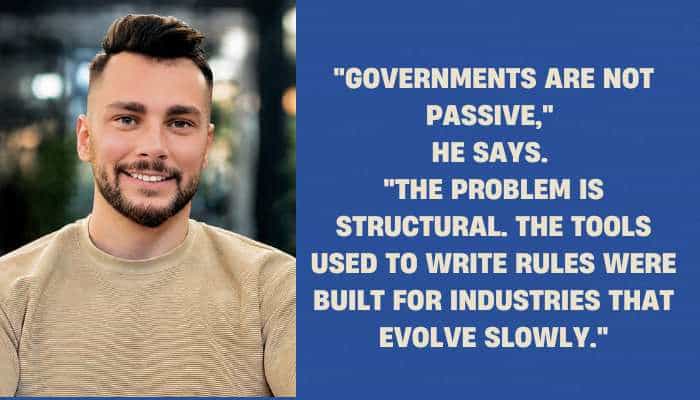
“Governments are not passive,” he says. “The problem is structural. The tools used to write rules were built for industries that evolve slowly.”
Why Governments Fall Behind
The regulatory process runs through a predictable sequence: consultation periods, drafts, stakeholder submissions, parliamentary debate, and sign-off. Each stage takes months. In online entertainment, months can mean the mainstream adoption of an entirely new product category before any government has defined it.
Gold points to live dealer gaming as an early example — it emerged in legal ambiguity across multiple markets simultaneously. Jurisdictions with adaptive frameworks updated their licence conditions quickly; those waiting for full legislative reform left players operating under rules that didn’t describe what they were doing. “They were in a product space their regulators hadn’t named yet,” Gold observes.
The pattern repeats. TycoonStory, which covers regulatory shifts as a business and entrepreneurship challenge, has noted that iGaming operators consistently outpace the regulatory environments in which they operate — treating regulatory gaps not as legal grey areas but as market opportunities.
When Regulation Lags, Platforms Lead
When governments are slow, operators fill the vacuum — and not always in ways that serve players. Gold has documented this dynamic across multiple licensing jurisdictions: platforms introduce features, mechanics, or payment integrations that existing rules were not written to classify, and regulators are left to retroactively determine whether those features fall within or outside current frameworks.
“The speed asymmetry is the real problem,” Gold says. “An operator can ship a new retention mechanic in a product update. A regulator needs a consultation period, a legal review, and a drafted amendment, just to name a few.”
TycoonStory’s coverage of the iGaming sector as a startup and scale-up environment makes this tension visible from the other side: for founders and investors, regulatory ambiguity is often read as runway — time to operate before the rules catch up. Gold considers that framing is honest, if uncomfortable, for the consumer protection argument.
The MGA: Benchmark Under Pressure
For markets without robust domestic regulation, the Malta Gaming Authority’s licensing regime serves as a de facto reference standard for many offshore operators.
The MGA’s tiered Player Fund Protection requirements give Gold’s framework a useful baseline. Operators must demonstrate one of three levels: unsegregated funds with disclosure, segregated client accounts, or insurance-backed protection. Gold treats this as a primary indicator of solvency risk — it reflects real decisions about how an operator handles deposited player funds.
“Regulators that don’t develop vocabulary for AI personalisation and gamification will find the question answered for them — by the platforms, in the platforms’ interest,” Gold says. The pace of MGA Technical Directive updates has accelerated since 2022, which he reads as an acknowledgement that the gap is real.
New Zealand 2026: A Market Starting to Catch Up
New Zealand spent years in a position where players were active on offshore platforms that domestic law simply could not reach — a pattern Gold considers among the clearest examples of regulatory lag in the English-speaking world. The Online Casino Gambling Act 2026 came into force on 1 May 2026, establishing a licensing regime for up to 15 domestic online casino operators, with unlicensed platforms required to exit the market by December 2026.
Gold’s assessment is measured. “New Zealand is doing something meaningful,” he says. “But the licensing process opens in July 2026, and the first licensed operators go live in December. Until then — and in every market that hasn’t made this move — the evaluation burden still falls on players.”
“Players choose operators whose regulatory status is set by a foreign jurisdiction they know nothing about,” Gold notes. “The quality of their protection is invisible unless someone maps it for them.”
How BetPokies NZ Evaluates Operators
When domestic frameworks fall short, the question becomes what independent evaluation should look at instead. Rather than relying on licensing labels alone, Gold and the BetPokies NZ team assess operators against a consistent set of regulatory and risk indicators:
- Licensing jurisdiction and type — primary licences (UKGC, MGA, Gibraltar) versus e-gaming sub-licences, which carry substantially different accountability structures
- Player fund protection level — whether funds are segregated, insurance-backed, or pooled with operating capital
- Responsible gambling tools — deposit limits, session controls, self-exclusion, and third-party integrations such as GamStop
- Dispute resolution access — designated independent ADR schemes under the operator’s licence
- AML and KYC requirements — verification thresholds and disclosed payment processor relationships
- Published complaint record — cross-referenced against the UKGC compliance case register and eCOGRA accreditation list
“A government taxing gambling revenue tells you almost nothing about whether an operator is trustworthy,” Gold explains. “These indicators do.”
Gold’s Verdict: Can Governments Keep Up?
After a decade tracking how regulation responds to industry acceleration, Gold’s answer is precise. Governments cannot keep pace if keeping pace means writing product-specific rules before products reach consumers — the cycle times are structurally incompatible. What effective governments can do is build outcome-based frameworks: rules specifying what player protection, fund security, and accountability must look like, without prescribing the formats through which those outcomes are delivered. New Zealand’s 2026 reform is a step in that direction; the question is whether the licensed regime delivers in practice what the legislation promises on paper.
“Outcome-based frameworks don’t become obsolete when products change,” Gold concludes. “The things regulators should care about don’t shift because a new mechanic appeared. Governments that understand this write rules that last — and players stop having to do the regulator’s job for them.” Until that point arrives in any given market, independent evaluation remains the only substitute that actually works — and what betpokies.co.nz is built to provide.
