




Can clobetasol propionate be used on private parts? In most cases, no, not without a doctor’s prescription and clear instructions. Clobetasol propionate is a super-potent topical corticosteroid, and private-area skin can absorb medicine more easily than thicker skin areas.
The safest answer to whether clobetasol propionate can be used on private parts safely is this: it may be used only when a healthcare professional diagnoses a specific skin condition and explains exactly how to apply it. It should not be used casually for itching, rash, yeast infection, bumps, burning, soreness, or irritation.
Mayo Clinic advises that clobetasol should not be used on the face, groin, or underarms unless directed by a doctor. DailyMed also states that clobetasol cream should not be used on the face, groin, or axillae, and that treatment is usually limited because it is a super-high potency steroid.
However, clobetasol may be prescribed for certain diagnosed genital skin conditions, especially lichen sclerosus, under medical supervision. The key point is simple: do not self-apply clobetasol propionate to private parts without a proper diagnosis.
Key Takeaways
- Clobetasol propionate is a very strong topical steroid.
- It should not be used on private parts unless prescribed by a healthcare professional.
- Genital skin absorbs topical steroids more easily, which increases side-effect risk.
- Clobetasol does not treat yeast infections, bacterial infections, viral infections, or STIs.
- It may be prescribed for genital lichen sclerosus after diagnosis.
- Long-term or incorrect use can cause skin thinning, irritation, hidden infection, and other side effects.
- If symptoms include sores, discharge, burning urination, bleeding, swelling, or persistent white patches, medical evaluation is important.
What Is Clobetasol Propionate?
Clobetasol propionate is a super-potent topical corticosteroid used to reduce inflammation, redness, itching, and swelling in certain skin conditions. Doctors may prescribe it for severe eczema, psoriasis, dermatitis, or other steroid-responsive skin diseases. DailyMed describes clobetasol propionate cream 0.05% as a super-high potency topical corticosteroid and states that treatment should usually be limited to short periods, with total use generally not exceeding 50 grams per week.
Topical steroids work by calming inflammation in the skin. DermNet explains that topical corticosteroids have anti-inflammatory, immunosuppressive, anti-proliferative, and vasoconstrictive effects. Because clobetasol is much stronger than mild steroids like hydrocortisone, it is not a general cream for every rash, itch, or irritation. It should be used only for the condition and body area your doctor is treating.
Why People Ask: Can Clobetasol Propionate Be Used on Private Parts?
Many people search “can clobetasol propionate be used on private parts” because they may already have a tube of the medicine at home and are dealing with uncomfortable private-area symptoms.
Common symptoms include:
- Genital itching
- Redness or soreness
- White patches
- Burning or irritation
- Rash near the groin
- Dry or cracked skin
- Pain during sex
- Irritation around the anus
- Swelling or discomfort
- Recurrent private-area itching
The problem is that many private-area symptoms look similar but have different causes. A yeast infection, bacterial infection, sexually transmitted infection, eczema, allergic reaction, psoriasis, lichen sclerosus, friction rash, or contact dermatitis can all cause itching or irritation.
Using clobetasol on the wrong condition may temporarily reduce redness while the real problem continues underneath. This can delay diagnosis and sometimes make infections harder to recognize.
So, when readers ask can clobetasol propionate be used on private parts, the best answer is not just “yes” or “no.” The correct answer depends on the diagnosis, the exact body area, the strength of the steroid, the duration of use, and whether a doctor is monitoring treatment.
Why a Doctor’s Diagnosis Matters Before Using Clobetasol on Private Parts
Before using clobetasol propionate on private parts, the most important step is getting the correct diagnosis. Itching, burning, soreness, white patches, bumps, discharge, or rash may come from many different causes.
A doctor may check for:
- Contact dermatitis from soap, detergent, pads, condoms, lubricants, or hygiene sprays
- Yeast infection or fungal infection
- Bacterial infection
- Herpes or another viral infection
- Sexually transmitted infection
- Genital eczema or psoriasis
- Lichen sclerosus
- Lichen planus
- Friction or sweat irritation
- Menopause-related dryness
- Skin changes that may need biopsy
This is why the answer to can clobetasol propionate be used on private parts is not a simple “yes” for everyone. Clobetasol may help certain inflammatory skin conditions, but it can be the wrong treatment if the real cause is fungal, bacterial, viral, or sexually transmitted.
A healthcare provider may ask about symptoms, examine the skin, review product use, and sometimes recommend swabs, urine tests, STI testing, fungal testing, or a biopsy if white patches or long-term skin changes are present.
Is Clobetasol Safe for the Groin or Genital Area?
For self-use, no. Clobetasol is generally not considered safe for private parts unless prescribed and monitored by a healthcare professional. The genital area has thin, sensitive skin. DermNet notes that the greatest absorption of topical steroids occurs through thin skin such as the eyelids, genitals, and skin creases. It also says potent topical steroids are best avoided in these areas unless medically directed.
Mayo Clinic advises that clobetasol should not be used on the face, groin, or underarms unless directed by a doctor. MedlinePlus also says clobetasol should be avoided in genital and rectal areas unless directed by a doctor. In simple terms, can clobetasol propionate be used on private parts safely? Yes, but only in selected cases where a doctor has diagnosed a steroid-responsive condition and given clear instructions. Without medical guidance, it can be risky.
Safety Table: Clobetasol on Private Parts
| Question | Safe Answer |
| Can I use clobetasol on private parts without a doctor? | No. Avoid self-use. |
| Can clobetasol propionate be used on private parts if prescribed? | Yes, only for selected diagnosed conditions. |
| Can it be used inside the vagina? | No. It is not for intravaginal self-use. |
| Can it treat yeast infection? | No. It is not an antifungal medicine. |
| Can it treat STI symptoms? | No. STI symptoms need testing and proper treatment. |
| Can it thin genital skin? | Yes, especially with strong or long-term use. |
| Should I stop if burning or irritation worsens? | Contact a doctor promptly. |
Why Private Parts Absorb Clobetasol More Easily
Private-area skin is thinner and more sensitive than many other body areas. The groin, vulva, penis, foreskin, perianal area, and skin folds may absorb topical medicines more easily.
Absorption can increase when the area is:
- Warm
- Moist
- Inflamed
- Covered by tight underwear
- Exposed to friction
- Treated under occlusion
- Affected by broken or damaged skin
DermNet explains that absorption is greatest through thin skin such as the genitals and skin creases, and that absorption can be greatly enhanced by occlusion. This is why using clobetasol on private parts without medical guidance is riskier than using it on thicker skin areas like elbows, knees, palms, or soles.
When Doctors May Prescribe Clobetasol for Private Parts
Although clobetasol is not recommended for casual use on private parts, doctors may prescribe it for certain diagnosed inflammatory skin conditions.
A doctor may consider clobetasol or another prescription steroid for:
- Vulvar lichen sclerosus
- Penile lichen sclerosus
- Severe genital eczema or dermatitis
- Severe inflammatory vulvar skin disease
- Certain cases of genital psoriasis
- Persistent inflammatory rashes after diagnosis
This does not mean everyone with genital itching should use clobetasol. It means that when a doctor confirms a steroid-responsive condition, clobetasol may be used carefully with clear instructions about where, how much, how often, and how long to apply it.
This is the safest context where the answer to can clobetasol propionate be used on private parts may become “yes” — but only under medical supervision.
Clobetasol for Lichen Sclerosus: Why It Is an Exception
One important exception is lichen sclerosus, a chronic inflammatory skin condition that often affects genital skin. The NHS says lichen sclerosus can affect the vulva, anus, foreskin, and end of the penis, causing itchy white patches, soreness, bleeding, tearing, or pain. For lichen sclerosus, doctors may prescribe a strong steroid ointment such as clobetasol propionate 0.05%.
The British Association of Dermatologists says the most effective treatment for lichen sclerosus is usually a strong steroid ointment, most commonly clobetasol propionate 0.05%. This exception is important because some medicine labels warn against genital use, but specialists may still prescribe clobetasol safely for lichen sclerosus when the diagnosis is confirmed, and the patient is monitored.
Lichen Sclerosus Treatment Schedule: What Doctors May Use
A lichen sclerosus treatment plan is not the same as casual self-use. It is a structured medical plan.
A commonly recommended 3-month pattern is:
| Treatment Phase | Common Specialist Pattern |
| Month 1 | Apply once daily |
| Month 2 | Apply on alternate days |
| Month 3 | Apply twice weekly |
| Maintenance | Follow the doctor’s long-term plan |
The British Association of Dermatologists describes a similar 3-month regimen: every day for 1 month, alternate days for 1 month, and then twice weekly for 1 month.
Mayo Clinic also notes that clobetasol ointment is commonly prescribed for lichen sclerosus and that use is often reduced after several weeks to help prevent symptoms from returning.
This schedule is included for education only. Do not start this plan unless your doctor has diagnosed lichen sclerosus and prescribed it for you.
When You Should Not Use Clobetasol on Private Parts
You should not use clobetasol propionate on private parts if you are guessing the cause of symptoms. It is especially risky when symptoms may be caused by infection.
Avoid using clobetasol without medical advice if you have:
- Thick white discharge
- Bad odor
- Pain while urinating
- Blisters or sores
- Genital ulcers
- New bumps or warts
- Fever or pelvic pain
- Painful swelling
- Rash after sexual contact
- Suspected yeast infection
- Suspected herpes
- Suspected ringworm or fungal infection
- Symptoms after using a new soap, lubricant, condom, detergent, or hygiene product
DermNet notes that topical steroids can cause, aggravate, or mask infections such as tinea and herpes simplex. That is why using a strong steroid on private parts without diagnosis can be harmful. It may reduce redness for a short time while the real problem continues.
Do Not Use Clobetasol If You Suspect an STI or Infection
Clobetasol propionate does not treat sexually transmitted infections, yeast infections, bacterial infections, or viral infections. It is a steroid, not an antibiotic, antifungal, or antiviral medicine.
Avoid clobetasol and seek medical advice if you have:
- Genital sores or blisters
- Unusual discharge
- Bad odor
- Burning while urinating
- Bleeding between periods
- Pain during sex
- New bumps or ulcers
- Rash after sexual contact
- Fever, pelvic pain, or swollen glands
The CDC says symptoms such as an unusual sore, smelly discharge, burning when urinating, or bleeding between periods should be checked by a healthcare provider. Mayo Clinic also lists STI warning symptoms such as painful urination, vaginal discharge, penile discharge, bleeding between periods, testicle pain or swelling, rectal pain, and fever. Using clobetasol on an infection may hide symptoms and delay proper treatment.
Possible Side Effects of Clobetasol on Private Parts
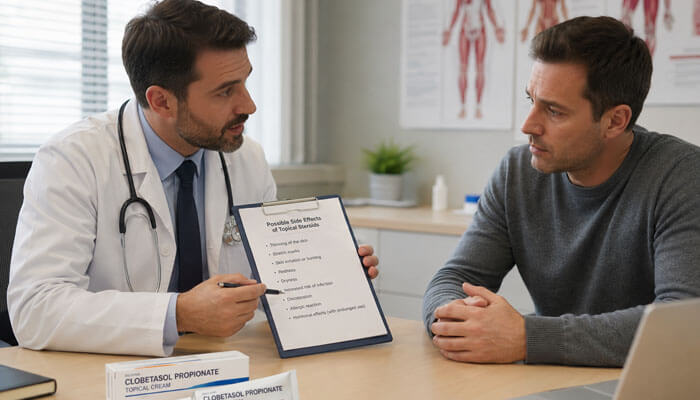
Because private-area skin is thin and sensitive, side effects may happen more easily if clobetasol is used incorrectly, too often, or for too long.
Possible side effects include:
- Burning
- Stinging
- Itching
- Irritation
- Dryness
- Skin thinning
- Shiny or fragile skin
- Easy bruising
- Stretch marks in the groin
- Color changes in the skin
- Worsening infection
- Delayed healing
- Increased sensitivity
- Small bumps or acne-like rash
MedlinePlus lists possible clobetasol side effects such as burning, itching, irritation, redness, dryness, acne, bruising, shiny skin, thin or fragile skin, and changes in skin color. DailyMed also warns that excessive or prolonged use of high-potency topical corticosteroids can increase the risk of systemic absorption and HPA-axis suppression.
Children, Pregnancy, and Breastfeeding: Extra Safety Warning
Extra caution is needed for children, pregnant people, and breastfeeding mothers. DailyMed notes that clobetasol can carry greater systemic-risk concerns in pediatric patients because children have a higher skin-surface-area-to-body-mass ratio. DailyMed also advises that pregnant and breastfeeding patients use the smallest skin area and shortest duration possible when treatment is necessary.
Breastfeeding women should not apply clobetasol directly to areas where an infant may have direct contact unless a healthcare professional gives specific instructions. For private parts, these warnings are especially important because genital skin may absorb more medicine than expected.
Why Clobetasol Can Be Riskier on Private Parts Than Other Skin Areas
The private area is not the same as the arms, legs, or back. Several factors make clobetasol more risky there.
1. Genital Skin Absorbs More Medicine
Thin skin absorbs topical steroids more easily. DermNet specifically notes that the greatest absorption occurs through thin skin such as genitals and skin creases.
2. Moisture and Friction Increase Irritation
The groin area is warm, moist, and often covered by tight clothing. This can increase rubbing, sweating, and irritation.
3. Infections Are Common in This Area
Yeast infections, fungal infections, bacterial infections, viral infections, and sexually transmitted infections can affect private parts. A steroid may temporarily calm redness but does not treat the infection.
4. Long-Term Use Can Thin Skin
Skin thinning is one of the major concerns with strong topical steroids. This risk is more serious on delicate areas.
5. Symptoms Can Be Misleading
Itching does not always mean eczema. Burning does not always mean irritation. White patches do not always mean dryness. A diagnosis matters.
6. Clobetasol Cream vs Ointment for Private Parts
Clobetasol comes in different forms, including cream, ointment, lotion, gel, foam, spray, solution, and shampoo. Not every form is suitable for every body area.
| Form | Important Point |
| Cream | May be used for some moist or weepy skin conditions, but may irritate sensitive skin in some people. |
| Ointment | Often preferred for dry inflammatory skin conditions and commonly used in lichen sclerosus treatment when prescribed. |
| Lotion | Not meant for groin self-use unless specifically directed. |
| Gel/Solution | Often used for scalp or hair-bearing areas, not private-area self-treatment. |
| Spray/Foam | Usually not appropriate for private parts. |
| Shampoo | For scalp use, not genital use. |
NHS guidance says cream may be better for moist or weepy skin, while ointment is thicker and greasier and may be better for dry or flaky skin.
Can Clobetasol Be Used Inside the Vagina?
No. Clobetasol should not be used inside the vagina unless a specialist gives very specific instructions for an external vulvar condition.
Mayo Clinic says clobetasol is for skin use and should not get into the eyes, nose, mouth, or vagina.
This distinction is important:
- Vulva = external genital skin
- Vagina = internal canal
A medicine prescribed for external vulvar skin should not automatically be placed inside the vagina.
Can Men Use Clobetasol on the Penis?
Men should not use clobetasol on the penis unless prescribed by a doctor. The penis and foreskin have thin, sensitive skin, and symptoms such as redness, itching, tight foreskin, sores, white patches, or burning may need medical evaluation.
The NHS notes that lichen sclerosus can affect the foreskin and end of the penis. A doctor may prescribe a strong steroid for a diagnosed condition such as penile lichen sclerosus, but self-treatment is not recommended. Some infections, including fungal infections and sexually transmitted infections, can worsen or spread if treated incorrectly.
Can Clobetasol Be Used Around the Anus?
Clobetasol should not be used around the anus unless a doctor prescribes it. Anal or perianal itching may be caused by many conditions, including hemorrhoids, fissures, fungal infection, dermatitis, worms, psoriasis, lichen sclerosus, or irritation from wiping and hygiene products.
Because the skin around the anus is sensitive and may absorb medicine easily, strong steroids should be used only with professional guidance.
Can Clobetasol Treat Yeast Infection?
No. Clobetasol does not treat yeast infection. It is a steroid, not an antifungal. Yeast infections usually require antifungal treatment. Applying clobetasol may reduce redness or itching temporarily, but it can also hide symptoms and delay proper care.
If you have itching with thick discharge, odor, burning, soreness, or recurrent symptoms, speak with a healthcare professional.
Can Clobetasol Treat Genital Itching?
Clobetasol may reduce itching caused by certain inflammatory skin diseases, but it should not be used for general genital itching without diagnosis.
Genital itching may come from:
- Yeast infection
- Bacterial vaginosis
- Herpes
- Contact dermatitis
- Lichen sclerosus
- Psoriasis
- Eczema
- Pubic lice
- Friction
- Sweat rash
- Allergic reaction
- Menopause-related dryness
- STI-related irritation
Because the causes are so different, the treatment must match the diagnosis. Using clobetasol without knowing the cause is not a safe shortcut.
How Doctors Usually Guide Safe Use
If a doctor prescribes clobetasol for private parts, follow the prescription exactly. Do not copy someone else’s prescription or use leftover medicine from another condition.
A doctor may explain:
- Where exactly to apply it
- How much to use
- How often to apply it
- How many days or weeks to continue
- Whether to use ointment instead of cream
- Whether to avoid sex during flare-ups
- Whether to use moisturizers or barrier ointment
- When to return for follow-up
- What side effects to watch for
Mayo Clinic warns not to use more clobetasol, use it more often, or use it longer than ordered because doing so may cause unwanted side effects or skin irritation.
How Much Clobetasol Is Usually Used If Prescribed?
If a doctor prescribes clobetasol for private parts, use only the amount they recommend. More cream does not mean faster healing.
A safe-use approach usually includes:
- Apply only to the diagnosed external skin area.
- Use a thin layer, not a thick coating.
- Do not apply inside the vagina, rectum, or urethra.
- Do not cover with tight bandages unless your doctor says so.
- Do not combine it with other steroid creams unless instructed.
- Do not continue longer than prescribed.
- Return for follow-up if symptoms come back.
This section helps answer the real concern behind can clobetasol propionate be used on private parts: not just whether it can be used, but how risky it is without professional instructions.
Safe-Use Checklist If Your Doctor Prescribes It
Use this checklist only if a healthcare professional has prescribed clobetasol for your genital or groin skin condition.
- Use only on the exact area your doctor showed you.
- Do not apply inside the vagina, rectum, or urethra.
- Use the smallest amount prescribed.
- Do not cover with tight bandages unless your doctor says so.
- Wash hands after applying.
- Do not mix with other steroid creams unless instructed.
- Do not use longer than prescribed.
- Stop and contact a doctor if symptoms worsen.
- Go for follow-up if symptoms return repeatedly.
What to Do If You Already Used Clobetasol on Private Parts
If you used clobetasol once or twice by mistake, do not panic. Gently wash the area with water if there is irritation, avoid applying more, and contact a doctor or pharmacist for advice.
Seek medical help sooner if you notice:
- Burning that gets worse
- Severe redness
- Swelling
- Blisters
- Open sores
- Painful urination
- Unusual discharge
- Bleeding
- Skin becoming shiny, thin, or fragile
- Rash spreading
- Symptoms returning after stopping
If symptoms are related to infection, you may need antifungal, antibacterial, antiviral, or other specific treatment.
Safer Alternatives for Mild Private-Area Irritation
Do not use strong steroid creams as the first step for mild private-area irritation. Some safer general care steps may help while you arrange medical advice:
- Wash with plain water or a gentle, fragrance-free cleanser.
- Avoid scented soaps, bubble baths, intimate sprays, and deodorants.
- Wear loose cotton underwear.
- Avoid scratching.
- Avoid tight clothing during irritation.
- Stop using new products that may have triggered symptoms.
- Use a simple barrier ointment only if suitable for your skin.
- See a doctor if symptoms last, worsen, or return.
For lichen sclerosus, NHS guidance recommends avoiding scented soaps, bubble baths, tight clothing, scratching, and rubbing. It also suggests using an emollient soap substitute and barrier ointment when appropriate.
Clobetasol vs Hydrocortisone on Private Parts
Hydrocortisone is a mild steroid, while clobetasol is a super-potent steroid. That difference matters.
| Feature | Hydrocortisone | Clobetasol Propionate |
| Strength | Mild | Super-potent |
| Common use | Mild inflammation or irritation | Severe steroid-responsive skin disease |
| Risk on private parts | Lower but still needs caution | Higher risk |
| Self-use | Sometimes available OTC in some places | Prescription-strength medicine |
| Best approach | Ask pharmacist or doctor | Use only if doctor prescribes |
Even mild steroids should be used carefully on private parts. But clobetasol requires much more caution because of its high potency.
Common Mistakes to Avoid
Many people make mistakes when using strong steroid creams. Avoid these:
- Using clobetasol for any itching without diagnosis
- Applying it inside the vagina
- Using it on the penis without medical advice
- Applying it to a suspected yeast infection
- Using it for bumps, sores, or ulcers
- Sharing prescription creams with a partner
- Using it longer than prescribed
- Applying thick layers
- Combining multiple steroid creams
- Stopping follow-up after symptoms improve
- Ignoring recurring symptoms
These mistakes can increase the risk of side effects and delay proper treatment.
Follow-Up Is Important for Genital Lichen Sclerosus
If clobetasol is prescribed for genital lichen sclerosus, follow-up is important even after symptoms improve. Lichen sclerosus can be long-term and may need maintenance treatment, symptom monitoring, and regular skin checks. Mayo Clinic says healthcare providers may recommend follow-up exams once or twice a year for lichen sclerosus and that long-term treatment is needed to control symptoms and prevent serious complications.
The British Association of Dermatologists states that there is a small risk, less than 5%, of developing skin cancer in affected vulval areas, and that lifelong self-examination is important for females with genital lichen sclerosus. Contact a doctor sooner if symptoms return, skin becomes thicker or ulcerated, pain increases, sex becomes painful, urination becomes painful, or a new lump or sore appears.
When to See a Doctor Immediately
Get medical advice quickly if you have:
- Genital sores or blisters
- Painful urination
- Fever
- Pelvic pain
- Unusual discharge
- Bleeding
- Severe swelling
- A new lump
- Skin ulcers
- White patches that do not go away
- Pain during sex
- Tight foreskin
- Symptoms after unprotected sex
- Symptoms that keep returning
These symptoms may need testing, prescription treatment, or specialist evaluation.
Final Verdict: Can clobetasol propionate be used on private parts
So, can clobetasol propionate be used on private parts safely? The safest answer is: only when prescribed by a doctor for a diagnosed condition.
Clobetasol propionate is not a normal anti-itch cream for private parts. It is a very strong topical steroid that can cause side effects when used incorrectly, especially on thin genital skin. It may be appropriate for certain conditions like lichen sclerosus, but only with medical supervision.
If you have itching, burning, rash, white patches, sores, redness, swelling, discharge, or pain in the private area, do not guess. Get a diagnosis first. The right treatment depends on the real cause.
Can clobetasol propionate be used on private parts FAQs
1. Can clobetasol propionate be used on private parts?
Clobetasol propionate should not be used on private parts unless a doctor prescribes it. The groin and genital area absorb topical steroids more easily, increasing the risk of side effects.
2. Can clobetasol propionate be used on private parts safely for itching?
Only if a doctor confirms the itching is caused by a steroid-responsive skin condition. Do not use it for general genital itching because infections, allergies, STIs, and irritation can cause similar symptoms.
3. Can clobetasol propionate be used on private parts for lichen sclerosus?
Yes, clobetasol propionate may be prescribed for private parts when a doctor diagnoses genital lichen sclerosus. In this condition, a strong steroid ointment may help reduce inflammation, itching, soreness, and white patches, but it must be used exactly as directed.
4. Can clobetasol propionate be used on private parts without a prescription?
No. Clobetasol propionate should not be used on private parts without a prescription. It is a very strong topical steroid, and using it without medical guidance may worsen infections, thin the skin, hide symptoms, or delay the correct treatment.
No. Clobetasol is not an antifungal medicine. Yeast infections usually need antifungal treatment, not a strong steroid.
5. Why do doctors prescribe clobetasol for lichen sclerosus?
Doctors may prescribe a strong steroid ointment for lichen sclerosus because it is an inflammatory skin condition that commonly affects genital skin. It must be used exactly as directed.
