



Blue and red LED devices may look similar when switched off, but their wavelengths interact differently. Blue light has a surface-focused, acne-oriented photochemical action; red light is commonly used in photobiomodulation (PBM) for skin-quality and recovery.
For clinics, wellness operators, distributors, and brand teams, blue light vs red light therapy is not about one color being better. It is about matching a verified spectrum and protocol to a defined service goal.
This article explains blue light vs red light therapy through wavelength, tissue interaction, and application.
Understand the Blue Wavelengths
Blue light is the surface-focused side of this comparison.
- Visible-spectrum position: Blue light is part of the visible spectrum.
- Common device range: Dermatology-oriented LED devices commonly use blue wavelengths around 405–470 nm.
- Acne-focused output: Acne-focused devices often use light near 415 nm because Cutibacterium acnes porphyrins absorb strongly around this wavelength.
- Tissue interaction: Shorter blue wavelengths scatter and absorb more readily, so they generally act closer to the skin’s surface than red or near-infrared light.
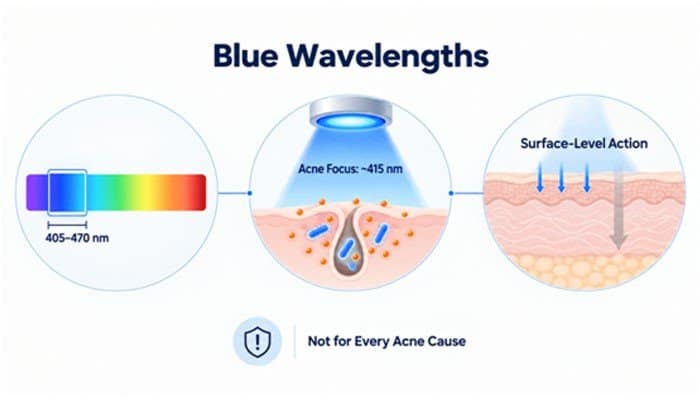
The blue side of blue light vs red light therapy is relevant for acne-oriented services, not a substitute for red or near-infrared light. It is not a universal acne solution: acne has inflammatory, hormonal, and treatment-related causes. Facilities need accurate claims and referral boundaries.
Understand the Red Wavelengths
Red light follows a different optical pathway. The visible red band is used in PBM devices, but wavelength is only one factor in a suitable device configuration.
- Visible red range: Red light usually refers to visible wavelengths around 620-700 nm.
- Common PBM wavelengths: Commercial devices use wavelengths around 630 nm, 633 nm, or 660 nm, sometimes combined with near-infrared wavelengths.
- Tissue interaction: In blue light vs red light therapy, red light generally penetrates farther because of different absorption and scattering. Visible red light in the 600-700 nm range can reach the dermis, while blue light remains more superficial.
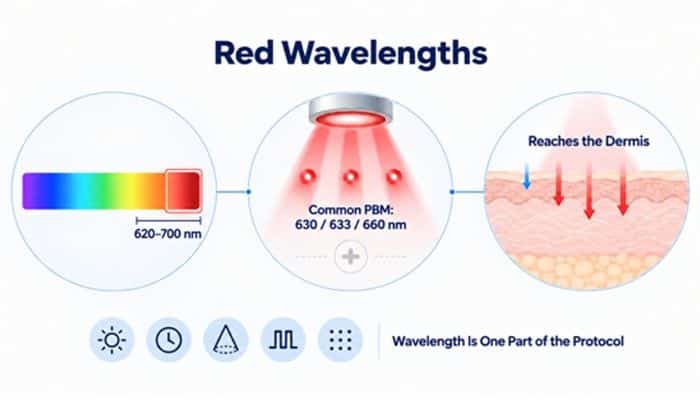
A red light therapy wavelength does not define a complete protocol. Irradiance, treatment time, beam angle, pulsing, treatment area, and operating procedure determine dose. A red light therapy wavelength should match the target application, not depth alone.
Understand the Difference-What Each Color Interacts With
The practical difference rests on wavelength energy, penetration depth, and chromophores-the molecules that absorb light. In blue light vs red light therapy, blue stays near the surface, while red reaches deeper and triggers different cellular signals.
Blue Light: A More Photochemical, Surface-Focused Action
- Target interaction: Near 415 nm, blue light is absorbed by C. acnes porphyrins in superficial skin.
- Photochemical reaction: Excited porphyrins transfer energy to oxygen and generate reactive oxygen species (ROS).
- Functional result: ROS can damage bacterial components and reduce C. acnes activity. Blue acts on the acne-related bacterial component, not dermal fibroblasts or collagen. In a red vs blue light comparison, it is the antibacterial option.
Red Light: A Photobiomodulation-Focused Action
- Target interaction: PBM is linked to cellular photoacceptors; cytochrome c oxidase is a proposed one, with nitric-oxide signaling also relevant.
- Photobiomodulation response: Red-light absorption can modify mitochondrial and cellular signaling, including ATP and regulated ROS/NO pathways, rather than causing bacterial oxidative damage.
- Functional result: These responses are associated with fibroblast activity, collagen-related processes, microcirculation, and repair. In a red vs blue light comparison, red is the skin-quality and recovery option.
Understand the Difference in Applications
These mechanisms matter when selection starts with the actual skin concern. In blue light vs red light therapy, blue is the more direct choice for acne, while red is more relevant to skin quality, wrinkles, and collagen-related goals.
1. For Acne
Acne involves both bacterial activity and local inflammation, so blue and red light can have complementary roles.
- Blue light’s role: It is the direct acne-focused component, acting through acnes porphyrins and ROS-mediated bacterial reduction.
- Red light’s role: It does not replace the antibacterial action; its PBM activity supports local inflammatory regulation and tissue-recovery processes.
Together, blue addresses the bacterial driver, while red supports the recovery environment.
2. For Wrinkles and Collagen
Wrinkles and collagen loss relate to dermal structure, fibroblast function, and collagen turnover rather than a bacterial target.
- Red light’s role: PBM is associated with fibroblast activity, collagen-related processes, microcirculation, and repair signaling.
- Why blue is not primary: Blue is surface focused and does not directly address the dermal fibroblast and collagen processes a wrinkle-focused service aims to support.
In blue light vs red light therapy for wrinkles and collagen, red is the relevant visible-light choice; blue has a limited structural-aging role.
The difference is functional: blue light is selected when acne is the primary concern, while red light is selected when the service centres on skin quality, wrinkles, or collagen-related goals.
How Can Magique Power Support Different Light Therapy Requirements?
Once the application is clear, Magique Power can turn it into an OEM/ODM device and service configuration. The best red light panel is a service-fit decision, not a fixed model choice.
Wavelength configuration
Magique Power offers flexible wavelength customization from 450 nm to 1060 nm, including multi-wavelength combinations for red, near-infrared, blue, or other options.
Device and brand customization
Services cover panel or enclosed-bed formats, size, color, ergonomic design, and logo customization.
Software and operating configuration
Businesses can customize software functions, preset therapy modes, and multi-language settings for their service workflow.
Project matching
Teams can work with Magique Power on a best red light panel configuration that matches coverage, wavelength selection, brand requirements, and service environment.
This service-led approach helps buyers match a blue light vs red light therapy plan and the best red light panel or full-body format to the required application.
Conclusion
Blue light vs red light therapy differs primarily in wavelength, tissue interaction, and intended application. Blue light is generally used for a superficial acne-oriented action, while red light supports PBM-focused skin-quality and collagen-related services.
A sound red vs blue light decision verifies the published wavelength configuration, irradiance, controls, and protocol before defining a service. Magique Power offers configurable panel and full-body options that can align with the required coverage and workflow.
Discuss your light therapy requirements with Magique Power to develop a tailored OEM/ODM configuration for your service goals, treatment area, and operating workflow..
