


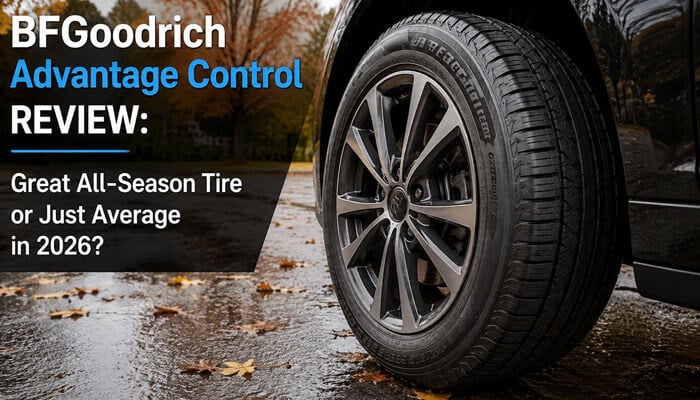

The BFGoodrich Advantage Control is designed for drivers who want a comfortable, predictable, and long-lasting all-season tire for daily commuting, highway travel, and family vehicles. It combines a touring-focused tread pattern with wet-weather technology, stable dry-road handling and treadlife coverage of up to 75,000 miles, depending on the tire’s speed rating.
However, the BFGoodrich Advantage Control entered the U.S. market in 2021, and the all-season tire category has changed significantly since then. Newer all-weather competitors now offer stronger snow capability, updated tread compounds and 3-Peak Mountain Snowflake certification, making it important to evaluate whether this BFGoodrich tire still provides competitive performance in 2026.
This review examines the BFGoodrich Advantage Control across dry roads, rain, comfort, noise, snow, ice, tread life, warranty and overall value. The evidence suggests it remains a dependable choice for drivers in warm and mild climates, but its weaker winter performance means motorists who regularly encounter snow and ice may find better alternatives.
Quick Answer: BFGoodrich Advantage Control
The BFGoodrich Advantage Control is a good conventional all-season tire for everyday driving, but it is not one of the strongest choices for severe winter conditions.
Its main strengths include:
- Predictable dry-road handling
- Comfortable commuting and highway driving
- Competent wet traction
- Long treadlife coverage
- Broad vehicle compatibility
- A large 14- to 21-inch size range
- Good owner-reported treadwear
- A 60-day satisfaction guarantee
Its main weaknesses include:
- Poor snow and ice results in current independent testing
- No advertised 3PMSF severe-snow certification
- Road noise that varies by vehicle and pavement
- Different specifications and warranties across sizes
- No BFGoodrich manufacturer road-hazard coverage
- Increasing competition from newer all-weather tires
Best for: sedans, coupes, crossovers and family vehicles driven mainly in warm, mild or moderate climates.
Consider another tire if: snow-covered roads, freezing rain or ice are regular parts of your winter.
Key Takeaways
- The BFGoodrich Advantage Control is strongest in dry driving, ride comfort and treadwear.
- Its wet performance is capable and forgiving but not clearly class-leading.
- Tire Rack found its dry emergency behavior predictable and stable.
- Current independent testing exposed significant snow and ice limitations.
- BFGoodrich offers the tire in 99 sizes for wheels ranging from 14 to 21 inches.
- H-rated versions receive a 75,000-mile treadlife warranty.
- V- and W-rated versions receive a 65,000-mile warranty.
- UTQG ratings, tread depth, load range and maximum inflation vary by size.
- The maximum PSI printed on the tire is not the vehicle’s recommended pressure.
- The 60-day satisfaction guarantee does not cover road-hazard damage.
- The Advantage Control HT is a separate model for larger CUVs, SUVs and pickups.
BFGoodrich Advantage Control at a Glance
| Feature | BFGoodrich Advantage Control |
|---|---|
| Category | Grand Touring All-Season |
| Introduced | 2021 |
| Primary use | Everyday paved-road and highway driving |
| Typical vehicles | Coupes, sedans, crossovers, and SUVs |
| Tread pattern | Symmetric |
| Tread compound | Silica-rich all-season compound |
| Available sizes | 99 |
| Wheel diameters | 14 to 21 inches |
| Common UTQG ratings | 700 B A or 600 B A, depending on size |
| Typical initial tread depth | Approximately 10.5/32 to 11.5/32 inch |
| H-rated warranty | 75,000 miles |
| V/W-rated warranty | 65,000 miles |
| Satisfaction guarantee | 60 days, subject to conditions |
| Advertised 3PMSF rating | No |
| Tire Rack test score | 7.04/10 |
| Strongest areas | Dry handling, comfort and treadwear |
| Weakest area | Snow and ice traction |
| Overall verdict | Good mild-climate tire with winter limitations |
The BFGoodrich Advantage Control is available in sizes for wheels from 14 through 21 inches, giving it broad compatibility with passenger cars, family sedans, crossovers and some SUVs.
What Is the BFGoodrich Advantage Control?
The BFGoodrich Advantage Control is a replacement Grand Touring All-Season tire developed for passenger cars, crossovers, minivans and some SUVs.
Unlike BFGoodrich’s best-known off-road products, the BFGoodrich Advantage Control is designed for ordinary paved-road use. Its priorities are comfort, predictable control, wet traction and tread life.
It is not intended to be:
- A dedicated winter tire
- A severe off-road tire
- A track-focused performance tire
- An aggressive Ultra High Performance tire
- A maximum-efficiency EV tire
Its purpose is straightforward: provide dependable and uncomplicated everyday transportation.
That positioning matters when evaluating the BFGoodrich Advantage Control. A touring tire should not be criticized simply because it lacks sports-car steering, but it should provide confidence during rain, highway travel, emergency maneuvers, and normal seasonal weather.
How Is the BFGoodrich Advantage Control Designed?
The BFGoodrich Advantage Control combines a symmetric tread pattern with several technologies intended to improve wet traction, ride comfort, steering stability and treadwear.
Aqua-Flume Technology
Aqua-Flume Technology uses wide circumferential channels and curved lateral grooves to move water away from the contact patch. The goal is to reduce the amount of water trapped between the road and the BFGoodrich Advantage Control during wet-weather driving.
This design is particularly relevant during:
- Moderate rain
- Highway travel on wet roads
- Driving through shallow standing water
- Wet cornering
- Emergency braking in rain
Active Sipe Technology
Sipes are narrow cuts in the tread blocks that create additional biting edges. The BFGoodrich Advantage Control uses Active Sipe Technology to support wet and light-snow traction. Full-depth tread features are also intended to preserve useful tread characteristics as the tire wears.
Silica-Rich All-Season Compound
The tread uses a silica-rich all-season compound.
Silica allows manufacturers to balance grip, flexibility, and treadwear across different temperatures. It does not automatically make one tire better than every competitor, but it is a common feature in modern touring-tire construction.
Computer-Optimized Footprint
The footprint is designed to distribute contact forces more evenly across the tread.
More consistent loading can help the BFGoodrich Advantage Control provide:
- Predictable steering
- Stable road contact
- Reduced irregular wear
- Consistent braking
- Better long-term tread life
g-Wedge Sidewall Stabilizers
BFGoodrich uses g-Wedge sidewall stabilizers to reinforce the tire while preserving its touring-focused ride.
The goal is to stop the BFGoodrich Advantage Control from feeling excessively soft without creating the harshness associated with some performance-focused tires.
BFGoodrich Advantage Control Dry Performance
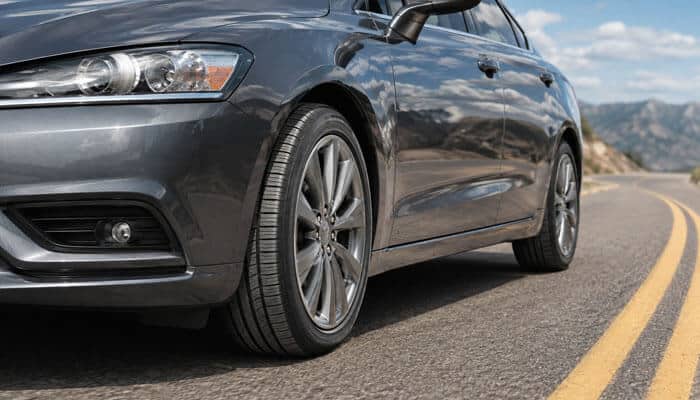
Dry-road handling is one of the strongest characteristics of the BFGoodrich Advantage Control. In Tire Rack’s latest evaluation, the tire remained predictable during the dry Emergency Lane Change test. It tended to communicate its limits through the front axle rather than suddenly rotating at the rear.
This progressive behavior can be valuable when:
- Avoiding road debris
- Changing lanes suddenly
- Correcting a steering mistake
- Entering or leaving a highway
- Responding to an unexpected obstruction
Tire Rack described the steering as fluid and natural but unhurried.
That means the BFGoodrich Advantage Control does not offer the immediate turn-in or aggressive response of an Ultra High Performance tire. For an ordinary commuter, however, predictable behavior is often more valuable than sharp steering.
BFGoodrich Advantage Control Dry Performance Verdict
The BFGoodrich Advantage Control provides stable, forgiving dry-road behavior. Enthusiasts may find it relaxed, but commuters should appreciate its predictable limits.
BFGoodrich Advantage Control Wet Performance
Wet traction is a major part of the marketing behind the BFGoodrich Advantage Control. BFGoodrich says Aqua-Flume grooves, Active Sipe Technology and the silica-infused compound help evacuate water and improve wet grip.
The manufacturer also promotes an internal comparison in which the BFGoodrich Advantage Control stopped eight feet shorter from 50 mph than specific General Altimax and Cooper CS5 Ultra Touring tires.
That claim requires context.
The test involved:
- A 2017 Honda Accord
- 215/60R16 95V tires
- Specific General and Cooper competitors
- Testing connected with the tire’s original launch
The comparison does not prove that the BFGoodrich Advantage Control outbrakes every current tire available in 2026.
Independent testing provides a more balanced assessment. Tire Rack found the tire capable in wet conditions. It was not especially quick, but testers reported sufficient traction for hard cornering and slalom maneuvers. The tire also remained relatively forgiving when steering and throttle inputs were combined.
BFGoodrich Advantage Control Wet Performance Verdict
The BFGoodrich Advantage Control should provide reassuring rain performance for ordinary driving. Drivers seeking maximum wet braking or cornering grip should compare it with newer premium alternatives.
Is the BFGoodrich Advantage Control Good in Heavy Rain?
The BFGoodrich Advantage Control uses wide longitudinal grooves and curved Aqua-Flume channels to move water away from the tread.
That design should help the tire maintain contact with the road during rain, but hydroplaning resistance depends on more than the tire model.
Important factors include:
- Vehicle speed
- Standing-water depth
- Tire width
- Remaining tread depth
- Inflation pressure
- Vehicle weight
- Pavement condition
Even a capable rain tire can hydroplane when driven too quickly through deep water. Tread depth is especially important. As the BFGoodrich Advantage Control wears, its grooves have less space available to channel water away from the contact patch. Drivers should expect wet-weather capability to decline as the tire approaches the end of its useful tread life.
BFGoodrich Advantage Control Ride Comfort
Ride comfort is another important strength of the BFGoodrich Advantage Control. During Tire Rack’s road evaluation, the tire felt soft and pleasant compared with many of the other tested products. Larger impacts were cushioned reasonably well, although some additional movement remained after the initial impact.
This relaxed character should suit:
- Daily commuters
- Family sedans
- Crossovers
- Minivans
- Long-distance highway drivers
- Drivers who prioritize comfort over sharp steering
The BFGoodrich Advantage Control may not feel as tightly controlled as the best premium touring tires, but it avoids the harshness that can make performance-focused tires tiring during everyday driving.
BFGoodrich Advantage Control Comfort Verdict
Is the BFGoodrich Advantage Control Quiet?
The BFGoodrich Advantage Control is generally reasonably quiet, although noise depends heavily on the vehicle, road surface and tire size.
BFGoodrich designed the tread pattern partly around reduced noise. The company’s original testing compared the tire favorably with a specific Yokohama AVID Ascend GT configuration.
Tire Rack’s more recent test produced a more moderate conclusion. Testers found the sound reasonably well blended but noticed:
- Higher overall volume on asphalt
- Some higher-frequency tones on smooth pavement
- Noticeable variation between road surfaces
BFGoodrich’s owner-review summary also shows mixed experiences. Many customers praise the smooth and quiet ride, while some report excessive highway noise.
Road noise from the BFGoodrich Advantage Control can change with:
- Pavement texture
- Tire width
- Wheel diameter
- Vehicle insulation
- Inflation pressure
- Alignment
- Suspension condition
- Tread wear
BFGoodrich Advantage Control Snow Performance
Winter traction is the clearest weakness of the BFGoodrich Advantage Control. BFGoodrich markets it as an all-season, M+S tire and highlights biting edges intended to support light-snow traction. However, it is not promoted as a 3-Peak Mountain Snowflake tire.
In Tire Rack’s Winter 2026 update, the BFGoodrich Advantage Control managed small steering inputs but became overwhelmed as cornering speed and intensity increased.
Testers reported:
- Traction loss that arrived quickly
- Limited warning before sliding
- Slow recovery after grip was lost
- Difficulty maintaining the intended line through turns
BFGoodrich Advantage Control Ice Performance
Ice was the weakest part of Tire Rack’s current comparison.
The tested BFGoodrich Advantage Control was a 215/55R17 94V Standard Load tire mounted on the same Toyota Camry used for the other products.
| Ice Test | BFGoodrich Advantage Control |
|---|---|
| Acceleration to 60 feet | 7.2 seconds |
| Braking from 12 mph | 67.9 feet |
| Relative result | Slowest acceleration and longest braking distance |
The BFGoodrich Advantage Control required the most time to accelerate and the greatest distance to stop among the 11 tires tested.
Is the BFGoodrich Advantage Control 3PMSF Rated?
The BFGoodrich Advantage Control is not promoted as a 3-Peak Mountain Snowflake tire.
The words “all-season” and “M+S” do not mean a tire will perform equally well in every winter condition.
| Marking or Category | General Meaning |
|---|---|
| All-season | Intended for a broad range of mild weather |
| M+S | Tread geometry meets mud-and-snow criteria |
| 3PMSF | Meets a defined severe-snow acceleration requirement |
| Dedicated winter tire | Engineered for colder temperatures, snow and ice |
A 3PMSF rating does not guarantee exceptional ice braking, but it generally provides more meaningful snow-performance evidence than the M+S designation alone.
The lack of 3PMSF certification is therefore an important consideration for anyone comparing the BFGoodrich Advantage Control with modern all-weather tires.
BFGoodrich Advantage Control Tread Life
Treadwear is one of the strongest reasons to consider the BFGoodrich Advantage Control.
Current consumer-survey data reports approximately:
- 227 survey ratings
- 2.6 million reported miles
- 95% recommended
- An 8.7 treadwear score
These results are owner-reported rather than controlled treadwear testing. However, millions of reported miles provide useful evidence about long-term use.
Actual BFGoodrich Advantage Control tread life depends on:
- Inflation pressure
- Tire rotation
- Wheel alignment
- Vehicle weight
- Suspension condition
- Road quality
- Driving style
- Climate
- Highway versus city driving
The BFGoodrich Advantage Control cannot achieve its full treadlife potential when consistently underinflated, misaligned, or improperly rotated.
BFGoodrich Advantage Control Warranty
The BFGoodrich Advantage Control warranty is one of the tire’s strongest selling points.
| Coverage | Current Terms |
|---|---|
| H-rated treadlife warranty | 75,000 miles |
| V/W-rated treadlife warranty | 65,000 miles |
| Workmanship and materials | Original usable tread or six years, whichever comes first |
| Satisfaction guarantee | 60 days, subject to conditions |
| Manufacturer road-hazard warranty | Not included |
H-rated versions of the BFGoodrich Advantage Control receive a 75,000-mile warranty, while V- and W-rated versions receive 65,000 miles.
BFGoodrich Advantage Control Warranty for Staggered Fitments
Some vehicles use wider tires at the rear than at the front. These staggered setups may prevent normal front-to-rear rotation. Owners of vehicles with different front and rear BFGoodrich Advantage Control sizes should review the exact warranty documentation because limited rotation can reduce or otherwise affect treadlife coverage.
Does the BFGoodrich Advantage Control Have Road-Hazard Coverage?
BFGoodrich does not provide manufacturer road-hazard coverage for the BFGoodrich Advantage Control. Damage from nails, potholes, glass, curbs or road debris is different from a defect in materials or workmanship. A tire retailer may offer separate protection, but that policy is not administered by BFGoodrich.
Before buying, compare:
- Manufacturer warranty terms
- Retailer road-hazard protection
- Replacement and proration rules
- Installation coverage
- Transferability
How Does the BFGoodrich Advantage Control 60-Day Guarantee Work?
The BFGoodrich Advantage Control is included in BFGoodrich’s 60-Day Satisfaction Guarantee. The program applies to up to six purchased and mounted tires per customer. Qualifying buyers can return the tires to the place of purchase within the required period for an eligible exchange.
The guarantee excludes tires damaged by:
- Misuse
- Misapplication
- Road hazards
- Mechanical vehicle problems
- Racing or competitive events
- Removal from the original vehicle
The guarantee can help when a driver dislikes the BFGoodrich Advantage Control because of its noise, ride or handling, but it is not an unconditional damage warranty.
BFGoodrich Advantage Control UTQG Ratings Explained
The BFGoodrich Advantage Control does not have one universal UTQG rating.
Many H-rated sizes carry:
700 B A
Several V- and W-rated versions carry:
600 B A
BFGoodrich Advantage Control Treadwear Grade
The first number indicates relative wear compared with a government control tire. A rating of 700 does not mean the BFGoodrich Advantage Control will automatically last 70,000 miles. UTQG treadwear grades and mileage warranties are separate measurements.
BFGoodrich Advantage Control Traction Grade
The UTQG wet straight-line braking grades are:
- AA
- A
- B
- C
The BFGoodrich Advantage Control commonly carries a B traction grade.
That may appear surprising beside its wet-performance marketing, but UTQG testing does not fully represent:
- Wet cornering
- Hydroplaning resistance
- Steering response
- Emergency maneuvering
- Performance on every pavement type
BFGoodrich Advantage Control Temperature Grade
Many sizes carry an A temperature grade. Temperature grades measure resistance to heat generation and the ability to dissipate heat during standardized testing. A is the highest UTQG temperature grade.
BFGoodrich Advantage Control Specifications Vary by Size
Do not assume every BFGoodrich Advantage Control tire has identical specifications.
| Example Size | Service Description | Load Range | Typical UTQG | Tread Depth | Maximum Inflation |
|---|---|---|---|---|---|
| 235/60R17 | 102H | SL | 700 B A | 11.5/32″ | 44 psi |
| 215/55R16 | 97H | XL | 700 B A | 11.5/32″ | 50 psi |
| 245/40R18 | 97W | XL | 600 B A | 10.5/32″ | 50 psi |
Exact specifications can differ in:
- Speed rating
- Load index
- Load range
- Maximum load
- Maximum inflation
- Initial tread depth
- Tire weight
- UTQG grade
- Mileage warranty
- Approved rim-width range
Always inspect the exact BFGoodrich Advantage Control size and service description rather than relying on a generic specification.
BFGoodrich Advantage Control H vs V vs W Ratings
The BFGoodrich Advantage Control is available with multiple speed ratings, including H, V and W. A higher speed rating does not automatically mean one version is best for every vehicle.
The correct tire should meet the vehicle manufacturer’s requirements for:
- Size
- Load index
- Speed rating
- Load range
The treadlife warranty also changes.
| Speed Rating | Limited Treadlife Warranty |
|---|---|
| H | 75,000 miles |
| V | 65,000 miles |
| W | 65,000 miles |
Do not select an H-rated BFGoodrich Advantage Control only to obtain the longer warranty if the vehicle requires a V- or W-rated tire.
BFGoodrich Advantage Control SL vs XL
Some BFGoodrich Advantage Control sizes use Standard Load construction, while others are Extra Load.
SL: Standard Load
An SL tire is designed to carry its rated load at standard passenger-tire inflation levels.
XL: Extra Load
An XL BFGoodrich Advantage Control can carry additional load at an appropriately higher inflation pressure compared with a similar Standard Load tire.
XL does not automatically mean better.
An Extra Load version may have:
- Greater load capacity
- A firmer ride
- Higher maximum inflation
- Additional weight
Use the BFGoodrich Advantage Control construction and service description approved for your vehicle.
What Tire Pressure Should the BFGoodrich Advantage Control Use?
There is no universal BFGoodrich Advantage Control PSI.
Some sizes list a maximum inflation pressure of 44 psi, while various Extra Load versions list a maximum of 50 psi. Those figures are tire limits, not necessarily the correct operating pressure for your vehicle.
Use the recommended cold PSI shown:
- On the driver-side door placard
- In the owner’s manual
- On the vehicle manufacturer’s tire-information label
Do not automatically inflate the BFGoodrich Advantage Control to the maximum PSI printed on its sidewall.
Check BFGoodrich Advantage Control Pressure Cold
Pressure should be checked before driving or after the vehicle has been parked for at least three hours.
Check every tire monthly and before long trips.
Incorrect inflation can contribute to:
- Irregular treadwear
- Poor handling
- Reduced wet traction
- Increased fuel consumption
- Excessive heat
- Tire damage
- Shorter service life
When Should BFGoodrich Advantage Control Tires Be Replaced?
Do not judge BFGoodrich Advantage Control replacement timing only by mileage.
A tire may need replacement because of:
- Insufficient tread depth
- Cracking
- Cuts
- Bulges
- Exposed cords
- Repeated pressure loss
- Irregular wear
- Impact damage
- Excessive age
- Changes in vibration or noise
Grip in adverse conditions is significantly reduced when tread depth becomes very low. The legal minimum should not be confused with ideal rain or winter capability.
Wet and snow performance may decline well before the BFGoodrich Advantage Control reaches its minimum usable tread depth. Tires should also be inspected more carefully as they age, even if substantial tread remains.
Common BFGoodrich Advantage Control Problems
Most owner feedback is positive, but several recurring BFGoodrich Advantage Control problems appear in customer reviews.
BFGoodrich Advantage Control Highway Noise
Some owners report more highway noise than expected.
Possible contributing factors include:
- Coarse pavement
- Wider tire sizes
- Larger wheels
- Vehicle insulation
- Alignment
- Irregular treadwear
- Inflation pressure
BFGoodrich Advantage Control Premature Wear
Some reviews mention faster-than-expected treadwear.
Uneven wear can also result from:
- Incorrect alignment
- Worn suspension components
- Missed tire rotations
- Underinflation
- Overinflation
- Aggressive driving
A premature-wear complaint should be investigated rather than automatically attributed to a defective BFGoodrich Advantage Control.
BFGoodrich Advantage Control Fuel Economy
A minority of owners report lower fuel economy after installation.
Changes can result from differences in:
- Tire weight
- Width
- Inflation
- Compound
- Tread depth
- Rolling resistance
- Weather conditions
The BFGoodrich Advantage Control is not marketed primarily as a low-rolling-resistance tire.
What Do BFGoodrich Advantage Control Owners Say?
Owner surveys and professional tests answer different questions.
Current consumer-survey data reports approximately:
- 227 survey ratings
- 2.6 million reported miles
- 95% recommended
- 8.9 wet score
- 9.2 dry score
- 8.0 winter/snow score
- 8.5 comfort score
- 8.7 treadwear score
These results are more favorable than the controlled winter test.
The difference is understandable.
Owner impressions of the BFGoodrich Advantage Control depend on:
- Vehicle type
- Climate
- Drivetrain
- Road treatment
- Driving habits
- Tire age
- Previous tires
- Personal expectations
A driver using an all-wheel-drive crossover on quickly cleared roads may describe the tire as satisfactory in snow. A controlled same-vehicle test can still show that competing products brake and accelerate more effectively.
Controlled testing deserves more weight when comparing measurable braking and traction. Owner reviews are particularly useful for long-term comfort, noise, and wear.
BFGoodrich Advantage Control 2026 Independent Test Results
Tire Rack tested 11 Grand Touring All-Season and all-weather tires on a Toyota Camry and later added snow and ice results in its Winter 2026 update.
The tested BFGoodrich Advantage Control was:
215/55R17 94V Standard Load
Its total score was:
7.04/10
| Test Area | Tire Rack Finding |
|---|---|
| Ride quality | Soft and pleasant |
| Steering | Fluid, natural and relaxed |
| Noise | Acceptable but surface-dependent |
| Wet handling | Capable and forgiving |
| Dry emergency behavior | Predictable and stable |
| Snow | Weak |
| Ice | Very weak |
| Overall | Capable warm-weather tire with winter limitations |
The BFGoodrich Advantage Control performed competently in wet and dry testing but needed substantially more winter traction.
Why Older BFGoodrich Advantage Control Reviews Need Context
The BFGoodrich Advantage Control has not necessarily become worse since its 2021 introduction.
The market around it has improved.
Newer competitors may offer:
- Better snow acceleration
- Shorter winter braking
- 3PMSF certification
- Updated tread compounds
- More recent design priorities
The relevant question is therefore not simply whether the BFGoodrich Advantage Control is good.
The better question is whether it offers the right combination of climate suitability, comfort, warranty and installed price for your vehicle in 2026.
Is the BFGoodrich Advantage Control Good for EVs and Hybrids?
The BFGoodrich Advantage Control is available in sizes that fit some electric and hybrid vehicles, but it is not primarily marketed as an EV-specific tire.
EV owners should consider:
- Load index
- Vehicle weight
- Instant torque
- Treadwear
- Rolling resistance
- Road noise
- Driving range
- Approved fitment
A BFGoodrich Advantage Control fitting the wheel does not automatically make it the best tire for the vehicle. Drivers prioritizing maximum electric range should look for reliable rolling-resistance comparisons in their exact tire size.
Is the BFGoodrich Advantage Control Worth the Money?
The BFGoodrich Advantage Control can provide strong value when priced below newer premium all-weather tires.
Prices vary according to:
- Tire size
- Retailer
- Region
- Installation package
- Promotions
- Availability
- Road-hazard coverage
Compare the complete installed cost, including:
- Tire price
- Mounting
- Balancing
- Taxes
- Disposal fees
- TPMS service
- Road-hazard protection
- Alignment if needed
The BFGoodrich Advantage Control is most compelling when:
- Winter capability is not a major concern
- Comfort and tread life matter
- The approved size is competitively priced
- The buyer values the warranty
- Premium competitors cost substantially more
Its value becomes less convincing when a stronger all-weather tire is available for only a small additional amount.
BFGoodrich Advantage Control vs Advantage Control HT
The BFGoodrich Advantage Control HT is a separate product from the standard BFGoodrich Advantage Control.
BFGoodrich launched the HT model in 2025 for larger CUVs, full-size SUVs and light-duty pickups.
| Feature | BFGoodrich Advantage Control | Advantage Control HT |
|---|---|---|
| Launch year | 2021 | 2025 |
| Main vehicles | Cars, crossovers and some SUVs | Larger CUVs, SUVs and pickups |
| Primary category | Grand Touring All-Season | Highway-focused all-season |
| Mileage warranty | Up to 75,000 miles | 70,000 miles |
| Main purpose | Touring comfort and everyday control | Everyday driving for larger vehicles |
| Design age | Older | Newer |
Owners of larger SUVs and pickups should confirm whether the standard BFGoodrich Advantage Control or Advantage Control HT is the correct model for their vehicle.
BFGoodrich Advantage Control vs Competitors
The best alternative to the BFGoodrich Advantage Control depends on climate, driving style, tire size and installed price.
| Tire | Best Reason to Consider It | Main Trade-Off |
|---|---|---|
| BFGoodrich Advantage Control | Comfort, treadwear and mild-climate value | Weak latest winter results |
| Yokohama AVID Ascend GT | Balanced conventional all-season performance | Limited severe-winter focus |
| Falken Aklimate | Stronger winter performance | Different ride and handling balance |
| Nokian Encompass AW02 | Modern all-weather balance | Availability may vary |
| Goodyear Assurance WeatherReady2 | Severe-snow-rated touring capability | Often more expensive |
| Michelin CrossClimate2 | Established all-weather performance | Premium pricing in many sizes |
A mild-climate driver may place greater value on the BFGoodrich Advantage Control warranty, comfort and price than on severe-snow certification. A driver living in a snow-heavy region should give much more weight to controlled winter testing.
Who Should Buy the BFGoodrich Advantage Control?
The BFGoodrich Advantage Control makes the most sense for drivers who:
- Live in a warm or mild climate
- Drive primarily on paved roads
- Spend substantial time commuting
- Want predictable dry handling
- Need competent rain traction
- Prioritize ride comfort
- Value long treadlife coverage
- Rarely encounter significant snow or ice
- Find it meaningfully cheaper than premium alternatives
The BFGoodrich Advantage Control can be particularly suitable for family vehicles and high-mileage commuters that need a dependable touring tire.
Who Should Skip the BFGoodrich Advantage Control?
Consider another product if:
- Snow-covered roads are common
- Ice is a recurring winter hazard
- You specifically want 3PMSF certification
- Maximum wet braking is your priority
- You want sharp performance-car steering
- Maximum EV range is a major concern
- A newer all-weather alternative costs only slightly more
- Your vehicle needs a more specialized tire
The winter weakness of the BFGoodrich Advantage Control is supported by current comparative testing rather than subjective criticism alone.
What to Check Before Buying BFGoodrich Advantage Control Tires
Before ordering the BFGoodrich Advantage Control:
- Confirm the manufacturer-approved tire size.
- Verify the required load index.
- Check the correct speed rating.
- Determine whether SL or XL is appropriate.
- Confirm the warranty for that version.
- Check whether the vehicle uses staggered sizes.
- Compare retailer road-hazard plans.
- Compare the total installed price.
- Evaluate your actual winter conditions.
- Decide whether you need 3PMSF certification.
- Use the vehicle placard for normal cold pressure.
- Compare at least two current competitors.
- Inspect the manufacturing date after delivery.
How to Maximize BFGoodrich Advantage Control Tread Life
Proper maintenance can significantly extend BFGoodrich Advantage Control tread life.
- Check pressure monthly when the tires are cold.
- Use the vehicle manufacturer’s recommended PSI.
- Rotate the tires according to the recommended schedule.
- Check alignment when the vehicle pulls or wear becomes uneven.
- Inspect suspension components when abnormal wear appears.
- Balance the tires correctly during installation.
- Investigate vibration promptly.
- Inspect the tires after major pothole impacts.
- Avoid prolonged underinflation.
- Monitor tread depth before rainy or winter seasons.
BFGoodrich Advantage Control Pros and Cons
| Pros | Cons |
|---|---|
| Predictable dry handling | Weak snow and ice test results |
| Comfortable ride | No advertised 3PMSF certification |
| Competent wet-road behavior | Not a class-leading wet performer |
| Up to 75,000-mile warranty | V/W versions receive shorter coverage |
| Broad 14- to 21-inch size range | Some owners report highway noise |
| Strong consumer treadwear feedback | Some owners report premature wear |
| Symmetric touring tread | No manufacturer road-hazard coverage |
| Established dealer network | Older than many all-weather competitors |
| Forgiving emergency behavior | Not designed around maximum efficiency |
BFGoodrich Advantage Control Rating for 2026
| Category | Editorial Score |
|---|---|
| Dry handling | 8.5/10 |
| Wet everyday performance | 8/10 |
| Ride comfort | 8.5/10 |
| Road noise | 7.5/10 |
| Treadlife potential | 8.5/10 |
| Warranty | 8.5/10 |
| Light-snow performance | 6/10 |
| Ice performance | 4.5/10 |
| Value when competitively priced | 8/10 |
| Overall | 7.8/10 |
These are editorial assessments based on specifications, independent test results, owner surveys, warranty terms and intended use. They are not laboratory measurements.
Final BFGoodrich Advantage Control Verdict
The BFGoodrich Advantage Control is better than an average budget tire, but it is not a class-leading all-season option in every condition.
It remains strong where many everyday drivers need it to be:
- Comfortable
- Predictable
- Stable on dry pavement
- Competent in rain
- Easy to drive
- Supported by a long treadlife warranty
Its winter performance prevents it from becoming a universal recommendation.
Buy the BFGoodrich Advantage Control If:
You primarily drive on dry and wet roads, live in a mild climate, value comfort and tread life, and can purchase the BFGoodrich Advantage Control at a competitive installed price.
Choose Another Tire If:
Snow and ice are routine parts of your winter, you specifically want severe-snow certification, or a stronger all-weather tire is available for only a modest price increase.
Final rating: 7.8/10
For the right driver, the BFGoodrich Advantage Control remains a smart and dependable purchase in 2026. It is best understood as a comfortable, long-wearing conventional all-season tire—not a complete severe-winter solution.
Conclusion: BFGoodrich Advantage Control
The BFGoodrich Advantage Control remains a dependable all-season tire for drivers who prioritize comfortable road manners, predictable dry handling, capable wet traction and long treadlife coverage. Its strongest qualities make it particularly suitable for commuters, family vehicles and highway drivers in warm or mild climates. The broad size range, warranty of up to 75,000 miles and forgiving everyday handling also strengthen its value when it is competitively priced.
However, winter performance is the tire’s clearest limitation. Current independent testing shows that the BFGoodrich Advantage Control falls behind several newer all-weather competitors in snow and especially on ice. Drivers who regularly encounter severe winter conditions should compare 3PMSF-rated all-weather tires or consider dedicated winter tires.
For the right driver, this BFGoodrich tire is still a smart purchase in 2026. It is comfortable, stable and built for long-term everyday use—but it should be viewed as a conventional all-season touring tire rather than a complete severe-winter solution.
BFGoodrich Advantage Control FAQs
1. Is the BFGoodrich Advantage Control a good tire?
Yes. The BFGoodrich Advantage Control is a good Grand Touring All-Season tire for commuting, highway driving, dry roads and rain. Its main limitation is weaker snow and ice performance compared with several newer all-weather products.
2. How long does the BFGoodrich Advantage Control last?
H-rated BFGoodrich Advantage Control tires receive a 75,000-mile limited treadlife warranty, while V- and W-rated versions receive 65,000 miles. Actual tire life depends on inflation, alignment, rotation, vehicle condition, climate and driving habits.
3. Is the BFGoodrich Advantage Control good in rain?
Yes. The BFGoodrich Advantage Control is capable and forgiving in wet conditions, although it is not among the strongest current tires for maximum wet handling. Its Aqua-Flume grooves and silica-rich compound are designed to support wet traction.
4. Is the BFGoodrich Advantage Control good in snow?
The BFGoodrich Advantage Control may be adequate for occasional light snow, but it is not a strong choice for regular winter driving. Current independent testing found that it lost traction quickly as cornering demands increased.
5. Is the BFGoodrich Advantage Control 3PMSF rated?
The BFGoodrich Advantage Control is marketed as an all-season M+S tire but is not promoted with 3-Peak Mountain Snowflake certification. Drivers needing stronger winter capability should compare severe-snow-rated alternatives.
