




You live in Texas, the land of no state income tax, big skies, and—unfortunately 529 plans that can cost five times more than the nation’s top alternatives. Because there’s no state tax break locking you into the Texas College Savings Plan, you’re free to shop nationwide and keep every tax benefit.
Texas law also shields any 529—whether it’s opened in Dallas or Delaware—from creditors, so your college dollars stay yours. That freedom lets you build a ruthlessly efficient savings strategy that keeps costs microscopic and growth on track.
In the next few minutes you’ll meet eight standout plans that beat Texas on fees, performance, and user experience—and you’ll see exactly how to open one tonight.
How we ranked the plans
You deserve a clear rubric before we name any front-runners, so we built a transparent scorecard for Texans who receive no state-tax perk.
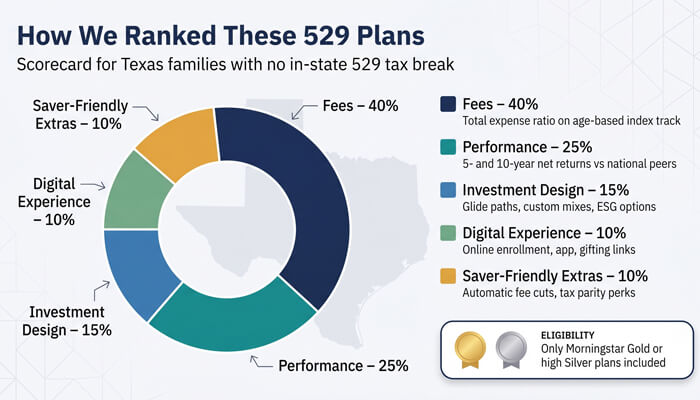
Fees came first and counted for 40 percent of the score. Every extra tenth of a percent in expenses is money that never reaches the market, so we compared the total expense ratio on each plan’s age-based index track.
Performance weighed 25 percent. We stacked five- and ten-year net returns of those same portfolios against the national peer group.
Investment design earned 15 percent. Multiple glide paths, custom mixes, and an ESG sleeve showed the flexibility we want for both set-it-and-forget-it families and hands-on investors.
Digital experience mattered, too. Clunky sites kill momentum, so 10 percent of the grade went to fast online enrollment, a solid app, and one-click gifting links.
The final 10 percent rewarded saver-friendly extras such as automatic fee cuts or tax parity for out-of-state contributors.
Every contender also had to appear on Morningstar’s latest medal list, and only Gold or high Silver plans made the cut. Five of our eight picks hold Morningstar’s top Gold rating: Illinois, Utah, Massachusetts, Pennsylvania, and Alaska.
With the grading done, let’s meet the plans that passed the test and see how far they can stretch your college dollars.
1. Illinois Bright Start: gold-level quality at index-fund prices
If you want one plan that excels on every metric—cost, stewardship, and long-run returns—Bright Start leads the class.

- Fees stay razor thin. Its index portfolios average about 0.13 percent all-in, less than one-third of the Texas direct plan and among the lowest nationwide.
- Performance matches those savings. Morningstar awards Bright Start a Gold rating for “compelling investment options that are also highly cost-effective,” meaning you gain broad global stock and bond exposure under disciplined oversight from the Illinois Treasurer.
- Diversity adds quiet strength. The plan blends Vanguard, DFA, and other managers inside its enrollment-date tracks, so you avoid reliance on a single firm. Prefer adjustments? Static portfolios let you dial risk up or down without leaving the platform.
- Digital experience feels modern. Online enrollment takes minutes, there is no minimum to start, and Ugift codes allow friends and family to contribute without paperwork.
Texas families give up nothing by choosing Bright Start—no lost tax break, no legal downside—yet they cut expenses and tap a program built to win on numbers rather than marketing.
Formally known as the Illinois Bright Start 529 College Savings Plan, which the Illinois State Treasurer highlights for its Gold Morningstar rating and index-track fees under 0.15 percent, the program welcomes savers from every state, so Texans can keep those low costs without restriction.
According to ISS Market Intelligence’s Q4 2025 529 fee study, Bright Start 529’s average asset-based expense across all portfolios is 0.24 percent—less than half the 0.49 percent national norm—while the index track highlighted above runs just 0.13 percent, all with no sales charges or minimum to open.
2. Utah my529: customizable, low-cost, and loved by DIY investors
Utah’s plan is the Reddit darling for families in states without income-tax breaks, and the numbers justify the praise.

The default index track costs about 0.11 percent a year. That slim fee keeps roughly three-tenths of a percent in your pocket annually compared with the Texas direct plan. Over eighteen years, the gap compounds into thousands of tuition dollars.
Utah layers in flexibility. You can stay with a ready-made enrollment-date fund or build your own glide path from Vanguard and DFA funds. Prefer eighty percent stocks until ninth grade, then a faster taper? Drag, drop, done.
The site makes setup painless. Open an account in about ten minutes, set recurring transfers, and send a secure gifting link to grandparents at birthday time. The mobile dashboard shows progress in plain English, not chart clutter.
Governance adds quiet strength. The board negotiates lower fees almost every year as assets grow, so costs trend downward. Morningstar has kept my529 on its Gold list since ratings began, a streak no other plan matches.
If you value choice without complexity, and fees so low they barely register, Utah my529 belongs near the top of your shortlist.
3. Massachusetts U.Fund: Fidelity convenience without the Fidelity price tag
If you already view your IRA or brokerage on Fidelity’s dashboard, Massachusetts U.Fund adds a 529 column right beside them. One login, full picture.

Cost stays sharp. The all-index age-based track runs about 0.13 percent total, nearly matching Utah’s fee and far below Texas’s half-percent drag.
Choice is the standout feature. Stick with the passive track, switch to a passive-plus-active blend, or go fully active if you expect Fidelity’s managers to add value. Switching takes a couple of clicks, with no paperwork.
Morningstar awards U.Fund a Gold medal, praising the oversight from the Massachusetts Educational Financing Authority and Fidelity’s deep bench of portfolio pros. The index track mirrors its global benchmarks, and the active sleeve has even outpaced indexes in several periods after fees.
Enrollment feels seamless. There is no minimum to open, automatic contributions link from any bank, and the site produces shareable gift links so relatives can contribute without fuss.
For Texas families already comfortable in the Fidelity ecosystem, or anyone who values optionality wrapped in low fees, U.Fund is a smart fit.
4. Pennsylvania 529 Investment Plan: quietly cutting fees and beating benchmarks
Pennsylvania’s direct plan seldom grabs headlines, yet it ranks near the top of performance charts. Quiet competence is its super-power.
Start with the dollars. In 2023 the state treasury secured another fee drop, trimming most index portfolios to about 0.19 percent, a level inside the national low-cost club and far below Texas’s half-percent sticker.
Oversight is rigorous. A state investment committee reviews the lineup each quarter and swaps out lagging funds without hesitation. The payoff is clear: five-year returns on the age-based track sit in the top quartile of all 529s.
The menu stays simple. Vanguard index funds anchor the lineup, and a Socially Responsible Equity option adds flavor, so you avoid analysis paralysis.
Opening the account is easy. Ten dollars unlocks it, recurring transfers connect to any checking account, and a shareable gifting link invites family support.
For savers who want watchdog governance and a track record of steady fee cuts, the Pennsylvania 529 Investment Plan is a reliable place to grow college dollars.
5. Alaska T. Rowe Price 529: active management that delivers
Most active 529 plans charge more and still trail plain index funds, but Alaska flips that script.
Its age-based portfolios invest solely in T. Rowe Price funds overseen by a seasoned multi-asset team. Fees average about 0.48 percent, higher than our index leaders yet a bargain among active options.
Performance backs the cost. During the past five years, the moderate enrollment track returned more than nine percent annually, outpacing comparable index tracks even after fees. Morningstar awarded the plan a Gold rating, a rare honor for an actively steered lineup.
Risk control adds another edge. The glide path stays growth-heavy while children are young, then reins in volatility earlier than many index peers, giving parents greater peace of mind as college approaches.
Opening the account is simple. There is no minimum, the ReadySave529 mobile app keeps balances handy, and a clean gifting portal invites family contributions.
Choose Alaska if you trust skilled managers to earn their keep and still want transparent oversight with fees well under one percent.
6. Ohio CollegeAdvantage: low-cost index core with safety-first options
Ohio offers a buffet of investments without bloated fees, making it a versatile pick for families who want growth and capital-preservation pockets.
Start with cost. After a 2023 fee trim, most index portfolios charge about 0.20 percent total. That is not Utah-level cheap, yet it still cuts the Texas expense ratio by more than half.
Flexibility is Ohio’s hallmark. Two age-based tracks cover moderate and aggressive glides. Beyond those, you can mix Vanguard index funds, Dimensional factor funds, and FDIC-insured bank CDs. A five-year CD helps if your student is already in high school and you refuse to risk senior-year tuition.
Oversight is quietly rigorous. Ascensus handles daily operations, while the Ohio Tuition Trust Authority audits performance and cost each quarter, keeping providers sharp. Long-term returns for the index tracks remain in the top tier.
Online setup takes about ten minutes. A twenty-five-dollar minimum opens the door, and the gifting interface rivals the best on our list.
Pick Ohio if you want one account that lets you dial risk precisely—index core, factor tilt, or bank-backed safety—without paying advisor-style fees.
7. New York 529 Direct: rock-bottom fees wrapped in pure simplicity
Sometimes the smartest move is to stop fiddling and pick the cheapest, cleanest tool on the shelf, and New York’s direct plan fits that bill.
Every portfolio costs 0.11 percent. There are no tiers and no hidden program fee. Few plans undercut that figure, and none match New York’s multibillion-dollar scale, which helps keep costs low year after year.
The investment menu is intentionally Spartan. You get one age-based track built from three broad Vanguard index funds and a few static mixes for set allocations. Less choice may sound limiting, yet it eliminates analysis paralysis, delivering market returns at warehouse-club pricing.
Performance tracks global benchmarks almost to the decimal. Morningstar assigns a Silver rating, citing the razor-thin fee as the decisive edge.
Account setup feels friction-free. There is no minimum to open, ACH linking takes minutes, and the gifting tool generates a shareable link grandparents can fund in seconds. The website skips fancy charts, yet everything you need sits two clicks away.
Choose New York if you prefer no-frills efficiency and want to keep every possible penny working for college.
8. California ScholarShare: user-friendly tech with an ESG twist
ScholarShare proves that a government-run plan can feel as smooth as your favorite finance app.
Core index enrollment tracks cost about 0.20 percent. You pay slightly more than Utah or New York, yet you gain an interface that feels built by Silicon Valley, not state IT. The dashboard offers progress bars, quick projections, and one-tap recurring deposits that even busy parents handle on a phone.
Investment choice stays focused. Age-based funds do the heavy lifting, while a few static mixes add flavor. The Social Choice equity portfolio screens for environmental and social factors, useful if you want college dollars to back planet-friendly companies.
Performance lands where an index plan should: tracking global markets once fees are stripped out. Morningstar assigns a Silver rating, citing cost as the only drawback.
Opening an account takes about fifteen minutes with no minimum contribution. The gifting portal lets relatives send money through a text link, turning birthday wishes into tuition.
Pick ScholarShare if you value a polished user experience or want an ESG sleeve inside a low-cost, nationally open 529.
At-a-glance comparison
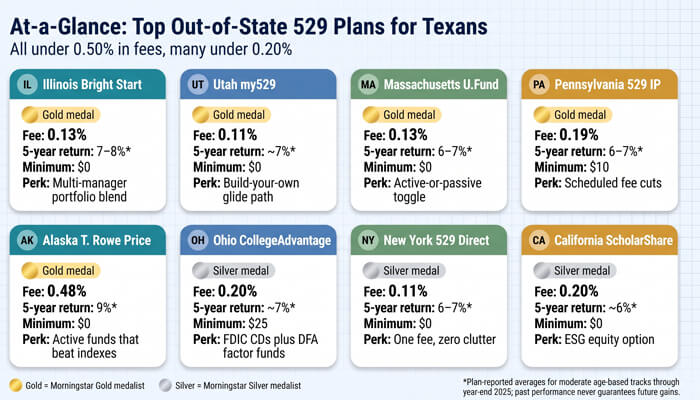
Numbers speak louder than prose, so here is a side-by-side view of all eight winners.
| Plan | Morningstar medal | Index-track fee | 5-year return* | Minimum to open | Standout perk |
| Illinois Bright Start | Gold | 0.13% | 7–8% | $0 | Multi-manager portfolio blend |
| Utah my529 | Gold | 0.11% | ~7% | $0 | Build-your-own glide path |
| Massachusetts U.Fund | Gold | 0.13% | 6–7% | $0 | Active-or-passive toggle |
| Pennsylvania 529 IP | Gold | 0.19% | 6–7% | $10 | Scheduled fee cuts |
| Alaska T. Rowe Price | Gold | 0.48% | 9% | $0 | Active funds that beat indexes |
| Ohio CollegeAdvantage | Silver | 0.20% | ~7% | $25 | FDIC CDs plus DFA factor funds |
| New York 529 Direct | Silver | 0.11% | 6–7% | $0 | One fee, zero clutter |
| California ScholarShare | Silver | 0.20% | ~6% | $0 | ESG equity option |
*Returns are plan-reported averages for moderate age-based tracks through year-end 2025; past performance never guarantees future gains.
Every plan in the table charges under half a percent, five land below 0.20 percent, and all eight pair low costs with solid long-term growth. Refer to this snapshot when selecting the plan that matches your style.
Opening and funding your plan in under 20 minutes
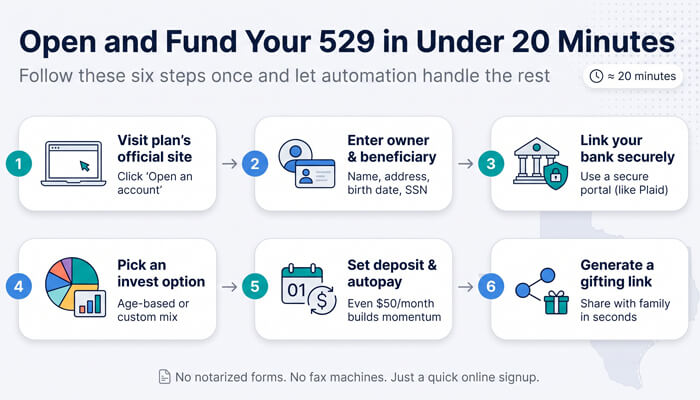
You have your shortlist; now it is time to act. Each plan follows the same streamlined playbook.
1. Visit the plan’s official site and select “Open an account.”
2. Enter owner and beneficiary details. Provide legal name, address, birth date, and SSN.
3. Link your bank. Most plans use a secure portal such as Plaid, so routing numbers populate automatically.
4. Pick an investment option. Choose the age-based fund for set-and-forget or build a custom mix.
5. Set an initial deposit and schedule autopay. Even fifty dollars a month builds momentum.
6. Generate a gifting link. Text or email it to relatives before you forget.
No notarized forms or fax machines required. If you already hold a Texas 529, request a trustee-to-trustee rollover—allowed once every twelve months—then relax while the new plan handles the paperwork.
Texas-sized FAQs
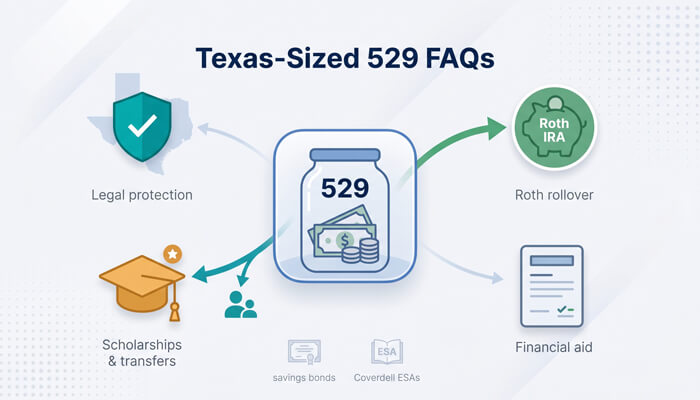
1. Do I lose legal protection if my 529 lives outside Texas?
No. State law shields any qualified tuition plan you own, whether it sits in Utah or Austin, from creditors.
2. Can I roll unused 529 dollars into my child’s retirement?
Yes. Under SECURE 2.0, up to $35,000 of 529 assets held at least fifteen years may transfer into the beneficiary’s Roth IRA within annual contribution limits.
3. Could an out-of-state plan hurt our chance at Texas tuition grants?
No. FAFSA treats all parent-owned 529s the same, and Texas aid formulas ignore them.
4. Is it smart to open two plans for one child?
One low-fee plan usually does the job; extra logins add complexity without improving returns.
5. What if my student earns a full scholarship?
You may withdraw the matching amount without penalty or assign the 529 to another family member.
6. Are Coverdell ESAs or savings bonds better than a 529?
They serve niches, yet low contribution limits and income caps reduce their impact. A well-chosen 529 offers higher limits, easy management, and the new Roth rollover option in one wrapper.
Conclusion
You now have eight low-fee, top-medal alternatives to Texas’s costly direct plan, plus the exact rubric we used to rank them. Pick the option whose fees, flexibility, and digital experience best fit your family, open it tonight in under twenty minutes, and let those college dollars start compounding tax-free.
