


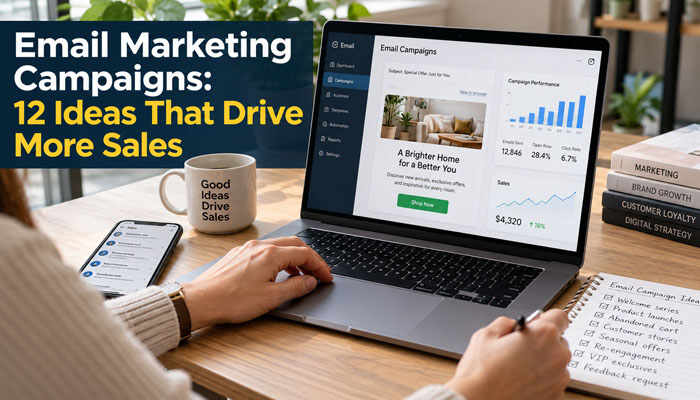

Email marketing campaigns help businesses attract customers, generate leads, increase sales, and encourage repeat purchases. However, sending promotional emails alone is not enough. Successful campaigns deliver relevant messages to the right audience at the right time.
From welcome emails and personalized recommendations to abandoned cart reminders and customer loyalty programs, businesses can use different campaigns to achieve specific marketing goals.
This guide explores 12 effective email marketing campaigns, real brand examples, automation strategies, email templates, performance benchmarks, and practical steps to improve conversions and grow revenue.
Quick Answer
The most effective email marketing campaigns include welcome sequences, abandoned cart reminders, lead nurturing emails, personalized product recommendations, promotional offers, and customer retention messages.
Businesses can improve results by building permission-based email lists, segmenting subscribers, delivering valuable content, and tracking conversions. Automated campaigns are especially useful because they respond to customer actions and purchasing interests.
Key Takeaways
- Email marketing campaigns help businesses generate leads, increase conversions, and strengthen customer relationships.
- Welcome emails, product launches, cart recovery messages, and loyalty campaigns serve different business goals.
- Audience segmentation and personalization make email communications more relevant.
- Automated email campaigns can generate more attributed revenue per message than general promotional broadcasts.
- Effective subject lines, useful content, and clear calls to action encourage customer engagement.
- Conversion rates, revenue per recipient, and customer retention provide meaningful performance insights.
- Proper email authentication, list management, and unsubscribe compliance support long-term deliverability.
- Businesses should continuously test and improve campaigns instead of relying on one marketing approach.
What Is Email Marketing?
Email marketing is a digital marketing strategy that businesses use to promote products, share updates, generate leads, increase sales, and build lasting customer relationships through email. It involves sending targeted messages to subscribers based on their interests, preferences, and purchasing behavior.
Businesses use email marketing to welcome new customers, announce products, offer discounts, recover abandoned carts, and encourage repeat purchases. These messages may be sent manually or through automated email marketing campaigns.
For example, an online clothing store might send a welcome email to new subscribers, personalized product recommendations to existing customers, and special offers during seasonal sales.
The main benefits of email marketing include:
- Building stronger customer relationships
- Generating qualified leads
- Increasing product and service sales
- Encouraging repeat purchases
- Delivering personalized promotions
- Improving customer retention
- Tracking campaign performance
Successful email marketing focuses on sending relevant messages to the right audience at the right time while respecting subscriber preferences and applicable marketing rules.
What Are Email Marketing Campaigns?
Email marketing campaigns are planned promotional, informational, or relationship-building messages sent to a selected audience to achieve a measurable business objective. Companies use these campaigns to introduce products, share useful information, generate qualified leads, recover abandoned purchases, and encourage customer loyalty.
Some campaigns are scheduled for particular dates, while others are automatically triggered by customer actions. For example, an e-commerce retailer may send a seasonal promotion to interested subscribers. A software company may deliver onboarding emails after someone registers for a free trial. Both examples involve email marketing campaigns, but their objectives and audiences are different.
How Do Email Marketing Campaigns Work?
Most successful email campaigns follow a structured process.
- Build an audience: Collect email addresses through appropriate subscription methods.
- Segment subscribers: Group customers according to interests, preferences, or purchasing behavior.
- Define campaign goals: Identify the desired action, such as a purchase, registration, or booking.
- Create relevant content: Develop useful messages supported by clear calls to action.
- Schedule delivery: Send emails at planned times or trigger automated workflows.
- Track performance: Monitor clicks, conversions, revenue, and customer responses.
- Improve results: Use campaign data to identify opportunities for improvement.
The objective is not simply to send more emails. It is to provide information and offers that customers find relevant.
Why Are Email Marketing Campaigns Important for Business Growth?
Email provides businesses with a direct communication channel to subscribers who have expressed interest in their products, services, or expertise. Unlike organic social media content, email allows marketers to contact defined customer segments without depending entirely on social platform algorithms. However, successful inbox delivery still depends on sender reputation, message relevance, and technical authentication.
Main Benefits of Email Marketing Campaigns
| Benefit | How It Helps Businesses |
| Lead generation | Converts interested visitors into potential customers |
| Sales growth | Encourages purchases through relevant offers |
| Customer retention | Maintains relationships with existing buyers |
| Personalization | Delivers content based on customer preferences |
| Automation | Reduces repetitive marketing activities |
| Brand awareness | Keeps a business visible to subscribers |
| Customer loyalty | Encourages repeat purchases and referrals |
| Performance tracking | Measures engagement, conversions, and revenue |
| Cost efficiency | Supports targeted communication and scalable workflows |
What Does Recent Email Marketing Research Show?
Recent industry research highlights the commercial importance of automation.
According to Omnisend’s 2026 email marketing benchmarks, based on email activity during 2025 across more than 27,000 brands:
- Standard campaigns generated an average of $0.155 in attributed revenue per email sent.
- Automated emails generated approximately $3.41 per email.
- Standard campaigns recorded a 08% conversion rate.
- Automated messages recorded a 49% conversion rate.
These figures represent the provider’s analyzed e-commerce dataset and should not be treated as guaranteed business results. The findings suggest that customer behavior, relevant timing, and personalization can play important roles in campaign performance.
How to Build an Email List for Marketing Campaigns
A relevant subscriber list is the foundation of successful email marketing campaigns. Instead of collecting as many email addresses as possible, businesses should focus on attracting people who genuinely want information about their offerings.
Effective Ways to Grow an Email List
- Website signup forms: Add subscription forms to relevant website pages.
- Lead magnets: Offer downloadable ebooks, checklists, templates, or useful reports.
- Landing pages: Create dedicated pages explaining the value of subscribing.
- Webinars and events: Invite interested participants to register for future marketing updates.
- Checkout subscriptions: Provide an appropriate choice to receive promotional communications.
- Blog subscriptions: Allow readers to receive updates about topics that interest them.
- Social media promotion: Direct interested followers to a dedicated signup page.
For example, a business consulting company could offer a free startup budgeting template to visitors who subscribe to its newsletter. This approach helps attract people already interested in business planning, making future communications more relevant.
Single Opt-In vs. Double Opt-In
Businesses commonly use two subscription methods.
| Feature | Single Opt-In | Double Opt-In |
| Registration | One signup form | Sign-up plus email confirmation |
| Convenience | Faster registration | Requires an additional step |
| Verification | Address not automatically confirmed | Confirms access to the address |
| Main advantage | Lower signup friction | Helps improve list accuracy |
| Main drawback | Greater risk of invalid signups | Some subscribers may not confirm |
Double opt-in can help reduce unwanted or incorrect subscriptions, but it is not universally required by law. Businesses should follow applicable marketing regulations and maintain appropriate records of permission.
Why Buying Email Lists Is Risky
Purchased email lists may contain outdated addresses, uninterested contacts, or people who never agreed to receive promotional messages.
Possible consequences include:
- High bounce rates
- Spam complaints
- Poor customer engagement
- Deliverability problems
- Legal compliance risks
- Damage to sender reputation
Best practice: Build permission-based email lists and prioritize interested subscribers over list size.
How Email Marketing Campaigns Support the Sales Funnel
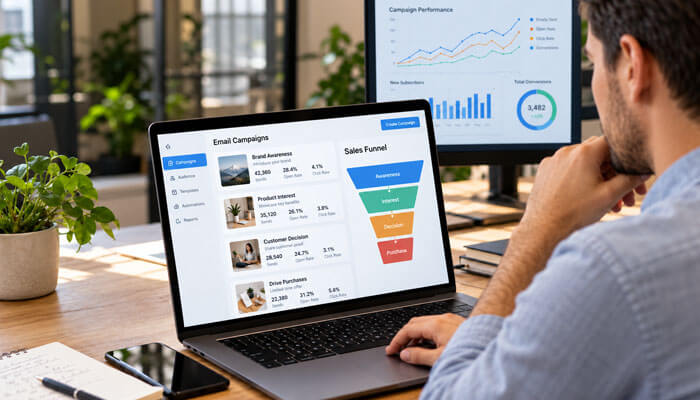
Customers usually move through several stages before making a purchase. They may discover a business, research solutions, compare products, complete a purchase, and eventually become repeat buyers.
Different email marketing campaigns can support customers throughout this journey.
| Customer Journey Stage | Customer Need | Recommended Email Campaign |
| Awareness | Understand a problem | Educational newsletter |
| Interest | Explore possible solutions | Welcome and lead nurturing emails |
| Consideration | Compare products or services | Case studies and demonstrations |
| Conversion | Complete a purchase | Promotional and cart recovery emails |
| Retention | Continue receiving value | Post-purchase and renewal emails |
| Loyalty | Maintain the relationship | VIP rewards and referrals |
| Reactivation | Reconnect with a business | Win-back campaigns |
For example, a software startup might attract subscribers through a free productivity guide. The company could then send educational messages, explain relevant software features, share customer experiences, and invite interested prospects to begin a trial.
After a purchase, onboarding and renewal emails can help maintain the relationship. This approach connects email marketing campaigns with actual customer needs rather than treating every email as a sales promotion.
12 Best Email Marketing Campaigns to Drive More Sales
The best email marketing campaigns combine useful information, clear business objectives, and appropriate timing.
Different campaigns address customer acquisition, purchase decisions, and retention.
Overview of the 12 Email Marketing Campaign Ideas
| Campaign Type | Main Objective | Target Audience |
| 1. Welcome emails | Introduce the business | New subscribers |
| 2. Educational newsletters | Build trust | Interested readers |
| 3. Lead nurturing | Convert prospects | Potential customers |
| 4. Product launches | Generate product interest | Relevant subscribers |
| 5. Limited-time promotions | Encourage purchases | Offer-responsive customers |
| 6. Abandoned cart recovery | Recover incomplete purchases | Cart abandoners |
| 7. Personalized recommendations | Increase relevant sales | Browsers and buyers |
| 8. Post-purchase follow-ups | Improve customer experience | Recent customers |
| 9. Replenishment and renewal | Encourage recurring purchases | Existing customers |
| 10. Win-back campaigns | Re-engage customers | Inactive subscribers |
| 11. Loyalty and VIP rewards | Improve retention | Repeat buyers |
| 12. Referral campaigns | Attract new customers | Satisfied customers |
1. Welcome Email Marketing Campaigns
Welcome emails introduce new subscribers to a business and establish expectations for future communication. These messages are often the first interaction after someone subscribes to a newsletter, registers for an account, or requests information. Successful welcome email marketing campaigns explain the value of the business and provide a useful next step.
Example: An online clothing store introduces its popular collections and provides shopping recommendations for new subscribers.
Subject line: Welcome! Here’s What You Can Expect From Us
Call to action: Explore Our Collection
What to Include in Welcome Emails
- A friendly brand introduction
- A reminder of why the person subscribed
- The benefits of receiving future messages
- Useful resources or popular products
- One clear call to action
Example Welcome Email Sequence
| Suggested Timing | Purpose | |
| Email 1 | Immediately after signup | Welcome the subscriber |
| Email 2 | 1–2 days later | Share helpful resources |
| Email 3 | 3–5 days later | Address common customer questions |
| Email 4 | Based on engagement | Introduce a relevant offer |
These timings are starting points for testing, not universal rules.
Best practice: Deliver promised signup incentives immediately and adjust follow-up messages when a subscriber makes a purchase.
Success metric: First-purchase conversion rate or completion of the intended next step.
2. Educational Newsletter Email Campaigns
Educational newsletters share useful information that helps subscribers solve problems, understand industry developments, or make informed decisions. These email marketing campaigns are especially useful for consulting companies, agencies, SaaS startups, and professional service businesses.
Example: A digital marketing agency sends weekly SEO tips with links to practical tutorials.
Subject line: 5 Website Mistakes That Could Be Costing You Leads
Call to action: Read the Full Guide
Educational newsletters may include:
- Industry news
- Practical tutorials
- Expert insights
- Research findings
- Product usage tips
- Customer questions
- New blog articles
How Educational Newsletters Generate Sales
Educational content can help potential customers understand their challenges and evaluate possible solutions. Over time, useful communication may strengthen trust in a business and encourage subscribers to consider its products or services.
Best practice: Focus on providing valuable information rather than turning every newsletter into a promotion.
Success metric: Qualified website visits, meaningful engagement, and assisted conversions.
3. Lead Nurturing Email Marketing Campaigns
Lead nurturing campaigns guide potential customers through the purchasing process. Not everyone who downloads a guide or visits a pricing page is ready to buy immediately.
Some prospects need additional information about features, benefits, pricing, or implementation.
Example: A project management software company sends a sequence of educational emails to people who download its workflow planning guide.
Subject line: Still Managing Projects Manually? Try These 3 Improvements
Call to action: See How It Works
Example Lead Nurturing Sequence
- Explain a common customer problem.
- Share practical ways to address it.
- Demonstrate how the product helps.
- Present a relevant customer case study.
- Invite interested prospects to request a demonstration.
Effective lead nurturing email marketing campaigns use relevant customer signals to determine which information to send next. For example, someone downloading a beginner’s guide may need educational content, while a prospect repeatedly visiting a pricing page may be interested in a consultation.
Best practice: Match the message with the prospect’s buying stage.
Success metric: Qualified leads, demo bookings, or trial-to-paid conversions.
4. Product Launch Email Marketing Campaigns
Product launch emails introduce new products, services, features, or collections to interested subscribers. These campaigns are useful for ecommerce brands, technology startups, educational businesses, and service providers.
Example: A SaaS company launches a new automated invoicing feature.
Subject line: Introducing a Faster Way to Manage Your Invoices
Call to action: Explore the New Feature
Three Stages of a Product Launch Campaign
Before launch: Introduce the upcoming product and explain the customer problem it addresses.
Launch day: Announce availability, features, pricing, and practical benefits.
After launch: Answer questions, demonstrate uses, and address purchasing concerns.
Successful product launch email marketing campaigns focus on customer benefits rather than simply listing technical specifications. For example, instead of only describing automation features, an invoicing software company could explain how the product reduces manual payment follow-ups.
Best practice: Send announcements to subscribers interested in the relevant category.
Success metric: Product purchases, feature adoption, or qualified trial signups.
5. Limited-Time Promotional Email Campaigns
Promotional emails encourage purchasing decisions through relevant offers. Examples include discounts, free shipping, product bundles, introductory pricing, and seasonal sales.
Example: A home accessories retailer offers free shipping on selected products during a weekend promotion.
Subject line: Free Shipping This Weekend on Selected Home Essentials
Call to action: Shop Eligible Products
Elements of Effective Promotional Emails
- A clearly explained offer
- Accurate product information
- Transparent eligibility conditions
- Genuine promotional deadlines
- A prominent call to action
- A relevant landing page
Promotional email marketing campaigns work best when subscribers understand the offer and its conditions. Avoid misleading discounts, fake countdown timers, and repeated final-chance messages for promotions that never actually end.
Businesses should also consider profitability. An increase in order volume does not necessarily improve profit when discounts and fulfillment costs are included.
Best practice: Evaluate the financial contribution of each promotion, not only the number of purchases.
Success metric: Incremental sales, contribution profit, and revenue per recipient.
6. Abandoned Cart Recovery Email Campaigns
Abandoned cart emails remind shoppers about products they selected but did not purchase. Customers may abandon checkout because of shipping costs, payment difficulties, uncertainty, or interruptions.
These email marketing campaigns help customers return to their carts when they are still interested.
Example: An online footwear retailer reminds customers about shoes remaining in their shopping carts.
Subject line: Your Selected Items Are Still Waiting
Call to action: Return to Your Cart
Example Abandoned Cart Email Sequence
| Suggested Timing | Purpose | |
| First reminder | 1–3 hours later | Remind customers about selected products |
| Second reminder | Around 24 hours later | Address purchasing concerns |
| Final follow-up | 48–72 hours later | Offer assistance or a justified incentive |
These timings should be tested according to customer behavior, communication preferences, and relevant marketing permissions.
How to Improve Cart Recovery
- Include accurate product information.
- Display relevant product images.
- Provide a direct link to the saved cart.
- Explain shipping and return conditions.
- Offer assistance with checkout problems.
- Stop reminders when purchases are completed.
- Test discounts rather than automatically offering them.
Best practice: Compare reminder-only messages with incentive-based versions to determine which creates greater incremental profit.
Success metric: Recovered orders and incremental contribution profit.
7. Personalized Product Recommendation Campaigns
Personalized recommendation emails suggest relevant products based on customer interests and information collected and used appropriately. Businesses may consider previous purchases, preferred categories, and permitted browsing activity.
Example: A skincare retailer recommends complementary products based on a customer’s earlier purchases.
Subject line: Products Selected for Your Skincare Routine
Call to action: View Your Recommendations
Common Personalization Methods
| Customer Information | Suggested Email |
| Previous purchase | Compatible accessories |
| Preferred category | Relevant new arrivals |
| Product browsing | Related product information |
| Purchase frequency | Replenishment suggestions |
| Declared interests | Personalized educational resources |
| Membership status | Eligible customer benefits |
Successful personalized email marketing campaigns go beyond adding a customer’s first name to a subject line. They focus on providing information and recommendations that match customer needs.
Browse Abandonment Emails
Browse abandonment messages target eligible, identifiable subscribers who viewed products without adding them to a cart. For example, a furniture retailer could send additional information about an office desk a subscriber recently examined. These campaigns should respect applicable tracking permissions and privacy choices.
Back-in-Stock Emails
Back-in-stock alerts notify interested customers when previously unavailable products become available again.
Subject line: Good News! Your Favorite Item Is Back
According to Omnisend’s 2026 benchmark report, back-in-stock automations generated an average of $9.14 in attributed revenue per email sent and a 6.72% conversion rate within its analyzed dataset.
Price-Drop Alerts
Price-drop messages notify interested subscribers when relevant products become cheaper. These campaigns can be useful for electronics, furniture, fashion, and other comparison-driven purchases.
Best practice: Use personalization responsibly and avoid recommendations that feel intrusive.
Success metric: Product conversions and revenue per recipient.
8. Post-Purchase Email Marketing Campaigns
Post-purchase emails maintain communication after a customer completes an order. These messages can improve customer satisfaction, support product use, and encourage repeat purchases.
Example: A fitness equipment retailer sends setup instructions after a customer purchases exercise equipment.
Subject line: Get More From Your New Fitness Equipment
Call to action: View Your Setup Guide
Useful Post-Purchase Email Ideas
- Product setup instructions
- Maintenance recommendations
- Educational tutorials
- Customer satisfaction surveys
- Review requests
- Related product recommendations
- Service reminders
Effective post-purchase email marketing campaigns prioritize customer support before introducing additional promotions. Businesses should distinguish transactional messages, such as receipts and shipping confirmations, from marketing communications. Adding promotional content to transactional messages can affect how the email is legally classified.
Best practice: Send follow-ups that match the customer’s actual product experience.
Success metric: Repeat purchase rate, customer satisfaction, and product engagement.
9. Replenishment and Subscription Renewal Campaigns
Replenishment emails remind customers when they may need another supply of a regularly used product. Renewal emails support subscription-based products, memberships, service agreements, and software licenses.
Example: A coffee retailer reminds customers when their previously purchased coffee may be running low.
Subject line: Running Low on Coffee? Reorder Your Favorite Blend
Call to action: Reorder Your Coffee
Products suitable for replenishment campaigns include:
- Coffee and tea
- Skincare products
- Pet supplies
- Household essentials
- Subscription products
- Maintenance services
How to Choose Replenishment Timing
Businesses should examine purchase history, typical product usage, and customer preferences. A customer purchasing coffee monthly may benefit from a reminder near the expected reorder date.
However, not every customer consumes products at the same rate. Renewal email marketing campaigns should accurately explain relevant pricing, renewal dates, cancellation terms, and any required notices.
Best practice: Make reordering convenient without creating unnecessary pressure.
Success metric: Repeat purchase rate, renewal rate, and customer retention.
10. Win-Back Email Marketing Campaigns
Win-back campaigns reconnect with customers who have stopped purchasing or engaging. Their purpose is to determine whether customers remain interested and offer relevant reasons to return.
Example: A meal delivery company introduces new menu options to customers who have not ordered recently.
Subject line: Ready to Try Something New? See Our Latest Menu
Call to action: Explore What’s New
Example Win-Back Email Sequence
Email 1: Reintroduce the brand and explain what has changed.
Email 2: Share relevant products, useful resources, or an appropriate offer.
- Email 3: Invite subscribers to update their communication preferences or unsubscribe.
How to Identify Inactive Customers
Customer inactivity depends on purchasing behavior. Someone who orders groceries weekly has a different buying cycle from a customer purchasing furniture once a year.
Businesses should use actual purchase history and meaningful engagement signals rather than one universal inactivity period. Well-planned win-back email marketing campaigns can help businesses identify reactivation opportunities while improving list quality.
Best practice: Stop unnecessary follow-ups when subscribers remain persistently inactive.
Success metric: Reactivated customers and repeat purchases.
11. Customer Loyalty and VIP Email Campaigns
Loyalty campaigns reward existing customers and encourage continued relationships. These email marketing campaigns are useful for businesses with repeat purchasing opportunities.
Example: An online bookstore gives loyal customers early access to selected new releases.
Subject line: Your Member Benefits Are Ready to Explore
Call to action: View Your Benefits
Common loyalty incentives include:
- Reward points
- Early product access
- Member-only offers
- Birthday benefits
- Exclusive educational resources
- Personalized appreciation messages
How to Measure Loyalty Campaign Success
Businesses should examine repeat purchase frequency, customer retention, reward redemption, and profitability. A loyalty campaign is not automatically successful because subscribers open or click its messages.
Best practice: Offer benefits customers genuinely value and explain all eligibility conditions clearly.
Success metric: Retention, repeat purchase frequency, and reward redemption.
12. Referral Email Marketing Campaigns
Referral campaigns encourage satisfied customers to recommend a business to other potential buyers. These campaigns can help attract customers through existing relationships.
Example: A software company offers eligible customers account credit when a referred business purchases a qualifying subscription.
Subject line: Know a Team That Could Use Our Software?
Call to action: Share Your Referral Link
How to Create a Referral Campaign
- Define eligible customers.
- Explain the referral benefits.
- Provide unique referral links or codes.
- Establish clear qualification conditions.
- Track successful referrals.
- Deliver rewards according to the stated rules.
Successful referral email marketing campaigns make participation straightforward without encouraging unsolicited bulk messaging. Businesses should not automatically send promotional emails to customers’ friends without an appropriate legal basis. Material referral incentives may also need disclosure.
Best practice: Measure the acquisition cost, retention, and profitability of referred customers.
Success metric: Qualified referrals and referred-customer acquisition cost.
Real-World Examples of Successful Email Marketing Campaigns
Real brand examples help businesses understand how email segmentation, automation, and timing work in practice. The following cases come from published platform or agency reports. Their figures represent reported performance and platform-attributed revenue rather than independently verified incremental sales.
Example 1. Cheeky Wipes Uses Personalized Email Campaigns
Cheeky Wipes, a reusable personal care products brand, uses subscriber preferences to personalize its marketing communication.
According to its published Klaviyo case study, the business collects customer interests during signup and uses that information in welcome sequences, abandoned cart messages, and post-purchase emails.
The case study reports:
- 47% of revenue attributed to Klaviyo
- 16% placed-order rate from the welcome flow
- 8% conversion rate from abandoned cart messages
The company also tailors recommendations according to the categories customers are interested in.
Key lesson: Personalized email marketing campaigns should reflect actual customer needs rather than sending identical content to everyone.
Source: Klaviyo Cheeky Wipes Case Study
Example 2. Stair Warehouse Uses Automated Customer Follow-Ups
Stair Warehouse used multiple automated email flows to reconnect with interested shoppers. In a case study published March 11, 2026, Ventura Web Design reported the following Klaviyo-attributed revenue over six months.
| Automated Campaign | Reported Attributed Revenue |
| Abandoned cart | $357,524.68 |
| Welcome series | $47,752.54 |
| Browse abandonment | $4,508.07 |
| Post-purchase review | $2,319.12 |
The agency reported $412,932.88 in total email-attributed revenue during the period. These results do not prove that every attributed purchase was caused by email marketing.
Key lesson: Businesses can develop several relevant email marketing campaigns around customer actions instead of relying exclusively on promotional newsletters.
Source: Stair Warehouse Email Marketing Case Study
Example 3. Grind Combines Cart Recovery and Replenishment Emails
Coffee brand Grind uses different abandoned cart workflows for one-time purchases and subscriptions. Its published Klaviyo case study reports a 12.3% average conversion rate for its general abandoned cart sequence.
The flow generated 41% of revenue attributed to its automated emails. Grind also sends replenishment reminders based on estimated coffee consumption periods.
Key lesson: Businesses selling regularly used products can combine abandoned cart recovery with timely reorder reminders.
Source: Klaviyo Grind Case Study
Which Email Marketing Campaigns Work Best for Different Businesses?
The most effective email marketing campaigns depend on business type, customer purchasing behavior, and marketing objectives.
| Business Type | Recommended Campaigns | Main Goal |
| Ecommerce store | Welcome, cart recovery, recommendations | Increase purchases |
| SaaS startup | Lead nurturing, onboarding, renewal | Improve paid conversions |
| B2B agency | Educational newsletters, case studies | Generate qualified leads |
| Local service business | Customer follow-ups, loyalty | Encourage repeat bookings |
| Online course creator | Educational sequences, course launches | Increase enrollments |
| Subscription company | Renewal, replenishment, win-back | Improve customer retention |
| Retail brand | Product launches, VIP rewards | Encourage repeat sales |
| Professional consultant | Educational content, lead nurturing | Generate consultations |
A small business does not need to launch all 12 campaign types immediately.
It is usually better to begin with campaigns addressing the most important customer acquisition or retention opportunities.
Best Tools for Creating Email Marketing Campaigns
Email marketing software helps businesses manage subscribers, design messages, build automated workflows, and measure results.
Choosing the right platform depends on audience size, campaign complexity, integrations, and available budget.
Popular Email Marketing Platforms
| Platform | Notable Features | Suitable For |
| Mailchimp | Campaign design, segmentation, reporting | General business marketing |
| Klaviyo | Ecommerce data and automated customer journeys | Online retailers |
| Omnisend | Ecommerce email, automation, SMS capabilities | Retail businesses |
| Brevo | Email marketing, automation, transactional messaging | Growing businesses |
| MailerLite | Newsletters, signup forms, landing pages | Small businesses and creators |
These are examples of established platforms, not an independent ranking of their performance.
How to Choose Email Marketing Software
Before selecting a platform, consider:
- Subscriber and sending limits
- Segmentation capabilities
- Email automation workflows
- Mobile-responsive templates
- CRM and ecommerce integrations
- Conversion reporting
- A/B testing
- Authentication support
- Unsubscribe and consent management
- Customer service
- Pricing scalability
The best platform is the one that supports the business’s actual marketing requirements.
How Much Do Email Marketing Campaigns Cost?
The cost of email marketing campaigns depends on subscriber count, software features, sending frequency, content production, automation, and technical support.
Some businesses start with free email marketing tools, while others invest in paid platforms and professional campaign management.
Main Email Marketing Expenses
| Expense | What It Covers |
| Marketing platform | Campaign sending and subscriber management |
| Copywriting | Subject lines, email content, promotional offers |
| Email design | Templates, branding, mobile layouts |
| Automation | Workflow creation and integrations |
| List management | Signup forms and subscriber maintenance |
| Analytics | Tracking, testing, and reporting |
| Technical support | Deliverability and troubleshooting |
Free Email Marketing Software Options
As of October 2026:
- Mailchimp Free: Up to 250 contacts and 500 monthly email sends, with a maximum of 250 sends per day.
- MailerLite Free: Up to 250 active subscribers and 2,500 monthly emails.
Additional feature restrictions apply, and providers may change their plans.
Example Monthly Email Marketing Budget
Consider a hypothetical small business with a $500 monthly marketing budget.
| Activity | Illustrative Budget |
| Email marketing software | $75 |
| Content creation | $175 |
| Campaign design | $100 |
| Automation and testing | $100 |
| Reporting and maintenance | $50 |
| Total | $500 |
These figures are a planning example, not verified market pricing.
Businesses should evaluate whether their email marketing campaigns generate enough incremental customer value to justify the investment.
How to Create Successful Email Marketing Campaigns Step by Step
Creating effective campaigns requires a clear objective, relevant audience, useful message, and reliable performance measurement.
Step 1. Set a Specific Campaign Goal
Every campaign should have one primary objective.
Common goals include:
- Increasing product sales
- Generating qualified leads
- Encouraging repeat purchases
- Booking consultations
- Improving free-trial conversions
- Recovering abandoned orders
A clear goal determines the audience, message, CTA, and measurement strategy.
Step 2. Segment Your Audience
Audience segmentation divides subscribers into smaller groups based on relevant characteristics.
| Segment | Recommended Message |
| New subscriber | Welcome and introduction |
| Interested prospect | Educational content |
| First-time customer | Onboarding and support |
| Repeat buyer | Relevant recommendations |
| At-risk customer | Win-back message |
| Loyal customer | Rewards and appreciation |
Use RFM Segmentation for Advanced Campaigns
RFM stands for:
- Recency: How recently a customer purchased
- Frequency: How often they purchase
- Monetary value: How much they have spent
Businesses can use these indicators to identify loyal customers, occasional buyers, high-value customers, and people who may need re-engagement.
RFM thresholds should reflect the business’s actual purchasing cycle.
Step 3. Select the Appropriate Campaign Type
Match the campaign with the customer’s current needs.
A new subscriber may benefit from a welcome sequence, while an existing customer may respond better to replenishment reminders or helpful product recommendations.
Step 4. Write an Effective Subject Line
Subject lines should clearly communicate the content’s value.
Examples include:
- 3 Ways to Improve Your Marketing Workflow
- Your Guide to Choosing Better Business Software
- Explore Our Latest Product Collection
- Your Upcoming Subscription Renewal
- Your Shopping Cart Is Ready When You Are
Avoid exaggerated claims, misleading urgency, or promises that the email does not fulfill.
Step 5. Create Relevant Email Content
An effective email usually includes:
- An opening explaining why the message matters.
- Useful information or a relevant offer.
- Supporting details or customer benefits.
- One clear call to action.
Keep paragraphs concise and focus on what the customer needs to know.
Step 6. Add a Clear Call to Action
Common email CTAs include:
- Shop the Collection
- Book a Consultation
- Start Your Free Trial
- Read the Full Guide
- Complete Your Purchase
- Register for the Webinar
The destination page should match the promise made in the email.
Step 7. Optimize Emails for Mobile Devices
Email marketing campaigns should remain readable across phones, tablets, and desktop devices.
Use responsive layouts, clear typography, sufficient contrast, accessible buttons, and meaningful alternative text for informative images.
Provide a readable plain-text alternative.
Step 8. Choose Sending Time and Frequency
There is no universal best sending time for every business.
Test different delivery windows according to audience location, customer behavior, and campaign objectives.
Avoid sending several overlapping messages to the same subscriber without a useful reason.
Step 9. Test Before Sending
Check:
- Subject line and preview text
- Sender name and reply-to details
- Personalization fields
- Product information and pricing
- Links and landing pages
- Mobile responsiveness
- Tracking parameters
- Unsubscribe options
- Automation triggers
- Audience exclusions
Step 10. Measure Results and Improve
Review campaign performance against its original objective.
If subscribers click but rarely purchase, examine the landing page, offer, pricing, and checkout experience.
If engagement is weak, reconsider audience relevance, content, timing, and deliverability.
Successful email marketing campaigns improve through continuous testing and analysis.
A Practical Email Marketing Campaign Blueprint
Businesses can use a repeatable campaign framework to organize messages and measure results.
Example: Launching a New Software Feature
| Campaign Element | Example |
| Business goal | Increase qualified free-trial signups |
| Audience | Prospects interested in workflow management |
| Campaign type | Product launch |
| Customer problem | Excessive manual administrative work |
| Core benefit | Simplify repetitive business tasks |
| Subject line | Spend Less Time on Repetitive Work |
| Preview text | See how our new workflow feature can simplify daily tasks |
| Main CTA | Try the New Feature |
| Landing page | Dedicated feature and signup page |
| Main KPI | Qualified trial registrations |
| Secondary KPI | Trial-to-paid conversion rate |
Example Campaign Email
Subject: Spend Less Time on Repetitive Work
Preview text: See how our new workflow feature can simplify daily tasks.
Hi [First Name],
Managing repetitive tasks can take time away from more important work.
We’ve introduced a new workflow feature designed to help teams simplify routine activities and stay organized.
With this update, you can:
- Organize recurring tasks
- Reduce unnecessary manual steps
- Keep important activities visible
Explore the feature and see whether it fits your team’s workflow.
CTA: Try the New Feature
Best regards,
The [Company Name] Team
How to Evaluate This Campaign
Track qualified trial registrations, feature adoption, and eventual paid conversions.
For larger campaigns, a randomized control group can help estimate how many additional conversions resulted from the email.
This provides stronger evidence than relying only on platform-attributed revenue.
Email Marketing Campaigns vs. Email Automation
Scheduled campaigns and automated email sequences both support marketing strategies, but they operate differently.
| Feature | Scheduled Email Campaign | Automated Email Sequence |
| Trigger | Planned sending time | Customer action or condition |
| Example | Monthly newsletter | Welcome email after signup |
| Audience | Selected subscriber segment | Contacts meeting workflow rules |
| Timing | Marketer-controlled | Event-driven |
| Main benefit | Broad communication | Timely customer follow-ups |
Businesses can combine both approaches.
Scheduled email marketing campaigns communicate product announcements and educational content, while automation provides timely information after specific customer actions.
How to Use AI in Email Marketing Campaigns
Artificial intelligence can support campaign planning, content creation, segmentation, and performance analysis.
However, AI-generated messages still require human review.
Common AI Applications
| AI Application | Practical Use |
| Subject line generation | Create variations for testing |
| Copywriting assistance | Draft campaign content |
| Customer segmentation | Identify useful audience groups |
| Product recommendations | Suggest relevant products using permitted data |
| Send-time optimization | Estimate suitable delivery windows |
| Performance analysis | Summarize campaign results |
| Predictive modeling | Estimate purchase or churn likelihood |
| Localization | Adapt content for different audiences |
For example, an ecommerce retailer might use AI to draft separate messages for first-time customers and repeat buyers.
Automation can deliver approved messages when relevant conditions are met.
AI-assisted email marketing campaigns should still be checked for factual accuracy, customer relevance, brand consistency, and privacy compliance.
How to A/B Test Email Marketing Campaigns
A/B testing compares two email variations to determine which performs better against a defined objective.
Businesses can test subject lines, calls to action, offers, content length, and delivery times.
Email A/B Testing Examples
| Campaign Element | Version A | Version B |
| Subject line | Explore Our New Collection | New Products for Your Home |
| CTA | Shop Now | View the Collection |
| Content | Short email | Detailed explanation |
| Offer | Free shipping | Percentage discount |
| Design | Product-focused | Text-focused |
| Delivery time | Morning | Afternoon |
Example of an A/B Test
Suppose an online retailer wants to increase purchases from its email marketing campaigns.
It creates two versions with identical products and pricing.
Version A uses “Shop Now,” while Version B uses “Explore the Collection.”
The business then:
- Randomly divides eligible subscribers into comparable groups.
- Sends each version to the appropriate group.
- Measures completed purchases during a predefined period.
- Checks whether the difference is statistically meaningful.
- Reviews unsubscribe rates and other outcomes.
- Applies useful findings to future campaigns.
Test one major variable at a time when practical.
A small number of clicks is not enough to prove that one version is more effective.
How to Measure Email Marketing Campaign Performance
Businesses need reliable metrics to understand whether their email marketing campaigns generate meaningful results.
Important Email Marketing Metrics
| Metric | What It Measures |
| Delivery rate | Emails accepted by receiving servers |
| Open rate | Recorded email opens |
| Click-through rate | Click activity relative to delivered emails |
| Click-to-open rate | Click activity relative to recorded opens |
| Conversion rate | Recipients completing a defined action |
| Revenue per recipient | Attributed revenue divided by recipients |
| Unsubscribe rate | Recipients choosing to unsubscribe |
| Spam complaint rate | Recipients reporting messages as spam |
| ROI | Financial return relative to marketing costs |
Why Open Rates Are Not Enough
Email privacy features can make open tracking unreliable. For example, Apple’s Mail Privacy Protection limits the information senders can collect about recipients’ email-opening behavior. Businesses should therefore prioritize meaningful clicks, purchases, qualified leads, customer retention, and revenue.
How to Calculate Email Marketing ROI
A simplified revenue-based ROI formula is:
ROI = (Attributed Revenue − Campaign Cost) ÷ Campaign Cost × 100
For example, assume a business spends $500 on an email campaign and attributes $2,000 in sales to that campaign.
The calculation is:
($2,000 − $500) ÷ $500 × 100 = 300%
However, this simplified figure is not necessarily profit-based ROI.
Product costs, discounts, refunds, fulfillment expenses, and purchases that would have happened without the campaign also matter.
A stronger financial evaluation considers incremental contribution profit.
Track Email Campaigns With UTM Parameters
UTM parameters help marketers identify website traffic from individual campaigns.
Example:
https://www.example.com/shop?utm_source=newsletter&utm_medium=email&utm_campaign=summer_launch
Google Analytics can use these parameters to organize campaign traffic and related conversions. Consistent naming makes performance reports easier to compare.
Email Marketing Campaign Benchmarks for 2026
Email marketing benchmarks provide useful context, but performance varies by industry, audience, product, and campaign type.
The following figures come from Omnisend’s analysis of 2025 activity, published in May 2026.
| Metric | Standard Campaigns | Automated Emails |
| Open rate | 30.41% | 30.21% |
| Click-through rate | 0.74% | 4.66% |
| Conversion rate | 0.08% | 1.49% |
| Revenue per email sent | $0.155 | $3.41 |
| Unsubscribe rate | 0.20% | 0.59% |
Automated emails often reach customers at moments of specific interest, such as after abandoning a cart or requesting product availability information. However, standard campaigns and automated emails typically reach different audiences under different conditions.
Their performance differences do not prove that automation alone caused the additional conversions. Businesses should evaluate their own email marketing campaigns against relevant internal trends and comparable industry data.
Email Deliverability Best Practices for Marketing Campaigns
Email deliverability refers to whether messages successfully reach recipients’ mailboxes. Even well-designed email marketing campaigns cannot produce strong results when messages are rejected or regularly filtered as spam.
Understand SPF, DKIM, and DMARC
Three email authentication technologies help protect sending domains.
- SPF: Identifies systems authorized to send email for a domain.
- DKIM: Uses digital signatures to help verify message authenticity.
- DMARC: Uses SPF and DKIM alignment to establish domain authentication policies and reporting.
Gmail, Yahoo, and Outlook Sender Requirements
Major email providers have strengthened their requirements for high-volume senders.
| Provider | Important Requirements |
| Gmail | Authentication, low spam rates, and applicable one-click unsubscribe support |
| Yahoo | SPF, DKIM, DMARC for bulk senders, low complaint rates, and easy unsubscribe |
| Outlook.com | SPF, DKIM, and DMARC for domains sending more than 5,000 daily messages to consumer Outlook mailboxes |
Google’s additional bulk-sender requirements apply to senders reaching approximately 5,000 or more messages daily to personal Gmail accounts.
Google recommends keeping user-reported spam rates below 0.1% and preventing them from reaching 0.3% or higher. Yahoo requires bulk senders to maintain spam rates below 0.3% and honor unsubscribe requests within two days.
Gmail’s one-click unsubscribe requirement applies to covered marketing and promotional messages. A visible unsubscribe link in the email body alone does not satisfy the required one-click header implementation.
How to Improve Email Deliverability
- Send messages to contacts with appropriate permission or another valid legal basis.
- Maintain accurate subscriber lists.
- Remove invalid addresses.
- Monitor bounces and complaints.
- Authenticate sending domains.
- Use recognizable sender information.
- Provide easy unsubscribe options.
- Avoid unnecessary sending frequency.
- Increase sending volumes carefully.
- Review automation workflows regularly.
Monitor Campaigns With Google Postmaster Tools
Google Postmaster Tools helps eligible senders monitor outgoing email performance to personal Gmail accounts. Available information may include domain reputation, IP reputation, authentication results, spam complaints, delivery errors, and sender compliance. Some reports may not be available when sending volume is too low.
Email Marketing Laws and Compliance
Businesses must follow marketing and privacy regulations that apply to their recipients. Requirements differ by country, customer category, and communication purpose.
United States: CAN-SPAM Act
The CAN-SPAM Act establishes requirements for commercial email. Businesses must use accurate header information, avoid misleading subject lines, provide a valid physical postal address, and offer a clear opt-out mechanism.
Qualifying opt-out requests must be honored within 10 business days. The law also applies to business-to-business commercial email.
United Kingdom: UK GDPR and PECR
The UK’s Privacy and Electronic Communications Regulations generally require consent before unsolicited marketing emails are sent to individual subscribers. An existing-customer exception, commonly called the soft opt-in, may apply when all relevant conditions are met.
Rules for corporate subscribers differ, and applicable data protection obligations still apply. The Information Commissioner’s Office updated its electronic marketing guidance on April 28, 2026.
European Union: GDPR and ePrivacy Requirements
EU email marketing commonly requires prior consent, subject to applicable exceptions and national rules. Businesses must also respect relevant data protection obligations, withdrawal of consent, and objections to direct marketing. Using an established marketing platform does not automatically make every campaign compliant.
Three Ready-to-Use Email Marketing Campaign Templates
These templates provide practical starting points for different marketing objectives.
Template 1. Welcome Email Campaign
Subject: Welcome to [Brand Name]!
Preview text: Your first steps with [Brand Name] start here.
Hi [First Name],
Thanks for joining us.
At [Brand Name], we help customers [main customer benefit].
You’ll receive useful tips, product updates, and occasional offers related to your interests.
To get started, explore our most popular resources and see how we can help.
CTA: Explore Our Resources
Best regards,
The [Brand Name] Team
Template 2. Promotional Email Campaign
Subject: Save on Your Favorite Products This Weekend
Preview text: Explore selected products included in our latest offer.
Hi [First Name],
Looking for something new?
We’re offering [promotion details] on selected products through [accurate ending date].
Browse the eligible collection and choose the products that suit your needs.
CTA: Shop the Offer
Thanks,
The [Brand Name] Team
Template 3. Customer Re-Engagement Campaign
Subject: Here’s What’s New at [Brand Name]
Preview text: See our latest improvements and update your interests.
Hi [First Name],
It’s been a while since we last connected.
We’ve introduced [new feature, product, or benefit], and we thought you might find it useful.
Explore our latest updates or tell us which topics you would prefer to receive.
CTA: Explore What’s New
Best regards,
The [Brand Name] Team
Businesses should adapt these templates to actual products, customer permissions, brand voice, and applicable unsubscribe requirements.
A 30-Day Plan to Launch Email Marketing Campaigns
Businesses can establish an effective email marketing foundation without creating every possible campaign immediately.
Example 30-Day Email Marketing Plan
| Period | Main Activities | Expected Deliverable |
| Days 1–7 | Review subscribers, goals, permissions, authentication, and analytics | Campaign strategy |
| Days 8–14 | Create signup forms, email templates, and welcome automation | Subscriber onboarding |
| Days 15–21 | Launch one relevant sales or lead-generation campaign | Initial performance data |
| Days 22–30 | Analyze results, test improvements, and build another workflow | Optimization plan |
Example Monthly Email Marketing Calendar
| Week | Campaign | Target Audience | Objective |
| Week 1 | Educational newsletter | Interested subscribers | Build engagement |
| Week 2 | Product or service spotlight | Relevant prospects | Generate interest |
| Week 3 | Customer success story | Potential buyers | Build trust |
| Week 4 | Targeted promotional offer | Eligible customers | Encourage conversions |
Automated email marketing campaigns can continue operating alongside scheduled messages. Businesses should establish frequency limits and audience exclusions to prevent unnecessary communication overlap.
Common Email Marketing Campaign Mistakes to Avoid
Several mistakes can reduce campaign effectiveness and damage customer relationships.
- Sending identical messages to everyone: Different subscribers have different interests and purchasing needs.
- Using misleading subject lines: Deceptive messages reduce trust and may create compliance problems.
- Sending too many promotional emails: Excessive communication can increase unsubscribes and complaints.
- Ignoring mobile users: Difficult-to-read layouts create unnecessary friction.
- Using too many calls to action: Competing actions can distract from the main objective.
- Neglecting email authentication: Poor technical setup can affect deliverability.
- Buying unsuitable email lists: Low-quality contacts may damage sending reputation.
- Ignoring inactive subscribers: Repeated messages to uninterested contacts often provide little value.
- Relying entirely on open rates: Privacy features limit tracking reliability.
- Failing to test landing pages: Broken purchasing processes reduce conversions.
- Ignoring campaign costs: Higher sales do not automatically mean higher profit.
- Leaving automation unchecked: Outdated offers and incorrect triggers can harm the customer experience.
How to Improve Email Marketing Campaigns Over Time
Long-term campaign performance depends on understanding customers, testing improvements, and measuring meaningful outcomes. If subscribers click but rarely purchase, investigate the offer, product pricing, landing page, and checkout experience.
If engagement is weak, evaluate message relevance, frequency, audience segmentation, and deliverability. Businesses should also analyze performance by customer lifecycle stage.
Welcome emails should help new subscribers progress. Retention campaigns should support continued customer value. Win-back messages should focus on meaningful reactivation.
For larger email marketing campaigns, randomized control groups can help estimate incremental results rather than relying only on attributed revenue. The strongest marketing programs improve the customer experience while supporting sustainable business growth.
Conclusion
Successful email marketing campaigns combine valuable content, customer understanding, relevant timing, and measurable business objectives. Welcome sequences introduce subscribers, promotional emails encourage purchases, abandoned cart reminders recover missed opportunities, and loyalty campaigns strengthen customer relationships.
The 12 campaign ideas in this guide provide a practical foundation for startups, ecommerce stores, agencies, and established businesses. However, sending more emails is not automatically the best strategy. Businesses benefit from permission-based subscriber lists, meaningful segmentation, responsible automation, reliable deliverability, and continuous performance analysis.
Start with a few relevant email marketing campaigns, measure their contribution to sales and customer satisfaction, and expand your strategy based on actual results. The goal is not simply to reach more inboxes. It is to create stronger customer relationships and generate sustainable business growth.
Email Marketing Campaigns FAQs
1. What are the most effective email marketing campaigns?
The most effective email marketing campaigns often include welcome sequences, abandoned cart reminders, personalized recommendations, lead nurturing, and post-purchase emails. Their performance depends on the audience, business model, and message relevance.
2. How often should businesses send email marketing campaigns?
There is no universal sending frequency. Businesses should consider subscriber expectations, customer buying cycles, campaign value, and unsubscribe trends when choosing a schedule.
3. Can email marketing campaigns help small businesses?
Yes. Small businesses can use email marketing campaigns to generate leads, promote services, build customer relationships, and encourage repeat purchases without requiring a large marketing team.
4. Can email marketing campaigns increase sales without discounts?
Yes. Educational content, product demonstrations, personalized recommendations, customer reviews, and timely reminders can encourage purchases without reducing prices.
5. What is the difference between drip emails and email marketing campaigns?
Drip emails are automated sequences usually delivered according to predetermined conditions or intervals. Email marketing campaigns include scheduled newsletters, promotional messages, automated workflows, and customer engagement emails.
6. Can businesses start email marketing campaigns without a website?
Yes. Some platforms provide hosted signup forms and landing pages. Businesses still need an appropriate subscription process, legitimate sender information, and a relevant destination for customer actions.
7. How long does it take to see results from email marketing campaigns?
Some email marketing campaigns generate measurable actions shortly after delivery, while lead nurturing and retention campaigns may require several customer purchasing cycles. Results depend on audience size, campaign goals, and customer behavior.
8. How do you measure successful email marketing campaigns?
Businesses should measure email marketing campaigns against their original objectives. Important indicators include conversions, qualified leads, revenue per recipient, incremental profit, unsubscribe rates, and customer retention.
