



There is a reason so much AI advice to small businesses sounds interchangeable. The models behind it are trained on the same public corpus, so when 65% of aspiring US entrepreneurs use AI to launch a business and 46% of owners use it to run one, most of them are receiving variations of the same recommendations. Post more consistently. Run an ad campaign. The suggestions are reasonable, and they are the same for everyone.
The missing ingredient is context that a general model cannot obtain. A chatbot can pattern-match toward good practice, but it has no visibility into what is generating revenue right now for businesses at the same stage, in the same category, as the one asking. It can advise in general terms. It cannot say, with any specificity, what will produce the next sale.
Whop, a technology company whose platform hosts businesses across thousands of verticals, released its answer. Economic Intelligence is the company’s name for Whop-owned context, an understanding of what successful businesses do at every stage, built from anonymized activity across the platform. The distinction from a model matters to Whop.
Economic Intelligence is the guidance. The agent that acts on it is a separate execution layer, and the company’s view is that models have become commoditized to the point where the guidance, and the data behind it, is where the value now sits.
“Whop has economic data from business across sectors, and in a world where models are all commoditized, we can marry agentic actions with this data to unlock value for many people building businesses,” said Ishan Garg, Head of Engineering at Whop.

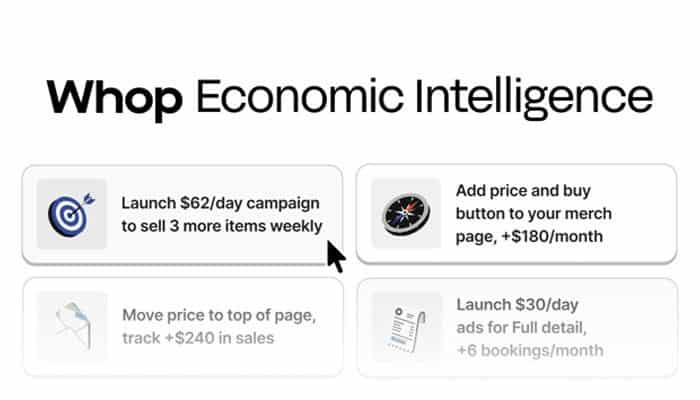
The first product built on that context is a set of recommended actions. On the homepage of a Whop business, beneath the balance, a “Recommended for you” section lists the action Whop expects to deliver the highest return next. Each recommendation carries a projected value, visible on hover, and an action history records what earlier recommendations returned once taken. Clicking one hands it to Whop AI Chat, which prompts the owner only where input is genuinely required, a product name for example, and then executes. The owner accepts, and the platform does the work with minimal further involvement.
The scope of those actions is broader than a recommendation engine usually implies. For an established business, Economic Intelligence may propose optimizing the website and funnel with Whop Blueprints, revising product pricing, launching ad campaigns through Whop Ads aimed at high return on ad spend, recovering abandoned carts, reducing churn through automatic retargeting, or setting up a recurring weekly message to top customers. For someone without a business, it can recommend one and build the website. The unifying metric behind every action is time to the next dollar earned.
For technical teams there is a second interface. Economic Intelligence is exposed through an API endpoint, which Whop positions as a benefit for developers already building on its platform. It sits alongside the Whop CLI, released in August, which opens the platform’s full API to business owners and to the AI agents working on their behalf, and a partnership with SpaceXAI that brings the same capability into Grok and Cursor.
Whop reported results from a beta of recommended actions across 14,905 businesses. Combined sales grew 31.8% for the group with Economic Intelligence. Unique paying customers grew 26.3%.
The larger project is what Whop calls the first end-to-end API for running a business, covering money movement, customer acquisition and an on-demand workforce, in service of a mission to deliver everyone a sustainable income. Economic Intelligence is the layer that turns that infrastructure into a decision. Whop’s own summary is that it proactively surfaces the next revenue move, like a hire who knows the whole business, built in. Access is by waitlist from the whop.com dashboard, with the full announcement on the Whop blog.
