


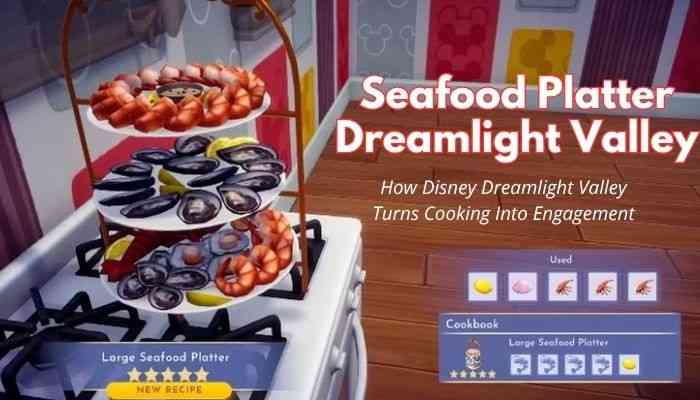

Cooking is one of the simplest activities in Disney Dreamlight Valley, yet the Seafood Platter Dreamlight Valley recipe connects directly with exploration, fishing, foraging, quests, energy, friendship, restaurants, and recipe collections.
The dish needs only two seafood ingredients, but collecting them can take players to Dazzle Beach, encourage resource gathering, complete quest requirements, restore energy, and support interactions with Disney and Pixar characters.
This makes the Seafood Platter Dreamlight Valley recipe more than a basic meal. It shows how Dreamlight Valley turns one small cooking task into a wider gameplay loop that keeps several progression systems connected.
Quick Answer
The Seafood Platter Dreamlight Valley recipe is a two-star appetizer made with two Seafood ingredients. It restores at least 458 Energy, while its final Energy and Star Coin value can vary depending on the seafood used.
Use ingredients classified as Seafood, such as Clams, Scallops, Oysters, or Shrimp, rather than regular Fish.
Key Takeaways
- Seafood Platter Dreamlight Valley is a two-star appetizer made with two Seafood ingredients.
- Large Seafood Platter requires four Seafood ingredients and one Lemon.
- Seafood Salad is made with one Seafood ingredient and one Lettuce.
- Fish and Seafood are separate ingredient categories, so regular Fish may not work for Seafood recipes.
- Dazzle Beach is one of the easiest early locations for collecting Seafood.
- The Seafood used can affect a meal’s final Energy and Star Coin value.
- The Seafood Platter Dreamlight Valley recipe connects cooking with quests, exploration, energy, friendship, restaurants, and collections.
- Restaurant meals also support the 2026 Best Friends progression system.
- Recipe search, sorting, improved ingredient selection, and the Slow Cooker make cooking easier as the recipe collection grows.
What Is Seafood Platter in Disney Dreamlight Valley?
The Seafood Platter Dreamlight Valley recipe is a permanent two-star appetizer made with two ingredients classified as Any Seafood.
After cooking it for the first time, Seafood Platter is added to the Dreamlight Valley Meals Collection and restores at least 458 Energy.
Here is a quick comparison of the three related seafood recipes:
| Recipe | Category | Stars | Ingredients | Minimum Energy |
|---|---|---|---|---|
| Seafood Platter | Appetizer | 2 | 2 Seafood | 458+ |
| Large Seafood Platter | Appetizer | 5 | 4 Seafood + Lemon | 1,810+ |
| Seafood Salad | Entrée | 2 | Seafood + Lettuce | 349+ |
These meals can support quests, meal collections, energy recovery, restaurant orders, friendship progress, favorite gifts, and recurring objectives.
How to Make Seafood Platter Dreamlight Valley
To prepare the Seafood Platter Dreamlight Valley recipe:
- Visit a cooking station.
- Open the cooking menu.
- Add one qualifying Seafood ingredient.
- Add a second qualifying Seafood ingredient.
- Make sure you have one Coal Ore.
- Start cooking.
Standard cooking uses one Coal Ore for each meal.
Seafood + Seafood = Seafood Platter
You do not need Lemon, Lettuce, vegetables, or regular Fish for the basic recipe.
Which Ingredients Count as Seafood?
Several ingredients can satisfy the Any Seafood requirement in the Seafood Platter Dreamlight Valley recipe.
Common options include:
- Clam
- Scallop
- Oyster
- Shrimp
- Crab
- Squid
- Lobster
Available Seafood depends on the locations and game content you have unlocked. Dazzle Beach offers several useful options for early-game players.
Seafood Is Not the Same as Fish
Disney Dreamlight Valley treats Fish and Seafood as separate ingredient categories, so not every creature caught from water will work in the Seafood Platter Dreamlight Valley recipe.
Recipes may require:
- Any Fish
- Any Seafood
- A specific Fish
- A specific Seafood ingredient
Using an ingredient classified only as Fish can produce a different dish. For Seafood Platter, choose ingredients specifically categorized as Seafood.
What Do You Need to Unlock First?
You do not need to unlock every biome to make the Seafood Platter Dreamlight Valley recipe.
- Dazzle Beach — 1,000 Dreamlight
Best early location for collecting seafood ingredients. - Forest of Valor — 3,000 Dreamlight
Useful for finding Lemons needed for Large Seafood Platter. - Glade of Trust — 5,000 Dreamlight
Another location where players can collect Lemons.
For the basic Seafood Platter, unlocking Dazzle Beach is the most useful first step.
Where to Find Seafood for Seafood Platter
Dazzle Beach is one of the easiest places to collect ingredients for the Seafood Platter Dreamlight Valley recipe.
Scallops
- Found on the ground around Dazzle Beach.
- Classified as Seafood.
- Sell for 50 Star Coins each.
Oysters
- Found along the ground at Dazzle Beach.
- Classified as Seafood.
- Sell for 50 Star Coins each.
Shrimp
- Caught by fishing at Dazzle Beach.
- Most commonly found in blue fishing ripples.
- Can also appear in white fishing ripples.
- Sell for 300 Star Coins each.
- Restore 750 Energy when eaten directly.
For a quick Seafood Platter, Scallops and Oysters are usually convenient because they can be collected without fishing.
What Is the Best Seafood to Use?
The best ingredient for the Seafood Platter Dreamlight Valley recipe depends on whether you are cooking for a quest, Energy, selling, or saving resources.
For Quest Cooking
- Use common Seafood such as Scallops or Oysters.
- Avoid wasting rare or expensive ingredients when the quest only requires the correct meal.
For Energy
- Seafood with higher base Energy can increase the meal’s final Energy value.
For Selling
- Higher-value Seafood can increase the final Star Coin value of the dish.
For Resource Conservation
- Scallops and Oysters are practical choices for regular cooking.
- Save more valuable Seafood, such as Shrimp, when it has a better use elsewhere.
For most routine cooking, common and easily replaced Seafood is the most practical choice.
Dreamlight Valley Seafood Platter
The Seafood Platter Dreamlight Valley recipe is a simple two-star appetizer made with two Seafood ingredients.
Dreamlight Valley Seafood Platter Recipe
Use:
- 1 Seafood
- 1 Seafood
It is classified as:
- Two-star meal
- Appetizer
- Dreamlight Valley Meals Collection recipe
- Minimum Energy of 458
When Is Seafood Platter Useful?
Seafood Platter can be useful for:
- Completing quests
- Serving restaurant orders
- Restoring Energy
- Filling the Meals Collection
- Giving meals to Villagers
- Completing cooking objectives
It is also required during the Peacemakers quest involving Maui.
Large Seafood Platter Dreamlight Valley
The Seafood Platter Dreamlight Valley recipe also has a larger five-star version that requires four Seafood ingredients and one Lemon.
Large Seafood Platter Recipe
Combine:
- 4 Seafood
- 1 Lemon
Large Seafood Platter is a five-star appetizer that restores at least 1,810 Energy.
Where to Find Lemon
Lemons can be collected from Lemon Trees in:
- Forest of Valor
- Glade of Trust
Large Seafood Platter Quest Uses
Large Seafood Platter is used in quests including:
- A Festival of Friendship
- The Great Gathering
During The Great Gathering, players prepare food as part of Simba and Remy’s quest activities.
Seafood Salad Dreamlight Valley
Seafood Salad is another simple seafood recipe made with one Seafood ingredient and one Lettuce.
Seafood Salad Recipe
Combine:
- 1 Seafood
- 1 Lettuce
Seafood Salad is a two-star entrée that restores at least 349 Energy.
Seafood Salad vs Seafood Platter
| Feature | Seafood Salad | Seafood Platter |
|---|---|---|
| Stars | 2 | 2 |
| Category | Entrée | Appetizer |
| Seafood Needed | 1 | 2 |
| Other Ingredient | Lettuce | None |
| Minimum Energy | 349+ | 458+ |
| Peacemakers Quest | Yes | Yes |
Seafood Salad is useful when you want to save Seafood because it replaces the second Seafood ingredient with Lettuce.
Why Seafood Platter Values Can Differ Between Guides
The Seafood Platter Dreamlight Valley recipe can have different Energy and Star Coin values depending on the Seafood ingredients used.
For reference:
- Seafood Platter — 458+ Energy
- Seafood Salad — 349+ Energy
- Large Seafood Platter — 1,810+ Energy
This is why minimum Energy values are more useful than treating one number as fixed for every combination.
Seafood Platter Sell Price and Recipe Economics
The final selling value of Seafood Platter depends partly on the ingredients used.
Players can choose to:
- Sell Seafood individually
- Cook it into meals
- Keep meals for Energy
- Save meals for quests
- Serve restaurant customers
- Give meals to Villagers
For routine cooking, common Seafood such as Scallops or Oysters can be a practical choice instead of using more valuable ingredients.
Can Expansion Seafood Be Used?
Expansion ingredients can work in the Seafood Platter Dreamlight Valley recipe if the game classifies them as Seafood.
For example, Prisma Shrimp from Eternity Isle is classified as Seafood.
However, paid expansion content is not required. Base-game Seafood from locations such as Dazzle Beach is enough to prepare the standard recipe.
How Cooking Works in Disney Dreamlight Valley
Cooking turns gathered or purchased ingredients into meals, and the Seafood Platter Dreamlight Valley recipe shows how one simple dish can connect resource gathering, recipe discovery, Energy, collections, and character interactions.
Cooking supports:
- Ingredient discovery
- Resource gathering
- Recipe collection
- Energy management
- Quest progress
- Character interactions
Once a valid meal is cooked, it can also become part of the player’s recipe collection.
Coal Ore Adds Another Resource Connection
Standard cooking requires one Coal Ore per meal, so preparing the Seafood Platter Dreamlight Valley recipe also connects cooking with mining and resource management.
A typical cooking process may involve:
- Exploring Dazzle Beach
- Gathering Seafood
- Obtaining Coal Ore
- Visiting a cooking station
- Preparing the meal
- Using or serving it
This keeps cooking connected with several gameplay activities instead of limiting it to one menu.
How Cooking Creates an Engagement Loop
The Seafood Platter Dreamlight Valley recipe can begin a simple cycle that encourages players to explore, gather resources, cook, earn rewards, and continue progressing.
Explore → Gather → Cook → Eat or Serve → Gain Reward → Progress
A player may also:
- Gather Scallops
- Fish for Shrimp
- Collect Coal Ore
- Complete a quest
- Restore Energy
- Serve a Villager
- Increase Friendship
One meal can therefore lead naturally into several other activities.
Resource Gathering Encourages Exploration
Ingredients needed for the Seafood Platter Dreamlight Valley recipe give players another reason to revisit areas such as Dazzle Beach.
Seafood can be used for:
- Cooking
- Quests
- Gifts
- Collections
- Energy
- Restaurant orders
This helps previously unlocked biomes remain useful as players continue progressing.
Recipe Discovery Supports Completion Goals
Cooking a recipe for the first time adds another entry to the player’s Meals Collection.
For completion-focused players, cooking becomes more than preparing useful food. It creates a longer goal of finding and preparing more recipes across the game.
Food Supports Energy Management
Meals restore Energy, while cooked food can also help build the Well Fed Energy bar, giving the Seafood Platter Dreamlight Valley recipe another practical purpose beyond quests and collections.
The Well Fed bonus can provide:
- Faster movement
- Sprint access
- Improved gathering efficiency
This creates a useful cycle:
Gather → Cook → Gain Energy → Explore → Gather Again
Restaurant Orders Turn Food Into Social Progress
Serving the Seafood Platter Dreamlight Valley recipe or other requested meals at restaurants can connect cooking directly with Friendship progression and Star Coin rewards.
At locations such as Chez Remy and Tiana’s Palace, Villagers can request specific meals.
The reward loop becomes:
Ingredients → Meal → Villager Interaction → Friendship → Reward
This gives cooking both practical and character-based value.
Cooking and Friendship Progression
Friendship can increase through activities such as:
- Quests
- Daily conversations
- Hanging out
- Gifts
- Restaurant meal service
Traditional Friendship progression reaches Level 10.
Because restaurant service contributes to Friendship, cooking remains useful for character progression rather than serving only as an Energy or inventory system.
How the 2026 Best Friends System Makes Cooking More Important
The Seafood Platter Dreamlight Valley recipe can now support more than regular Friendship progress. The Pixel Perfect update, released on July 29, 2026, introduced the Best Friends system for Villagers who reach Friendship Level 10.
Players can fill the daily Best Friends Bar through:
- Daily conversations
- Favorite gifts
- Restaurant meal service
- Hanging out
The bar resets at 5:00 AM local time. Filling it unlocks temporary benefits such as Best Friends Sprint and max-level profession bonuses, giving meals such as Seafood Platter Dreamlight Valley another purpose after normal Friendship progression is complete.
Cooking Supports Daily and Recurring Gameplay
The Seafood Platter Dreamlight Valley recipe fits naturally into recurring cooking activities, where gathering ingredients, preparing meals, and serving Villagers can contribute to daily gameplay.
Remy’s Special Deliveries are repeatable quests built around preparing and delivering food for Villagers.
Receive Request → Gather Ingredients → Cook → Deliver → Earn Rewards
Why Daily Cooking Can Improve Player Retention
Preparing a Seafood Platter Dreamlight Valley meal can lead players into several connected activities rather than keeping cooking isolated.
Cooking can involve:
- Exploration
- Fishing
- Foraging
- Mining
- Energy management
- Quests
- Restaurants
- Friendship
- Collections
These connected activities give players several reasons to continue exploring and progressing.
How Gameloft Reduced Cooking Friction
Making a Seafood Platter Dreamlight Valley recipe became easier as Gameloft improved the cooking interface in the Tales of Agrabah update released on February 26, 2025.
The update added:
- Recipe search
- Sorting for restaurant orders
- Sorting for quest meals
- The Slow Cooker
- Smarter automatic ingredient selection
The Slow Cooker can queue multiple meals for a Dreamlight cost, while generic recipes prioritize suitable ingredients that players have in larger quantities.
Engagement Does Not Always Mean More Steps
The improvements surrounding Seafood Platter Dreamlight Valley show that stronger engagement does not always require more actions. Removing unnecessary friction can make existing gameplay more enjoyable.
For example:
- Search reduces scrolling.
- Sorting makes recipes easier to find.
- Smart ingredient selection helps preserve rarer resources.
- Meal queues reduce repetitive cooking.
The result is a smoother cooking system that keeps the focus on meaningful gameplay rather than unnecessary repetition.
Why Seafood Recipes Are Strong Examples of Progressive Complexity
The Seafood Platter Dreamlight Valley recipe shows how Dreamlight Valley introduces cooking complexity gradually without changing the basic interaction.
Players can progress through:
- Seafood Platter — 2 Seafood
- Seafood Salad — 1 Seafood + 1 Lettuce
- Large Seafood Platter — 4 Seafood + 1 Lemon
The cooking process stays familiar while ingredient requirements become more demanding, making progression easy to understand.
Why Multiple Rewards Make Cooking More Valuable
The Seafood Platter Dreamlight Valley recipe can support several goals from a single cooking action.
Players may use it to:
- Discover a recipe
- Complete a collection entry
- Finish a quest
- Restore Energy
- Serve a restaurant order
- Increase Friendship
- Support Best Friends progress
This gives one simple meal several practical uses.
How Familiar Characters Strengthen Engagement
Cooking the Seafood Platter Dreamlight Valley recipe becomes more meaningful when meals connect with familiar Disney and Pixar characters.
Meals can be prepared for characters such as:
- Remy
- Maui
- Simba
- Mickey
- Anna
- Tiana
This connects practical rewards such as Energy and Friendship with character interactions and story progression.
Why Seafood Platter Is an Example of Scalable Game Design
The Seafood Platter Dreamlight Valley recipe uses a simple cooking system that can continue supporting new content without changing its basic mechanics.
Cooking can connect with:
- New Villagers
- New quests
- Friendship systems
- Restaurants
- Expansion ingredients
- Recurring challenges
- New recipes
- Collections
This allows Dreamlight Valley to expand existing gameplay systems instead of creating a completely new mechanic for every update.
Common Seafood Platter Mistakes
Avoid these common mistakes when making the Seafood Platter Dreamlight Valley recipe:
- Using Fish instead of Seafood: Choose ingredients specifically classified as Seafood.
- Adding Lettuce: Seafood + Lettuce makes Seafood Salad, not Seafood Platter.
- Forgetting Lemon: Large Seafood Platter requires 4 Seafood + 1 Lemon.
- Forgetting Coal Ore: Standard cooking requires 1 Coal Ore per meal.
- Using expensive Seafood: Save valuable ingredients when common Seafood will work.
- Expecting one fixed sell price: Different Seafood combinations can change the Energy and Star Coin value.
For the Seafood Platter Dreamlight Valley recipe, using common qualifying Seafood is usually the simplest option.
Best Strategy for Cooking Seafood Platters Efficiently
For faster Seafood Platter Dreamlight Valley cooking, keep a small reserve of useful ingredients instead of collecting everything only when a quest requires it.
Useful items to store include:
- Scallops
- Oysters
- Clams
- Shrimp
- Lemons
- Lettuce
- Coal Ore
Collect Seafood whenever you visit Dazzle Beach, harvest Lemons when passing through Lemon-producing biomes, and keep enough Coal Ore for regular cooking.
Is Large Seafood Platter Better Than Seafood Platter?
The Seafood Platter Dreamlight Valley recipe and Large Seafood Platter serve different purposes, so the better option depends on what you need.
Use Seafood Platter When
- You need the exact Seafood Platter recipe.
- You need a two-star appetizer.
- You want to use fewer ingredients.
- You are completing Peacemakers.
- A restaurant customer requests it.
Use Large Seafood Platter When
- You need a five-star appetizer.
- You want higher minimum Energy.
- A quest requires Large Seafood Platter.
- You need its Meals Collection entry.
Choose the recipe that matches your quest, Energy needs, or collection goal.
Seafood Platter vs Seafood Salad vs Large Seafood Platter
| Factor | Seafood Platter | Seafood Salad | Large Seafood Platter |
|---|---|---|---|
| Category | Appetizer | Entrée | Appetizer |
| Stars | 2 | 2 | 5 |
| Seafood Needed | 2 | 1 | 4 |
| Extra Ingredient | None | Lettuce | Lemon |
| Minimum Energy | 458+ | 349+ | 1,810+ |
| Easy for Early Players | Yes | Yes | Requires more progression |
| Quest Uses | Yes | Yes | Yes |
The Seafood Platter Dreamlight Valley recipe remains useful because it needs only two Seafood ingredients, is easy to remember, and appears in quest and restaurant activities.
Conclusion
The Seafood Platter Dreamlight Valley recipe looks simple on the surface, but its value comes from how effectively it connects exploration, resource gathering, quests, Energy, collections, restaurants, and character progression.
That broader system is what makes the Seafood Platter Dreamlight Valley recipe more than a two-ingredient meal. Dreamlight Valley shows that strong engagement does not always require entirely new mechanics. A familiar activity can remain valuable when developers keep connecting it to new rewards, progression systems, and reasons for players to return.
FAQs About seafood platter dreamlight valley
1. Can I use two of the same seafood in Seafood Platter Dreamlight Valley?
Yes. Two of the same qualifying Seafood, such as two Clams, can be used to make the dish.
2. Is Seafood Platter Dreamlight Valley an appetizer or entrée?
It is a two-star appetizer made with two Seafood ingredients.
3. Can I make Seafood Platter before unlocking Glade of Trust?
Yes. Dazzle Beach provides qualifying Seafood, so Glade of Trust is not required for the standard recipe.
4. Does Seafood Platter Dreamlight Valley need Lemon?
No. Lemon is only required for the five-star Large Seafood Platter.
5. Can Scallops and Oysters be mixed in one Seafood Platter?
Yes. Both are classified as Seafood and can be combined in the standard recipe.
6. Does Seafood Platter count toward the Meals Collection?
Yes. Cooking Seafood Platter for the first time adds it to your Dreamlight Valley Meals Collection.
7. Can Prisma Shrimp be used for Seafood Platter?
Yes. Prisma Shrimp is classified as Seafood and can qualify for the recipe if you have access to it.
8. Is Seafood Platter useful for early-game players?
Yes. Its two-ingredient recipe is simple, and qualifying Seafood can be collected at Dazzle Beach.
