



Recessions do not hit every trade at the same speed. Some kinds of work thin out within a quarter, while others hold their volume and occasionally pick up. Repair belongs to a folklore of the second kind, and the folklore is only partly true.
Why Repair Survives Only Where An Object’s Material Value Outweighs Labor Cost, And What This Threshold Means For Jewelry, Watches, Suits And Shoes
The idea that people mend things when money is tight is intuitive and endlessly repeated. It survives because it describes something real, though narrower than it sounds.
What actually decides whether a broken object gets fixed is a single ratio. On one side sits the value of the material it is made from, plus whatever the owner attaches to it. On the other sits the price of an hour of skilled labor. Where the first outweighs the second, the repair trade continues regardless of the business cycle.
The Work That Comes Back When The Buying Stops
Consumer spending on new goods falls quickly in a downturn. Spending on keeping existing goods alive does not fall at the same rate, and in a few categories it climbs. That is the honest version of the folk belief, and it applies to a narrow band of objects.
The band is defined by arithmetic. A pair of sneakers costs thirty euros and takes an hour to fix, so nobody fixes them. A toaster is cheaper to replace than to open. A gold chain with a snapped link is a different proposition entirely, because the gold is still gold and the work takes twenty minutes. Shoe repair survives in the same narrow way, on welted shoes built to be resoled and priced accordingly.
Trades inside that band keep their order books through contractions. Trades outside it discover that a recession does not send customers back to them, it simply stops them buying anything at all.
Jewelry Making And The Value That Stays In The Metal
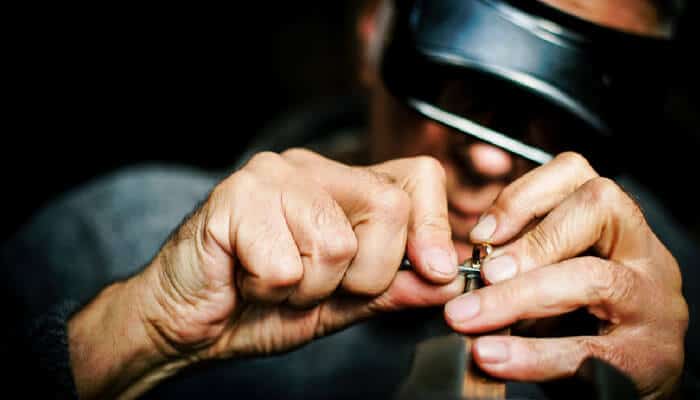
A snapped clasp costs far less to solder than a new chain costs to buy, and worn prongs get rebuilt for the same reason. Rings get resized, stones come out of a tired mount and go into a fresh one. Precious metals carry their value through every one of those operations, so repair and restoration keep the jewelry craft busy even in seasons when nobody commissions new work. Craftsmanship at that level takes years, and it is learned at the bench, on jewelry making courses such as those run by Rome’s Accademia delle Arti Orafe. Training at that school, one of Europe’s better-known jewelry schools, runs to hundreds of hours of hands-on practice.
Remounting shows it most plainly. An inherited brooch that nobody would wear becomes two rings and a pendant, and the workshop bills for the labor while the client supplies the alloy.
Polishing, rhodium plating and stone tightening follow the same logic on a smaller scale. None of that work depends on anyone feeling optimistic about the economy. It depends on a damaged piece of fine jewelry still being worth more than the hours needed to make it wearable again.
Watch Repair, Where The Movement Outlives The Owner
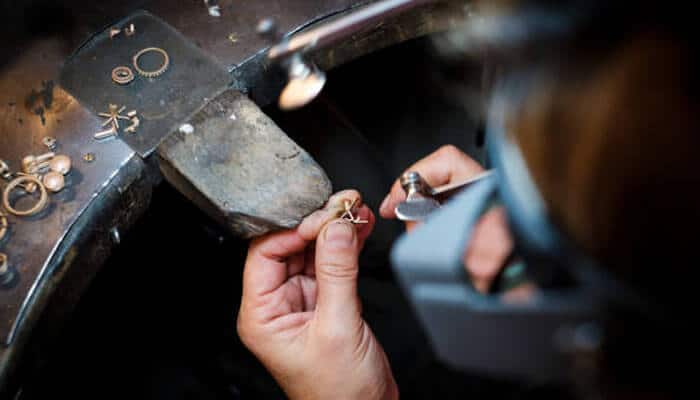
Mechanical watches fail in predictable ways. Oils dry out, mainsprings tire, a crown gets pushed in at the wrong angle. Servicing a movement takes several hours. Replacement parts are frequently made by hand when no supply exists. For a quartz piece bought in a department store, that arithmetic is absurd, while for a mechanical caliber with fifty years left in it the same bill is unremarkable.
The trade contracted badly after the quartz crisis and never recovered its numbers. What survived is the upper end, where the movement is the asset and the case is only its housing. Independent watchmakers now work mostly on pieces designed from the start to be dismantled, cleaned and rebuilt.
A watch that reaches its third owner has usually been serviced more times than it has been sold. That is the shape of a repair trade that lasts, work attached to objects that outlive the people who bought them.
The Tailoring Bench And The Clothes Worth Altering
Clothing sits closer to the threshold, and mostly on the wrong side of it. Fast fashion made replacement cheaper than an hour with a needle. The tailoring and alterations trade contracted accordingly. What remains clusters around garments that were expensive to begin with.
A tailored suit gets taken in, let out, re-lined and re-cuffed across a decade of a wearer’s changing body. That work is skilled, and it is priced against a garment that once cost a month’s rent. The wider picture is less comfortable. Employment across the European consumer repair sector fell by around 14 percent between 2017 and 2021, according to the European Environment Agency. Its figures place watch and jewelry repair in the same statistical category as clothing, bicycles and musical instruments.
The decline is concentrated where objects are cheap and labor is not. Nothing in those numbers suggests the higher end is following the same curve.
Which Repair Work Survives And Which Quietly Disappears
The threshold moves. Materials get cheaper, wages get more expensive, and each shift pushes another category out of the repairable range. Bicycles held on longer than toasters. Suits held on longer than shirts, and shoes held on only in the narrow segment built around a welt.
Precious metal sits at the far end of that range and shows no sign of moving. As long as a broken ring is worth melting down, someone has to know how to solder, set and finish it. That knowledge passes from hand to hand or it disappears. The economy decides how much new jewelry gets made. It has much less say over how much old jewelry needs mending, and the bench that does the mending tends to stay occupied while the shop windows go quiet.
