


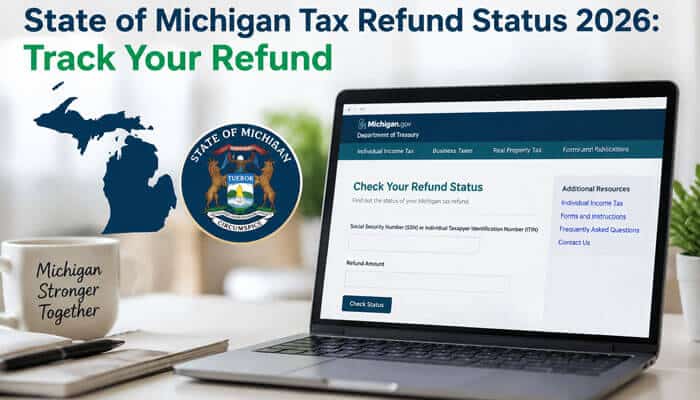

Checking your state of Michigan tax refund status in 2026 is the easiest way to find out whether your Michigan income tax return is still processing, has been approved, or has moved to the payment stage. Michigan Treasury eServices is the state’s official online system for checking a return and tracking a refund.
For most taxpayers checking their state of Michigan tax refund status during the 2026 filing season, the refund relates to a 2025 Michigan individual income tax return.
Michigan generally advises taxpayers to allow 4–6 weeks after an electronically filed return is accepted or 6–8 weeks after mailing a paper return before checking refund status. Processing information is normally updated overnight Monday through Friday.
Most refunds are processed without major problems. However, identity verification, incorrect information, missing documents, complicated tax credits, manual review, debt offsets, garnishments, banking problems, or lost checks can increase the waiting time.
This complete guide explains how to check your state of Michigan tax refund status, current Michigan refund processing times, common reasons for delays, missing deposits, refund offsets, amended returns, and what to do if your refund has not arrived.
Quick Answer
You can check your state of Michigan tax refund status through Michigan Treasury eServices.
Taxpayers generally have two options:
- Guest Services: Select Where’s My Refund
- Account Services: Sign in and select My Return Status
To use the Guest Services refund tracker, you generally need:
- Filer’s identification number, such as a Social Security number
- Tax year
- Expected Michigan refund amount
Make sure you enter the refund amount from your Michigan state tax return, not your federal IRS refund.
Michigan Refund Timeline
| Situation | Michigan Guidance |
|---|---|
| E-filed return | Allow 4–6 weeks after acceptance |
| Paper return | Allow 6–8 weeks after mailing |
| Return already processed | Allow up to 5–7 business days for refund issuance |
| Treasury requested additional documents | Allow about 8 weeks after Treasury receives your response |
| Closed bank account | Paper check can take up to 6 weeks after Treasury receives the returned deposit |
| Missing direct deposit | A tracer may be requested after the required waiting period |
| Lost paper refund check | Stop-payment and replacement procedures can add several weeks |
| Amended return | Can take substantially longer than an original return |
Michigan normally updates refund-processing information overnight Monday through Friday.
Key Takeaways
- Michigan Treasury eServices is the official system for checking the state of Michigan tax refund status.
- Electronically filed returns generally require 4–6 weeks before taxpayers should expect meaningful status information.
- Paper returns generally require 6–8 weeks.
- Nearly 90% of Michigan returns are being processed and refunds issued within the normal 4–6 week timeframe.
- Identity verification, complicated credits, errors, missing information, debt offsets, and garnishments can delay a refund.
- An accepted Michigan return does not automatically mean the refund has been approved.
- A refund showing as issued can still be delayed by banking problems.
- Michigan has separate procedures for missing direct deposits and lost paper checks.
- Joint refunds can be affected when one spouse owes a qualifying debt.
- Michigan uses Form 743 rather than federal IRS Form 8379 for its non-obligated spouse process.
State of Michigan Tax Refund Status 2026 at a Glance
| Situation | Michigan Guidance |
|---|---|
| E-filed return | Allow 4–6 weeks after acceptance |
| Paper return | Allow 6–8 weeks after mailing |
| Return already processed | Allow up to 5–7 business days for refund issuance |
| Treasury requested additional documents | Allow about 8 weeks after Treasury receives your response |
| Closed bank account | Paper check can take up to 6 weeks after Treasury receives the returned deposit |
| Missing direct deposit | A tracer may be requested after the required waiting period |
| Lost paper refund check | Stop-payment and replacement procedures can add several weeks |
| Amended return | Can take substantially longer than an original return |
Michigan’s 2026 individual income tax filing season opened on January 26, 2026. Taxpayers who obtained a qualifying extension generally have until October 15, 2026 to file their 2025 Michigan return. However, an extension to file did not extend the April 15 deadline for paying tax that was owed.
How to Check State of Michigan Tax Refund Status Online
The fastest way to check your state of Michigan tax refund status is through Michigan Treasury eServices. The official portal allows taxpayers to track their refund without relying on third-party refund websites.
Option 1: Use Where’s My Refund
Under Michigan Treasury eServices Guest Services, select Where’s My Refund.
You will generally need:
- Filer’s ID number
- Tax year
- Expected refund amount
Enter the refund amount shown on your Michigan tax return. Do not enter the amount of your federal IRS refund because Michigan and federal tax refunds are processed separately.
Option 2: Use My Return Status
Taxpayers with a Michigan Treasury eServices account can sign in and select My Return Status.
An account can also help you:
- Check tax and payment records
- Review Michigan Treasury correspondence
- Respond to letters
- Upload requested documents
- Send secure messages
- Make payments
- Review account information
For many taxpayers, eServices is the most convenient way to monitor their state of Michigan tax refund status without calling Treasury.
What Changed With Michigan Refund Tracking in 2026?
Michigan introduced a major tax-processing technology change for the 2026 filing season. The Michigan Department of Treasury replaced a tax system that had been in use for roughly 40 years with a modernized platform designed to manage individual income tax administration.
Michigan Treasury eServices has become an important central location for:
- Refund tracking
- Tax account information
- Treasury letters
- Document submission
- Secure communication
- Payments
Michigan also acknowledged several problems that occurred during the transition and created a public Tax Year 2025 Solutions Tracker to report known issues and corrective actions.
For taxpayers checking the state of Michigan tax refund status, this makes it especially important to rely on the latest Michigan Treasury guidance instead of older instructions found on third-party websites.
Does Accepted Mean My Michigan Refund Is Approved?
No.
An electronically filed Michigan tax return being marked accepted generally means the state successfully received the return.
It does not necessarily mean:
- Processing has finished
- Your refund has been approved
- Payment has been issued
- Identity verification has been completed
- Treasury will not request additional information
Michigan generally tells taxpayers with accepted electronic returns to allow 4–6 weeks before expecting refund processing to be completed.
Therefore, seeing an accepted return and seeing an approved refund are two different stages of the state of Michigan tax refund status process.
How Long Are Michigan Tax Refunds Taking in 2026?
Most Michigan tax refunds are being processed within the state’s normal timeframe. As of August 24, 2026, Michigan Treasury reported that nearly 90% of returns were processed and refunds issued within the normal 4–6 week period.
State of Michigan Tax Refund Status Processing Times
| Refund Situation | General Processing Guidance |
|---|---|
| Electronically filed return | 4–6 weeks |
| Paper-filed return | 6–8 weeks |
| Refund after completed processing | Up to 5–7 business days |
| Additional documents submitted | Allow about 8 weeks |
| Garnishment involved | May take substantially longer |
| Returned direct deposit | Up to 6 weeks after Treasury receives returned payment |
| Direct-deposit tracer | Can take up to 24 weeks |
| Lost-check replacement | Can take up to 12 weeks after required steps |
An individual state of Michigan tax refund status may remain unchanged longer when the return requires identity verification, supporting documents, debt review, or manual processing.
Latest 2026 Michigan Tax Refund Statistics
Current statistics provide useful context when taxpayers are concerned about Michigan refund delays. As of August 24, 2026, the Michigan Department of Treasury reported:
- More than 5.25 million individual income tax returns processed
- More than $3.7 billion in refunds issued
- Nearly 90% of returns processed and refunds issued within the normal 4–6 week timeframe
Treasury reported that overall processing volume was keeping pace with the previous year. Earlier in the filing season, Michigan reported an average refund of $901 as of June 8, 2026. That amount is only a statewide average. It does not predict what any individual taxpayer should receive.
Why Is My State of Michigan Tax Refund Status Still Processing?

Many taxpayers become concerned when their state of Michigan tax refund status continues to show that the return is processing.
A longer wait does not necessarily mean the return is lost.
Common reasons include:
- Filing a paper return
- Not selecting direct deposit
- Errors on the return
- Missing information
- Identity verification
- Additional review
- Complicated credits
- Multiple tax schedules
- Supporting documents being required
- Outstanding debts
- Garnishments
Michigan says approximately 10% of returns require additional processing because of factors such as missing information, identity checks, complex returns, debt, or garnishments.
What Does Additional Review Mean?
Some Michigan returns require extra or manual review before Treasury can complete processing. Additional review does not automatically mean that you made an error or that your tax return is being audited.
Treasury may need to:
- Confirm income
- Review tax credits
- Examine supporting documents
- Verify taxpayer identity
- Resolve inconsistent information
- Review debts
- Review garnishment information
If a return is selected for additional review, your state of Michigan tax refund status may remain in processing longer than the standard timetable. Respond quickly if Treasury sends you a letter requesting information.
Michigan Identity Verification and Refund Delays
Identity verification is another reason your state of Michigan tax refund status may not change as quickly as expected. Michigan Treasury may send a letter asking you to confirm your identity before releasing a refund. Michigan Treasury eServices includes a Verify My Identity service.
If you receive an identity-verification letter:
- Keep the Treasury letter available.
- Access Michigan Treasury eServices through the official state website.
- Select the identity-verification option.
- Follow the instructions contained in your letter.
- Submit the requested information promptly.
Delaying identity verification can also delay the refund.
Never provide tax or banking information through an unexpected email, text message, or suspicious website claiming to offer Michigan identity verification.
What If Michigan Treasury Requests More Information?
Michigan Treasury may send a Request for Information letter when it cannot complete your return using the information already provided.
Treasury may need additional documents related to:
- Tax credits
- Income
- Retirement benefits
- Supporting schedules
- Property information
- Other items reported on the return
Failing to provide requested information can result in a tax credit being denied or other changes to the return.
If you receive a request:
- Read the full notice
- Confirm the tax year
- Gather every requested document
- Follow Treasury’s submission instructions
- Respond before the stated deadline
- Keep copies of all documents
- Check eServices for updates
Do not ignore the request simply because your state of Michigan tax refund status still shows processing.
State of Michigan Tax Refund Status Says Issued but No Deposit Arrived
Another common problem occurs when your state of Michigan tax refund status suggests that the refund was issued but the money is not in your bank account.
First, verify:
- Routing number
- Bank account number
- Account type
- Exact refund amount
- Expected deposit date
Michigan Treasury cannot add or change direct-deposit information after receiving your tax return. Ask your financial institution to trace the payment using the exact refund amount and deposit information.
If the financial institution cannot locate your refund after four weeks, Michigan allows taxpayers to request a direct-deposit tracer. Treasury says the tracer process can take up to 24 weeks, with results generally provided by mail.
What If My Michigan Refund Went to a Closed Bank Account?
If the bank account shown on your tax return was closed, the financial institution should reject the payment and return it to Michigan Treasury. Treasury can then issue a paper refund check. Michigan says the paper check should generally be mailed within six weeks after Treasury receives the returned direct deposit.
Changing your bank information after filing is not an option because Treasury cannot simply replace the original direct-deposit information after receiving your return.
If your state of Michigan tax refund status shows that a refund was issued but you know your bank account was closed, the returned-deposit process may explain the delay.
What If My Tax Preparer Cannot Find My Refund?
Some taxpayers use refund-related products through a tax preparer. In these situations, the refund may first be routed through a financial institution associated with the preparer. If that financial institution cannot locate the refund after four weeks, Michigan permits the taxpayer to request a direct-deposit tracer.
Treasury states that a tracer can take up to 24 weeks. If the tracer confirms that the refund was successfully deposited into the preparer’s account, the dispute may become a civil matter between the taxpayer and the preparer.
What If My Michigan Refund Check Never Arrived?
Paper refund checks follow different procedures from direct deposits. Michigan generally advises taxpayers to allow four weeks from the check’s issue date before requesting a stop payment for a lost or stolen refund check.
The replacement process generally involves:
- Waiting four weeks from the issue date
- Requesting a stop payment
- Receiving an affidavit from Treasury
- Completing and returning the affidavit
- Waiting for Treasury to issue a replacement
Michigan says the affidavit can take approximately four weeks to arrive. After the completed affidavit is returned, taxpayers may need to allow up to 12 weeks for the replacement check. If the original check is later found, contact Treasury before trying to cash or deposit it.
Why Was My Michigan Tax Refund Reduced or Taken?
Your final refund may sometimes be smaller than the amount originally shown on your Michigan return.
Possible reasons include:
- Treasury corrected an error
- A tax credit was changed
- Past-due Michigan tax was deducted
- Another qualifying state debt applied
- A garnishment was involved
- Another eligible debt was offset
Applying a refund to an eligible debt is generally known as a refund offset. If Treasury applies only part of the refund to a debt, the remaining eligible balance may still be returned to the taxpayer.
A reduced refund therefore does not necessarily mean that the original state of Michigan tax refund status information was incorrect. Treasury may have adjusted the refund during processing.
Can Michigan Take My Refund If I Have a Payment Plan?
Yes.
Michigan can apply a tax refund to an assessed debt even when the taxpayer is making payments through an approved installment agreement.
A payment plan does not necessarily prevent a refund offset. Taxpayers with an existing Michigan tax debt should therefore consider a potential offset when reviewing their state of Michigan tax refund status.
What If Only My Spouse Owes the Debt?
Special rules can apply when married taxpayers file jointly and only one spouse is responsible for the debt. Michigan uses the Income Allocation for Non-Obligated Spouse Form 743.
The process can apply to certain debts involving:
- Michigan taxes
- State debts
- Child support
- IRS levies
- Garnishments
- Court orders
When applicable, Michigan sends a personalized Form 743. The form generally needs to be returned within 30 days from the date of the accompanying letter.
If the form is not returned or is incomplete, the available joint refund can potentially be applied to the debt.
Does Michigan Accept IRS Form 8379?
No.
Michigan does not use the federal IRS Form 8379, Injured Spouse Allocation, to divide a Michigan state refund. Michigan requires its own personalized Form 743. This difference is important because federal and Michigan refund-offset procedures are separate.
Does Michigan Pay Interest on Delayed Refunds?
Michigan states that under MCL 205.30(3), interest on qualifying refunds begins 45 days after the return is received or the return’s due date, whichever is later.
That does not mean every delayed refund automatically receives interest. Eligibility and the amount depend on the circumstances and applicable Michigan law.
A taxpayer whose state of Michigan tax refund status has remained unresolved for an extended period should still rely on Treasury’s official account information rather than attempting to calculate refund interest independently.
Michigan Amended Tax Refund Status
An amended Michigan tax return follows a different processing timeline from an original return. Taxpayers generally should amend a Michigan return only after the original return or claim has been filed and processed.
An amended return may be necessary when:
- Income was reported incorrectly
- A credit was omitted
- A deduction needs correction
- Federal tax information changed
- Another material error affected the Michigan return
If an IRS adjustment changes the federal adjusted gross income or exemptions reported to Michigan, an amended Michigan return may need to be filed within the applicable state deadline.
Because amended returns require additional review, the normal 4–6 week state of Michigan tax refund status timetable should not be assumed to apply.
Michigan State Refund vs. Federal IRS Refund
Your Michigan state tax refund and your federal refund are completely separate.
| Michigan State Refund | Federal Refund |
|---|---|
| Administered by Michigan Department of Treasury | Administered by Internal Revenue Service |
| Tracked through Michigan Treasury eServices | Tracked through IRS refund services |
| Michigan processing rules apply | Federal processing rules apply |
| Michigan refund amount | Federal refund amount |
| Michigan offset procedures | Federal offset procedures |
Receiving your federal refund does not mean Michigan has approved your state refund. Likewise, receiving a Michigan state refund does not necessarily mean the IRS has finished processing the federal return.
When researching your state of Michigan tax refund status, always use Michigan Treasury information rather than the federal IRS refund tracker.
Important Michigan Tax Refund Issues Reported in 2026
Michigan’s move to a modernized tax-processing system created several issues during the 2026 filing season. Treasury created an official Solutions Tracker to explain known problems and corrective action.
Request for Information Letters
Some taxpayers reported confusion after receiving Request for Information letters. These letters generally mean Treasury requires additional information before it can finish processing the return.
If you receive one, follow the instructions in the letter rather than simply waiting for your state of Michigan tax refund status to change.
Refund Status Phone-System Improvements
Michigan previously reported a syncing issue that caused some refund-status information in its automated phone system to lag. Treasury upgraded its Individual Income Tax Contact Center in July 2026.
The updated system increased call capacity, added a callback feature, and aligned automated status information more closely with Michigan Treasury eServices.
For most taxpayers who simply want current state of Michigan tax refund status information, eServices remains the best first option.
Can Michigan Expedite a Tax Refund?
Michigan offers expedited processing consideration for certain documented hardship situations.
Qualifying situations may include:
- Court-approved foreclosure
- Court-approved eviction
- A current official utility shutoff notice affecting the taxpayer’s principal residence
Supporting documentation is required. Even expedited processing is not immediate. Michigan says taxpayers approved for hardship processing should generally allow 10–14 business days after submitting documentation for return processing, followed by up to 5–7 business days for refund issuance.
What to Do If Your State of Michigan Tax Refund Status Is Still Processing
If the normal processing period has passed and your state of Michigan tax refund status still has not changed, follow these steps:
- Confirm your electronic return was accepted.
- Determine whether the standard waiting period has passed.
- Check Michigan Treasury eServices.
- Review Treasury letters and secure messages.
- Complete identity verification if requested.
- Submit any requested supporting documents.
- Verify your direct-deposit information.
- Determine whether Treasury already issued the refund.
- Check whether a debt offset or garnishment may apply.
- Contact Michigan Treasury if the official status still does not explain the delay.
Do not file a second tax return simply because the first return is taking longer than expected. A duplicate filing can create additional complications.
How to Contact Michigan Treasury About Your Refund
The Michigan Individual Income Tax Contact Center can be reached at:
517-636-4486
Representatives are generally available:
Monday through Friday, 8:00 a.m.–4:30 p.m.
Before calling, keep a copy of your Michigan return nearby.
You may need:
- Primary filer’s Social Security number
- Last name
- Tax year
- Filing status
- Income information from the return
For routine state of Michigan tax refund status questions, Michigan Treasury eServices should normally be the first place you check.
Can Calling Michigan Treasury Speed Up My Refund?
Calling Treasury does not automatically move a return ahead of other returns in processing. Treasury phone representatives generally have access to the same basic processing information available through Michigan Treasury eServices.
Calling may be useful when:
- The normal processing timeframe has passed
- Treasury requested documents
- You cannot access eServices
- An issued refund is missing
- You received a notice you do not understand
- You have an account-specific problem
For a simple state of Michigan tax refund status update, checking online can save time.
When Should You Contact the Michigan Taxpayer Advocate?
Michigan’s Office of the Taxpayer Advocate is intended as a resource of last resort for taxpayers who have already tried to resolve a tax problem through normal Treasury procedures.
The Taxpayer Advocate is generally not intended to provide ordinary refund-status updates or shorten standard processing times. If you receive a Treasury notice containing an appeal or response deadline, contacting the Advocate does not automatically stop or extend that deadline.
Taxpayers should continue following all deadlines shown on Treasury correspondence.
Beware of Michigan Tax Refund Scams
Scammers frequently take advantage of tax-refund season. Michigan has warned taxpayers about people pretending to represent the Department of Treasury.
Scammers may:
- Call from unfamiliar numbers
- Claim your refund has been frozen
- Ask for immediate payment
- Request banking information
- Send fake refund links
- Ask for personal identity information
Protect yourself by:
- Using official Michigan government websites
- Avoiding unexpected tax-refund links
- Never giving banking information to unsolicited callers
- Reviewing Treasury correspondence through official channels
- Calling Michigan Treasury directly when you are unsure
If someone contacts you unexpectedly about your state of Michigan tax refund status, verify the claim independently through Michigan Treasury eServices.
Still Filing Your 2025 Michigan Return in 2026?
If you received a valid filing extension, you generally have until October 15, 2026, to file your 2025 Michigan individual income tax return. Keep in mind that an extension to file does not extend the deadline to pay your taxes. Any tax you owed was generally due by April 15, 2026.
After you file your extended return, you can use Michigan Treasury eServices to check your state of Michigan tax refund status and track the progress of your refund.
Conclusion: State of Michigan Tax Refund Status
Checking your state of Michigan tax refund status in 2026 is the best way to understand whether your return is still processing, has been approved, or has moved to the payment stage. For the most accurate information, start with Michigan Treasury eServices rather than relying on third-party refund trackers.
Michigan generally advises taxpayers to allow 4–6 weeks for an accepted electronically filed return and 6–8 weeks for a mailed paper return. Once processing is complete, issuing the refund may take an additional 5–7 business days.
If your state of Michigan tax refund status has not changed after the normal processing period, review any Treasury letters or secure messages and check whether identity verification, missing documents, additional review, a refund offset, garnishment, or banking problem may be causing the delay.
The key is to use official Michigan Treasury services, respond quickly to legitimate requests for information, and contact Treasury when the normal processing period has passed without a clear explanation. Keeping your filing information and Treasury correspondence available can make it easier to resolve refund problems and track your Michigan refund successfully.
State of Michigan Tax Refund Status FAQs
1. How do I check my state of Michigan tax refund status?
You can check your state of Michigan tax refund status through Michigan Treasury eServices. Under Guest Services, select Where’s My Refund, or sign in to your account and choose My Return Status. You generally need your filer identification number, tax year, and expected Michigan refund amount.
2. How long does a Michigan tax refund take in 2026?
Michigan generally recommends allowing 4–6 weeks after an electronically filed return is accepted and 6–8 weeks after a paper return is mailed. After processing is complete, refund issuance may take another 5–7 business days.
3. Why is my state of Michigan tax refund status still processing?
Your state of Michigan tax refund status may continue to show processing because of missing information, errors, identity verification, complicated tax credits, supporting-document requests, manual review, debts, or garnishments. A longer processing time does not necessarily mean your return is lost or denied.
4. Does “accepted” mean my Michigan tax refund is approved?
No. An accepted Michigan tax return generally means the state successfully received your electronically filed return. It does not mean processing has finished, the refund has been approved, or payment has been issued. Your state of Michigan tax refund status can remain in processing after the return is accepted.
5. What should I do if my Michigan refund says issued but I have not received it?
If your state of Michigan tax refund status says the refund was issued but the deposit has not arrived, first confirm your bank account information, refund amount, and expected deposit date. Ask your financial institution to trace the payment. If the bank cannot locate it after the applicable waiting period, Michigan may allow you to request a direct-deposit tracer.
