


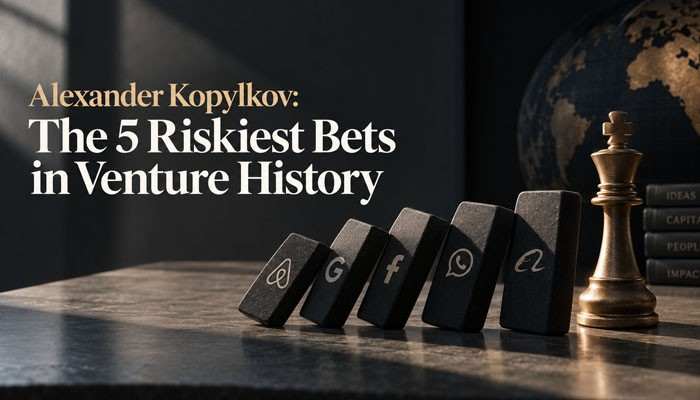

A $20,000 wager on strangers renting spare rooms and a $20 million check for a company almost no one outside China had heard of both turned into some of the biggest returns ever made
Every legendary venture return started as a bet almost no one else wanted to make. Venture investor and founder Alexander Kopylkov keeps a running list of five he considers the most instructive, not because he wrote any of the checks, but because each one shows what a genuinely good risk looks like before anyone can prove it was one. Each also had to clear a specific bar to make the list: a real, realized dollar return, documented in a public filing or a reported acquisition, not a rumor or a paper gain that evaporated in the next downturn.
In 2008, investors rejected Airbnb outright. The idea that strangers would pay to sleep in someone’s spare room struck almost everyone as absurd. The founders kept the company alive by selling novelty cereal boxes, raising about $30,000 from customers instead of investors. That stunt is what convinced Y Combinator to put in $20,000 for 6% of the company. Airbnb’s market capitalization passed $100 billion this year.
In 1998, Jeff Bezos put $250,000 into a two-person search engine most of Silicon Valley had not heard of yet, saying later that he simply liked the founders. By the time Google went public in 2004, that stake was worth $280 million.
Alexander Kopylkov breaks the pattern into first principles: each of these bets depended on an assumption every other investor had already rejected, a founder who could not yet prove that assumption true, and a market too small or too strange to fit on a spreadsheet.
In 2004, Peter Thiel became the first outside investor in a website built for college students, paying $500,000 for a 10% stake that valued the whole company at about $4.9 million. He sold about 20 million shares, a majority of his stake, within months of Facebook’s 2012 IPO, for roughly $400 million.
Sequoia Capital invested roughly $60 million across several rounds in a messaging app that charged a dollar a year and refused to run ads, a model most investors considered too small to matter. When Facebook bought WhatsApp for $19 billion in 2014, Sequoia’s stake was worth about $3 billion, a 50-times return on the fund behind the deal.

Kopylkov puts it plainly:
“None of these looked smart at the time. That’s not a coincidence. If they had looked smart, the price would already have been too high for anyone to make real money.”
SoftBank’s Masayoshi Son put $20 million into Alibaba in 2000, when the Chinese e-commerce company was valued at just $60 million and barely known outside China. By the time SoftBank had fully exited the position in 2024, it had booked a gain of roughly $8.5 billion, about 425 times its initial outlay.
Kopylkov compares the pattern to what is happening again right now, in 2026, inside AI infrastructure and enterprise software, where the founders getting funded earliest are the ones proposing something that still sounds implausible to most of the room. He sees no reason the pattern will look any different over the next twenty years than it did over the last twenty.
From an investor’s perspective, Kopylkov evaluates a bet like this by asking one question: was it rejected because the idea was wrong, or only because it was early? All five on this list were rejected for the second reason.
For founders facing rejection today, Alexander Kopylkov recommends the same test before assuming the pitch itself is broken: ask each investor, specifically, whether they doubt the market exists at all or just doubt it exists yet. Airbnb’s first investors were making the identical mistake that Bezos avoided when he chose to back two founders he believed in over a business model he could not yet verify.
Kopylkov flags a related trap founders should watch for: rejection for the wrong reason is not the same as validation. A founder who mistakes “you’re early” for “you’re right” can spend years chasing a market that genuinely never arrives. The test only works when investors are willing to explain their actual reasoning instead of giving a polite, generic no, so it is worth asking directly rather than guessing at the answer.
He applies a version of the same filter to his own pipeline. Before valuation ever comes up, he asks a founder to walk through every rejection they have already collected and explain, in their own words, why each investor passed. A vague or defensive answer is itself useful information. A founder who can name the specific assumption an investor doubted, and explain why that doubt does not hold up, is further along than one who blames bad luck in general terms.
In his view, the next investment that belongs on a list like this has not been recognized yet, and will not be for years, because by definition, it still looks like a bad idea today.
That is what makes these five worth studying as a working definition of what a great risk actually looks like. At the time, each one was the easiest pitch in the room to pass on.
