


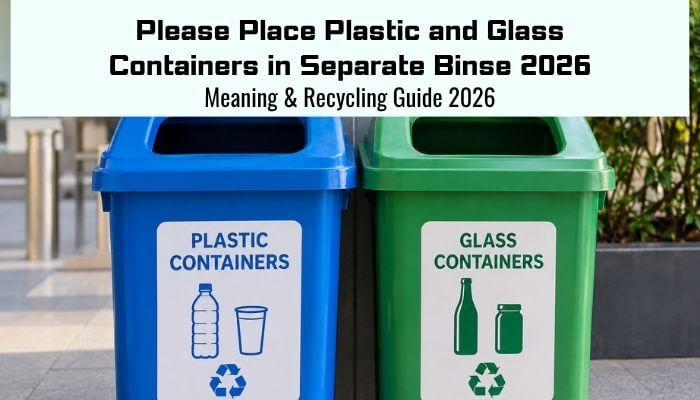

The instruction “Please place plastic and glass containers in separate bins” means recyclable plastic and glass containers should be sorted into their designated bins when a recycling station uses separate collection. You may see this message at schools, offices, apartment buildings, airports, hotels, restaurants, shopping centers, and public recycling points.
If you searched “please place plastic and glass containers in seperate bins,” there is also a spelling issue to know about. “Seperate” is incorrect. The correct spelling is “separate.”
However, plastic and glass do not always need different recycling bins. Some recycling services use multi-stream collection, while others use single-stream recycling and separate accepted materials later at a recycling facility.
Understanding when to please place plastic and glass containers in separate bins can help prevent recycling contamination and make waste sorting easier. This guide explains the meaning of the phrase, the spelling correction, plastic and glass recycling rules, common mistakes, and important recycling guidance for 2026.
Quick Answer
“Please place plastic and glass containers in separate bins” means recyclable plastic and glass should be sorted into their designated bins when separate collection is required. However, some recycling programs use mixed or single-stream recycling, so always follow the labels on the bins and your local recycling rules.
Key Takeaways
- Separate is correct; seperate is a spelling mistake.
- Plastic and glass should be separated when clearly labeled individual bins are provided.
- Not every recycling system requires separate plastic and glass bins.
- Some communities use single-stream recycling and separate materials later.
- A plastic resin code does not guarantee that an item is recyclable locally.
- Plastic bags and film often require different handling from rigid plastic containers.
- Compostable plastic should not automatically go into conventional plastic recycling.
- Glass bottles and jars are different from drinking glasses, ceramics, mirrors, and heat-resistant cookware.
- Containers should normally be empty and reasonably clean.
- Local recycling instructions should always take priority.
What Does “Please Place Plastic and Glass Containers in Separate Bins” Mean?
The phrase is a waste-sorting instruction.
Imagine a recycling station with two containers:
- Plastic Containers
- Glass Containers
A plastic water bottle would go into the plastic container, while an accepted glass sauce jar would go into the glass container.
The purpose is to keep different materials in the correct collection stream when the recycling system has been designed for source separation.
Plastic and glass require different recycling processes. Plastic may need to be separated by polymer type, while glass is normally processed separately before being crushed, cleaned, melted, and turned into new products.
What Is Wrong With “Please Place Plastic and Glass Containers in Seperate Bins”?
If you searched “please place plastic and glass containers in seperate bins,” the error is the spelling of “seperate.” The correct spelling is “separate.”
So the correct sentence is:
Please place plastic and glass containers in separate bins.
This is an important distinction because some readers may arrive at this topic through a spelling exercise, proofreading question, recycling sign, or grammar search rather than looking for recycling instructions.
Does “Please” Need a Comma?
A comma is not normally required in this instruction.
The natural sentence is:
Please place plastic and glass containers in separate bins.
Here, please politely introduces the instruction. The main correction in the commonly searched phrase is the spelling change from “seperate” to “separate.”
Why Are Plastic and Glass Sometimes Collected Separately?
Plastic and glass are different materials and require different recycling processes. This is one reason some recycling stations ask people to please place plastic and glass containers in separate bins.
Plastic packaging can be made from several polymers, so recycling facilities may sort it by:
- Polymer type
- Product type
- Color
- Quality
- Contamination level
Glass follows a different process. Collected container glass may be sorted, crushed, cleaned of contaminants, melted, and formed into new bottles and jars.
Separate collection can help create cleaner material streams when a recycling program is designed for source-separated recycling. However, some modern facilities can also separate accepted plastic, glass, metal, and other materials after mixed collection.
Do Plastic and Glass Always Need Separate Recycling Bins?
No. Recycling systems vary by location and collection provider.
The EPA describes two common approaches to recyclable collection.
Multi-Stream Recycling
Different recyclable materials are collected separately.
For example:
- Plastic in one container
- Glass in another
- Paper and cardboard in another stream
Single-Stream Recycling
Several accepted recyclable materials are placed together in one recycling bin and separated later at a processing facility.
This means an instruction to please place plastic and glass containers in separate bins usually applies to a specific recycling system or location. It should not be treated as a universal rule for every recycling program.
Always follow the labels on the bins and the current guidance from your local recycling provider.
What If There Are No Separate Plastic and Glass Bins?
If separate bins are not available, look for a recycling container labeled:
- Mixed recycling
- Single-stream recycling
- Dry recycling
- Containers
- Recyclables
In some recycling systems, accepted plastic and glass can be placed together and separated later at a processing facility.
If a sign does not specifically tell you to please place plastic and glass containers in separate bins, check the bin label and local recycling instructions before disposing of the items.
If you are unsure:
- Read the bin label carefully.
- Check the pictures or list of accepted materials.
- Review the recycling provider’s current instructions.
- Ask staff at the location if necessary.
- Avoid placing uncertain items in recycling just because you hope they are accepted.
Recycling rules vary by community and facility, so local guidance should always take priority.
Plastic vs. Glass Recycling at a Glance
| Material | Common Examples | Commonly Excluded Items | Basic Preparation |
|---|---|---|---|
| Plastic bottles | Water, soda, shampoo, and detergent bottles | Acceptance varies locally | Empty and lightly clean |
| Plastic tubs | Yogurt pots and food tubs | Some plastics may not be accepted | Remove food residue |
| Plastic bags and film | Shopping bags and flexible wrapping | Often excluded from ordinary curbside recycling | Use specialist collection if available |
| Glass bottles | Beverage and food bottles | Specialist glass products | Empty and rinse if necessary |
| Glass jars | Sauce, jam, and food jars | Ceramics and cookware | Empty and lightly rinse |
| Drinking glasses | Tumblers and stemware | Usually excluded from bottle-and-jar recycling | Follow local disposal guidance |
| Mirrors and heat-resistant glass | Mirrors and cookware | Usually excluded from container-glass recycling | Check local rules |
This comparison shows why some recycling stations ask people to please place plastic and glass containers in separate bins. However, accepted materials and preparation requirements can differ by local recycling program, so always check the collection guidance in your area.
Which Plastic Containers Can Usually Be Recycled?
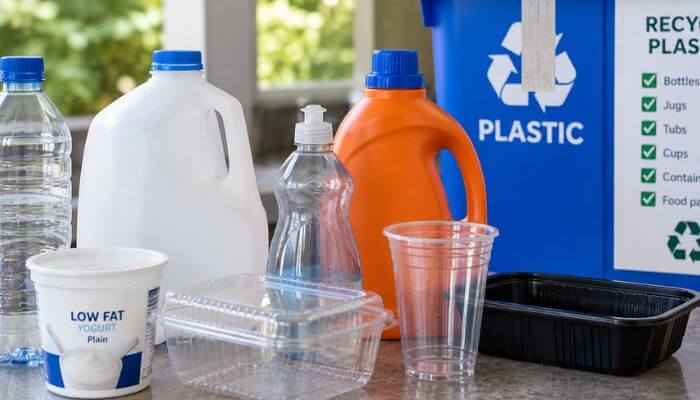
Depending on the recycling service, commonly accepted rigid plastic packaging may include:
- Water bottles
- Soft-drink bottles
- Milk jugs
- Detergent bottles
- Shampoo bottles
- Plastic food tubs
- Yogurt pots
- Plastic jars
- Some food trays
- Some takeaway containers
However, being made from plastic does not automatically make an item recyclable in your household collection.
Recycling facilities may accept certain plastic types while rejecting others, so check your local recycling rules before placing an unfamiliar plastic item in the bin.
What Do the Numbers on Plastic Containers Mean?
Many plastic products display a number inside a triangular symbol. These numbers are known as resin identification codes and indicate the type of plastic used.
| Code | Plastic Type | Common Uses |
|---|---|---|
| #1 | PET or PETE | Drink bottles and food packaging |
| #2 | HDPE | Milk jugs and detergent bottles |
| #3 | PVC | Some packaging and household products |
| #4 | LDPE | Bags, films, and flexible packaging |
| #5 | PP | Food tubs and yogurt containers |
| #6 | PS | Some disposable food packaging |
| #7 | Other | Mixed and other plastic materials |
A common misconception is that the number automatically means the product can be recycled.
It does not.
A resin identification code identifies the plastic type, but local recycling programs decide which materials they accept. This is why instructions such as please place plastic and glass containers in separate bins should always be followed together with the local accepted-material list.
Remember:
Resin code = identifies the plastic type.
Local rules = determine whether it is accepted for recycling.
Can Plastic Bags Go in the Plastic Recycling Bin?
Often, not in an ordinary household recycling bin.
Plastic bags and flexible films behave differently from rigid bottles and containers and may require a separate collection route.
Examples include:
- Grocery bags
- Produce bags
- Bread bags
- Flexible wrapping
- Bubble wrap
- Mailing film
- Some flexible food packaging
Some recycling programs or retailers provide dedicated collection points for plastic bags and films. Before putting flexible plastic into a household recycling bin, check the current instructions from your local recycling provider.
Should Recyclables Be Put Inside Plastic Bags?
Unless your local recycling service specifically requires it, recyclable bottles, jars, cans, and containers are often best placed loose in the recycling bin.
Putting recyclables inside an unaccepted plastic bag can create problems during sorting because the bag itself may require a different recycling route.
For this reason, do not assume that bagging recyclables makes them easier to process. If a recycling station asks you to please place plastic and glass containers in separate bins, place the accepted containers directly into the correct bin unless the instructions say otherwise.
Always follow the collection guidance printed on the recycling bin or provided by your local waste service.
Compostable Plastic vs. Recyclable Plastic
Packaging labeled compostable, biodegradable, bio-based, or plant-based should not automatically be placed in conventional plastic recycling.
These materials can look similar to ordinary plastic but may require a completely different disposal method.
Depending on the product and local collection system, the correct option may include:
- Industrial composting
- Specialist collection
- A dedicated organic-waste stream
- General waste when no suitable collection option is available
A product labeled bio-based is not automatically compostable, and a product labeled compostable is not automatically suitable for conventional plastic recycling.
Always check the packaging instructions and your local waste provider’s guidance before disposal.
Which Glass Containers Can Usually Be Recycled?
Commonly accepted container glass may include:
- Wine bottles
- Beer bottles
- Soft-drink bottles
- Sauce jars
- Jam jars
- Baby-food jars
- Perfume bottles
- Some cosmetic bottles
Recycle Now lists bottles of different colors, food jars, perfume bottles, aftershave bottles, and similar glass packaging among items accepted through applicable recycling schemes.
If a recycling station asks you to please place plastic and glass containers in separate bins, make sure the glass item is actually accepted container glass before placing it in the glass recycling bin.
Can Every Type of Glass Go Into Glass Recycling?
No. Not every glass product belongs in a bottle-and-jar recycling stream.
Items commonly excluded include:
- Drinking glasses
- Ceramics
- Crockery
- Pyrex and other heat-resistant glass
- Microwave plates
- Light bulbs
- Fluorescent tubes
- Vases
- Mirrors
- Window glass
Recycle Now specifically excludes items such as ceramics, drinking glasses, glass cookware, light bulbs, tubes, and vases from ordinary bottle-and-jar recycling guidance.
These products can have different compositions and melting properties, which means they may need a separate disposal or recycling route.
Made of glass does not automatically mean it belongs in a glass bottle recycling bin.
Always check your local recycling rules before disposing of an unfamiliar glass item.
What Should You Do With Broken Glass?
Broken glass requires extra care.
The EPA advises that broken glass should not be placed in ordinary U.S. recycling bins because shards can injure workers and damage equipment.
Recycle Now likewise advises against placing broken drinking glasses and Pyrex with ordinary container-glass recycling.
Because disposal rules vary:
- Avoid handling shards with bare hands.
- Secure sharp pieces safely.
- Check local disposal instructions.
- Do not assume broken glass belongs in a bottle bank.
Should Plastic and Glass Containers Be Washed Before Recycling?
Plastic and glass containers usually do not need to be perfectly clean before recycling. In most cases, they should simply be:
- Empty
- Free from significant food residue
- Free from excess liquid
- Reasonably clean
The EPA advises that plastic, metal, and glass recyclables should generally be empty and rinsed to remove food debris. Recycle Now also recommends emptying glass bottles and jars and giving them a quick rinse when necessary.
If a recycling station asks you to please place plastic and glass containers in separate bins, make sure the containers are empty and reasonably clean before placing them in the correct recycling stream.
Simple Cleaning Method
- Empty the container completely.
- Scrape out leftover food.
- Give it a quick rinse if needed.
- Allow excess liquid to drain.
- Check local instructions for caps and lids.
- Place the container in the correct recycling bin.
There is usually no need to use large amounts of hot water or make recyclable packaging spotless. The goal is simply to remove enough food and liquid to help reduce contamination.
Should Caps and Lids Stay On?
There is no single rule that applies everywhere.
Different recycling facilities use different sorting and processing systems, so instructions for caps and lids can vary by location.
Recycle Now currently advises replacing caps and lids on eligible glass bottles and jars because they can be separated during processing. Other recycling programs may provide different instructions.
For this reason, always check your local recycling guidance before removing or replacing caps and lids.
What Is Recycling Contamination?
Recycling contamination happens when food, liquids, or unacceptable materials are placed in a recycling stream.
Common examples include:
- Food residue
- Liquids
- Plastic bags where they are not accepted
- Ceramics mixed with container glass
- Unaccepted plastics
- Batteries
- General household waste
- Incorrectly sorted packaging
If a recycling station asks you to please place plastic and glass containers in separate bins, following that instruction can help prevent incorrectly sorted materials from entering the wrong recycling stream.
The EPA explains that unacceptable items may need to be removed during sorting and can increase processing costs.
Correct sorting helps keep recyclable materials cleaner and makes it easier for facilities to recover usable materials.
What Is Wishcycling?
Wishcycling means placing an uncertain item in recycling simply because you hope it can be recycled.
Examples can include:
- Plastic toys
- Unaccepted packaging
- Ceramics
- Broken household glass
- Plastic film
- Mixed-material products
- Heavily contaminated containers
Although the intention may be positive, wishcycling can increase contamination.
A better rule is:
When in doubt, check before you recycle.
What Happens to Plastic After Collection?
The exact recycling process varies by polymer and facility.
Typical stages can include:
- 1. Collection: Accepted plastic is collected from households, businesses, deposit programs, or drop-off centers.
- 2. Sorting: Plastic is separated from other materials and may then be divided by polymer, color, or product type.
- 3. Cleaning: Food, liquid, labels, and contaminants may be removed.
- 4. Shredding: Plastic can be reduced into smaller pieces.
- 5. Additional Separation: Processors may further separate different plastics or qualities.
- 6. Reprocessing: Recovered plastic can be converted into flakes, pellets, or another manufacturing feedstock.
- 7. Manufacturing: The recycled material may be used in packaging or other products where its properties are suitable.
What Happens to Glass After Collection?
Glass follows a different recycling process from plastic.
Recycle Now describes the main stages as:
- Sorting the glass where required
- Crushing it into smaller pieces
- Removing contaminants
- Mixing recovered glass with other materials when necessary
- Melting it in a furnace
- Molding or blowing it into new glass products
When glass bottles and jars are collected correctly and kept free from unsuitable materials, they can be processed into new containers and other glass products.
Do Recycling Bin Colors Mean the Same Everywhere?
No. Recycling-bin colors are not standardized everywhere.
You should not assume:
- Blue always means recycling
- Green always means glass
- Yellow always means plastic
- Black always means general waste
Bin colors can vary by:
- Country
- State
- City
- Local council
- Building
- Business
- School or university
- Waste contractor
If a recycling station asks you to please place plastic and glass containers in separate bins, follow the written labels and accepted-item signs rather than relying only on the color of the bins.
Always check the words, pictures, and accepted-material list before disposing of an item.
Recycling Rules in the United States
Recycling collection varies significantly across the United States.
There is no single curbside list that applies to every household.
The EPA recommends checking with the local recycling provider because certain facilities may accept items that others do not. The agency also notes that glass itself may not be accepted in every community.
For example, one location may collect:
- Plastic bottles
- Glass bottles and jars
- Cardboard
- Paper
- Metal cans
while another may exclude glass or accept fewer categories of plastic.
That makes local information more important than any nationwide generic recycling list.
England Recycling Rules in 2026
England’s Simpler Recycling household requirements came into force on March 31, 2026.
The government says waste collectors must by default collect:
- Food and garden waste
- Paper and card
- Other dry recyclable materials such as glass, metal, plastic and cartons
- Residual non-recyclable waste
This does not mean every household must have an individual plastic bin and an individual glass bin.
The rules allow dry recyclable materials to be collected according to suitable local collection arrangements.
Important 2026 Plastic-Film Update
Some older official guidance still states that plastic film packaging and plastic bags would need to be collected with plastic from March 31, 2027.
However, newer information published by the Local Government Association in August 2026 reports that Defra decided in July 2026 to defer mandatory household and workplace plastic-film collection until April 1, 2030.
This is a good example of why recycling advice should be checked against the newest local guidance.
How to Sort Plastic and Glass Correctly
Follow these simple steps to sort plastic and glass properly.
Step 1: Check the Bin Label
Read the label on the recycling bin to see which materials are accepted.
Step 2: Identify the Material
Check whether the item is plastic, glass, metal, paper, or another type of waste.
Step 3: Empty the Container
Remove leftover food, drinks, or other liquids before recycling.
Step 4: Rinse If Needed
Give the container a quick rinse if it has food or sticky residue. It does not need to be perfectly clean.
Step 5: Check Caps and Lids
Follow local instructions about whether caps and lids should stay on or be removed.
Step 6: Check If the Item Is Accepted
Not every plastic or glass item belongs in household recycling. Some items may need a different disposal method.
Step 7: Keep Special Waste Separate
Do not mix batteries, electronics, light bulbs, chemicals, ceramics, or similar items with ordinary recycling unless they are specifically accepted.
Step 8: Use the Correct Bin
If the recycling station says please place plastic and glass containers in separate bins, put accepted plastic containers in the plastic bin and accepted glass bottles or jars in the glass bin.
If mixed recycling is provided, follow the instructions on the recycling container.
Plastic and Glass Recycling Checklist
Before recycling a plastic or glass container, check these points:
- Is the item accepted by your local recycling service?
- Is it a plastic or glass container?
- Is that type of plastic accepted?
- Is the glass a bottle or jar rather than another type of glass?
- Is the container empty?
- Have you removed leftover food or liquid?
- Should the cap or lid stay on?
- Should recyclables be placed loose in the bin?
- Is the item plastic film or flexible packaging?
- Are separate recycling bins provided?
If a recycling station asks you to please place plastic and glass containers in separate bins, follow the labels and put each accepted material into the correct collection stream.
10 Common Recycling Mistakes to Avoid
Even simple recycling mistakes can lead to contamination or rejected materials. Avoid these common problems:
- Recycling every plastic item: Not all plastic products are accepted by local recycling programs.
- Assuming the plastic number means recyclable: Resin codes identify the type of plastic, but they do not guarantee that the item is accepted locally.
- Putting plastic film with rigid plastics: Plastic bags, wraps, and flexible films may require a separate collection point.
- Mixing ceramics with glass recycling: Ceramics should not usually be placed with glass bottles and jars.
- Putting drinking glasses in bottle recycling: Drinking glasses can have different melting properties and may require another disposal method.
- Leaving food or liquid inside containers: Empty containers and remove significant food residue before recycling.
- Choosing a bin only by its color: Recycling-bin colors vary, so always read the label and accepted-item list.
- Putting recyclables inside plastic bags: Some collection systems require bottles, jars, cans, and other recyclables to be placed loose in the bin.
- Mixing compostable plastic with recyclable plastic: Compostable packaging may require industrial composting or another dedicated disposal route.
- Wishcycling: Do not place uncertain items in recycling simply because you hope they are accepted. Check local guidance first.
If a recycling station tells you to please place plastic and glass containers in separate bins, follow the labeled collection system rather than relying on assumptions about what belongs where.
Why Correct Recycling Matters
Correct recycling helps keep useful materials in the right waste stream and reduces contamination.
When plastic, glass, paper, or other recyclables are sorted properly, recycling facilities can process them more efficiently.
Correct sorting can help:
- Reduce contamination
- Improve the quality of recovered materials
- Protect sorting equipment
- Reduce unnecessary processing
- Keep unsuitable waste out of recycling streams
- Support the reuse of valuable materials
This is why signs that ask people to please place plastic and glass containers in separate bins are important when a location uses separate recycling streams.
Reduce and Reuse Before Recycling
Recycling is useful, but reducing waste and reusing products can be even better.
Simple ways to reduce packaging waste include:
- Use a reusable bottle
- Reuse suitable glass jars
- Choose refillable products
- Avoid unnecessary packaging
- Buy durable products when possible
- Choose packaging accepted by your local recycling service
A simple waste hierarchy is:
Reduce → Reuse → Recycle correctly
Recycling Tips for Businesses and Public Places
Schools, offices, businesses, restaurants, and public venues can make recycling easier by using clear signs and well-placed bins.
Good practices include:
- Use large, easy-to-read labels
- Show pictures of accepted items
- Place recycling and general waste bins close together
- Clearly identify materials that are not accepted
- Avoid relying only on bin colors
- Keep recycling instructions consistent
- Update signs when collection rules change
- Train cleaning and facilities staff
- Check recycling bins regularly for contamination
If plastic and glass are collected separately, the signs should clearly tell users which container belongs in each bin.
If mixed recycling is used instead, the wording should match the actual collection system.
Conclusion
The instruction “please place plastic and glass containers in separate bins” means accepted plastic and glass should be sorted into their designated recycling streams when separate collection is required.
However, recycling systems are not the same everywhere. Some locations use separate bins, while others use single-stream recycling and sort accepted materials later. If you searched “please place plastic and glass containers in seperate bins,” remember that separate is the correct spelling.
The best approach is to read the bin label, follow local recycling rules, empty and lightly clean containers, and avoid placing uncertain items in recycling.
When a recycling station asks you to please place plastic and glass containers in separate bins, following the instruction helps reduce contamination and keeps recyclable materials in the correct collection stream.
FAQs About Please Place Plastic and Glass Containers in Separate Bins
1. Should Plastic Bottles Be Crushed Before Recycling?
Not always. Some recycling facilities prefer bottles to keep their original shape for easier sorting. Check your local recycling instructions before crushing them.
2. Can Labels Stay on Plastic and Glass Containers?
Usually, labels can stay on bottles and jars because recycling facilities can often remove them during processing. Local rules may differ.
3. Can Colored Glass Bottles Go in the Same Recycling Bin?
In some programs, different glass colors can be collected together. Other systems separate clear, green, and brown glass, so follow the bin label.
4. What Does Source-Separated Recycling Mean?
Source-separated recycling means different materials are sorted before collection. A sign saying please place plastic and glass containers in separate bins is an example of this system.
5. Can Black Plastic Containers Be Recycled?
It depends on the local recycling facility and its sorting technology. Check whether black plastic packaging is included in your area’s accepted materials.
6. Can Plastic and Glass Be Stored Together Before Recycling?
Yes, they can generally be stored together temporarily if they are later sorted correctly. Where signs say please place plastic and glass containers in separate bins, separate them before disposal.
7. Should Bottles and Jars Be Completely Dry Before Recycling?
They do not normally need to be perfectly dry, but excess liquid should be emptied before recycling to help reduce contamination.
8. What Should I Do If a Recycling Sign Is Unclear?
Check the accepted-material pictures, scan any available QR code, or consult the local recycling provider before putting an uncertain item in the bin.
