




The rank of a matrix tells you how much independent information a matrix contains. Even if a matrix has many rows and columns, some may repeat information already represented by others.
Instead of simply counting rows or columns, the rank of a matrix measures the number of independent directions that remain after redundant information is removed.
This concept is fundamental to linear algebra and connects directly with linear independence, row reduction, pivots, determinants, bases, systems of equations, nullity, Singular Value Decomposition (SVD), and low-rank approximation.
Quick Answer
The rank of a matrix is the number of linearly independent rows or columns it contains. It is equal to the number of pivot positions after row reduction and shows how much independent information the matrix represents.
Key Takeaways
- The rank of a matrix measures how many independent rows or columns it contains.
- Dependent rows or columns do not increase rank.
- The number of pivots equals the rank.
- Row rank and column rank are always equal.
- For an m×nm \times n matrix, rank cannot exceed min(m,n)\min(m,n).
- A square matrix is invertible when it has full rank.
- Rank helps analyze the consistency and number of solutions of linear systems.
- Rank and nullity are connected by the rank-nullity theorem.
- Singular values help determine numerical rank in computational problems.
- Low-rank approximations reduce complex data to its most important components.
What Is the Rank of a Matrix?
For a matrix AA, the rank of a matrix is the dimension of its column space. Since row rank and column rank are always equal, it is also the dimension of the row space.
It is commonly written as:
rank(A)\operatorname{rank}(A)
Other notations include r(A)r(A) and ρ(A)\rho(A).
The rank of a matrix can also be identified by counting its pivot positions or the non-zero rows in row echelon form.
Different Ways to Understand Matrix Rank
| View of Rank | Meaning |
|---|---|
| Independent rows | Maximum number of linearly independent rows |
| Independent columns | Maximum number of linearly independent columns |
| Row echelon form | Number of non-zero rows |
| Pivot method | Number of pivot positions |
| Column-space view | Dimension of the column space |
| Row-space view | Dimension of the row space |
| Minor method | Order of the largest non-zero minor |
| SVD method | Number of non-zero singular values in exact arithmetic |
Although these definitions look different, they all describe the same mathematical quantity.
Why Do Some Rows Matter While Others Don’t?
Consider the matrix:
A =
| 1 | 2 | 3 |
|---|---|---|
| 2 | 4 | 6 |
| 3 | 6 | 9 |
Here:
R₂ = 2R₁
R₃ = 3R₁
Rows 2 and 3 are dependent on Row 1, so they do not add any new independent information.
Therefore:
rank(A) = 1
This shows that the rank of a matrix depends on the number of independent rows or columns, not simply on the size of the matrix.
Now Consider a Different Matrix
B =
| 1 | 2 | 3 |
|---|---|---|
| 2 | 4 | 6 |
| 1 | 1 | 1 |
Here:
R₂ = 2R₁
However, Row 3 is not a multiple of Row 1, so it adds another independent direction.
After row reduction:
| 1 | 2 | 3 |
|---|---|---|
| 0 | -1 | -2 |
| 0 | 0 | 0 |
Two non-zero independent rows remain.
Therefore:
rank(B) = 2
This confirms that matrix size alone does not determine rank. What matters is how many rows or columns are linearly independent.
Linear Independence Is the Real Idea Behind Rank
Understanding linear independence makes the rank of a matrix easier to understand.
Suppose a matrix has rows:
R₁, R₂, …, Rₖ
These rows are linearly independent if:
c₁R₁ + c₂R₂ + … + cₖRₖ = 0
has only the solution:
c₁ = c₂ = … = cₖ = 0
If one row can be formed from the others, the rows are linearly dependent. For example:
R₃ = 2R₁ − 3R₂
Here, R₃ adds no new independent information because it is already determined by R₁ and R₂.
Therefore, rank depends on independent rows or columns, not simply on the number of non-zero rows in the original matrix.
Row Rank and Column Rank Are Equal
A fundamental result in linear algebra is that row rank and column rank are always equal. This means the rank of a matrix can be determined using either its independent rows or independent columns.
Row rank = Column rank
If a matrix has three independent rows, its column space also has dimension three. Because both values are equal, we simply refer to this common value as rank(A).
What Is the Maximum Rank of a Matrix?
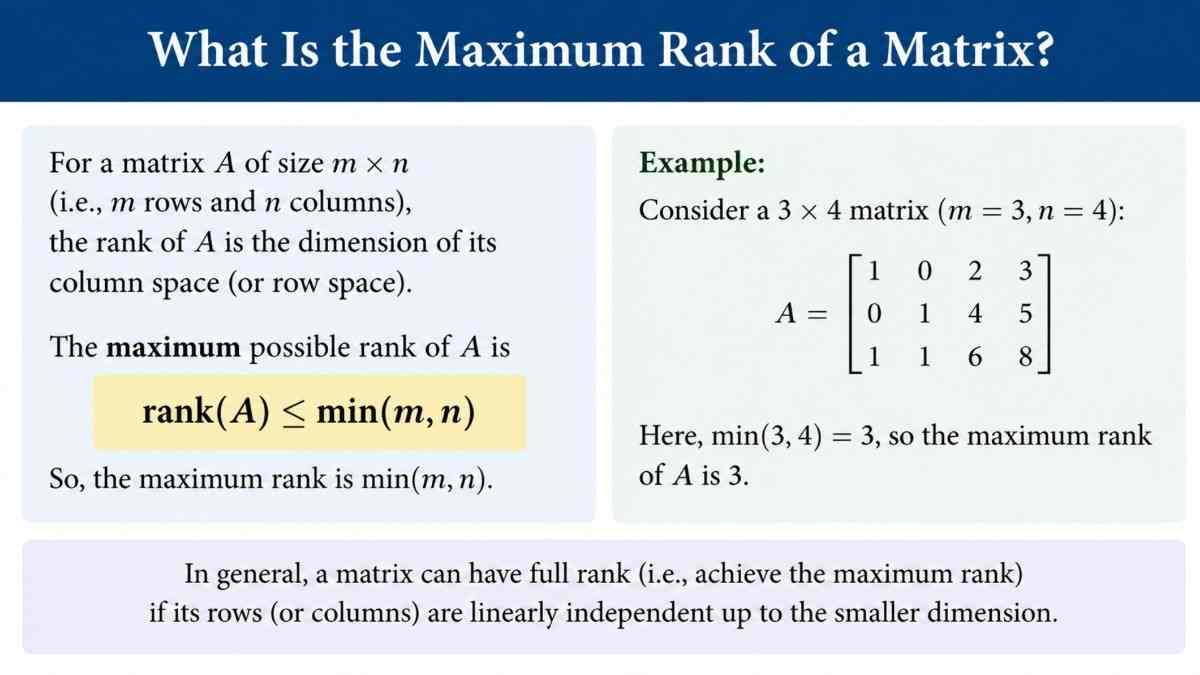
For an m × n matrix, the rank of a matrix cannot exceed the smaller of the number of rows and columns.
rank(A) ≤ min(m, n)
Therefore:
0 ≤ rank(A) ≤ min(m, n)
A matrix cannot contain more independent rows than its total rows or more independent columns than its total columns.
Maximum Rank Examples
| Matrix Size | Maximum Possible Rank |
|---|---|
| 2 × 2 | 2 |
| 3 × 3 | 3 |
| 3 × 5 | 3 |
| 5 × 3 | 3 |
| 4 × 8 | 4 |
| 10 × 10 | 10 |
Rank of a Rectangular Matrix
The rank of a matrix also applies to rectangular matrices. For example, consider:
A =
| 1 | 2 | 3 | 4 |
|---|---|---|---|
| 2 | 4 | 6 | 8 |
| 0 | 1 | 1 | 2 |
This is a 3 × 4 matrix, so its maximum possible rank is 3.
Since:
R₂ = 2R₁
Row 2 is dependent. After row reduction, only two independent rows remain.
Therefore:
rank(A) = 2
Tall and Wide Matrices
For a wide matrix where m < n, the maximum possible rank is m.
For a tall matrix where m > n, the maximum possible rank is n.
Therefore, a rectangular matrix can still have full rank even though it is not square.
What Does Full Rank Mean?
The rank of a matrix is full when it reaches the maximum value allowed by its dimensions:
rank(A) = min(m, n)
For a square n × n matrix, full rank means:
rank(A) = n
For example:
A =
| 1 | 2 |
|---|---|
| 3 | 4 |
Its determinant is:
det(A) = (1 × 4) − (2 × 3) = −2
Since det(A) ≠ 0, the matrix has full rank:
rank(A) = 2
A square matrix with full rank is also invertible.
Full Row Rank vs Full Column Rank
For rectangular matrices, full rank depends on whether the number of rows or columns is smaller. The rank of a matrix reaches its maximum possible value when it equals min(m,n)\min(m,n).
Full Row Rank
If m < n and:
rank(A) = m
the matrix has full row rank.
Full Column Rank
If m > n and:
rank(A) = n
the matrix has full column rank.
Square Matrix
If m = n and:
rank(A) = n
the matrix has both full row rank and full column rank.
What Is a Rank-Deficient Matrix?
The rank of a matrix is deficient when it is smaller than the maximum possible rank:
rank(A) < min(m, n)
For example:
A =
| 1 | 2 |
|---|---|
| 2 | 4 |
Since:
R₂ = 2R₁
the second row is dependent on the first, so only one independent row remains.
Therefore:
rank(A) = 1
instead of the maximum possible rank of 2. Rank deficiency indicates linear dependence or redundancy within the matrix.
How to Find the Rank of a Matrix
There are several ways to calculate the rank of a matrix, including row reduction, determinants, normal form, and Singular Value Decomposition (SVD). The best method depends on the matrix and whether the calculation is done by hand or with numerical software.
Common methods include:
- Row echelon form
- Reduced row echelon form
- Minors and determinants
- Normal form
- Singular Value Decomposition
Method 1: Find Rank Using Row Echelon Form
For most hand calculations, the rank of a matrix is easiest to find using Gaussian elimination. Reduce the matrix to row echelon form and count the pivots or non-zero rows.
You may:
- Swap two rows.
- Multiply a row by a non-zero number.
- Add a multiple of one row to another.
The number of pivots in the final echelon form is the rank.
Solved Example: Finding Rank by Row Reduction
Consider:
A =
| 1 | 2 | 3 |
|---|---|---|
| 2 | 4 | 6 |
| 1 | 1 | 1 |
Apply:
R₂ → R₂ − 2R₁
R₃ → R₃ − R₁
This gives:
| 1 | 2 | 3 |
|---|---|---|
| 0 | 0 | 0 |
| 0 | -1 | -2 |
Move the zero row to the bottom:
| 1 | 2 | 3 |
|---|---|---|
| 0 | -1 | -2 |
| 0 | 0 | 0 |
There are two pivots and two non-zero rows.
Therefore:
rank(A) = 2
Why Row Operations Do Not Change Rank
Elementary row operations change how the rows are written without changing their number of independent directions. This is why Gaussian elimination can reveal dependencies while preserving the rank of a matrix.
For example:
R₂ → R₂ − 3R₁
replaces one row with an equivalent linear combination without creating or removing an independent dimension.
Does Row Reduction Preserve the Column Space?
Row operations preserve matrix rank and the row space, but they do not generally preserve the original column space.
If Columns 1 and 3 become pivot columns after row reduction, use Columns 1 and 3 from the original matrix to form a basis for Col(A).
Use this process:
- Row-reduce the matrix.
- Identify the pivot columns.
- Return to the original matrix.
- Select the corresponding original columns.
Method 2: Find Rank Using Minors and Determinants
Another way to determine the rank of a matrix is to find the largest square submatrix with a non-zero determinant.
For a 3 × 3 matrix:
- If det(A) ≠ 0, then rank(A) = 3.
- If det(A) = 0, check the 2 × 2 minors.
- If at least one 2 × 2 minor is non-zero, rank(A) = 2.
- If all 2 × 2 minors are zero but at least one entry is non-zero, rank(A) = 1.
- If every entry is zero, rank(A) = 0.
Example: Rank Using a Determinant
Consider:
A =
| 1 | 2 |
|---|---|
| 2 | 5 |
Calculate:
det(A) = (1 × 5) − (2 × 2) = 1
Since det(A) ≠ 0, the matrix has full rank.
Therefore:
rank(A) = 2
Quick Rank Test for a 2×2 Matrix
For:
A =
| a | b |
|---|---|
| c | d |
calculate:
det(A) = ad − bc
If:
ad − bc ≠ 0
then:
rank(A) = 2
If:
ad − bc = 0
but at least one matrix entry is non-zero:
rank(A) = 1
If every element is zero:
rank(A) = 0
This is usually the fastest rank test for a 2 × 2 matrix.
Quick Rank Test for a 3×3 Matrix
For a 3 × 3 matrix, use the following steps.
Step 1
Calculate the determinant. If:
det(A) ≠ 0
then:
rank(A) = 3
Step 2
If:
det(A) = 0
check the 2 × 2 minors. If at least one is non-zero:
rank(A) = 2
Step 3
If all 2 × 2 minors are zero but at least one matrix entry is non-zero:
rank(A) = 1
Step 4
If every entry is zero:
rank(A) = 0
For larger matrices, row reduction is usually more efficient than checking many minors.
Method 3: Find Rank Using Normal Form
A matrix can also be transformed using elementary row and column operations into the normal form:
[ Iᵣ 0 ]
[ 0 0 ]
Here, Iᵣ is an identity matrix of order r, and r is the rank.
For example:
| 1 | 0 | 0 |
|---|---|---|
| 0 | 1 | 0 |
| 0 | 0 | 0 |
The identity block has order 2.
Therefore:
rank(A) = 2
The normal-form method is especially useful in courses that allow both row and column transformations.
Method 4: Find Numerical Rank Using Singular Values
In numerical computing, the rank of a matrix may be estimated using Singular Value Decomposition when data contains rounding errors or measurement noise.
Suppose:
C₂ = 2C₁
but measured data gives:
C₂ ≈ 2C₁
The columns are nearly dependent rather than exactly dependent.
Using SVD:
A = UΣVᵀ
the diagonal entries of Σ are the singular values. In exact arithmetic, rank equals the number of non-zero singular values. In numerical calculations, very small singular values may instead be treated as zero based on a tolerance.
Exact Rank vs Numerical Rank
| Type | Meaning |
|---|---|
| Exact rank | Counts mathematically non-zero independent directions |
| Numerical rank | Counts significant directions above a chosen numerical tolerance |
This distinction is important in scientific computing, statistics, data analysis, optimization, and machine learning.
Rank of a Matrix and Pivots
A pivot is a leading non-zero position that appears during Gaussian elimination. The rank of a matrix equals the number of pivot positions.
Suppose:
| 1 | 3 | 2 | 4 |
|---|---|---|---|
| 0 | 1 | 5 | 2 |
| 0 | 0 | 0 | 0 |
There are two pivots.
Therefore:
rank(A) = 2
A useful rule is:
Rank = Number of pivots
How Rank Helps Find a Basis
The rank of a matrix also helps identify vectors that form a basis for its row or column space.
Suppose:
RREF(A) =
| 1 | 0 | 2 | 0 |
|---|---|---|---|
| 0 | 1 | -1 | 3 |
| 0 | 0 | 0 | 0 |
The pivot positions are in Columns 1 and 2, so:
rank(A) = 2
Columns 1 and 2 of the original matrix form a basis for the column space. The non-zero rows of an echelon form can similarly provide a basis for the row space.
Rank of a Matrix and the Determinant
For a square n × n matrix, the determinant provides a quick test for the rank of a matrix.
If:
det(A) ≠ 0
then:
rank(A) = n
The matrix is full rank and invertible.
If:
det(A) = 0
then:
rank(A) < n
The matrix is singular, but its exact rank is still unknown. For example, a 4 × 4 matrix with zero determinant could have rank 3, 2, 1, or 0.
Rank of a Matrix and Linear Equations
The rank of a matrix helps determine how many independent constraints exist in a system of linear equations.
Consider:
x + y = 2
2x + 2y = 4
The second equation is twice the first, so it adds no new independent constraint. Although two equations are present, only one is independent.
For a system:
Ax = b
the vector b must belong to the column space of A for the system to have a solution.
How Rank Determines the Number of Solutions
For Ax = b, the rank of a matrix can be compared with the rank of the augmented matrix [A | b] to determine whether solutions exist.
Let n be the number of unknowns.
| Rank Condition | Number of Solutions |
|---|---|
| rank(A) = rank([A | b]) = n | One unique solution |
| rank(A) = rank([A | b]) < n | Infinitely many solutions |
| rank(A) ≠ rank([A | b]) | No solution |
This provides a quick way to classify a linear system without solving every variable.
Example of an Inconsistent System
Consider:
x + y = 2
2x + 2y = 5
The coefficient matrix is:
| 1 | 1 |
|---|---|
| 2 | 2 |
Since Row 2 is twice Row 1, the rank of a matrix representing the coefficients is:
rank(A) = 1
The augmented matrix is:
| 1 | 1 | 2 |
|---|---|---|
| 2 | 2 | 5 |
Apply:
R₂ → R₂ − 2R₁
This gives:
| 1 | 1 | 2 |
|---|---|---|
| 0 | 0 | 1 |
Therefore:
rank([A | b]) = 2
Since:
rank(A) ≠ rank([A | b])
the system is inconsistent and has no solution.
Example of Infinitely Many Solutions
Suppose a system has four unknowns and:
rank(A) = 2
rank([A | b]) = 2
Because the ranks are equal, the system is consistent. However, since 2 < 4, there are free variables.
Therefore, the system has infinitely many solutions. The rank of a matrix helps reveal whether a system has enough independent equations to determine every variable.
Rank and Nullity
The rank of a matrix is closely related to nullity through the rank-nullity theorem.
For an m × n matrix:
rank(A) + nullity(A) = n
Rank represents the number of pivot variables or independent column directions, while nullity represents the dimension of the null space and the number of free variables in Ax = 0.
Example
Suppose matrix A has five columns and:
rank(A) = 3
Then:
3 + nullity(A) = 5
Therefore:
nullity(A) = 2
So the homogeneous system Ax = 0 has two free variables.
Can Rank Change Depending on a Variable?
Yes. The rank of a matrix can change when a variable changes the relationship between its rows or columns.
Consider:
A =
| 1 | 2 |
|---|---|
| 2 | k |
Its determinant is:
det(A) = k − 4
When k ≠ 4
det(A) ≠ 0
Therefore:
rank(A) = 2
When k = 4
The matrix becomes:
| 1 | 2 |
|---|---|
| 2 | 4 |
Since R₂ = 2R₁, the rows are dependent.
Therefore:
rank(A) = 1
This shows how changing one value can change the rank of a matrix by creating or removing linear dependence.
Important Properties of the Rank of a Matrix

These basic properties are useful when solving matrix problems:
- Rank is never negative: rank(A) ≥ 0
- Maximum rank: rank(A) ≤ min(m, n)
- Zero matrix: rank(A) = 0
- Identity matrix: rank(Iₙ) = n
- Transpose: rank(A) = rank(Aᵀ)
- Row operations: Elementary row operations preserve rank.
- Non-zero scalar: rank(cA) = rank(A), when c ≠ 0
- Product: rank(AB) ≤ min(rank(A), rank(B))
- Sum: rank(A + B) ≤ rank(A) + rank(B)
- Invertible matrix: An n × n matrix is invertible exactly when rank(A) = n.
Rank Factorization: Showing Which Columns Really Matter
Rank factorization gives a deeper way to understand the rank of a matrix. If an m×nm × n matrix AA has rank rr, it can be written as:
A = CR
where:
- C is an m×rm × r matrix containing rr independent columns.
- R is an r×nr × n matrix showing how all columns of AA are built from those independent columns.
This means that if rank(A) = r, only rr independent column directions are needed to reconstruct every column in the matrix.
Why Low-Rank Matrices Matter in Real Data
The rank of a matrix becomes especially useful when working with large datasets because much of the important information may be concentrated in only a few independent directions.
Using Singular Value Decomposition:
A = UΣVᵀ
a matrix can be represented using rank-one components. By keeping only the most important components, we obtain a low-rank approximation that can preserve useful structure while reducing complexity.
Why Is That Useful?
Low-rank approximation is useful for:
- Data compression
- Dimensionality reduction
- Image and signal processing
- Principal component analysis
- Information retrieval
- Scientific computing
- Machine learning
In practical applications, the rank of a matrix can therefore indicate the effective complexity of a dataset rather than simply its physical size.
Rank 1 Matrices: The Simplest Non-Zero Case
A rank 1 matrix has only one independent row direction and one independent column direction, making it the simplest non-zero case of the rank of a matrix.
For example:
| 1 | 2 | 3 |
|---|---|---|
| 2 | 4 | 6 |
| 4 | 8 | 12 |
Every row is a multiple of:
[1, 2, 3]
Therefore:
rank(A) = 1
A rank 1 matrix can also be expressed as the product of one column vector and one row vector.
Rank of a Matrix at a Glance
This table summarizes the most common situations used to identify the rank of a matrix quickly.
| Situation | Rank |
|---|---|
| Every entry is zero | 0 |
| All non-zero rows are multiples of one row | 1 |
| Two independent directions remain | 2 |
| rr pivots appear | rr |
| n×nn × n matrix has a non-zero determinant | nn |
| Square matrix is invertible | Full rank |
| Determinant of a square matrix is zero | Below full rank |
| Matrix has rr independent columns | rr |
| Matrix has rr independent rows | rr |
| SVD has rr non-zero singular values | rr in exact arithmetic |
Which Method Should You Use to Find Matrix Rank?
Different problems are easier to solve with different methods.
| Method | Best Used For |
|---|---|
| Row echelon form | Most hand calculations |
| RREF and pivots | Basis and free-variable problems |
| Determinant | Testing full rank in small square matrices |
| Minors | Finding exact rank of small matrices |
| Normal form | Row and column transformation problems |
| SVD | Numerical and near-dependent data |
For most students, row reduction is the best default method because it works for both square and rectangular matrices while revealing pivots, dependencies, and free variables.
Common Mistakes When Finding Matrix Rank
Students often make simple errors when calculating the rank of a matrix. Avoid these common mistakes:
- Counting non-zero rows too early: Reduce the matrix first because non-zero rows may still be dependent.
- Assuming rank equals matrix size: A 4 × 4 matrix can have rank 0, 1, 2, 3, or 4.
- Stopping when det(A) = 0: This only shows that a square matrix is not full rank.
- Assuming different-looking rows are independent: One row may still be a combination of other rows.
- Confusing a zero entry with a zero row: A zero row must contain only zeros.
- Using RREF columns for the column-space basis: Use pivot positions from RREF, but select the corresponding columns from the original matrix.
- Treating tiny numerical values as exact zeros: Numerical calculations often use a tolerance to determine the rank of a matrix.
The Fastest Way to Understand Rank
The easiest way to understand the rank of a matrix is to think about independent information.
If a matrix has six rows but three can be created from the other three, its rank may be only 3. Adding more dependent rows increases the matrix size but does not add new independent directions.
Simply remember:
Rank = Number of independent directions
Why the Rank of a Matrix Matters Beyond Exams
The rank of a matrix is important in mathematics, data science, engineering, and computing because it reveals independence, redundancy, and the effective structure of data.
Rank helps determine:
- Whether equations contain redundant constraints
- Whether a linear system has a solution
- Whether the solution is unique
- Whether a square matrix is invertible
- How many independent directions exist
- The dimensions of row and column spaces
- The number of free variables
- Whether data contains redundancy
- Whether low-rank approximation can simplify data
These applications make matrix rank useful far beyond classroom calculations, from small matrices to large datasets used in scientific computing and machine learning.
Conclusion
The rank of a matrix is ultimately a measure of how much independent information a matrix really contains. Rows and columns may increase in number, but only those that add a new direction contribute to rank.
That simple idea has wide implications. It helps explain pivots, linear independence, invertibility, solution behavior, nullity, and even modern techniques such as SVD and low-rank approximation.
For students, the practical takeaway is straightforward: do not judge a matrix by its size. Look instead at how much of its information is genuinely independent.
Understanding the rank of a matrix turns what can seem like a technical calculation into a powerful way of seeing structure, redundancy, and complexity across linear algebra and real-world data.
FAQs About Rank of a Matrix
1. Can two different matrices have the same rank of a matrix?
Yes. Matrices with different values or even different dimensions can have the same rank if they contain the same number of independent rows or columns.
2. What is the rank of a diagonal matrix?
The rank of a matrix that is diagonal equals the number of non-zero entries on its main diagonal.
3. Is the rank of a matrix equal to the number of non-zero eigenvalues?
Not always. However, a square matrix has full rank exactly when zero is not one of its eigenvalues.
4. What happens to matrix rank if a row or column is deleted?
Deleting one row or column cannot increase rank. It can either leave the rank unchanged or reduce it by one.
5. Does multiplying by an invertible matrix change rank?
No. If an invertible matrix multiplies AA from either side, the rank of a matrix remains unchanged.
6. What does matrix rank tell us about a linear transformation?
Matrix rank gives the dimension of the image or range of the transformation, showing how many independent output directions it produces.
7. What is the rank of an outer-product matrix?
For non-zero vectors uu and vv, the matrix uvTuv^T has rank 1. If either vector is zero, its rank is 0.
8. What is the rank of a block-diagonal matrix?
For a block-diagonal matrix, the rank of a matrix equals the sum of the ranks of its diagonal blocks.
