


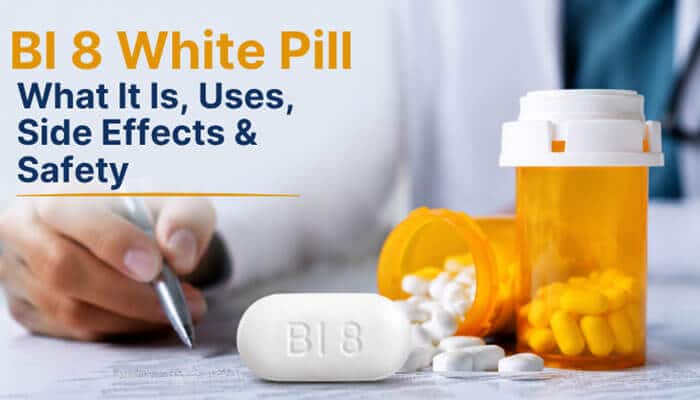

The BI 8 white pill is ibuprofen 800 mg, a prescription-strength nonsteroidal anti-inflammatory drug, or NSAID. Current U.S. DailyMed labeling identifies the BI 8 tablet as a white, film-coated caplet containing 800 mg of ibuprofen. Product information also describes the tablet as white, capsule-shaped, approximately 19 mm long, and unscored.
The BI 8 white pill is used within prescription ibuprofen treatment for pain and inflammatory conditions. Although ibuprofen is familiar because lower strengths are sold over the counter, an 800 mg prescription tablet should not be treated like an ordinary OTC pain reliever.
Prescription-strength NSAIDs can cause important gastrointestinal, cardiovascular, kidney, blood-pressure, and allergic complications. Those risks may become more important with higher doses, longer treatment, older age, interacting medications, or certain underlying health conditions.
If you found a loose BI 8 white pill, do not take it merely because the tablet resembles a photograph online. Confirm the complete imprint, color, shape, packaging, and prescription information, preferably with a pharmacist.
Quick Answer: What Is the BI 8 White Pill?
The BI 8 white pill is ibuprofen 800 mg, a prescription-strength NSAID used to relieve pain and inflammation in appropriate medical situations.
| Pill Detail | Identification |
| Imprint | BI 8 |
| Active ingredient | Ibuprofen |
| Strength | 800 mg |
| Color | White |
| Shape | Capsule-shaped/caplet |
| Approximate size | 19 mm |
| Score line | No score |
| Drug class | NSAID |
| Route | Oral |
| U.S. status | Prescription drug |
| Main purpose | Pain and inflammation relief |
The physical characteristics are important because identifying the BI 8 white pill requires more than seeing the imprint alone.
Key Takeaways
- The BI 8 white pill contains ibuprofen 800 mg
- It is a prescription-strength NSAID, not an opioid or narcotic
- One BI 8 tablet contains four times the ibuprofen in a typical 200 mg OTC tablet
- A higher dose does not automatically mean better pain relief
- Major NSAID risks include gastrointestinal bleeding, kidney problems, elevated blood pressure, fluid retention, heart attack, stroke, and severe allergic reactions
- Do not combine prescription ibuprofen with another NSAID or change your dose without professional guidance
- Pregnancy requires special caution with ibuprofen, particularly from about 20 weeks onward
- A loose BI 8 white pill should be professionally verified before use
BI 8 White Pill Identification
Correct BI 8 white pill identification involves more than reading the letters and number on the tablet.
The documented BI 8 tablet has the following characteristics:
- Active ingredient: Ibuprofen
- Strength: 800 mg
- Color: White
- Shape: Capsule-shaped/caplet
- Coating: Film-coated
- Imprint: BI 8
- Approximate size: 19 mm
- Score: None
If you are trying to identify a BI 8 white pill, compare all of these characteristics rather than relying only on the color or imprint.
Why Color, Shape, and Imprint Matter
Never identify medicine simply because it is a white tablet.
Generic drugs containing the same active ingredient can be produced by different manufacturers and may have different:
- Imprints
- Shapes
- Dimensions
- Colors
- Coatings
- Packaging
At the same time, tablets with similar colors can contain completely different medications.
When checking a suspected BI 8 white pill, compare:
- The complete imprint
- Color
- Shape
- Approximate size
- Whether it has a score line
- Markings on both sides
- Original pharmacy packaging, if available
If any important feature does not match, ask a pharmacist to identify the medication before taking it.
What Is Ibuprofen 800 mg?
Ibuprofen is a nonsteroidal anti-inflammatory drug.
Its pain-relieving and anti-inflammatory effects are related to reducing the production of prostaglandins. These substances participate in pain, inflammation, fever, blood-vessel function, stomach protection, kidney blood flow, and other normal body processes.
Reducing prostaglandin activity can help:
- Relieve pain
- Reduce inflammation
- Decrease swelling
- Lower fever
The BI 8 white pill contains a high-strength form of this familiar medication.
The same mechanism that produces ibuprofen’s benefits also helps explain why NSAIDs can cause gastrointestinal, kidney, cardiovascular, and bleeding-related problems in some people.
What Is the BI 8 White Pill Used For?
Prescription ibuprofen tablets are officially used for conditions including:
- Signs and symptoms of rheumatoid arthritis
- Signs and symptoms of osteoarthritis
- Mild-to-moderate pain
- Primary dysmenorrhea, or menstrual pain
Ibuprofen products are also commonly associated with relief of symptoms such as:
- Headaches
- Toothache
- Backache
- Muscular aches
- Menstrual cramps
- Arthritis pain
- Fever
However, the fact that ibuprofen can be used for these problems does not mean the BI 8 white pill at 800 mg is automatically the correct dose for every person or every painful condition.
BI 8 White Pill vs. Regular Ibuprofen
The active ingredient is the same: Ibuprofen.
The main difference is the amount contained in each tablet.
| Product | Ibuprofen Per Tablet |
| Typical OTC ibuprofen tablet | 200 mg |
| Two 200 mg OTC tablets | 400 mg |
| Prescription-strength tablet | 600 mg |
| BI 8 white pill | 800 mg |
A single BI 8 white pill therefore contains four times as much ibuprofen as a typical 200 mg OTC tablet.
That strength difference matters because NSAID risks depend partly on the amount used and the duration of treatment.
Prescription labeling generally emphasizes using the lowest effective dose for the shortest appropriate duration.
Is the BI 8 White Pill Strong?
Yes. The BI 8 white pill contains 800 mg of ibuprofen, making it a high-strength oral ibuprofen tablet. However, more milligrams do not automatically mean proportionally better pain relief.
For mild-to-moderate pain, prescription labeling reports that controlled trials did not show greater effectiveness from ibuprofen doses above 400 mg compared with 400 mg.
That does not mean an 800 mg tablet has no medical role. Higher-strength ibuprofen can form part of individualized treatment plans for inflammatory diseases such as rheumatoid arthritis or osteoarthritis.
The important rule is:
Do not increase your BI 8 white pill dose simply because your pain feels severe.
Follow the instructions provided by the prescribing healthcare professional.
How Does the BI 8 White Pill Work?
The BI 8 white pill works through ibuprofen’s NSAID activity.
Ibuprofen reduces prostaglandin production, which can decrease:
- Inflammation
- Swelling
- Pain
- Fever
This mechanism can make ibuprofen useful when inflammation contributes to pain. However, prostaglandins also have protective functions involving the stomach, kidneys, blood vessels, and other tissues. This is why high-dose or prolonged NSAID treatment requires appropriate caution.
How Long Does the BI 8 White Pill Take to Work?
Ibuprofen is absorbed relatively quickly after oral administration. Peak blood concentrations are generally reached around one to two hours after a dose.
However, the time before someone notices relief from the BI 8 white pill can vary depending on:
- The medical condition
- Severity of pain
- Severity of inflammation
- Food intake
- Individual response
- Other medications
For chronic inflammatory conditions, improvement may follow a different timeline than short-term pain relief.
How Long Does the BI 8 White Pill Stay in Your System?
Ibuprofen has a relatively short serum half-life, commonly reported at roughly 1.8 to 2 hours. This does not mean the medication completely disappears from the body after two hours. A drug’s concentration declines progressively as it is metabolized and eliminated.
The amount of time the BI 8 white pill remains in a person’s system can also be influenced by:
- Age
- Kidney function
- Liver function
- General health
- Other medications
A medication’s half-life is not a dosing instruction. Do not calculate your next BI 8 dose based on estimated elimination time. Follow your prescription label instead.
BI 8 White Pill Dosage: What Does the Prescription Label Say?
An important distinction is that 800 mg is the strength of the BI 8 white pill, not automatically the recommended dose for every type of pain. For mild-to-moderate pain, prescription labeling lists 400 mg every four to six hours as necessary.
For primary dysmenorrhea, prescription labeling lists 400 mg every four hours as necessary. For rheumatoid arthritis and osteoarthritis, higher total daily doses may be used under medical supervision and adjusted according to the person’s response. These are prescribing-label figures. They are not personal dosing instructions.
Important BI 8 White Pill Dosage Rules
If the BI 8 white pill was prescribed to you:
- Follow your pharmacy label
- Do not increase the amount because pain feels severe
- Do not take doses sooner than directed
- Do not copy another person’s prescription
- Do not combine multiple NSAIDs without guidance
- Contact your pharmacist or prescriber if the instructions are unclear
Can You Split the BI 8 White Pill in Half?
The documented BI 8 white pill is unscored. That means you should not automatically assume that cutting the tablet creates two accurate 400 mg doses.
Tablet splitting should follow product labeling and professional guidance. If your treatment requires less than 800 mg, ask your pharmacist or prescriber whether another tablet strength would be more appropriate rather than cutting the BI 8 white pill yourself.
Should You Take the BI 8 White Pill With Food?
Food can affect how rapidly ibuprofen is absorbed. Taking ibuprofen after a meal can slow the rate of absorption without necessarily reducing the overall amount absorbed.
Some people find taking prescription ibuprofen with food easier on the stomach. However, taking the BI 8 white pill with food does not eliminate the risk of serious stomach ulcers or gastrointestinal bleeding. These complications can sometimes occur without warning symptoms.
Common BI 8 White Pill Side Effects
The BI 8 white pill side effects are the potential adverse effects associated with prescription-strength ibuprofen.
Possible side effects include:
- Nausea
- Heartburn
- Indigestion
- Stomach discomfort
- Diarrhea
- Constipation
- Bloating
- Vomiting
- Dizziness
- Headache
- Rash
- Itching
- Ringing in the ears
- Swelling
- Fluid retention
The likelihood of side effects can vary based on:
- Dosage
- Duration of treatment
- Age
- Other medications
- Underlying health conditions
Serious BI 8 White Pill Side Effects and Warnings
Because the BI 8 white pill contains prescription-strength ibuprofen, several important NSAID warnings deserve special attention.
1. Stomach or Intestinal Bleeding
NSAIDs can cause serious gastrointestinal problems including:
- Stomach ulcers
- Intestinal ulcers
- Gastrointestinal bleeding
- Perforation
These problems can occur during treatment even without obvious warning symptoms.
Possible warning signs include:
- Black or tarry stools
- Blood in the stool
- Vomiting blood
- Vomit resembling coffee grounds
- Significant persistent stomach pain
Risk may be greater in people who:
- Are older
- Have previously had ulcers or gastrointestinal bleeding
- Use NSAIDs for long periods
- Smoke
- Drink large amounts of alcohol
- Take certain interacting medications
2. Heart Attack and Stroke
NSAIDs can increase the risk of serious cardiovascular events such as:
- Heart attack
- Stroke
Risk may become greater with higher doses or longer treatment.
Emergency warning signs can include:
- Chest pain
- Shortness of breath
- Sudden weakness on one side of the body
- Slurred speech
The BI 8 white pill should not be treated as harmless simply because ibuprofen is available in lower-strength OTC products.
3. Can the BI 8 White Pill Raise Blood Pressure?
Yes.
NSAIDs can cause new high blood pressure or worsen existing hypertension. People who already have hypertension should make sure their healthcare professional knows about it before using prescription-strength ibuprofen.
The BI 8 white pill can also interact with certain medications used for blood pressure or fluid management. Blood-pressure monitoring may therefore be appropriate during treatment.
4. BI 8 White Pill and Kidney Problems
NSAIDs can affect kidney function in susceptible people.
Extra caution may be important for people with:
- Existing kidney impairment
- Heart failure
- Liver problems
- Older age
- Dehydration
- Certain blood-pressure and diuretic medications
Someone who has previously tolerated occasional 200 mg OTC ibuprofen should not automatically assume that regular use of the BI 8 white pill carries the same risk profile.
5. Fluid Retention and Heart Failure
NSAIDs can contribute to fluid retention and may worsen heart failure.
Possible symptoms include:
- Swelling of the feet
- Swollen ankles
- Unexpected weight gain
- Worsening shortness of breath
- Unusual swelling elsewhere
Seek medical advice if these symptoms appear or worsen while using prescription ibuprofen.
6. Serious Allergic Reactions
The BI 8 white pill can cause severe allergic or anaphylactic reactions in susceptible people.
Emergency symptoms can include:
- Difficulty breathing
- Facial swelling
- Throat swelling
- Severe wheezing
- Widespread hives
People who previously experienced serious asthma, hives, or another allergic reaction after aspirin or another NSAID should discuss ibuprofen with a healthcare professional.
7. Serious Skin Reactions
Rare but serious skin reactions can occur with NSAID treatment.
Seek medical attention for:
- Severe rash
- Blistering
- Skin peeling
- Rapidly worsening skin symptoms
8. Liver Problems
Liver abnormalities can occur during NSAID therapy.
Symptoms that warrant medical evaluation may include:
- Yellow skin or eyes
- Persistent nausea
- Unusual fatigue
- Itching
- Significant upper-abdominal discomfort
Who Should Avoid or Use the BI 8 White Pill With Extra Caution?

The BI 8 white pill may not be appropriate for everyone.
Prescription ibuprofen is contraindicated in certain situations, including some people with previous serious hypersensitivity reactions to ibuprofen, aspirin, or other NSAIDs.
Additional caution may be necessary for people with:
- Previous stomach ulcers
- Gastrointestinal bleeding
- Kidney disease
- Liver disease
- Heart disease
- Heart failure
- High blood pressure
- Asthma
- Bleeding disorders
- Multiple interacting medicines
Anyone with these risk factors should make sure their healthcare professional knows about them before using prescription-strength ibuprofen.
What Should Older Adults Know About the BI 8 White Pill?
Older adults may be more vulnerable to NSAID-related complications. These can include gastrointestinal bleeding and kidney problems.
Older adults are also more likely to have:
- Reduced kidney function
- Cardiovascular disease
- Previous ulcers
- Blood-pressure treatment
- Anticoagulant use
- Multiple prescription medications
For these reasons, the BI 8 white pill may require greater attention to:
- Dosage
- Treatment duration
- Drug interactions
- Kidney function
- Gastrointestinal symptoms
- Medical monitoring
BI 8 White Pill Drug Interactions
The BI 8 white pill can interact with a variety of medications because it contains prescription-strength ibuprofen.
| Medication or Class | Why It Matters |
| Aspirin | Ibuprofen may interfere with aspirin’s antiplatelet effect |
| Other NSAIDs | Can increase NSAID-related risks |
| Anticoagulants | May increase bleeding concerns |
| Corticosteroids | Can increase GI bleeding risk |
| SSRIs/SNRIs | Can increase GI bleeding risk |
| ACE inhibitors | NSAIDs may reduce blood-pressure-lowering effects |
| Diuretics | NSAIDs may reduce their effectiveness |
| Lithium | Ibuprofen may raise lithium concentrations |
| Methotrexate | Interaction can increase toxicity concerns |
This is not a complete interaction list.
Before taking the BI 8 white pill, tell your healthcare professional or pharmacist about all:
- Prescription drugs
- OTC medicines
- Vitamins
- Supplements
- Herbal products
Is the BI 8 White Pill a Blood Thinner?
No.
The BI 8 white pill is not classified as an anticoagulant or traditional blood thinner. Ibuprofen is an NSAID.
However, NSAIDs can affect platelet function and increase bleeding concerns in certain situations. This is especially important when ibuprofen is combined with:
- Anticoagulants
- Antiplatelet drugs
- Aspirin
- Certain antidepressants
- Corticosteroids
- Other medicines that affect bleeding
So the most accurate answer is:
The BI 8 white pill is not a blood thinner, but it can increase bleeding risk in some people or medication combinations.
Can You Take the BI 8 White Pill With Aspirin?
Do not routinely combine prescription-strength ibuprofen with aspirin without medical or pharmacy guidance. Ibuprofen can interfere with aspirin’s antiplatelet effect under some conditions.
Combining NSAIDs can also increase adverse-effect risks. If you take aspirin for cardiovascular protection, ask a healthcare professional how other pain medications should be managed before taking a BI 8 white pill.
Can You Take the BI 8 White Pill With Aleve or Naproxen?
Ibuprofen and naproxen are both NSAIDs.
Taking them together can increase total NSAID exposure and potentially raise the risk of:
- Gastrointestinal bleeding
- Stomach ulcers
- Kidney problems
- Other adverse effects
Do not routinely combine naproxen with the BI 8 white pill unless a healthcare professional specifically recommends it.
Can You Take the BI 8 White Pill With Tylenol?
Acetaminophen, the active ingredient in Tylenol, is not an NSAID. Whether acetaminophen and prescription ibuprofen can be used within the same treatment plan depends on factors such as:
- Why the medicines are being used
- Other medications
- Liver health
- Kidney health
- Alcohol consumption
- The prescribed ibuprofen schedule
Because the BI 8 white pill contains 800 mg of ibuprofen, do not design your own alternating or combination dosing schedule without professional advice.
BI 8 White Pill and Pregnancy
Pregnancy requires special caution with the BI 8 white pill because it contains an NSAID. FDA guidance recommends avoiding NSAIDs such as ibuprofen at approximately 20 weeks of pregnancy or later unless specifically advised by a healthcare professional.
The concern is that NSAID exposure at this stage can affect fetal kidney function and contribute to low amniotic fluid. If treatment is considered necessary between approximately 20 and 30 weeks, healthcare professionals generally aim for the lowest effective dose for the shortest possible duration.
At approximately 30 weeks and later, additional fetal cardiovascular concerns make NSAID avoidance particularly important. Anyone who is pregnant or may be pregnant should discuss the BI 8 white pill with a healthcare professional.
BI 8 White Pill While Breastfeeding
Breastfeeding guidance is different from pregnancy guidance. Current NIH LactMed information indicates that ibuprofen enters breast milk in very low amounts and is generally considered a preferred analgesic or anti-inflammatory option for nursing mothers.
However, that does not mean every breastfeeding person should automatically use an 800 mg BI 8 white pill at any frequency.
The appropriate treatment depends on:
- Dose
- Frequency
- Treatment duration
- Medical indication
- Other medication use
Can Ibuprofen Affect Fertility or Ovulation?
Regular NSAID use has been associated with potentially reversible effects on ovulation in some circumstances. This does not mean that occasional ibuprofen automatically causes infertility.
People who are:
- Trying to become pregnant
- Having difficulty conceiving
- Undergoing infertility evaluation
should tell their healthcare professional about regular or high-dose ibuprofen use.
Can Children Take the BI 8 White Pill?
An adult BI 8 white pill containing 800 mg of ibuprofen should not be given to a child simply because pediatric ibuprofen products exist.
Pediatric ibuprofen treatment depends on factors such as:
- Age
- Body weight
- Formulation
- Reason for treatment
Children should use age- and weight-appropriate medication according to professional or product dosing instructions.
Is the BI 8 White Pill a Narcotic?
No.
The BI 8 white pill contains ibuprofen, which is an NSAID.
It is not:
- An opioid
- A narcotic painkiller
- A benzodiazepine
- An opioid-type prescription pain medicine
Its major safety risks come from NSAID effects rather than opioid-type respiratory depression or dependence.
Is the BI 8 White Pill Addictive?
Ibuprofen is not generally associated with the dependence mechanisms seen with opioids or certain controlled drugs.
However:
Non-addictive does not mean risk-free.
Excessive, inappropriate, or prolonged use of the BI 8 white pill can still contribute to serious problems involving:
- The stomach
- Intestines
- Kidneys
- Cardiovascular system
- Blood pressure
- Fluid balance
Use prescription ibuprofen only as directed.
What Happens If You Take Too Much BI 8 White Pill?
Taking more ibuprofen than prescribed can be dangerous.
Excessive exposure depends on factors such as:
- Total amount taken
- Body size
- Age
- Kidney function
- Underlying health conditions
- Other medications
- Additional NSAID use
If too much BI 8 white pill medication may have been taken, seek individualized medical or poison-control advice rather than waiting for severe symptoms.
Emergency evaluation becomes particularly important if symptoms include:
- Severe drowsiness
- Loss of consciousness
- Seizures
- Difficulty breathing
- Gastrointestinal bleeding
- Rapidly worsening illness
What If You Accidentally Took Two BI 8 White Pills?
Two BI 8 white pills contain a total of 1,600 mg of ibuprofen.
Do not assume this is automatically safe merely because some medically supervised treatment plans can involve high total daily doses.
Individual risk depends on:
- Your prescribed dose
- When previous doses were taken
- Kidney function
- Other medications
- Other NSAID use
- Age
- Medical history
If you accidentally took more BI 8 white pill medication than your prescription directs, contact a healthcare professional, pharmacist, or poison-control service for individualized advice before taking another dose.
What If You Miss a BI 8 White Pill Dose?
What to do depends on whether the medication was prescribed:
- On a fixed schedule
- Only when needed
Do not automatically double the next dose of the BI 8 white pill.
Follow your pharmacy instructions or contact your pharmacist if you are unsure what to do.
Does Long-Term BI 8 White Pill Use Require Monitoring?
It may.
Long-term prescription-strength NSAID treatment can sometimes cause complications before obvious symptoms develop.
For someone taking the BI 8 white pill over a longer period, a healthcare professional may monitor:
- Blood pressure
- Kidney function
- Blood counts
- Liver-related laboratory results
- Fluid retention
- Gastrointestinal symptoms
The type and frequency of monitoring depend on the person’s health, dose, treatment duration, and other medications.
How to Use the BI 8 White Pill More Safely
If the BI 8 white pill was prescribed to you:
- Take it exactly as directed
- Use the lowest effective dose appropriate to your treatment plan
- Do not increase the dose because pain feels severe
- Avoid accidentally taking additional ibuprofen
- Do not routinely combine NSAIDs
- Tell your healthcare professional about aspirin and blood thinners
- Discuss kidney disease, heart disease, or hypertension
- Report unusual swelling or bleeding
- Attend recommended follow-up appointments
The goal of prescription NSAID treatment is generally to balance symptom relief against potential risks.
Watch for Hidden Ibuprofen and Other NSAIDs
Accidental duplicate NSAID exposure is possible because ibuprofen or other NSAIDs can appear in combination medicines.
Check the Active Ingredients section of:
- Pain relievers
- Cold medicines
- Flu products
- Headache medicines
- Menstrual products
- Combination medications
Look for ingredients such as:
- Ibuprofen
- Naproxen
- Aspirin
- Another NSAID
Before taking another medication with a BI 8 white pill, ask a pharmacist if you are uncertain whether the products overlap.
What Should You Do If You Find a Loose BI 8 White Pill?
Do not take a loose BI 8 white pill merely because a pill-identification photograph appears to match.
Use this checklist:
- Does the imprint clearly say BI 8?
- Is the tablet white?
- Is it capsule-shaped/caplet shaped?
- Is it approximately 19 mm long?
- Is it unscored?
- Do both sides match the expected appearance?
- Is the original prescription container available?
- Can a pharmacist confirm the pill?
The documented BI 8 product is a white, capsule-shaped, unscored tablet containing 800 mg of ibuprofen.
Appearance alone cannot reliably rule out:
- Contamination
- Deterioration
- Improper storage
- Counterfeit medication
- A different pill with similar characteristics
How Should the BI 8 White Pill Be Stored?
The BI 8 white pill should be kept under appropriate medication-storage conditions.
General safe-storage practices include:
- Keep tablets in their properly labeled container
- Keep the container securely closed
- Protect medication from excessive heat and moisture
- Keep it away from children and pets
- Do not store unidentified tablets loosely
Unused prescription medication should be disposed of through an appropriate medication-disposal or take-back option when available.
BI 8 White Pill vs. Other Ibuprofen 800 mg Pills
Not every ibuprofen 800 mg tablet looks like the BI 8 white pill.
Different manufacturers can produce ibuprofen 800 mg tablets with different:
- Imprint codes
- Dimensions
- Shapes
- Coatings
- Packaging
This means:
The same medication can have different appearances, and similar-looking white pills do not necessarily contain the same drug.
Always identify medication using the complete imprint and physical characteristics.
BI 8 White Pill Safety at a Glance
| Question | Short Answer |
| What is the BI 8 white pill? | Ibuprofen 800 mg |
| Is the BI 8 white pill prescription strength? | Yes |
| Is it an NSAID? | Yes |
| Is it a narcotic? | No |
| Is it a blood thinner? | No, but it can increase bleeding concerns |
| Is BI 8 scored? | No |
| Can it cause stomach bleeding? | Yes |
| Can it affect kidney function? | Yes |
| Can it raise blood pressure? | Yes |
| Can NSAIDs increase heart attack or stroke risk? | Yes |
| Should it be combined with naproxen? | Not without professional guidance |
| Is pregnancy a concern? | Yes, especially from around 20 weeks onward |
| Can ibuprofen be used while breastfeeding? | Often compatible, but dose and circumstances matter |
| Should you take an unidentified loose BI 8 pill? | No, verify it first |
When Should You Seek Emergency Medical Help?
Seek urgent medical attention if serious symptoms occur after taking the BI 8 white pill, including:
- Trouble breathing
- Facial or throat swelling
- Chest pain
- Severe shortness of breath
- Sudden weakness affecting one side of the body
- Slurred speech
- Vomiting blood
- Black or tarry stools
- Loss of consciousness
- Seizures
- A rapidly worsening allergic reaction
These symptoms should not be managed solely through online medication information.
Conclusion: BI 8 White Pill
The BI 8 white pill is ibuprofen 800 mg, a prescription-strength NSAID used for pain and inflammatory conditions. The documented BI 8 tablet is white, capsule-shaped/caplet shaped, and contains 800 mg of ibuprofen.
Because lower-strength ibuprofen is widely available without a prescription, it can be easy to underestimate an 800 mg BI 8 white pill. Prescription-strength NSAIDs can cause serious gastrointestinal bleeding, kidney problems, increased blood pressure, cardiovascular events, fluid retention, allergic reactions, and drug interactions.
If the BI 8 white pill was prescribed to you, take it according to the instructions on your prescription rather than increasing the amount or changing the timing yourself.
If you found a loose BI 8 white pill, are uncertain about its identity, took more than prescribed, are pregnant, have kidney or cardiovascular problems, or take medicines such as aspirin or blood thinners, ask a pharmacist or healthcare professional what to do before taking another dose.
BI 8 White Pill FAQs
