


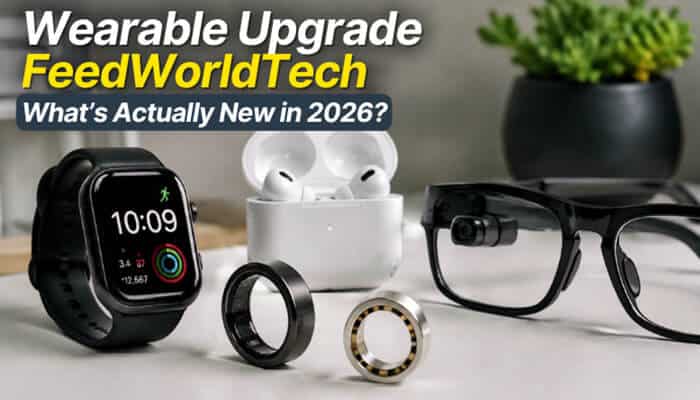

Wearable upgrade FeedWorldTech is not the name of a smartwatch, smart ring, fitness tracker, or hardware upgrade program. Instead, the phrase is associated with FeedWorldTech-related coverage of changing wearable technologies such as AI-powered health monitoring, smart rings, screen less trackers, intelligent sensors, better batteries, smart glasses, and connected health platforms.
Google has introduced the screen less Fitbit Air. Oura has made its newest smart ring substantially smaller. Samsung has released Galaxy Watch9. Google has announced Pixel Watch 5 with deeper Gemini integration. Apple’s AirPods Pro 3 bring heart-rate sensing into hearables, while AI glasses and MicroLED smartwatch displays are moving beyond the experimental stage.
However, the wearable upgrade FeedWorldTech discussion also includes ideas that require more context—especially hospital-level accuracy, cuffless blood pressure, non-invasive glucose monitoring, and AI systems that supposedly predict health problems. So what has actually improved, what is useful, and what still sounds better in marketing than it performs in real life?
This guide examines the evidence behind the wearable upgrade FeedWorldTech trend and explains the wearable changes that matter most in 2026.
Quick Answer: Wearable Upgrade FeedWorldTech
The biggest wearable upgrade FeedWorldTech changes in 2026 are not simply faster processors or another fitness score.
The more meaningful improvements include:
- smaller and more comfortable smart rings
- screen less trackers designed for passive monitoring
- AI that interprets health and activity information
- proactive health-trend monitoring
- heart-rate sensing moving into earbuds
- expanding AI glasses
- stronger women’s-health features
- better battery efficiency
- commercial MicroLED smartwatch displays
- improved health-data interoperability
- more attention to wearable privacy
- subscription-based health and coaching services.
Wearable technology is becoming less about constantly looking at another screen and more about collecting useful information quietly in the background.
Key Takeaways
- Wearable Upgrade FeedWorldTech is a technology topic rather than a confirmed product name.
- Fitbit Air shows that useful wearable tracking does not always need a screen.
- Oura Ring 5 demonstrates how miniaturization is becoming a meaningful wearable upgrade.
- AI is increasingly interpreting wearable data instead of merely displaying measurements.
- Hearables remain the largest wearable category by shipment volume.
- Smart glasses are among the fastest-growing emerging wearable categories.
- Wearable health features are becoming more proactive, but monitoring is not the same as diagnosis.
- The FDA continues to warn consumers about unsupported non-invasive glucose claims from watches and rings.
- Privacy, subscriptions, and ecosystem compatibility can matter as much as hardware specifications.
- The best wearable upgrade is one that solves a problem your existing device cannot.
What Does Wearable Upgrade FeedWorldTech Actually Mean?
The phrase wearable upgrade FeedWorldTech can easily be mistaken for the name of a branded wearable. That interpretation would be misleading.
FeedWorldTech-related content associated with the phrase discusses broader wearable trends such as:
- smart rings
- intelligent textiles
- wearable health sensors
- predictive AI
- battery improvements
- MicroLED displays
- haptic feedback
- connected healthcare systems.
The most useful way to understand wearable upgrade FeedWorldTech is as a discussion about the evolution of wearable computing.
A meaningful wearable upgrade does not necessarily mean adding another display, app, or notification.
Sometimes the better upgrade means making technology:
- smaller
- less distracting
- easier to wear continuously
- better at interpreting information
- more energy efficient
- more connected to other health platforms.
Fitbit Air provides a good example. It removes the screen almost entirely while continuing to collect fitness and wellness information. Oura Ring 5 follows a different path by putting increasingly sophisticated sensing inside a smaller piece of jewelry.
Wearables are moving away from miniature computers that constantly demand attention and toward sensors and AI systems that quietly work in the background.
Wearable Upgrade FeedWorldTech Claims vs 2026 Reality
One of the most valuable ways to evaluate the wearable upgrade FeedWorldTech topic is to separate technologies that are already established from those that remain limited or frequently overstated.
| Claim or technology | What the evidence shows in 2026 | Verdict |
| Smart rings tracking HRV, temperature, and sleep | Already established in mainstream wearable products | Real |
| Irregular-heart-rhythm detection | Available on selected supported devices | Real, with limits |
| Consumer wearable ECG equals a hospital ECG | Consumer devices can provide useful single-lead readings but do not replace a standard clinical 12-lead ECG | Needs context |
| Cuffless wearable blood pressure | Exists in selected systems, but calibration and regulatory requirements matter | Real but conditional |
| Watch or ring measuring glucose without piercing the skin | The FDA has warned against devices claiming to independently do this | Major caution |
| AI identifying changes from personal baselines | Increasingly common | Real |
| AI diagnosing disease before symptoms | Much stronger claim than identifying unusual trends | Often overstated |
| Smart textiles measuring physiological signals | Technically viable but not yet mainstream consumer wearables | Emerging |
| MicroLED smartwatch displays | Already commercialized in premium hardware | Real but early |
Consumer ECG Is Useful—but It Is Not a Full Clinical ECG
Consumer ECG functionality is one of the clearest examples of why wearable marketing needs context. Compatible Apple Watches can generate a waveform similar to a single-lead ECG.
A standard clinical ECG commonly uses 12 leads and examines electrical activity from multiple perspectives. Consumer wearable ECG technology can therefore provide useful information about heart rate and rhythm, but that does not make a smartwatch equivalent to the complete ECG equipment used in a hospital or clinic.
When a wearable upgrade FeedWorldTech claim uses phrases such as “hospital-level accuracy,” readers should always ask:
- Which measurement?
- Compared with which clinical equipment?
- Under what conditions?
- Was the feature independently validated?
- Is it intended for wellness, screening, or diagnosis?
Cuffless Blood Pressure Still Needs Context
Wearable blood-pressure technology is another rapidly developing area. Samsung’s supported Galaxy Watch blood-pressure system requires calibration with a conventional upper-arm cuff and periodic recalibration.
That means “cuffless” does not necessarily mean that conventional blood-pressure equipment becomes completely unnecessary. Accuracy, calibration, and regulatory authorization still matter.
Non-Invasive Glucose Watches Remain a Major Red Flag
This is one of the most important wearable-health facts for consumers. The FDA has stated that it has not authorized, cleared, or approved smartwatches or smart rings designed to independently measure or estimate blood glucose without piercing the skin.
A smartwatch displaying glucose information received from an authorized continuous glucose monitor is different.
In that situation:
the watch displays glucose data; it does not independently measure glucose. Any wearable upgrade FeedWorldTech discussion involving non-invasive glucose technology should keep that distinction clear.
What Is Actually New in Wearable Technology in 2026?
Several 2026 developments can already be connected to real products rather than futuristic predictions.
| Development | 2026 example | Why it matters |
| Screenless health tracking | Fitbit Air | Supports passive monitoring with fewer distractions |
| Smaller smart rings | Oura Ring 5 | Improves comfort for continuous wear |
| Proactive AI | Pixel Watch 5 | Moves AI toward contextual assistance |
| Continuous wellness baselines | Galaxy Watch9 | Focuses on patterns instead of isolated readings |
| Biometric hearables | AirPods Pro 3 | Moves heart-rate sensing into earbuds |
| AI glasses | Meta smart glasses | Brings AI closer to what users see and hear |
| MicroLED smartwatch displays | Garmin fēnix 8 Pro MicroLED | Shows a potential display step beyond OLED |
| Cross-app health infrastructure | Health Connect | Makes data portability more important |
These changes demonstrate why the future of the wearable upgrade FeedWorldTech trend is unlikely to belong to a single type of device.
Smartwatches remain important, but rings, hearables, and glasses are increasingly performing tasks that watches cannot always handle as naturally.
Screenless Wearables Are Reshaping the Wearable Upgrade FeedWorldTech Trend
For years, smartwatch development followed a predictable formula:
bigger screen → brighter screen → more apps → more notifications.
Fitbit Air shows that another strategy is possible.
Google introduced Fitbit Air in 2026 as a small, screen less tracker focused on continuous fitness and wellness monitoring.
Instead of displaying detailed information on the wrist, the device collects data while deeper insights remain available through the connected health platform.
The appeal is straightforward.
Many people want to monitor:
- sleep
- resting heart rate
- HRV
- workouts
- recovery
- daily activity
without wearing another screen that constantly demands attention. For those users, removing the display can actually be an upgrade.
The wearable upgrade FeedWorldTech idea makes particular sense here because better wearable technology does not always mean adding more interaction.
Sometimes it means reducing interaction.
A screen less tracker may also provide advantages involving:
- battery life
- simplicity
- comfort
- fewer notifications
- less temptation to repeatedly check the device.
For users primarily interested in passive health tracking, those qualities can matter more than a large touchscreen.
Smart Rings Are Becoming Smaller and More Practical
Smart rings are another important part of the wearable upgrade FeedWorldTech landscape. Oura introduced Oura Ring 5 in May 2026. The company says the new model has approximately 40% less volume than Oura Ring 4 while continuing to monitor dozens of wellness metrics.
Battery life is listed at approximately six to nine days depending on use. The most important upgrade is not simply the number of measurements. A wearable designed for continuous monitoring only works effectively when people are comfortable enough to keep wearing it.
Making hardware:
- thinner
- lighter
- less noticeable
- easier to sleep in
- easier to wear continuously
can therefore improve the usefulness of a device as much as adding another sensor. Smart rings are unlikely to replace smartwatches completely.
Instead, they suit people prioritizing:
- sleep
- recovery
- passive health tracking
- longer battery life
- minimal distraction.
That illustrates an important theme throughout wearable upgrade FeedWorldTech coverage: the best wearable is not always the device with the biggest screen or most apps.
AI Is Becoming Central to Wearable Upgrade FeedWorldTech
Wearables have been collecting health and fitness information for years. The harder problem has always been interpretation.
A user may know their:
- resting heart rate
- HRV
- sleep duration
- recovery score
- workout load
- temperature trends.
But knowing those numbers does not automatically explain what they mean or what action to take. AI is increasingly being used to bridge that gap.
Google Health Coach uses Gemini-powered systems to provide personalized guidance around exercise, sleep, recovery, and wellness. Oura provides personalized interpretation through Oura Advisor.
Apple’s Workout Buddy uses Apple Intelligence and workout information to deliver personalized feedback during exercise. The important wearable upgrade FeedWorldTech AI shift is therefore not simply:
“My smartwatch has AI.”
It is:
“My wearable can combine several measurements and turn them into information that is easier to understand and act on.” That is a much more useful standard for deciding whether AI genuinely improves a wearable.
Pixel Watch 5 Pushes Proactive AI Further Onto the Wrist
Google announced Pixel Watch 5 on August 12, 2026. At the time of this article’s August 19 update, retail availability was scheduled to begin August 20.
Its major improvements emphasize areas such as:
- proactive Gemini assistance
- Google Health Coach integration
- improved GPS
- Health Guardian tools
- contextual At a Glance information
- brighter display technology
- faster processing
- improved battery performance on the larger model.
The broader change is how users interact with their wearable. Traditional smartwatches generally wait for someone to open an app. Newer AI-focused devices increasingly attempt to determine when information may be useful and surface it automatically. That could become one of the defining characteristics of future wearables. The best smartwatch may eventually be the one that requires less manual interaction, not more.
Galaxy Watch9 Shows Why Physical Design Still Matters
Samsung’s Galaxy Watch9 also provides a useful example of how wearable upgrades extend beyond software.
The generation includes improvements relating to:
- battery capacity
- processing
- health tracking
- sensor positioning
- wearable fit
One interesting improvement is Samsung’s focus on keeping the watch closer to the wrist. Better skin contact can help sensors remain in a more consistent position. That illustrates something specification sheets often overlook:
physical fit can itself be a sensor upgrade.
Even an advanced sensor depends on:
- positioning
- movement
- skin contact
- comfort
- consistent wear.
Within the wearable upgrade FeedWorldTech discussion, comfort therefore deserves almost as much attention as processor speed or the number of sensors.
Health Tracking Is Becoming More Proactive
Early fitness trackers mainly told users what had already happened.
- You walked 8,000 steps.
- You slept seven hours.
- Your resting heart rate was 65 bpm.
Modern wearables increasingly compare measurements with personal baselines and identify changes over longer periods.
Apple Watch Series 11 includes supported health functionality involving:
- hypertension notifications
- ECG
- irregular-rhythm notifications
- sleep-apnea notifications.
Samsung uses continuous wellness data to highlight changes from normal patterns. Google’s wearable platform is also moving toward longer-term health interpretation. This represents an important wearable upgrade FeedWorldTech shift.
Wearables are moving from:
recording measurements
toward:
interpreting changes in those measurements.
But users should remember one crucial distinction:
detecting a change is not the same as diagnosing the medical reason for that change.
Terms such as:
- monitoring
- detecting
- screening
- alerting
- predicting
- diagnosing
should never automatically be treated as interchangeable.
Women’s Health Is Becoming a Major Wearable Use Case
Women’s health is receiving much more attention from wearable platforms than it did during the early fitness-tracker era.
Modern devices can combine information such as:
- temperature trends
- resting heart rate
- HRV
- sleep
- cycle information
- symptoms
to help people understand personal patterns.
Oura offers women’s health features covering areas such as:
- menstrual-cycle tracking
- pregnancy
- perimenopause
- menopause.
Its Menopause Insights functionality is intended to help users track symptoms and understand changes during the menopausal transition.
Apple’s Cycle Tracking can combine logged information with supported physiological data to improve predictions and provide retrospective ovulation estimates. However, cycle-tracking tools should not automatically be treated as contraception or diagnostic tools.
This is another example of the correct way to interpret the wearable upgrade FeedWorldTech trend wearables may provide useful personal context without replacing professional medical evaluation.
Hearables May Be the Most Underestimated Wearable Category
Smartwatches and rings receive enormous attention. By shipment volume, however, hearables are much larger.
IDC’s 2026 outlook indicates that hearables remain the dominant wearable category.
| Wearable category | Forecast 2026 shipments |
| Hearables | 407.6 million |
| Smartwatches | 159.7 million |
| Wristbands | 40.2 million |
| Smart glasses | 13.6 million |
| Smart rings | 4.9 million |
Earbuds are also becoming more than audio accessories.
Apple’s AirPods Pro 3 include in-ear heart-rate sensing that can support workout tracking.
The broader direction is becoming:
audio + biometric sensing + AI + translation + fitness.
Hearables already have one enormous advantage:
people understand why they would wear them.
The ear may therefore become an increasingly useful location for:
- biometric sensing
- voice assistants
- translation
- fitness monitoring
- contextual AI.
Any comprehensive wearable upgrade FeedWorldTech analysis should therefore look beyond watches and rings.
AI Glasses Are Becoming a Serious Wearable Category
Wearable computing is also moving beyond the wrist, finger and ear.
AI glasses can combine:
- visual context
- audio
- microphones
- cameras
- voice assistants
- translation
- accessibility tools
- hands-free interaction.
IDC forecasts smart-glasses shipments of around 13.6 million units in 2026, with strong year-over-year growth.
Why are glasses particularly interesting?
They sit close to:
- the eyes
- the ears
- the user’s voice
- the surrounding environment.
That potentially allows AI systems to understand more context without requiring a user to repeatedly pull out a smartphone.
Smart-Glasses Privacy Is Different
The same advantage creates an important challenge.
A smartwatch largely affects its owner.
Camera-equipped glasses can affect everyone nearby.
That means smart-glasses adoption will increasingly raise questions about:
- visible recording indicators
- consent
- workplace policies
- social expectations
- public-space recording
- bystander privacy.
The wearable upgrade FeedWorldTech conversation therefore needs to include social privacy as well as technical privacy.
Battery Life Remains a Core Wearable Upgrade FeedWorldTech Issue
Battery life is one of the easiest wearable features to oversimplify.
A smart ring, screen less tracker and LTE smartwatch have very different power requirements.
| Device | Manufacturer-stated battery figure |
| WHOOP 5.0 | 14+ days |
| Oura Ring 5 | About 6–9 days |
| Fitbit Air | Up to one week |
| Garmin fēnix 8 Pro MicroLED | Up to 10 days in smartwatch mode |
| Pixel Watch 5 | Up to 40 hours depending on model |
| Apple Watch Series 11 | Up to 24 hours |
A full smartwatch may need to power:
- an always-on display
- GPS
- LTE
- Wi-Fi
- apps
- notifications
- voice assistants
- continuous health sensing.
A smart ring has a completely different workload.
That is why comparing the battery life of completely different wearable types can be misleading.
The real battery improvements associated with wearable upgrade FeedWorldTech usually come from a combination of:
- larger batteries
- more efficient processors
- lower-power displays
- smarter software
- faster charging
- reduced background power consumption.
Battery comparisons should therefore be made mainly within the same wearable category.
MicroLED Is Real—but It Has Not Replaced OLED
FeedWorldTech-related wearable coverage also discusses newer display technologies.
MicroLED is no longer purely theoretical.
Garmin has already commercialized the technology in the fēnix 8 Pro MicroLED.
Potential advantages include:
- very high brightness
- strong outdoor visibility
- high contrast
- fast response
- potentially long display life.
However, MicroLED has not replaced OLED across the mainstream smartwatch market.
Most premium smartwatches still rely on OLED-family displays.
So within the wearable upgrade FeedWorldTech trend, MicroLED should be described as:
a genuine premium wearable display development that remains early in its adoption cycle.
That is more accurate than describing it as the new universal smartwatch standard.
Software Can Be a Bigger Wearable Upgrade Than Hardware
One of the biggest mistakes in annual wearable-buying cycles is assuming that every useful feature requires new hardware.
Many improvements arrive through software.
Apple can deliver intelligence and workout functionality through software updates.
Google increasingly connects wearable devices with Health Coach and broader health services.
Oura continues to expand personalized software experiences across supported devices.
Before replacing your wearable, ask:
- Is the feature coming through a software update?
- Does it genuinely require newer hardware?
- Is it actually part of a paid subscription?
- Is the feature available in my country?
- Does it require a newer smartphone?
- How long will my current device receive updates?
For many users, the smartest wearable upgrade FeedWorldTech decision may be to keep their existing hardware and take advantage of new software.
Health-Data Interoperability Is Becoming a Real Upgrade
Wearables can collect years of personal information.
That creates an important question:
What happens when you change devices?
Health-data platforms are increasingly designed to allow compatible services to exchange user-approved information.
This matters because wearable users can accumulate years of:
- workout history
- heart-rate trends
- sleep records
- weight information
- cycle information
- fitness data.
Before choosing a new wearable, ask:
- Can I export my information?
- Can another health app read it?
- Will my history move to a new phone?
- Can I change wearable brands?
- Which data categories can third-party apps access?
- Can I revoke those permissions?
A wearable sensor may become outdated within several years.
Your health history can remain useful for much longer.
Interoperability is therefore one of the most overlooked wearable upgrade FeedWorldTech improvements.
Wearable Upgrade FeedWorldTech and Health-Data Privacy
Better sensors produce more information.
They also produce more sensitive information.
Depending on the device, a wearable may collect information related to:
- heart rate
- sleep
- location
- exercise
- temperature
- reproductive health
- stress
- cardiovascular trends
- daily routines.
Consumers should not assume that every wellness app or wearable service operates under exactly the same privacy framework as a hospital or doctor’s office.
Before buying a health-focused wearable, check:
- What data is collected?
- Where is it stored?
- Is processing performed locally or in the cloud?
- Which companies or apps can receive the data?
- Can permissions be revoked?
- Can your history be exported?
- Can your information be deleted?
- What happens after cancelling an account?
- How is AI allowed to use your information?
The smartest wearable is not automatically the device collecting the most data.
Sometimes it is the device offering the clearest control over that data.
The Hidden Cost of a Wearable Upgrade FeedWorldTech Purchase
Hardware price is no longer always the true cost of wearable ownership.
Some modern wearable platforms increasingly follow this model:
device + software + analytics + subscription.
Oura uses a membership system.
WHOOP is heavily membership-based.
Google also offers premium health and coaching services.
That means consumers should calculate total ownership cost rather than comparing only retail prices.
| Cost | What to check |
| Device | Initial hardware cost |
| Membership | Monthly or annual recurring fee |
| Premium analytics | Are important insights paywalled? |
| AI coaching | Is it included or sold separately? |
| LTE service | Required for some cellular watches |
| Accessories | Replacement bands and chargers |
| Repairs | Battery or screen servicing |
| Upgrade cycle | How long will you keep the device? |
A cheaper wearable combined with several years of subscription payments can eventually cost more than a higher-priced device without recurring fees.
For anyone researching wearable upgrade FeedWorldTech, this is one of the most useful comparisons to make before purchasing.
Smart Textiles Are Promising—but Still Emerging
FeedWorldTech-related wearable content also discusses intelligent textiles.
The technology has genuine potential.
Sensors embedded into clothing could potentially measure or monitor:
- breathing
- muscular activity
- ECG patterns
- movement
- posture.
Clothing has several natural advantages as a sensor platform.
People already wear it.
It covers large areas of the body.
Sensors could remain in contact for long periods.
However, smart clothing remains much less commercially significant than:
- hearables
- smartwatches
- bands
- rings
- glasses.
That means intelligent textiles should currently be treated as an emerging wearable category, not a technology that has already replaced conventional trackers.
Wearables Are Moving Beyond Consumer Fitness
The wearable upgrade FeedWorldTech trend is also expanding far beyond step counting.
Potential and existing applications include:
- remote health monitoring
- rehabilitation
- workplace safety
- industrial environments
- accessibility
- logistics
- specialized sports
- hands-free computing.
AI glasses offer another example.
Hands-free wearable interfaces could help with:
- visual assistance
- translation
- navigation
- accessibility
- workplace information
- communication.
The category is gradually changing from:
fitness accessory
into:
general-purpose sensing and computing platform.
That may ultimately be one of the most important long-term wearable changes.
How Big Is the Wearable Market in 2026?
The wearable market is already enormous.
IDC reported approximately 145.7 million wearable-device shipments worldwide during Q1 2026, representing year-over-year growth.
Its full-year outlook highlights large differences between categories.
| Category | 2026 forecast | Year-over-year outlook |
| Hearables | 407.6 million | +4.0% |
| Smartwatches | 159.7 million | -2.8% |
| Wristbands | 40.2 million | -6.8% |
| Smart glasses | 13.6 million | +41.4% |
| Smart rings | 4.9 million | +12.8% |
The most interesting part of these numbers is not simply overall market size.
It is specialization.
Hearables remain enormous.
Smart glasses are expanding rapidly.
Smart rings continue growing from a smaller base.
Smartwatches remain important but no longer represent the entire wearable story.
The future of wearable upgrade FeedWorldTech may therefore involve consumers using several specialized wearable types instead of expecting one smartwatch to perform every task.
Smart Ring vs Smartwatch vs Screenless Tracker vs Hearables vs Smart Glasses
| Wearable | Best for | Main advantage | Main limitation |
| Smart ring | Sleep, recovery and passive tracking | Small and unobtrusive | Little or no display |
| Smartwatch | Apps, GPS, workouts and communication | Most versatile | Shorter battery life |
| Screenless tracker | Low-distraction continuous monitoring | Simple and comfortable | Phone needed for deeper insights |
| Hearables | Audio, AI, translation and workouts | Familiar form factor | Usually not worn 24/7 |
| Smart glasses | Hands-free AI and contextual computing | Positioned near eyes and ears | Privacy and social acceptance |
| Smart textiles | Specialized sensing | Can disappear into clothing | Limited mainstream availability |
There is no universal best wearable.
The right choice depends on the problem you want the technology to solve.
What Wearable Upgrade FeedWorldTech Gets Right
Despite some claims that require extra context, several ideas associated with wearable upgrade FeedWorldTech closely match the direction of the market.
Wearables Are Expanding Beyond the Wrist
Smart rings, hearables, and AI glasses make this increasingly obvious.
Passive Monitoring Matters
Screenless trackers and smart rings show that useful health tracking does not always require a display.
AI Is Becoming Part of the Wearable Interface
AI increasingly interprets sensor data and helps surface relevant information.
Battery Efficiency Still Matters
Continuous health tracking becomes less useful when the device spends too much time charging.
Interoperability Is Becoming Essential
Wearable hardware increasingly depends on the software and health-data ecosystem surrounding it.
Comfort Is an Upgrade Too
A smaller, lighter, or better-fitting wearable may generate more useful long-term information simply because the owner is willing to wear it more consistently.
Wearable Upgrade FeedWorldTech Claims That Deserve Extra Scrutiny
When evaluating wearable marketing, be cautious with phrases such as:
- “hospital-level accuracy” without identifying what was tested
- “medical grade” without specifying which feature has regulatory support
- “predicts disease” when the system actually detects trends
- “non-invasive glucose monitoring” from an ordinary watch or ring
- “cuffless blood pressure” without explaining calibration
- “weeks of battery life” without explaining usage conditions
- “AI diagnosis” when the feature actually provides wellness guidance.
Marketing language can make a useful wellness product sound significantly closer to medical equipment than it really is.
Should You Follow a Wearable Upgrade FeedWorldTech Recommendation in 2026?
A new model number is not enough reason to upgrade.
Start with the problem you are trying to solve.
| Your situation | Best approach |
| Battery has degraded badly | Consider upgrading |
| Sleep and recovery matter most | Consider a smart ring |
| You want fewer notifications | Consider a screen less tracker |
| You need maps, calls, apps and payments | Choose a smartwatch |
| You want hands-free contextual AI | Investigate smart glasses |
| You want AI fitness coaching | Compare subscriptions and ecosystems |
| You own a recent flagship watch | Check software updates first |
| You need a specific health feature | Confirm model, region and regulatory availability |
| You regularly switch phone brands | Prioritize interoperability |
| You dislike recurring costs | Check membership requirements |
| You require medical monitoring | Use appropriate medical equipment and professional guidance |
The correct question is not:
“Is the new wearable technically better?”
Almost every new generation improves something.
Ask instead:
“Does the improvement solve a problem I actually have?”
That is the best way to judge whether a wearable upgrade FeedWorldTech recommendation is genuinely useful.
12 Things to Check Before Buying a New Wearable
Before acting on a wearable upgrade FeedWorldTech recommendation, use this checklist.
- Battery Life
Compare battery figures using the features you actually plan to enable.
GPS, LTE, always-on displays, and continuous sensing can reduce runtime.
- Comfort
A sleep tracker is not useful if it is uncomfortable enough that you remove it every night.
- Subscription Cost
Check which features remain available without a paid membership.
- Phone Compatibility
Some wearables perform best—or only work fully—inside a specific smartphone ecosystem.
- Regional Availability
AI, medical, and emergency features may vary by country.
- Regulatory Status
Evaluate medical-sounding functionality feature by feature.
- Privacy
Understand what information is collected and how it is processed.
- Data Portability
Make sure years of health information will not become trapped in one service.
- Repairability
Battery and display servicing can determine the useful life of expensive wearable hardware.
- Software Support
Long-term software updates can provide more value than a small processor upgrade.
- Accuracy for Your Goal
A general-wellness wearable may not replace specialized sport or medical equipment.
- Total Ownership Cost
Consider:
- subscriptions
- LTE plans
- accessories
- chargers
- repairs
- replacement hardware.
What Is Mostly Hype in the Wearable Upgrade FeedWorldTech Trend?
Not every wearable improvement deserves equal attention.
Another Fitness Score
A new score is useful only when it changes a meaningful decision.
AI Added to Everything
AI matters when it improves interpretation or reduces effort.
Simply adding “AI” to a product page does not automatically create a better wearable.
“Medical-Grade” Everything
Different features inside the same device may have very different intended uses and levels of validation.
Disease Prediction From Consumer Sensors
Trend recognition is improving.
Reliable diagnosis is a different challenge.
Non-Invasive Glucose Watches
Unsupported claims in this category deserve especially careful scrutiny.
Every Annual Upgrade Being Essential
Software updates increasingly deliver meaningful improvements to existing wearable hardware.
For many people, the smartest wearable upgrade FeedWorldTech decision in 2026 may simply be:
not upgrading yet.
What Comes After the Wearable Upgrade FeedWorldTech Trend in 2026?
The biggest long-term wearable trend may be convergence.
Instead of one device handling every task, a person may eventually use:
- a ring for passive overnight sensing
- a smartwatch for workouts and navigation
- earbuds for voice AI and biometric sensing
- glasses for contextual assistance
- one health platform combining information from all of them.
Future wearable progress is likely to involve:
- smaller sensors
- lower-power processors
- better batteries
- more on-device AI
- improved privacy controls
- stronger interoperability
- personalized baselines
- less intrusive designs
- better clinical validation
- interfaces requiring fewer screens.
The long-term goal may not be putting more technology on the body.
It may be making technology less noticeable while making the information it produces more useful.
Conclusion: Wearable Upgrade FeedWorldTech
Wearable upgrade FeedWorldTech is best understood as a discussion about how wearable technology is evolving—not as the name of a FeedWorldTech smartwatch, smart ring, fitness tracker or hardware upgrade program.
Several trends associated with the phrase are genuinely visible in 2026.
Smart rings are becoming smaller. Screenless trackers are returning. AI is becoming more useful for interpreting sensor data. Heart-rate monitoring is expanding into earbuds. Smart glasses are developing into a serious wearable category. Women’s-health tools are becoming more sophisticated. MicroLED has reached commercial smartwatch hardware, while privacy and health-data interoperability are becoming increasingly important.
But readers should remain skeptical of the biggest marketing claims.
Terms involving:
- non-invasive glucose monitoring
- disease prediction
- blood-pressure measurement
- hospital-equivalent accuracy
- medical-grade sensing
should always be checked against the exact device, intended use and regulatory status.
The smartest approach to the wearable upgrade FeedWorldTech trend is therefore not to ask:
“Which wearable has the longest feature list?”
Ask:
“Which new capability will meaningfully improve how I use this device every day?”
If there is no convincing answer, keeping the wearable you already own may still be the best upgrade.
Small specification improvements alone may not justify replacing a recent device.
Wearable Upgrade FeedWorldTech FAQs
