


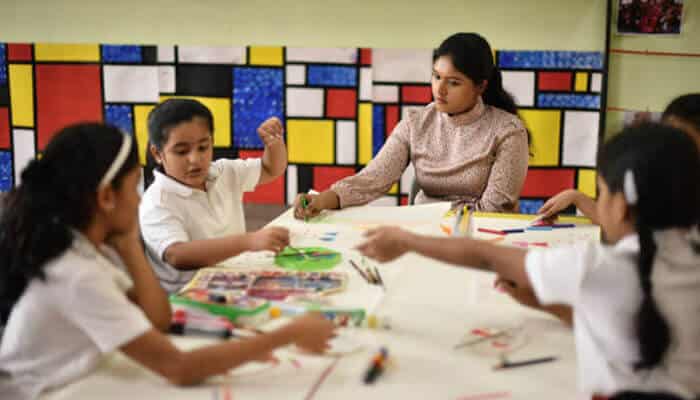

Middle School Art Lessons: Developing Independence and New Skills
Middle school is one of the most significant periods of development, when students begin to explore the world around them in greater detail and seek individual means of expression. Art lessons at this age should be not only teach practical skills but also oriented towards fostering critical thinking.
Good middle school art lessons can provide children with opportunities to experiment with different ways of working, develop visual communication skills, and perform more sophisticated tasks. Unlike the introductory period, which mostly involves getting acquainted with the materials, here more independence and take greater ownership of their work are required.
It is essential at this age to show children that the creative process includes several steps: research, planning, implementation, and evaluation of the completed artwork.
Key areas of effective learning:
1. Creative exploration—exploring different ways of expressing ideas through practical tasks and experiments.
2. Project development—creating works where students independently make decisions and develop their own style.
Programs for this age group should take into account changes in children’s perception. It is necessary for teens to find some sense in tasks and to understand how the knowledge gained connects to reality. Hence, nowadays, the programs include the study of cultural features, the history of artistic movements, and the analysis of masterpieces.
It is essential that the interest does not fall during the academic year. Various themes, methods, and forms of activity offer the possibility of avoiding boredom and finding an interesting direction.
Elementary Art Lessons: Building a Foundation for Future Development
These years are characterized by intensive perception, in which children learn best through hands-on activities. Thus, elementary art lessons should include both simple activities and opportunities for freedom of choice and experimentation.
During this stage, it is essential to develop a favorable attitude towards the process itself. Children acquire the skills of observation, comparison, different tools and materials, and the realization that there are many ways to find a solution.
The well-developed program allows for a step-by-step introduction of basic notions into the educational process. The children study features such as color, shape, composition, and structure, while developing coordination and concentration.
However, during these classes, it is necessary not only to copy existing examples but to provide conditions for developing their own ideas.
An effective learning process in elementary school contains certain factors. Firstly, the children learn a new theme, then analyze examples, and continue working independently. After doing the task, the children reflect on the finished project and evaluate their work.
In this way, the students become more confident and learn to think about their work. This is helpful not only in creative subjects but also in others.
Art Curriculum for Kids: How to Choose the Right Learning System

When working on the school curriculum, it is necessary to take into account age, skill level, and objectives. The universal method cannot guarantee good outcomes; therefore, appropriate solutions vary by developmental stage.
An effective art curriculum for children should include activities that allow pupils to progress from simpler to more complex tasks. It is necessary to provide students with the information and skills they can use in further studies.
Meet the Masters provides a good educational solution consisting of ready-to-use materials, step-by-step lessons, and teacher support to organize the process.
The following features are usually taken into account when selecting the curriculum:
- Structure Progression
The sequence of topics helps students develop skills gradually, without abrupt transitions between different levels of difficulty.
- Teaching Resources
Prepared materials allow teachers to focus more on class interaction and student support.
It’s also important to consider the variety of assignments. Different formats allow students with varying interests and skill levels to develop their abilities.
A good art curriculum for kids creates an environment where students can not only master techniques but also develop their creative thinking. This is especially important in modern education, where initiative, the ability to find solutions, and the ability to process information are valued.
How to Connect Learning Across Age Groups
A school curriculum becomes more effective when there is a logical connection between stages of learning. The knowledge gained at the primary level should serve as the base for subsequent, more complicated activities.
Elementary art lessons contribute to the development of basic skills and an interest in creativity. At that level, children are familiarized with the basics and how to work with different materials.
Such knowledge may be further advanced through more complicated exercises and personal projects. The next stage is middle school art lessons, where children start to develop ways of working and to analyze their own ideas.
Consistency plays an especially important role in maintaining motivation. If children track their progress and understand the connections between different levels of education, they participate more actively in classes.
Creative skills require time and consistent training to develop. That is why educational programs should be consistent and designed for long-term- growth, not just a series of individual lessons.
The Role of Modern Programs in School Education
Nowadays, schools seek to provide an environment where learners can acquire as many skills as possible. Creative subjects help foster flexibility of thinking, attentiveness, and the ability to work with various kinds of information.
A successful program should include theoretical knowledge and practice. Learners not only perform tasks but also learn why particular techniques were chosen and how to explain their creative decisions.
An art curriculum elementary program provides a strong foundation for future learning and developing skills for the next stage – middle school art classes.
A well-conceived system helps to organize lessons properly and provides teachers with an easy-to-use tool. It helps to integrate creativity naturally into everyday classroom learning.
