


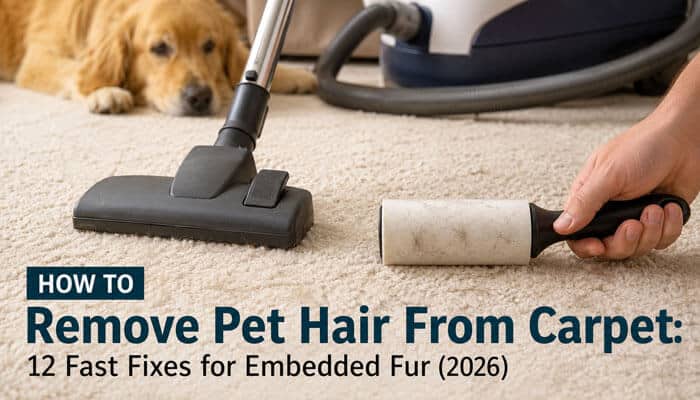

Pet hair can cling to carpet fibers, collect around baseboards, and become pressed deep into the pile. Even after vacuuming, you may notice stubborn strands wrapped around individual carpet yarns. Learning how to remove pet hair from carpet therefore requires more than making one quick pass with a vacuum cleaner.
The most effective approach is usually a two-stage process. First, loosen embedded fur with a carpet-safe rubber, silicone, or soft-bristled tool. Next, extract the released hair by vacuuming slowly with overlapping passes.
The correct cleaning method depends on the carpet construction and the type of fur you need to remove. Short, stiff dog hair can work between compact carpet fibers, while fine cat hair may cling through static electricity and scatter when exposed to strong airflow. A technique that works well on durable cut-pile carpet could damage wool, shag, loop, or handmade rugs.
This detailed guide explains how to remove pet hair from carpet using 12 practical methods. It also covers carpet safety, vacuum selection, no-vacuum solutions, cleaning myths, allergy considerations, professional cleaning, and ways to prevent pet hair from becoming embedded again.
Quick Answer: How to Remove Pet Hair From Carpet Fast
The fastest way to remove pet hair from carpet is to loosen the fur with a rubber carpet rake, rubber broom, or clean rubber squeegee. Pull the tool toward you in short, overlapping strokes until the hair gathers into visible clumps.
Pick up the clumps by hand, and then vacuum the carpet slowly in two different directions. Finish with a crevice attachment around baseboards, furniture edges, doors, corners, and heating vents.
For a small patch or carpeted stair, use a slightly damp rubber glove or handheld silicone pet-hair remover. For an entire room, a long-handled rubber broom followed by careful vacuuming is generally more efficient.
Key Takeaways
- Loosen embedded hair before relying on vacuum suction.
- Vacuum slowly with overlapping passes.
- Change direction to reach fur wrapped around different sides of the carpet yarn.
- Match the cleaning method to the carpet construction.
- Use suction-only cleaning when required for shag, thick-loop, cabled, wool, or delicate carpet.
- Remove dry pet hair before shampooing or hot-water extraction.
- Clean the vacuum bin, filters, hose, and brush roll regularly.
- Avoid metal grooming tools, wire brushes, and sharp scrapers.
- Test every unfamiliar tool or cleaning product in a hidden area.
- Keep pets away from treated carpet until it is completely dry.
- Treat pet hair, urine, stains, odors, and allergens as separate problems.
- Groom pets regularly to reduce the amount of loose fur entering the carpet.
Why Does Pet Hair Become Embedded in Carpet?
Pet hair does not always remain on the visible surface. Carpet construction, foot traffic, static electricity, natural oils, and vacuum performance can all influence how deeply fur becomes trapped.
Understanding these causes can help you choose a more effective method instead of repeatedly vacuuming without seeing a noticeable improvement.
Carpet Fibers Hold Hair Mechanically
Carpet contains thousands of yarns arranged as cut fibers, loops, twists, or long strands. Loose pet hair can fall between those yarns and become wrapped around them.
Walking over the carpet pushes the hair deeper. Furniture legs, pet beds, and repeated activity in one area may compress the pile, making the trapped fur more difficult to remove.
Short, stiff dog hair can be particularly troublesome because individual strands may work between tightly packed fibers instead of gathering into visible surface clumps.
Static Electricity Makes Fine Hair Cling
Friction between pet fur and synthetic carpet may create static attraction. Fine cat hair and lightweight undercoat can cling to carpet fibers instead of moving freely toward a vacuum inlet.
Rubber and silicone tools are useful because they create controlled friction and grip. They gather scattered strands into larger clumps that are easier to collect manually or remove with a vacuum.
Natural Oils Hold Hair and Dust Together
Pet hair may carry small amounts of skin oil, saliva, outdoor dirt, and household dust. These substances can make fur cling more firmly to carpet, especially around pet beds and favorite resting areas.
Hair mixed with oily residue may require both dry removal and deeper carpet cleaning. Remove the dry fur first, and then treat any remaining soil or odor with a product approved for the carpet.
Foot Traffic Pushes Fur Below the Surface
Freshly shed surface hair is generally easier to remove than hair that has been walked over repeatedly.
Frequent maintenance prevents loose fur from becoming compressed. Waiting until the carpet looks heavily covered usually creates a more difficult and time-consuming cleaning job.
The Vacuum May Be Incorrectly Adjusted
A vacuum head positioned too high may pass over the carpet without providing enough agitation. A head positioned too low may become difficult to push, restrict airflow, or brush the carpet too aggressively.
The strongest brush setting is not automatically the most effective. Some cut-pile carpets benefit from rotating-brush agitation, while shag, thick-loop, wool, and delicate carpets may require suction-only cleaning.
Hair May Be Wrapped Around the Brush Roll
Long pet hair and human hair can wrap around a vacuum roller. As the buildup increases, the brush may stop rotating effectively.
A full collection bin, blocked hose, dirty filter, or worn belt can also reduce cleaning performance. Vacuum maintenance is therefore an important part of learning how to remove pet hair from carpet successfully.
Pet Hair and Pet Dander Are Different Problems
Visible pet hair and pet allergens are related, but they are not identical.
Pet hair is the strand you can see and physically collect. Pet dander consists of small skin particles. Allergenic proteins may also be associated with pet saliva, urine, and other biological material.
Hair can carry dander, dust, pollen, and saliva residue, but removing every visible strand does not guarantee that all allergens have been removed.
An allergy-conscious cleaning routine may include:
- Frequent carpet vacuuming
- A well-maintained vacuum with suitable filtration
- Regular washing of pet bedding
- Upholstery cleaning
- Damp dusting of hard surfaces
- Consistent pet grooming
- Cleaning curtains and fabric furnishings
- Keeping selected rooms pet-free when medically necessary
- Professional medical advice for persistent allergy or asthma symptoms
People with significant allergies or asthma may prefer to leave the room while another person vacuums because cleaning can temporarily disturb particles that have settled in the carpet.
Before You Learn How to Remove Pet Hair From Carpet, Identify the Carpet Type
Not every carpet can tolerate the same amount of brushing, scraping, raking, or vacuum agitation.
Check the carpet care label, warranty, installation paperwork, or manufacturer’s maintenance instructions before using an unfamiliar tool.
Cut-Pile Carpet
Cut-pile carpet has exposed yarn ends rather than closed loops. Plush, Saxony, frieze, and many textured carpets belong to this category.
A rotating vacuum brush, rubber rake, or soft carpet brush may be suitable, depending on the manufacturer’s instructions. Begin with gentle pressure and stop if the carpet starts to fuzz.
Low-Pile Carpet
Low-pile carpet has short, compact fibers. Pet hair remains relatively close to the surface, making rubber squeegees, silicone tools, and rubber brooms particularly useful.
Commercial carpet tiles, entrance mats, and many indoor-outdoor carpets have relatively low piles.
Loop or Berber Carpet
Loop carpet contains uncut yarn loops. Tools with sharp edges, hooks, or metal teeth can catch and pull those loops.
A smooth rubber tool may be suitable when used gently, but it should be tested in a hidden area first. Avoid pet slicker brushes, metal rakes, and de-shedding blades.
Shag or Long-Pile Carpet
Long carpet yarn can wrap around a powered vacuum brush.
Use suction-only cleaning or lift the rotating brush away from the carpet when required by the manufacturer. Separate long fibers gently instead of scraping them aggressively.
Wool Carpet
Wool can fuzz or distort when brushed too forcefully. It may also react differently to moisture and cleaning chemicals than synthetic carpet.
Use only manufacturer-approved tools and products. Valuable wool rugs may require professional treatment.
Handmade, Persian, Oriental, and Delicate Rugs
Follow the care label and prevent fringes from entering a powered vacuum brush. Delicate or valuable rugs should be cleaned according to their specific construction rather than with generic household hacks.
Carpet-Safety Guide
| Carpet type | Recommended starting method | Avoid or limit |
| Low-pile synthetic | Rubber squeegee and adjustable vacuum | Excessive liquid |
| Textured cut pile | Rubber rake followed by slow vacuuming | Sharp metal tools |
| Plush carpet | Correctly adjusted vacuum and soft brush | Vacuum head set too low |
| Berber or loop pile | Suction or gently tested rubber tool | Hooks, blades, and rigid rakes |
| Shag carpet | Suction-only nozzle and gentle separation | Rotating brushes that catch yarn |
| Wool carpet | Manufacturer-approved vacuuming | Aggressive rubbing and unapproved chemicals |
| Handmade rug | Label-directed or professional care | Generic household cleaning hacks |
| Carpeted stairs | Handheld attachment and rubber glove | Unstable upright-vacuum use |
| Carpet tile | Rubber broom, squeegee, and vacuum | Saturating tile seams |
Match the Tool to the Type of Pet Hair
The best method does not depend only on the carpet. The length, stiffness, and density of the pet hair can also influence which tool works most efficiently.
| Type of pet hair | Common problem | Best starting method |
| Short, stiff dog hair | Works between compact carpet fibers | Rubber squeegee or silicone scraper |
| Long dog hair | Wraps around carpet yarn and vacuum rollers | Rubber rake followed by vacuuming |
| Fine cat hair | Spreads easily and clings through static | Rubber glove or silicone broom |
| Thick seasonal undercoat | Forms soft clumps over large areas | Long-handled rubber broom |
| Curly pet hair | Twists around individual carpet fibers | Rubber rake using short strokes |
| Hair mixed with dust | Becomes compacted in traffic lanes | Gentle agitation and slow vacuuming |
| Hair around baseboards | Collects outside the main vacuum path | Crevice tool and rubber glove |
For short, stiff strands, make several directional passes instead of pressing harder.
For long hair, stop periodically to remove strands wrapped around the vacuum brush roll.
For fine cat hair, gather the fur into clumps before using strong airflow that could scatter it.
The safest rule is to use the least aggressive tool capable of releasing the hair.
Pet Hair Removal Methods Compared
The table below can help you decide how to remove pet hair from carpet based on the size of the area, the carpet type, and how deeply the fur is embedded.
| Method | Best for | Speed | Cost | Main caution |
| Properly adjusted vacuum | Whole rooms and routine cleaning | Fast | Medium to high | Match the brush to the carpet |
| Rubber carpet rake | Deeply embedded fur | Fast | Low to medium | Avoid excessive pressure |
| Rubber squeegee | Low-pile carpet and stairs | Medium | Low | Less effective on shag |
| Slightly damp rubber glove | Small patches, edges, and stairs | Slow | Very low | Do not soak the carpet |
| Silicone scraper | Stubborn compacted hair | Medium | Low | Test on loop carpet |
| Rubber broom | Large rooms and surface shedding | Fast | Low to medium | Use controlled strokes |
| Lint roller | Small visible patches | Slow | Low | Creates disposable waste |
| Low-adhesion tape | Corners and isolated strands | Slow | Very low | Check for adhesive transfer |
| Soft carpet brush | Matted cut-pile carpet | Medium | Low | Avoid stiff bristles |
| Mini turbo attachment | Stairs and narrow areas | Fast | Medium | Check the roller for tangles |
| Crevice tool | Walls and room edges | Medium | Usually included | Inefficient for open areas |
| Professional cleaning | Hair combined with soil or odor | Fast for homeowner | High | Choose a qualified cleaner |
Supplies You May Need
You do not need every item on this list. Select tools that are appropriate for the carpet you are cleaning.
- Vacuum with adjustable carpet settings
- Rubber carpet rake
- Rubber or silicone broom
- Clean rubber squeegee
- Rubber household gloves
- Handheld silicone pet-hair remover
- Lint roller
- Low-adhesion tape
- Soft carpet brush with rounded bristles
- Crevice attachment
- Mini motorized or air-powered attachment
- Microfiber cloth
- Flashlight
- Trash bag
- Scissors or brush-roll cleaning tool
- Clean white towels
- Carpet-approved stain or odor treatment when necessary
Inspect each tool for sharp edges, cracks, loose parts, or exposed metal before using it.
How to Remove Pet Hair From Carpet: 12 Fast Fixes
1. Vacuum Slowly in Multiple Directions
Vacuuming remains the most practical whole-room method, but speed and technique strongly affect the result.
A quick pass may collect crumbs and loose surface fur while leaving strands wrapped around the carpet yarn. Slow movement gives the airflow and cleaning head more time to release and collect the hair.
If you are learning how to remove pet hair from carpet with a vacuum, the most important improvements are slowing down, overlapping each pass, and changing direction.
How to do it
- Remove pet beds, toys, bowls, blankets, and small furniture.
- Empty the vacuum bin or replace a full bag.
- Inspect the hose and filters.
- Remove tangled hair from the brush roll.
- Set the cleaning head to the correct carpet height.
- Divide the room into small sections.
- Vacuum each section using slow, overlapping passes.
- Turn 90 degrees and vacuum the same section again.
- Use the crevice tool around the perimeter.
- Inspect the carpet under low-angle light.
Overlap each pass so that narrow strips are not missed.
Best for: Whole rooms, routine maintenance, cut-pile carpet, and fur mixed with dry dust.
Safety warning: Disengage or raise the rotating brush when the carpet manufacturer requires suction-only cleaning.
2. Loosen Embedded Fur With a Rubber Carpet Rake
A rubber carpet rake is one of the most effective tools for deeply embedded fur.
The flexible teeth create friction against the pile, pulling hair upward and gathering it into visible rows or clumps.
How to do it
- Make sure the carpet is completely dry.
- Start at the far side of the room.
- Pull the rake toward you.
- Use short, controlled strokes.
- Work in sections approximately three feet wide.
- Gather the released hair into a pile.
- Pick up the pile immediately.
- Vacuum the treated section.
- Clean the rake before moving to another room.
Avoid pressing so hard that the rake reaches the carpet backing.
Best for: Medium-pile carpet, long dog hair, seasonal undercoat, and neglected pet areas.
Safety warning: Do not use a metal pet-grooming rake. Animal-grooming tools may catch, cut, or pull carpet yarn.
3. Pull Short Hair Out With a Rubber Squeegee
A clean window or floor squeegee can remove a surprising amount of short, stiff hair from low-pile carpet.
The rubber edge grips strands that may pass beneath a standard vacuum head.
How to do it
- Clean and inspect the rubber blade.
- Place the edge flat against the carpet.
- Pull it toward you in short strokes.
- Overlap each stroke.
- Collect the resulting fur piles.
- Vacuum afterward.
A long-handled squeegee works well in larger rooms. A handheld version is useful for stairs, entrance mats, and corners.
Best for: Low-pile carpet, short dog hair, stairs, mats, and areas around pet beds.
Safety warning: Do not use a damaged or sharp blade. Avoid heavy scraping on wool, loop, or handmade rugs.
4. Gather Fine Hair With a Slightly Damp Rubber Glove
A rubber household glove is useful for small, concentrated patches.
The textured surface grips hair, while a minimal amount of moisture can keep fine strands from floating away.
How to do it
- Put on clean rubber gloves.
- Lightly dampen the palms.
- Wipe away excess water.
- Rub the carpet using short strokes.
- Gather the hair into one pile.
- Rinse the glove when it becomes coated.
- Allow the surface to dry.
- Vacuum any remaining debris.
Best for: Stairs, corners, furniture edges, fine cat hair, and carpeted pet furniture.
Safety warning: The glove should be barely damp. Do not wet the carpet backing.
5. Use a Flexible Silicone Pet-Hair Scraper
A reusable silicone scraper can remove stubborn fur woven into compact carpet.
Choose a tool with a smooth, flexible edge rather than rigid metal teeth.
How to do it
- Test the tool behind furniture.
- Hold it at a low angle.
- Pull gently in one direction.
- Repeat from another direction if necessary.
- Remove the collected hair.
- Vacuum the area.
Best for: Embedded patches, low-pile carpet, carpeted cat trees, stairs, and areas beneath pet beds.
Safety warning: Stop if the collected material contains noticeable carpet yarn rather than pet hair.
6. Sweep the Carpet With a Rubber Broom
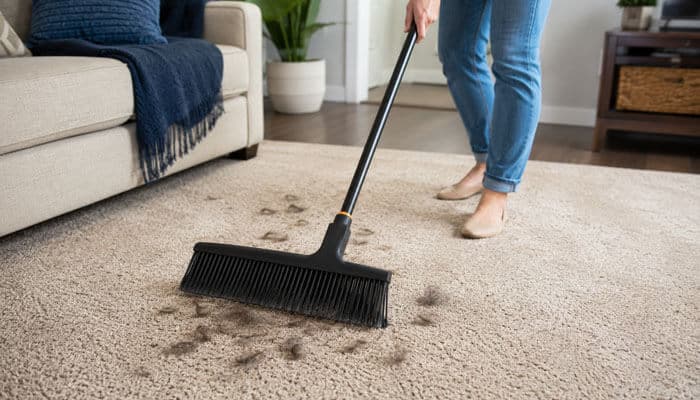
A rubber broom combines wide coverage with flexible, hair-gripping bristles. It is particularly useful in multi-pet households where loose fur covers a large area.
How to do it
- Pick up large debris.
- Begin near a wall.
- Pull the broom toward your body.
- Use shorter strokes than you would on hard flooring.
- Move the fur toward one collection point.
- Pick up the hair pile.
- Vacuum afterward.
Use straight and crosswise strokes only when the carpet construction allows them.
Best for: Large rooms, low- and medium-pile carpet, thick undercoat, and regular surface shedding.
Safety warning: Do not scrub aggressively. The rubber bristles should pass over the carpet rather than dig into it.
7. Finish Small Patches With a Lint Roller
A lint roller works well for final touch-ups but is inefficient for an entire room.
Use it after the main cleaning process to collect visible strands around furniture, stairs, and carpet transitions.
How to do it
- Roll in one direction.
- Change direction to collect crosswise strands.
- Replace the sheet when adhesion weakens.
- Use light pressure.
- Dispose of used sheets securely.
Best for: Small rugs, entrance mats, furniture legs, stair edges, and last-minute cleanup.
Safety warning: Keep used adhesive sheets away from pets that may chew or swallow them.
8. Use Low-Adhesion Tape in Corners
Tape can collect isolated strands from areas where a vacuum head or lint roller cannot fit.
Wrap a short strip around your fingers with the adhesive facing outward, or press a small piece gently onto the fur.
How to do it
- Test the tape in a hidden area.
- Press it lightly onto the hair.
- Lift it straight upward.
- Move to a clean section of tape.
- Vacuum the area afterward.
Best for: Baseboard corners, vents, door frames, furniture edges, and isolated strands.
Safety warning: Avoid duct tape, mounting tape, and industrial adhesives because they may transfer residue or pull carpet fibers.
9. Agitate Cut-Pile Carpet With a Soft Brush
A soft carpet brush can help release fur from compressed cut-pile carpet.
Use a brush with rounded synthetic bristles rather than wire or sharp teeth.
How to do it
- Confirm that brushing is suitable for the carpet.
- Test the brush in a hidden area.
- Brush gently in one direction.
- Vacuum the released hair.
- Brush from another direction.
- Vacuum again.
- Stop if the carpet begins to fuzz.
Best for: Matted cut pile, high-traffic pet pathways, plush synthetic carpet, and fur mixed with dry soil.
Safety warning: Never use a wire brush, metal comb, pet slicker brush, or de-shedding blade on carpet.
10. Clean Carpeted Stairs With a Mini Turbo Tool
Stairs collect fur on the horizontal tread, vertical riser, and side edges.
A small powered attachment can provide better control than a full-size vacuum head.
How to do it
- Position the vacuum securely.
- Keep the hose and cable behind you.
- Begin at the top.
- Clean the tread.
- Clean the riser.
- Use the crevice tool along both edges.
- Check the attachment roller for tangled hair.
- Finish at the bottom landing.
Best for: Carpeted stairs, narrow landings, closets, carpeted pet ramps, and furniture edges.
Safety warning: Use a suction-only attachment when rotating agitation is not permitted.
11. Collect Final Surface Hair With Microfiber
A barely damp microfiber cloth can collect fine strands remaining after vacuuming.
Treat this as a finishing step rather than a complete whole-room cleaning method.
How to do it
- Dampen a clean microfiber cloth.
- Wring it until it is almost dry.
- Wipe gently in one direction.
- Gather the hair into a pile.
- Rinse the cloth.
- Let the carpet dry.
- Vacuum again if necessary.
A flat microfiber mop may cover a larger low-pile area, but it should not release enough moisture to wet the carpet backing.
Best for: Fine cat hair, low-pile carpet, small rugs, and carpet near hard-floor transitions.
Safety warning: Never wet-mop carpet.
11. Arrange Professional Cleaning for Severe Buildup
Household tools may not be sufficient when pet hair is combined with oils, urine, persistent odor, heavy soil, or years of neglected maintenance.
A professional cleaner may use commercial vacuuming, pile agitation, stain treatment, and hot-water extraction. Dry pet hair should still be removed as thoroughly as possible before wet cleaning.
Consider professional help when
- Repeated vacuuming leaves substantial fur behind.
- Pet odors return after surface cleaning.
- Urine may have reached the padding or subfloor.
- The carpet is severely matted.
- The rug is wool, handmade, or valuable.
- The warranty requires professional maintenance.
- DIY cleaning has left sticky residue.
- Moisture damage is suspected.
- The carpet has not received periodic deep cleaning.
- Someone in the household has significant allergy concerns.
Ask the cleaner whether pre-vacuuming, stain treatment, furniture moving, odor treatment, and drying guidance are included.
What to Look for in a Vacuum for Pet Hair
A vacuum is not automatically effective simply because it is marketed as a pet vacuum. Carpet compatibility, cleaning-head design, airflow, filtration, and maintenance access are more important than the label.
Adjustable Cleaning-Head Height
Height adjustment helps the vacuum maintain suitable contact with different carpet piles.
A head positioned too high may not agitate the carpet. A head positioned too low may restrict airflow or become difficult to push.
Brush-Roll On/Off Control
A rotating brush can release embedded hair from many standard cut-pile carpets.
The ability to switch the brush off is important for shag, thick-loop, wool, and other carpets that require suction-only cleaning.
Accessible Brush Roll
Pet hair will eventually wrap around many rotating rollers.
Choose a machine with an accessible or removable brush roll. Anti-tangle technology may reduce maintenance, but it does not eliminate it.
Strong Edge Cleaning
A useful vacuum should clean close to walls or include an effective crevice attachment.
Hair commonly accumulates around baseboards because the main cleaning head cannot reach the edge completely.
Mini Motorized Attachment
A small attachment is useful for:
- Stairs
- Closets
- Carpeted pet ramps
- Upholstery edges
- Carpeted cat furniture
- Narrow areas around furniture
Suitable Filtration
Filtration matters when collecting fine dust and pet-related particles.
A sealed system with an appropriate high-efficiency filter may help allergy-conscious households. However, filtration cannot compensate for a poorly designed carpet head. The machine must release the hair before it can capture it.
Available Replacement Parts
Check whether the following components are readily available:
- Filters
- Bags
- Belts
- Brush rolls
- Hoses
- Batteries
- Attachments
A vacuum that cannot be maintained may gradually lose performance.
Carpet-Warranty Compatibility
Consult the carpet manufacturer before purchasing a vacuum. Some carpet constructions have specific vacuum requirements.
Best Whole-Room Method: How to Remove Pet Hair From Carpet Step by Step
When an entire room is affected, follow a structured process instead of applying random hacks.
Step 1: Remove Movable Items
Take out pet beds, blankets, toys, bowls, and lightweight furniture.
Wash washable pet bedding according to its care instructions so that it does not return hair to the carpet.
Step 2: Service the Vacuum
Before cleaning:
- Empty the collection bin.
- Replace a full bag.
- Inspect the filters.
- Check the hose for blockages.
- Remove wrapped hair from the brush roll.
- Confirm that the roller rotates normally.
- Adjust the cleaning-head height.
Unplug the vacuum before touching the brush roll or any moving component.
Step 3: Remove Large Debris
Pick up visible fur clumps, leaves, paper, toys, and other objects.
This prevents the rubber rake or broom from pushing debris deeper into the carpet.
Step 4: Loosen the Hair
Use a carpet-safe rubber rake, rubber broom, or squeegee.
Begin around the outside of the room and work toward the center. Gather the fur into manageable piles.
Step 5: Collect the Fur Piles
Pick up each pile as soon as it forms. Leaving clumps on the carpet allows them to spread again.
Step 6: Vacuum Slowly
Divide the room into sections and vacuum with slow, overlapping passes.
Do not rush simply because the most visible fur has already been collected.
Step 7: Change Direction
Turn 90 degrees and vacuum across the first series of passes.
Changing direction helps reach strands wrapped around different sides of the carpet yarn.
Step 8: Clean the Perimeter and Hidden Areas
Use the crevice attachment around:
- Baseboards
- Doors
- Closets
- Heating vents
- Furniture legs
- Room corners
- Carpet transitions
Clean beneath sofas, beds, and cabinets where safely possible.
Step 9: Inspect and Spot-Treat
Shine a flashlight horizontally across the carpet. Remaining strands should cast visible shadows.
Treat stubborn patches with a rubber glove, flexible silicone tool, or lint roller.
Step 10: Complete a Final Vacuum Pass
Make one final pass, clean the brush roll, empty the collection bin, and store the equipment.
How to Remove Pet Hair From Carpet Without a Vacuum
A vacuum is convenient, but manual tools can still remove a substantial amount of fur.
Use the following order:
- Sweep the open area with a rubber broom.
- Pull embedded fur upward with a rubber rake.
- Use a rubber squeegee on low-pile carpet.
- Collect the resulting piles with a rubber glove.
- Treat corners with a silicone remover.
- Finish isolated strands with a lint roller or low-adhesion tape.
A long-handled tool is usually the most efficient option for an entire room. Gloves and handheld scrapers are better for stairs, corners, and detailed work.
Collect each hair pile promptly. Without vacuum suction, air movement, and foot traffic may redistribute the fur.
Manual cleaning is not automatically safe for delicate rugs. Follow the care label before applying any friction-based tool.
Remove Dry Pet Hair Before Shampooing the Carpet
When deciding how to remove pet hair from carpet before deep cleaning, always begin with dry extraction.
Carpet shampooing and hot-water extraction are primarily designed to remove soil, stains, and residues. They should not be the first step when the carpet contains a heavy layer of dry pet hair.
Use this order:
- Allow the carpet to become completely dry.
- Pick up large fur clumps.
- Loosen embedded hair with a rubber tool.
- Vacuum slowly in two directions.
- Clean the room edges.
- Treat stains with an approved product.
- Shampoo or extract only when deeper cleaning is still necessary.
- Keep people and pets away until the carpet dries fully.
Wet pet hair can form clumps, collect inside equipment, and remain along room edges.
Do Popular Pet-Hair Cleaning Hacks Work?
Many internet cleaning tips sound inexpensive and convenient, but they may not be suitable for every carpet.
Baking Soda
Baking soda is frequently recommended for carpet odors, but it is not required for physical hair removal.
Fine powder can settle into the carpet pile, remain after vacuuming, or be unsuitable for certain vacuum systems.
For pet hair alone, a rubber tool followed by vacuuming is more direct.
Fabric Softener Spray
Diluted fabric softener is sometimes recommended for reducing static.
However, fabric softener is formulated for laundry rather than carpet. It may leave residue, attract soil, change the texture, introduce a strong fragrance, or conflict with warranty requirements.
A dry rubber or silicone tool is generally a safer option.
Vinegar
Vinegar does not mechanically remove pet hair. It cannot replace raking, brushing, or vacuuming and may be unsuitable for certain carpet fibers, dyes, or backing materials.
Use an approved carpet-cleaning product when liquid treatment is necessary.
Pumice Stone
Pumice may grip hair on durable automotive-style carpet, but it is abrasive.
It can:
- Fuzz carpet fibers
- Catch loops
- Remove yarn
- Leave mineral particles
- Damage wool or delicate carpet
A smooth silicone tool is a safer starting option.
Pet-Grooming Brushes
Slicker brushes, metal combs, and de-shedding blades are designed for animal coats, not carpets.
Their wires or cutting edges may pull and damage carpet yarn.
Dryer Sheets
Dryer sheets may collect some loose surface hair, but they can leave fragrance or conditioning ingredients behind.
A rubber glove or microfiber cloth provides a more controlled finishing method.
Wet Sponges
A damp sponge may gather surface hair, but it can introduce more moisture than necessary.
A barely damp rubber glove offers similar friction with better moisture control.
Pet-Safe Rules for Carpet-Cleaning Products
Most pet hair can be removed without chemicals.
When stains, soil, or odors also require treatment:
- Read the complete product label.
- Confirm that the product is compatible with the carpet fiber.
- Test it in a hidden area.
- Use only the recommended amount.
- Ventilate the room when instructed.
- Keep pets away during cleaning.
- Prevent animals from licking treated carpet.
- Wait until the carpet is completely dry before allowing access.
- Store cleaning products where pets cannot reach them.
- Never mix cleaning products unless the label directs you to do so.
- Do not assume that a product described as natural is automatically harmless.
Remember that pet hair, urine, stains, odors, and allergens are separate problems. A rubber rake can remove fur, but it cannot correct urine contamination that has reached the carpet pad or subfloor.
Quick Plans for How to Remove Pet Hair From Carpet
Five-Minute Emergency Cleanup
Use this routine when guests are arriving or one visible area requires immediate attention.
- Move the pet bed.
- Pull a rubber squeegee across the visible carpet.
- Pick up the resulting hair clumps.
- Use a lint roller around furniture legs.
- Vacuum the main walking path.
This improves the appearance quickly but does not replace complete cleaning.
Thirty-Minute Embedded-Hair Cleanup
Use this routine when ordinary vacuuming leaves visible fur behind.
- Remove movable objects.
- Service the vacuum.
- Rake the carpet in small sections.
- Collect every fur pile.
- Vacuum slowly with overlapping passes.
- Turn and vacuum from another direction.
- Clean the baseboards.
- Treat remaining patches with silicone or rubber.
- Inspect the carpet with a flashlight.
- Complete one final vacuum pass.
How to Check Whether the Carpet Is Really Clean
Pet hair can be difficult to see when its color is similar to the carpet.
Use Low-Angle Light
Shine a flashlight horizontally across the carpet.
Remaining strands will cast small shadows and become easier to identify.
Perform the Rubber-Glove Test
Pull a clean, slightly damp rubber glove across a previously affected area.
A large new clump means the carpet needs another rake-and-vacuum cycle.
Inspect the Room Edges
Check behind doors, furniture, heating vents, curtains, and baseboards.
Hair frequently collects outside the path of the main vacuum head.
Look Beneath Pet Bedding
Do not judge the room only by the open floor.
Hair beneath pet bedding can quickly spread back onto freshly cleaned carpet.
Inspect the Vacuum Brush Roll
A full collection bin shows that hair was captured, but a tangled roller may mean the vacuum stopped agitating effectively.
Check for Carpet Fibers
A small amount of normal carpet shedding may occur. However, visible loops, long yarn pieces, or excessive carpet fiber in the fur pile may indicate that the cleaning tool is too aggressive.
Common Pet-Hair Cleaning Mistakes
| Mistake | Why it causes problems | Better approach |
| Vacuuming too quickly | Leaves embedded hair below the surface | Use slow, overlapping passes |
| Using the wrong brush setting | May damage carpet or reduce pickup | Follow manufacturer instructions |
| Ignoring vacuum maintenance | Reduces suction and agitation | Clean filters, bins, hoses, and rollers |
| Waiting for visible buildup | Allows foot traffic to compress hair | Vacuum pet areas frequently |
| Wetting hair before dry removal | Creates wet clumps and equipment buildup | Remove dry fur first |
| Scrubbing aggressively | Can fuzz or distort carpet fibers | Use controlled strokes |
| Applying too much cleaner | May leave sticky residue | Follow label directions |
| Ignoring baseboards | Leaves major hair reservoirs | Use a crevice attachment |
| Using pet-grooming tools | May pull or cut carpet yarn | Use carpet-specific tools |
| Skipping a patch test | Risks visible damage or color change | Test in a hidden area |
| Replacing dirty pet bedding | Returns hair to clean carpet | Wash bedding first |
| Ignoring upholstery | Allows fur to fall back onto the floor | Clean surrounding surfaces |
Pet Hair, Allergies, and Indoor Air
Removing visible pet hair improves the appearance of the carpet, but it does not eliminate every pet-related particle.
Carpet may hold:
- Pet dander
- Dust
- Pollen
- Saliva residue
- Skin flakes
- Outdoor soil
- Dust-mite material
- Other biological particles
Helpful steps for allergy-sensitive households may include:
- Using a properly maintained vacuum
- Selecting suitable filtration
- Washing pet bedding
- Cleaning upholstery
- Damp-dusting hard surfaces
- Grooming pets regularly
- Addressing indoor moisture problems
- Following professional medical advice for asthma or allergy management
A portable air cleaner may capture some airborne particles, but it does not replace source control and regular surface cleaning.
How Often Should You Vacuum Carpet With Pets?
The correct cleaning frequency depends on the number of pets, coat type, shedding season, household traffic, carpet construction, and allergy sensitivity.
| Area | Suggested frequency |
| Main pet sleeping area | Daily or every other day |
| Busy living room | Three to seven times per week |
| High-traffic hallway | Three to seven times per week |
| Medium-use bedroom | About twice per week |
| Light-use guest room | About once per week |
| Carpeted stairs | Two or three times per week |
| Baseboards and edges | Weekly |
| Beneath furniture | Every two to four weeks |
| Rake-and-vacuum session | Every two to four weeks |
| Professional deep cleaning | Follow carpet warranty requirements |
Increase the frequency during seasonal shedding.
How to Remove Pet Hair From Carpet and Prevent It From Returning
Learning how to remove pet hair from carpet solves the immediate problem, but prevention can substantially reduce future cleaning work.
Groom Your Pet Regularly
Brushing captures loose hair before it reaches the carpet.
Use a grooming tool designed for the animal’s coat. Ask a veterinarian or professional groomer when you are unsure which tool is appropriate.
Use Washable Covers in Resting Areas
Place a washable blanket, mat, or pet bed where the animal usually sleeps.
Cleaning one removable cover is easier than removing a dense patch of hair from the carpet.
Vacuum Before Hair Is Trampled
Surface fur is easier to remove than hair compressed by repeated foot traffic.
A quick maintenance pass can prevent a much more difficult cleaning job later.
Use a Robot Vacuum for Surface Maintenance
A robot vacuum can collect daily shedding between deeper cleaning sessions.
However, it does not replace:
- Carpet raking
- Edge cleaning
- Stair cleaning
- Full-size vacuuming
- Brush-roll maintenance
- Professional carpet cleaning
Empty the robot frequently and remove hair from its rollers.
Maintain the Main Vacuum
Create a routine for:
- Emptying the collection bin
- Replacing bags
- Cleaning or replacing filters
- Inspecting belts
- Removing hair from rollers
- Checking hoses
- Replacing worn parts
Rotate and Clean Pet Beds
Moving a pet bed slightly can prevent constant pressure and hair buildup in one small carpeted area.
Wash the bedding regularly and place a washable mat beneath it where practical.
Clean Under Furniture
Use a low-profile attachment beneath sofas and beds.
Hidden fur can return to the open floor through air movement and foot traffic.
Groom Pets in an Easy-to-Clean Area
When practical, groom pets outdoors or on tile, vinyl, or another hard surface.
Collect the released fur immediately.
Clean Upholstery and Curtains
The carpet may not be the original source of hair that returns after cleaning.
Fur can fall from sofas, throws, cushions, curtains, and other fabric furnishings.
Investigate Unusual Shedding
Shedding varies by species, breed, coat, age, health, and season.
Consult a veterinarian when increased shedding is accompanied by:
- Bald patches
- Skin redness
- Wounds
- Persistent scratching
- Strong skin odor
- Lumps
- Visible parasites
- Major behavioral changes
Troubleshooting: Why Is Pet Hair Still in the Carpet?
| Problem | Likely cause | Recommended solution |
| Visible fur remains after vacuuming | Hair is wrapped around carpet yarn | Rake first and vacuum crosswise |
| Vacuum suction feels weak | Full bin, dirty filter, or blocked hose | Clean and inspect the machine |
| Brush roll does not rotate | Wrapped hair or worn belt | Unplug and service the roller |
| Hair remains near walls | Main vacuum head cannot reach | Use a crevice attachment |
| Carpet begins to fuzz | Cleaning tool is too aggressive | Stop and use gentler suction |
| Fur returns within hours | Bedding or upholstery still contains hair | Clean surrounding surfaces |
| Fine cat hair floats away | Airflow and static scatter it | Gather it with rubber first |
| Shag wraps around the roller | Powered brush catches long yarn | Use suction-only cleaning |
| Lint roller fills immediately | The cleaning area is too large | Use a rubber broom or rake |
| Carpet smells after hair removal | Oil, urine, or moisture remains | Use approved treatment or professional care |
| Hair remains below the surface | Vacuum passes are too fast | Slow down and overlap |
| Vacuum is difficult to push | Cleaning head is too low | Adjust the machine |
| Carpet yarn appears in the fur pile | The tool is damaging the carpet | Stop using the tool |
| Hair clings after repeated cleaning | Sticky cleaning residue may be present | Arrange carpet-appropriate cleaning |
| A stain returns after drying | Contamination may be deeper | Seek professional assessment |
When Should You Hire a Professional Carpet Cleaner?
Professional cleaning may be appropriate when:
- Pet hair is mixed with heavy soil.
- The carpet pile feels oily or sticky.
- Urine has reached the underlay.
- Odor returns after surface cleaning.
- The carpet remains matted.
- The rug is wool, handmade, or valuable.
- The manufacturer requires professional service.
- DIY cleaning has left residue.
- Moisture damage is suspected.
- The carpet has not been deep cleaned for an extended period.
Ask the provider:
- Do you inspect the carpet before quoting?
- Do you vacuum before wet cleaning?
- Which cleaning method will you use?
- Are the products suitable for this carpet fiber?
- How long will drying take?
- Are stain and odor treatments included?
- Will the cleaning process comply with the warranty?
- Is furniture moving included?
- What results are realistic?
When Should Carpet Be Replaced?
Pet hair alone rarely requires carpet replacement.
Replacement may be more practical when:
- Urine has repeatedly penetrated the carpet and padding.
- The subfloor remains contaminated.
- Odor persists after appropriate professional treatment.
- The carpet backing has separated.
- Carpet loops are unraveling.
- Fibers are severely worn.
- Mold or moisture damage is present.
- Previous chemicals caused permanent damage.
- Cleaning and repair costs approach replacement cost.
- The carpet has exceeded its useful service life.
A professional inspection can help determine whether the problem is limited to the carpet surface or extends into the pad and subfloor.
Final Verdict: How to Remove Pet Hair From Carpet
The most reliable answer to how to remove pet hair from carpet is to combine controlled friction with proper vacuuming. Release the fur with a rubber rake, rubber broom, squeegee, glove, or silicone tool. Pick up the visible clumps, and then vacuum slowly using overlapping passes from more than one direction.
Do not treat every carpet the same. Standard cut-pile carpet may tolerate rotating-brush agitation, while shag, thick-loop, cabled, wool, and delicate rugs often require gentler or suction-only cleaning. Check the carpet manufacturer’s maintenance instructions before using an aggressive tool.
Avoid soaking the carpet, applying unapproved household mixtures, or using sharp pet-grooming equipment. Remove dry fur before shampooing, keep animals away from wet cleaning products, and arrange professional help when hair is combined with persistent stains, urine, odors, or deep contamination.
Finally, reduce future buildup by vacuuming pet areas frequently, grooming pets consistently, washing pet bedding, cleaning upholstery, and keeping the vacuum in good working condition. Regular light maintenance is faster, safer, and more effective than waiting for pet hair to become heavily embedded.
How to Remove Pet Hair From Carpet FAQs
1. How to remove pet hair from carpet the easiest way?
The easiest way to remove pet hair from carpet is to loosen the fur with a rubber carpet rake or rubber broom. Gather the hair into clumps, pick them up, and vacuum slowly in two directions.
2. How do you remove deeply embedded pet hair from carpet?
Use a flexible rubber rake, silicone pet-hair remover, or rubber squeegee to pull embedded strands toward the surface. Work in small sections, collect the loosened fur, and vacuum using slow, overlapping passes.
3. How can I remove pet hair from carpet without a vacuum?
Sweep the carpet with a rubber broom or carpet rake. Use a slightly damp rubber glove for corners and stairs, then remove isolated strands with a lint roller or low-adhesion tape.
4. Why does my vacuum leave pet hair in the carpet?
Pet hair may be wrapped around carpet fibers or pushed deep into the pile. A tangled brush roll, dirty filter, blocked hose, full bin, or incorrect vacuum height can also reduce hair pickup.
5. What is the fastest way to remove pet hair from an entire carpeted room?
Rake or sweep the carpet first, collect the visible fur clumps, and then vacuum slowly with overlapping passes. Turn 90 degrees and vacuum again before cleaning edges with a crevice attachment.
