



A software founder can add a millionth user for almost nothing. A hardware founder pays full freight for the millionth unit — parts, assembly, shipping, duty, the lot. That gap is the whole story of why hardware is hard. You can have a product people love, a full order book, and a brand with buzz, and still lose money on every box that ships, because the number that decides whether you survive isn’t revenue. It’s cost of goods sold. Most first-time founders look at hardware COGS far too late, and by then the design that set it is already locked.
Cost of goods sold (COGS) is the direct, per-unit cost of producing a physical product — the components and machined parts, the assembly labor, the freight and duty to land it, and the scrap and returns baked into every run. It’s what sits between your selling price and your gross margin, and it’s mostly decided before you ever make a sale.
Why COGS Outranks Revenue for a Hardware Founder
The Software Comparison That Misleads
Software taught a generation of founders that scale is free. Write the code once, serve it to millions, watch the margin climb toward 100 percent. Hardware doesn’t work that way. Every unit consumes real materials and real labor, so your cost doesn’t vanish as you grow — it just gets a little smaller per unit if you’re lucky. Gross margins for consumer hardware usually land between 30 and 50 percent, not the 80-plus percent software founders expect. Plan your business on software math and you’ll run out of cash long before scale saves you.
COGS Is Really an Extended Bill of Materials
The cleanest way to think about COGS early on is as an extended bill of materials — the BOM, plus everything else you pay per unit to get the product out the door. That means the parts list, yes, but also the duty on imported components, the scrap rate, the share of units that come back, and the freight. Leave those extras out of your model and your “cost” looks healthy right up until the first real invoice lands.
What Actually Goes Into One Unit
Founders tend to price off the BOM and forget the rest. Here’s the fuller picture of a single unit’s cost.
The Per-Unit Costs
| COGS line | What it covers | Main driver |
| Components / machined parts | The physical pieces | Supplier and order volume |
| Assembly labor | Putting it together | Location, build complexity |
| Freight + duty | Landing the goods | Shipping mode, tariffs |
| Scrap / yield loss | Rejected units | Process maturity |
| Returns / warranty | Field failures | Design and quality |
Materials usually dominate — often around 60 percent of COGS — which is why a five percent cut in part cost moves total COGS by roughly three percent, while squeezing labor barely registers. Founders who chase labor savings are usually fighting the wrong line.

The Fixed Costs That Hide
Then there’s the money you spend once per design, not per unit: tooling, jigs, and certification (FCC, UL, CE, and friends). At low volume these one-time costs land brutally hard, because you’re spreading a $5,000 tooling bill across a few hundred units. They feel like COGS even when the accountants file them elsewhere, and they’re a big reason first production runs almost never make money.
Where Your Unit Cost Gets Locked In
The single biggest COGS line — the parts themselves — is decided by two things: who makes them and how many you order. That’s where founders have the most room to move, and use it the least.
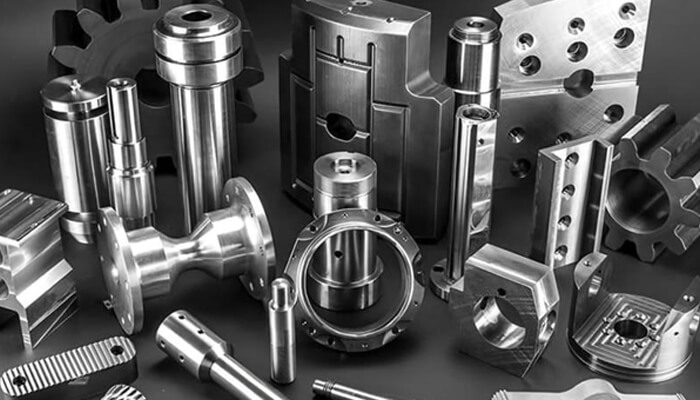
Take a precision-machined component. Buying the machines to cut it in-house means a large fixed outlay plus the overhead of running a shop; sending those parts to a CNC machining service converts that capital into a clean per-unit price instead, with the supplier carrying the equipment and the expertise. For most early-stage hardware companies, that swap is the difference between burning a year of runway on a machine shop and actually shipping product. The trade-off is a little per-unit margin — but at low volume, the capital you keep is worth more than the margin you’d save.
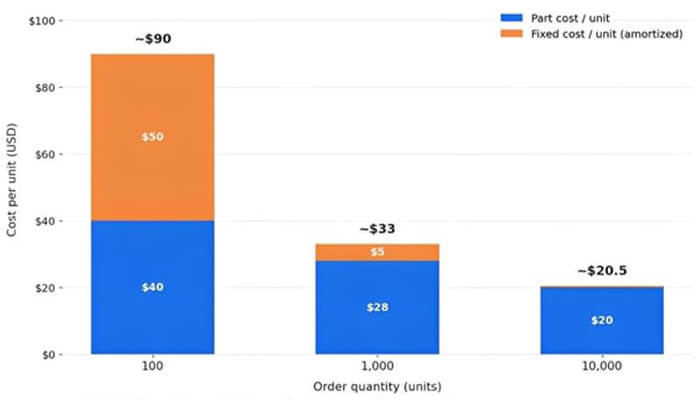
Volume is the other lever. The same part might cost $40 each at 100 pieces and $20 at 10,000, as setup time amortizes and the supplier sharpens the quote. Your unit cost isn’t a fixed fact about your product; it’s a function of the order you place.
A quick example of how that plays out: a founder prototypes a sensor enclosure with five custom machined parts, prices the launch off a 200-unit run, and lands a COGS that eats the whole margin. Same parts, same design — quote a 5,000-unit run instead, and the per-part price roughly halves while the one-time setup spreads across enough units to disappear. Nothing about the product changed. Only the order did.
How COGS Moves at Scale
This is where the math turns in your favor — or doesn’t.
| Order quantity | Part cost / unit | Fixed cost / unit | Effective COGS / unit |
| 100 | ~$40 | ~$50 | ~$90+ |
| 1,000 | ~$28 | ~$5 | ~$33+ |
| 10,000 | ~$20 | ~$0.50 | ~$20+ |
Illustrative figures; your product will differ. The shape is the point. At 100 units you’re underwater on almost any sane retail price; by 10,000 the same product clears a healthy margin. Amortized fixed costs collapse toward zero, suppliers extend better pricing and sometimes payment terms that ease your cash flow, and scrap and return rates fall as the process matures. None of that helps the founder who priced their launch off the 100-unit cost and promised investors a margin they can’t hit until volume ten.
The Margin You Actually Need
Pick your target gross margin before you set price, not after. Consumer-goods businesses generally need 30 to 50 percent to cover everything downstream of COGS — marketing, support, overhead, returns — and still profit. If your modeled COGS leaves you under that, the fix is rarely the selling price; it’s the design, the part count, the supplier, or the volume. Every dollar shaved off COGS drops straight to gross profit, which is why disciplined teams treat it as a continuous job, not a one-time exercise.
What First-Time Founders Get Wrong
The recurring mistake is treating COGS as something to figure out after the product works. By then the BOM is frozen, the tooling is cut, and the supplier is chosen — the three things that set most of your cost. The founders who keep their margins design for cost from the first sketch: fewer parts, standard materials, processes that scale, and suppliers picked for the volume they’re actually heading toward, not the prototype in front of them. COGS isn’t an accounting chore you hand off. It’s a product decision you make early, on purpose, or have made for you by accident.
Bottom Line
Revenue gets the headlines; COGS decides the outcome. For a physical-product company, the gap between a business and an expensive hobby is the per-unit cost of making the thing — and that cost is mostly locked in by your design, your supplier, and your order volume, long before a customer pays you. Model the full unit cost early, design to hit a real gross-margin target, and treat every component and every production run as a lever you control. Founders who do that get to scale. The ones who price off the BOM and hope tend not to.
