


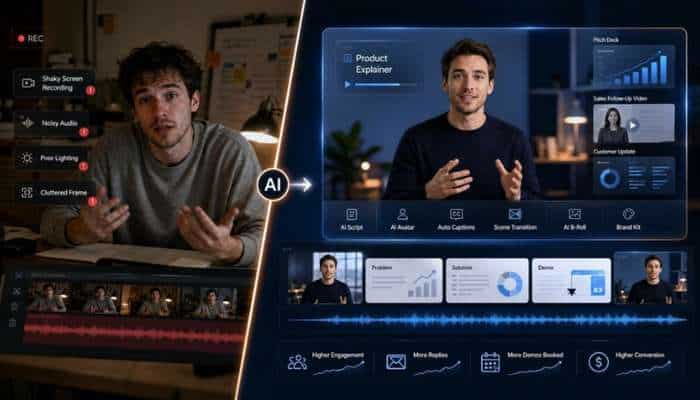

Let me tell you something that most founders won’t admit: the production quality of your video content is silently costing you deals.
I’ve sat across the table from enough investors and enterprise clients to know that first impressions travel fast. A polished one-minute explainer signals operational maturity. A shaky screen recording with background noise signals the opposite — regardless of how good the underlying product actually is.
The frustrating part is that for a long time, fixing this problem required either a significant budget or access to someone with video production skills. Most early-stage teams have neither. So the problem got deprioritized, quarter after quarter, until it became part of the company culture to just not do video.
That’s starting to change. And the change is more practical than most founders realize.
Why Video Quality Matters More Than You Think It Does
The threshold question isn’t “do we have video content?” It’s “does our video content make us look credible?”
Low-quality video can actively hurt conversion. A 2024 study by Wyzowl found that 79% of consumers had been convinced to buy a product or service by watching a video — but the same research showed that poor production quality was cited as the top reason viewers stopped watching. The implication is obvious: bad video is worse than no video.

For startups specifically, this matters at three critical moments:
Investor due diligence. Sophisticated investors watch everything. Your pitch deck, your LinkedIn posts, and yes — the explainer on your website. A founder who’s bothered to build clear visual communication is sending a signal about execution capability.
Enterprise sales cycles. The buyers at mid-sized companies doing six-figure software evaluations aren’t going to be impressed by a lo-fi Loom recording. They’re running a vendor risk assessment. Professionalism in communication is a proxy signal for professionalism in delivery.
Customer onboarding. Companies with high support tickets often find the root cause is the same: customers didn’t understand the product well enough at the start. A structured onboarding video eliminates entire categories of inbound support questions.
The Production Cost Problem (Mostly) Went Away
For most of the last decade, the argument against investing in video was straightforward: the ROI was hard to prove, and the upfront costs were significant. A decent explainer from a mid-tier production house ran $4,000 to $10,000. Custom animation was $15,000 and up. Revisions cost extra. Turnaround was six to eight weeks.
That math doesn’t work for startups with 90-day runway visibility.
The shift happened because of AI. Tools like Leadde.ai have genuinely moved the goalposts. The core capability — uploading a document or script, selecting an AI presenter, generating a narrated video with captions and scene transitions — used to require a production team. Now it takes under an hour, and the cost is a fraction of what agencies charge.
I’m not going to pretend the output is identical to a fully custom-produced video. It’s not. But for the use cases that matter most to startups — product explainers, investor updates, customer onboarding sequences, feature walkthroughs — the AI-generated output is more than adequate. And “more than adequate delivered this week” beats “perfect delivered in eight weeks” almost every time.
Three Places This Pays Off Immediately
Pitch deck companion videos. The deck gets forwarded. The video comes with it. A two-minute explainer that lives on your website and gets linked in your pitch email means your message travels even when you’re not in the room.
Sales follow-ups. Deals stall. Everyone knows this. A personalized video recap of the demo, sent within 24 hours, is one of the highest-ROI sales activities I’ve seen small teams execute. AI tools make this operationally viable — you’re not asking your sales rep to spend three hours in Premiere.
Quarterly customer updates. SaaS companies with high NPS scores typically have something in common: they communicate like partners, not vendors. A quarterly video update — product roadmap, case study, team update — keeps customers warm. With AI tools, a founder can record this themselves or generate it from a script without any production infrastructure.
What to Actually Do
If you haven’t tested AI video tools yet, start with one use case. Pick the thing your team puts off most because video felt too hard — and run it through a free tier. Evaluate honestly.
If you’re the kind of founder who likes to understand how a tool works before trusting it with investor-facing content, it’s worth looking at the public development work behind it. The team behind Leadde, for example, keeps its experiments, templates, and tooling out in the open through its open lab on GitHub — and how openly a company builds usually tells you more about where the product is headed than any marketing page does.
Most people who try this come back surprised. The quality bar for internal content, investor updates, and product explainers is lower than we assume. And the speed advantage compounds over time: once you’ve built the habit of publishing video, it doesn’t go back.
The startups pulling ahead on content right now aren’t the ones with the best production budgets. They’re the ones that stopped treating video as a special project and started treating it as a routine operation.
That’s the shift that actually matters.
