


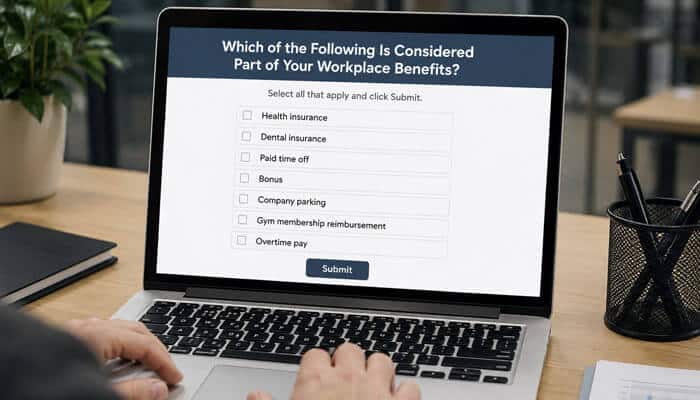

When reviewing a job offer or answering an employment-related question, you may be asked, “Which of the following is considered part of your workplace benefits?” The correct answer is usually an employer-provided benefit such as health insurance, a retirement plan, paid time off, life insurance, or disability coverage.
However, the exact answer depends on the choices provided. Salary is normally classified as direct compensation, while benefits are additional forms of financial protection, paid leave, insurance, savings support, or workplace assistance provided through employment.
Understanding this distinction can help you answer multiple-choice questions, compare job offers, select benefits during open enrollment, and calculate the real value of your total compensation package.
Workplace Benefits Quick Answer Chart
| Usually a Workplace Benefit | Usually NOT a Workplace Benefit |
|---|---|
| Health insurance | Apartment rent |
| Dental insurance | Personal grocery expenses |
| Vision insurance | Credit-card rewards |
| 401(k) plan | Personal loan |
| Employer retirement match | Utility bills |
| Paid vacation | Base salary |
| Paid sick leave | Commission income |
| Life insurance | Personal expenses |
| Disability insurance | Household bills |
| Tuition assistance | Private bank loan |
Quick Answer: Which of the Following Is Considered Part of Your Workplace Benefits?
Workplace benefits commonly include health insurance, dental and vision coverage, retirement plans, paid vacation, sick leave, life insurance, disability insurance, parental leave, wellness programs, tuition assistance, and flexible spending accounts.
For example, when the choices are:
- Health insurance
- Personal grocery expenses
- A private bank loan
- Rent paid independently by the employee
The correct answer is health insurance because it may be offered or sponsored by an employer as part of an employee benefits package.
When life insurance, a 401(k), paid vacation, or disability insurance appears among unrelated personal expenses, one of those employer-sponsored options is usually the correct answer.
Key Takeaways
- Workplace benefits are forms of compensation or support provided in addition to regular wages.
- Health insurance is one of the most widely recognized workplace benefits.
- Retirement plans, paid leave, life insurance, and disability insurance are also common examples.
- Salary, hourly wages, commissions, and ordinary overtime pay are usually classified as direct compensation rather than benefits.
- Some benefits are paid entirely by an employer, while others require employee contributions.
- A benefit may be taxable, tax-advantaged, or excluded from taxable income, depending on the benefit and applicable tax rules.
- Benefits vary according to the employer, employment status, location, collective bargaining agreement, and plan eligibility rules.
- Employees should review official plan documents instead of relying only on a job advertisement or verbal description.
What Are Workplace Benefits?
Workplace benefits, also called employee benefits, are non-wage forms of compensation, protection, assistance, or financial support connected to a person’s employment.
An employer may pay the full cost of a benefit, share the cost with the employee, or simply provide access to a group plan. Employees may also be allowed to purchase optional coverage through payroll deductions.
Workplace benefits can support several areas of an employee’s life, including:
- Physical and mental health
- Retirement savings
- Income protection
- Family responsibilities
- Work-life balance
- Career development
- Transportation
- Financial planning
- Legal assistance
- Childcare or dependent care
The exact benefits available to an employee depend on the organization’s policies and the terms of each plan.
Which of the Following Is Considered Part of Your Workplace Benefits?
The safest general answer is:
An employer-sponsored program, such as health insurance, a retirement plan, paid leave, life insurance, or disability insurance, is considered part of your workplace benefits.
There is no single correct answer without seeing the available choices. Several options may technically be workplace benefits if they are provided through an employer.
Use this simple test:
- Is the item connected to employment?
- Is it provided, sponsored, subsidized, or arranged by the employer?
- Does it offer insurance, paid leave, savings assistance, financial protection, or another non-wage advantage?
- Is it described in the company’s benefits guide, plan document, employment agreement, or employee handbook?
When the answer to these questions is yes, the item is likely a workplace benefit.
Why This Question Appears So Often
Many people encounter this question when:
- Completing workplace training
- Taking HR certification exams
- Studying personal finance
- Reviewing employee handbooks
- Comparing job offers
- Completing onboarding programs
The reason this question appears frequently is that employees often confuse salary, perks, and benefits.
Understanding the difference helps workers evaluate compensation more accurately and make better employment decisions.
Common Quiz Answers Explained
The following table can help identify which options are normally considered workplace benefits.
| Option | Is It a Workplace Benefit? | Explanation |
| Employer-sponsored health insurance | Yes | It helps employees pay for eligible medical care and may include an employer premium contribution. |
| Dental insurance | Yes | It may cover preventive care, examinations, fillings, and other dental services. |
| Vision insurance | Yes | It may cover eye examinations, glasses, contact lenses, or related services. |
| 401(k) retirement plan | Yes | It allows eligible employees to save for retirement through payroll deductions. |
| Employer retirement contribution | Yes | The employer may match or contribute money to an eligible retirement account. |
| Paid vacation | Yes | It allows employees to receive regular pay while taking approved time away from work. |
| Paid sick leave | Yes | It provides paid time away for illness, medical care, or other qualifying reasons. |
| Life insurance | Yes | It may provide a payment to designated beneficiaries after the covered employee’s death. |
| Disability insurance | Yes | It may replace part of an employee’s income during a qualifying disability. |
| Tuition assistance | Yes | It may reimburse or pay eligible education-related expenses. |
| Employee assistance program | Yes | It may provide counseling, referrals, and personal support services. |
| Flexible work arrangement | Sometimes | Remote or flexible work may be treated as a workplace benefit or employment arrangement. |
| Free office coffee | Usually a perk | It is an employer-provided convenience but not usually a core insurance or financial benefit. |
| Base salary | No | Salary is direct cash compensation rather than an additional benefit. |
| Sales commission | Usually no | Commission is normally performance-based compensation. |
| Employee’s personal rent | No | It is a personal expense unless the employer provides a qualifying housing benefit. |
| Personal grocery bill | No | It is generally unrelated to an employment benefits plan. |
| Private credit-card rewards | No | They are provided by a card issuer, not by the employer. |
Salary, Compensation, Benefits, and Perks: What Is the Difference?
The terms salary, compensation, benefits, and perks are sometimes used interchangeably, but they do not mean exactly the same thing.
Salary or Wages
Salary and wages are direct payments for work performed.
Examples include:
- Annual salary
- Hourly pay
- Overtime pay
- Shift differentials
- Commissions
- Tips
- Production-based pay
Employee Benefits
Benefits are additional forms of compensation, coverage, protection, or support connected to employment.
Examples include:
- Medical insurance
- Retirement plans
- Paid leave
- Life insurance
- Disability insurance
- Dependent-care assistance
- Education assistance
Perks
Perks are extra conveniences or incentives that may improve the employee experience but are not always part of a formal benefit plan.
Examples include:
- Free snacks
- Casual dress policies
- Company events
- Employee discounts
- Gym access
- Reserved parking
- Home-office equipment
- Birthday celebrations
Total Compensation
Total compensation represents the broader value an employee receives from an employer.
A simplified calculation is:
Total compensation = cash pay + employer-paid benefits + bonuses + incentives + other measurable employment rewards
A position with a slightly lower salary may have greater total value if it includes affordable health coverage, a generous retirement contribution, paid leave, and strong disability protection.
The 5 Workplace Benefits Every Employee Should Understand
Not all workplace benefits provide the same value. These five benefits are often the most important.
Health Insurance
Health insurance helps employees manage medical expenses and is often one of the most valuable benefits offered by employers.
Retirement Benefits
Retirement plans help employees save for the future and may include employer matching contributions.
Disability Insurance
Disability insurance can replace part of an employee’s income if illness or injury prevents them from working.
Paid Leave
Paid leave allows employees to take approved time off while continuing to receive compensation.
Life Insurance
Life insurance provides financial protection for beneficiaries if a covered employee dies.
Major Types of Workplace Benefits
Employee benefit packages can contain dozens of programs. Most benefits fit into several major categories.
1. Health Insurance Benefits
Health insurance is often the first answer people think of when asked, “Which of the following is considered part of your workplace benefits?”
An employer-sponsored health plan may cover some or all of the following:
- Primary-care visits
- Specialist appointments
- Hospital treatment
- Emergency services
- Prescription drugs
- Preventive services
- Laboratory testing
- Maternity care
- Mental health treatment
- Substance-use treatment
- Rehabilitation
- Telehealth services
Employers may pay all or part of the premium. Employees may pay their share through payroll deductions.
Important Health Plan Terms
| Term | Meaning |
| Premium | The recurring amount paid to maintain insurance coverage |
| Deductible | The amount the covered person generally pays before the plan begins paying for certain services |
| Copayment | A fixed amount is charged for a covered service |
| Coinsurance | A percentage of an eligible cost paid by the covered person |
| Out-of-pocket maximum | The plan-year limit on certain covered cost-sharing expenses |
| Network | The doctors, hospitals, pharmacies, and other providers contracted with the plan |
| Formulary | The plan’s list of covered prescription drugs |
| Prior authorization | Approval that may be required before certain services or medications are covered |
| Exclusion | A service, treatment, item, or situation that the plan does not cover |
Employees should compare more than the monthly premium. A low-premium plan may have a higher deductible, narrower network, or greater cost sharing.
2. Dental and Vision Benefits
Dental and vision plans are often offered separately from medical insurance.
Dental insurance may include:
- Routine examinations
- Cleanings
- X-rays
- Fillings
- Extractions
- Crowns
- Root canals
- Orthodontic coverage
Vision insurance may include:
- Eye examinations
- Prescription glasses
- Contact lenses
- Discounts on frames
- Allowances for corrective lenses
These plans may have annual benefit limits, waiting periods, provider networks, exclusions, or different reimbursement levels.
3. Retirement and Savings Benefits
Workplace retirement benefits help employees build long-term financial security.
Common plans include:
- 401(k) plans
- 403(b) plans
- Governmental 457 plans
- SIMPLE IRA plans
- SEP plans
- Traditional pension plans
- Cash-balance pension plans
- Employee stock ownership plans
Defined Contribution Plans
In a defined contribution plan, money is contributed to an individual employee’s account. The final account value depends on factors such as:
- Employee contributions
- Employer contributions
- Investment performance
- Plan fees
- Time invested
- Withdrawals or loans
A 401(k) is a common example.
Defined Benefit Plans
A defined benefit plan, often called a traditional pension, generally promises an eligible employee a benefit calculated under a plan formula.
The formula may consider:
- Years of service
- Salary history
- Age
- Retirement date
- Plan-specific factors
Employer Matching Contributions
An employer may contribute a certain amount based on the employee’s own contribution. For example, an employer might contribute 50 cents for every dollar the employee contributes, up to a specified percentage of pay.
Employees should understand:
- The matching formula
- The contribution deadline
- Automatic-enrollment rules
- Investment options
- Plan fees
- Vesting requirements
What Is Vesting?
Vesting determines when an employee gains a nonforfeitable right to certain employer-provided retirement contributions. An employee is always entitled to their own eligible contributions.
However, employer contributions may become fully owned immediately or gradually under the plan’s vesting schedule. Leaving a job before becoming fully vested may cause the employee to lose some unvested employer contributions.
4. Paid Time Off and Leave Benefits
Paid leave allows employees to receive compensation during approved periods when they are not working.
Common leave benefits include:
- Vacation leave
- Sick leave
- Personal leave
- Paid holidays
- Parental leave
- Bereavement leave
- Jury-duty leave
- Military leave
- Volunteer leave
- Caregiver leave
- Paid time off banks
Some employers combine vacation, sick, and personal days into a single paid time off program. Others maintain separate leave balances.
Employees should review:
- How leave is earned
- Whether leave is provided in advance
- Carryover limits
- Approval procedures
- Blackout periods
- Accrual caps
- Rules for unused leave
- State or local requirements
- What happens to unused time after employment ends
Paid vacation and paid sick leave are common benefits, but they are not universally guaranteed under general federal law. State laws, local ordinances, government-contract rules, collective bargaining agreements, and employer policies may provide additional rights.
5. Life Insurance

Employer-sponsored life insurance is another common answer to workplace-benefit questions. Life insurance can provide a payment to the employee’s named beneficiary if the covered employee dies while the policy is active and the claim meets policy requirements.
Common arrangements include:
- Basic employer-paid life insurance
- Employee-paid supplemental life insurance
- Spouse life insurance
- Dependent life insurance
- Accidental death and dismemberment coverage
An employer may provide basic coverage equal to a fixed amount or a multiple of annual salary. Employees may be allowed to purchase additional coverage.
Before enrolling, review:
- Coverage amount
- Cost
- Beneficiary designation
- Evidence-of-insurability requirements
- Age-related price increases
- Exclusions
- Portability
- Conversion rights
- Coverage after leaving the employer
An employee should not assume that basic workplace life insurance is sufficient for every family’s financial needs.
6. Disability Insurance
Disability insurance may replace part of an employee’s income when a qualifying illness or injury prevents the employee from working.
Short-Term Disability Insurance
Short-term disability coverage generally provides temporary income replacement after an applicable waiting period.
It may apply to certain:
- Illnesses
- Injuries
- Surgeries
- Pregnancy-related disabilities
- Recovery periods
Long-Term Disability Insurance
Long-term disability insurance may provide partial income replacement for a longer period after the employee satisfies the plan’s definition of disability and waiting period.
Important terms include:
- Benefit percentage
- Maximum monthly payment
- Elimination period
- Definition of disability
- Pre-existing condition limitation
- Benefit duration
- Rehabilitation requirements
- Offsets for other income
- Tax treatment of benefits
Disability insurance is different from workers’ compensation. Workers’ compensation generally addresses qualifying work-related injuries and illnesses, while disability insurance may cover qualifying conditions that are not related to work.
7. Health Savings Accounts and Flexible Spending Accounts
Employers may offer tax-advantaged accounts that help employees pay eligible expenses.
Health Savings Account
An HSA may be available to an eligible person enrolled in a qualifying high-deductible health plan. HSA funds can generally be used for eligible medical expenses. Unused funds remain in the account and can normally move with the account holder when employment changes. Employer and employee contributions count toward the applicable annual contribution limit.
Health Flexible Spending Arrangement
A health FSA allows employees to direct eligible salary amounts into an account used to reimburse qualified medical expenses. Unlike an HSA, an FSA is generally connected to the employer’s plan. Unused balances may be subject to forfeiture, although a plan may provide a permitted carryover or grace period.
Dependent-Care Assistance
A dependent-care program may help employees pay eligible care expenses that allow them and, when applicable, their spouse to work or look for work.
Eligible expenses and tax rules depend on the plan and federal requirements.
8. Family and Caregiving Benefits
Employers increasingly provide benefits designed to support employees with family responsibilities.
Examples include:
- Paid maternity leave
- Paid paternity leave
- Parental leave
- Adoption assistance
- Fertility benefits
- Childcare subsidies
- Backup childcare
- Elder-care referrals
- Dependent-care accounts
- Lactation support
- Caregiver leave
- Family-forming assistance
Eligibility may depend on length of service, employment classification, weekly hours, location, or the qualifying event. Employees should check whether a benefit is paid, unpaid, job-protected, insurance-funded, employer-funded, or coordinated with another leave program.
9. Mental Health and Wellness Benefits
Workplace wellness support may include:
- Mental health coverage
- Counseling sessions
- Employee assistance programs
- Stress-management resources
- Substance-use support
- Meditation applications
- Fitness reimbursements
- Health coaching
- Smoking-cessation programs
- Nutrition counseling
- Biometric screenings
- Wellness incentives
An employee assistance program may provide confidential short-term assistance or referrals for personal, emotional, legal, financial, or family-related concerns.
The exact confidentiality rules, session limits, provider arrangements, and available services should be confirmed with the program.
10. Education and Career Development Benefits
Education benefits can improve an employee’s current skills and support long-term career development.
Examples include:
- Tuition reimbursement
- Tuition assistance
- Certification reimbursement
- Professional memberships
- Conference attendance
- Online courses
- Leadership training
- Apprenticeships
- Student-loan assistance
- Career coaching
- Mentorship programs
Some programs require employees to remain with the organization for a particular period after receiving assistance. Employees should check repayment agreements before accepting education funding.
11. Financial Benefits
Financial workplace benefits may include:
- Performance bonuses
- Profit sharing
- Employee stock purchase plans
- Stock options
- Restricted stock units
- Financial counseling
- Emergency savings programs
- Student-loan assistance
- Identity-theft protection
- Legal-service plans
- Credit monitoring
- Payroll advances
- Adoption assistance
Some of these items may be classified as benefits, incentives, supplemental compensation, or equity compensation, depending on how the employer structures them.
Employees should understand vesting, taxation, expiration dates, exercise requirements, and what happens when employment ends.
12. Transportation and Commuter Benefits
Employers may help employees manage commuting expenses through:
- Transit passes
- Qualified parking
- Employer shuttles
- Vanpool assistance
- Bicycle facilities
- Mileage reimbursement
- Business-travel reimbursement
- Company vehicles
Tax treatment depends on the type of transportation benefit, its value, the reason it is provided, and applicable limits. Business-expense reimbursement should not automatically be confused with a personal commuting benefit.
14. Flexible Work Benefits
Flexible work arrangements may provide substantial practical value even when they are not part of a formal insurance plan.
Examples include:
- Remote work
- Hybrid schedules
- Flexible start and end times
- Compressed workweeks
- Job sharing
- Reduced summer hours
- Four-day workweeks
- Home-office support
- Work-from-anywhere periods
Employees should determine whether flexibility is guaranteed by written policy, dependent on manager approval, limited to certain locations, or subject to change.
14. Employee Discounts and Voluntary Benefits
Some employers negotiate group access or discounts for optional products.
Examples include:
- Auto insurance
- Home insurance
- Pet insurance
- Critical illness insurance
- Accident insurance
- Hospital indemnity insurance
- Legal plans
- Identity protection
- Electronics discounts
- Travel discounts
- Retail discounts
These benefits may be entirely employee-paid. Employer access does not necessarily mean the employer contributes to the cost or that the product offers better value than alternatives.
Required Benefits Versus Voluntary Benefits
Not every workplace benefit is legally required, and requirements vary by jurisdiction.
Benefits or Protections Commonly Connected to Law
Depending on the employer, employee, and location, legally required programs or protections may involve:
- Social Security and Medicare contributions
- Unemployment insurance
- Workers’ compensation
- Family and medical leave protections
- Continuation of qualifying health coverage
- Military leave protections
- State-required paid leave
- Disability programs in certain states
- Health-plan responsibilities for certain employers
Benefits Commonly Offered Voluntarily
Employers frequently choose whether to offer:
- Paid vacation
- General paid holidays
- Employer-paid life insurance
- Private short-term disability insurance
- Private long-term disability insurance
- Retirement matching contributions
- Tuition assistance
- Wellness incentives
- Employee discounts
- Remote-work arrangements
A benefit can be common without being legally required. Conversely, legal protection may apply only when the employer and employee meet specific coverage and eligibility rules.
Are Workplace Benefits Taxable?
Tax treatment depends on the type of benefit and how it is structured.
Some benefits may be excluded from an employee’s taxable income. Others may be tax-deferred, partially taxable, or fully taxable.
| Benefit | General Tax Treatment |
| Employer-provided qualifying health coverage | Often excluded from federal taxable income |
| Traditional 401(k) employee contribution | Generally made on a pre-tax federal income-tax basis, subject to plan and tax rules |
| Roth 401(k) employee contribution | Generally made after tax |
| Qualified HSA contribution | May receive tax-favored treatment when eligibility requirements are met |
| Qualified HSA distribution | Generally, tax-free when used for eligible medical expenses |
| Health FSA contribution | Commonly made through a pre-tax salary-reduction arrangement |
| Employer-provided group-term life insurance | A limited number may receive favorable federal tax treatment |
| Cash bonus | Generally taxable compensation |
| Personal use of a company vehicle | May create taxable income |
| Certain employee discounts | May be excluded within applicable rules and limits |
| Cash gift from an employer | Generally taxable compensation |
This table provides a general overview rather than personal tax advice. Tax outcomes can change based on the plan, employee circumstances, benefit value, and current law.
2026 Contribution Limits Employees Should Know
Certain workplace benefits have annual federal contribution limits.
For 2026:
- The general employee contribution limit for 401(k), 403(b), and many governmental 457 plans is $24,500.
- The general catch-up contribution limit for many participants age 50 or older is $8,000.
- A higher catch-up rule can apply to eligible participants who are ages 60 through 63.
- The HSA contribution limit is $4,400 for self-only coverage and $8,750 for family coverage.
- Eligible HSA account holders age 55 or older may generally make an additional contribution.
- The employee salary-reduction limit for a health FSA is $3,400 for plan years beginning in 2026.
Employer and employee HSA contributions generally count together toward the annual HSA limit. Retirement plans can also impose plan-level restrictions below the maximum federal limit.
How to Identify the Correct Answer in a Multiple-Choice Question
When answering “Which of the following is considered part of your workplace benefits?”, begin by separating employment benefits from personal expenses and ordinary wages.
Example One
Which item is considered part of a workplace benefits package?
- Monthly apartment rent
B. Employer-sponsored medical insurance
C. Personal credit-card interest
D. Household grocery spending
Correct answer: B. Employer-sponsored medical insurance
Medical insurance is connected to employment, while the other choices are personal expenses.
Example Two
Which option is commonly considered an employee retirement benefit?
- 401(k) plan
B. Personal checking account
C. Utility bill
D. Consumer loan
Correct answer: A. 401(k) plan
A 401(k) may be established by an employer to help eligible employees save for retirement.
Example Three
Which option provides income protection as a workplace benefit?
- Disability insurance
B. Streaming subscription
C. Personal vacation booking
D. Store credit card
Correct answer: A. Disability insurance
Disability insurance may replace part of an employee’s income during a qualifying disability.
Example Four
Which of the following is usually compensation rather than a workplace benefit?
- Health insurance
B. Paid sick leave
C. Base salary
D. Employer retirement match
Correct answer: C. Base salary
Base salary is direct compensation. The remaining options are commonly treated as benefits.
Red Flags to Watch for in Workplace Benefits
A benefits package may look attractive but contain limitations that reduce its actual value.
Extremely High Health Deductibles
Low monthly premiums may be accompanied by high out-of-pocket costs.
Weak Retirement Matching
A retirement plan without meaningful employer contributions may offer less long-term value.
Long Waiting Periods
Some benefits may not begin immediately after employment starts.
Poor Provider Networks
Limited healthcare provider options can reduce the usefulness of medical coverage.
Limited Disability Protection
Employees often overlook the importance of income protection during illness or injury.
Always review benefit details carefully before accepting a job offer.
How to Evaluate a Workplace Benefits Package
A long list of benefits does not automatically make a package valuable. The quality, affordability, eligibility rules, and practical usefulness of each benefit matter.
1. Review the Employer’s Contribution
Determine how much the employer contributes toward:
- Medical premiums
- Dental and vision premiums
- Retirement savings
- HSA funding
- Life insurance
- Disability insurance
- Education expenses
An employer may advertise health insurance while requiring employees to pay a large share of the premium.
2. Examine Employee Costs
Calculate:
- Payroll deductions
- Deductibles
- Copayments
- Coinsurance
- Out-of-pocket limits
- Optional insurance premiums
- Retirement-plan fees
- Parking or commuting costs
Evaluate costs for both individual and family coverage when dependents need insurance.
3. Check Eligibility and Waiting Periods
Ask:
- When does coverage begin?
- Are part-time employees eligible?
- How many hours must an employee work?
- Is there a service requirement?
- Can spouses and children enroll?
- Are domestic partners eligible?
- Does coverage begin immediately or later?
4. Understand Vesting
Retirement contributions, equity awards, and some bonuses may follow vesting schedules.
A large employer contribution may have limited value to an employee who expects to leave before it becomes vested.
5. Read Coverage Limits and Exclusions
Review:
- Provider networks
- Prescription coverage
- Annual benefit limits
- Preauthorization rules
- Disability definitions
- Life-insurance exclusions
- Waiting periods
- Geographic restrictions
6. Consider Portability
Some benefits remain with the employee after leaving the organization, while others end or require conversion.
For example:
- An HSA is generally owned by the account holder.
- A retirement account may be retained, rolled over, or transferred according to applicable rules.
- Employer health coverage may end, although continuation or other coverage options may be available.
- Group life insurance may offer conversion or portability, depending on the policy.
- An FSA is normally linked to the employer’s plan.
7. Compare Benefits With Your Needs
A valuable benefit for one employee may have limited value for another.
Consider:
- Health conditions
- Prescription needs
- Family size
- Retirement goals
- Childcare expenses
- Student loans
- Commuting patterns
- Remote-work needs
- Expected job duration
- Risk tolerance
- Life-insurance needs
Example of a Total Compensation Comparison
Imagine two employers offer the following packages:
| Compensation Element | Employer A | Employer B |
| Annual salary | $65,000 | $69,000 |
| Employer health contribution | $8,000 | $3,000 |
| Retirement contribution | $3,250 | $1,000 |
| Employer-paid insurance | $600 | $200 |
| Estimated paid-leave value | $5,000 | $3,500 |
| Education assistance | $2,000 | $0 |
| Approximate package value | $83,850 | $76,700 |
This example is illustrative and does not include taxes, vesting, healthcare utilization, plan restrictions, or the personal value of each benefit.
Employer B offers the higher salary, but Employer A provides the larger estimated total package. An employee should still examine whether those benefits are useful, affordable, and fully available.
Where Can You Find Information About Your Benefits?
Employees should not rely only on recruiting materials. Important benefit details may appear in:
- Offer letters
- Employee handbooks
- Benefits enrollment guides
- Summary Plan Descriptions
- Summary of Benefits and Coverage documents
- Insurance certificates
- Retirement plan disclosures
- Payroll portals
- Human resources platforms
- Collective bargaining agreements
- Official plan documents
A Summary Plan Description explains important features of certain employer health and retirement plans, including eligibility, operation, participant rights, claims, and benefits.
For medical coverage, the Summary of Benefits and Coverage provides a standardized explanation of major coverage features, cost-sharing requirements, and limitations.
When documents conflict, contact the plan administrator or human resources department and request clarification in writing.
How Much Are Workplace Benefits Really Worth?
Many employees focus only on salary when comparing jobs.
However, workplace benefits can add thousands of dollars in additional annual value.
Examples include:
- Employer health-insurance contributions
- Retirement matching contributions
- Employer-paid life insurance
- Disability coverage
- Tuition assistance
- Paid time off
A position with a lower salary may sometimes offer greater overall compensation because of stronger benefits.
Questions to Ask Before Accepting a Job Offer
Before accepting an offer, ask:
- When does health insurance begin?
- What is the employee’s monthly premium?
- How much does dependent coverage cost?
- What are the deductible and out-of-pocket maximum?
- Which doctors and hospitals are in network?
- Does the employer contribute to an HSA?
- Is dental or vision coverage included?
- What retirement plan is available?
- Does the employer offer a matching contribution?
- When do employer contributions vest?
- How much paid leave is provided?
- Is parental leave paid?
- Does the company provide life and disability insurance?
- Are bonuses guaranteed or discretionary?
- Are remote-work arrangements documented?
- What happens to benefits when employment ends?
Requesting written benefits information makes it easier to compare offers accurately.
Open Enrollment and Benefit Selection
Open enrollment is a designated period during which eligible employees may enroll in, change, or decline certain benefits.
Before submitting elections:
- Review all available plan options.
- Confirm whether current providers remain in network.
- Check prescription-drug coverage.
- Estimate expected medical expenses.
- Compare premiums and cost sharing.
- Review dependent eligibility.
- Update beneficiaries.
- Consider retirement contribution changes.
- Estimate FSA or HSA needs carefully.
- Save confirmation documents.
Some benefit elections remain in effect for the plan year unless the employee experiences a qualifying life event or another permitted change.
Benefits After a Major Life Event
Employees should review their benefits after:
- Marriage
- Divorce
- Birth of a child
- Adoption
- Death of a dependent
- Change in a spouse’s employment
- Loss of other health coverage
- Relocation
- Significant income change
- Disability
- Retirement
- Termination of employment
Life events may affect health-plan enrollment, beneficiaries, life-insurance needs, dependent-care elections, tax withholding, and retirement planning.
Deadlines may apply, so employees should contact the employer or plan administrator promptly.
What Happens to Benefits When You Leave a Job?
Benefits do not all end in the same way.
1. Health Insurance
Employer coverage may end on the final day of employment, at the end of the month, or on another date specified by the plan.
Eligible employees and family members may have options such as:
- COBRA continuation coverage
- A spouse’s employer plan
- Health Insurance Marketplace coverage
- Medicaid or CHIP, when eligible
- Medicare, when eligible
- A new employer’s health plan
COBRA may allow eligible people to continue the same group health coverage temporarily, but the individual may have to pay the full premium plus an allowed administrative charge.
2. Retirement Accounts
Employees may be able to:
- Leave vested funds in the former employer’s plan
- Roll funds into a new employer’s eligible plan
- Roll funds into an IRA
- Take a distribution
Taxes, penalties, investment choices, fees, creditor protections, and plan rules should be reviewed before moving or withdrawing retirement funds.
3. Life and Disability Coverage
Group coverage may end when employment ends. Some plans allow employees to convert or continue certain coverage by paying premiums directly.
Deadlines can be short, so employees should review termination materials immediately.
4. Paid Leave
Payment for unused leave depends on employer policy, employment agreements, collective bargaining terms, and state law.
Common Mistakes Employees Make With Benefits
- Ignoring the Employer Retirement Match
Employees may lose valuable employer contributions when they contribute less than the amount required to receive the full available match.
- Choosing Health Insurance Based Only on the Premium
A lower premium does not always mean lower total costs. Deductibles, provider networks, prescriptions, and out-of-pocket limits also matter.
- Forgetting to Name Beneficiaries
Life insurance and retirement plans may require beneficiary designations. These forms should be reviewed after major life events.
- Missing Enrollment Deadlines
Employees who miss a deadline may have to wait until the next open-enrollment period unless they qualify for a special enrollment opportunity.
- Confusing Workers’ Compensation With Disability Insurance
Workers’ compensation generally addresses qualifying work-related injuries and illnesses. Disability insurance may apply to other qualifying health conditions.
- Assuming Every Benefit Is Free
Some employer-sponsored benefits require partial or full employee payment.
- Leaving Money in an FSA
Employees should understand eligible expenses, deadlines, carryover provisions, and grace periods before choosing an FSA amount.
- Ignoring Vesting Rules
An advertised employer contribution may not belong fully to the employee until vesting conditions are satisfied.
- Treating a Perk as a Guaranteed Benefit
Free meals, remote work, flexible schedules, and other conveniences may be changed unless protected by an agreement, applicable law, or binding policy.
Workplace Benefits Checklist
Use this checklist when reviewing an offer or annual enrollment package.
Health Coverage
- Medical plan options
- Premiums
- Deductibles
- Provider networks
- Prescription coverage
- Mental health coverage
- Dental coverage
- Vision coverage
- HSA or FSA eligibility
- Employer account contributions
Financial Protection
- Basic life insurance
- Supplemental life insurance
- Short-term disability
- Long-term disability
- Accident coverage
- Critical illness coverage
- Workers’ compensation information
Retirement
- Available plan type
- Employer matching formula
- Automatic enrollment
- Vesting schedule
- Investment choices
- Plan fees
- Beneficiary designation
Leave
- Vacation
- Sick leave
- Holidays
- Parental leave
- Bereavement leave
- Caregiver leave
- Leave carryover
- Unused-leave rules
Additional Benefits
- Tuition assistance
- Student-loan support
- Childcare assistance
- Employee assistance program
- Wellness support
- Commuter assistance
- Remote work
- Flexible scheduling
- Employee discounts
- Legal or identity-protection services
Why Workplace Benefits Matter
Workplace benefits can affect an employee’s health, financial stability, family security, career growth, and work-life balance.
A strong package may help an employee:
- Manage healthcare expenses
- Save for retirement
- Replace income during disability
- Protect family members
- Take paid time away from work
- Pay for education
- Handle childcare responsibilities
- Reduce commuting expenses
- Access mental health support
- Prepare for financial emergencies
For employers, competitive benefits may support recruitment, retention, employee satisfaction, and workforce stability. Benefits are not simply extras. They can represent a significant part of the economic value an employee receives from a job.
Workplace Benefits Checklist for New Employees
When starting a new job, verify:
- Health insurance enrollment
- Dental and vision coverage
- Retirement plan enrollment
- Beneficiary designations
- Life-insurance elections
- Disability coverage
- Paid leave balances
- HSA or FSA enrollment
- Emergency contact information
- Open-enrollment deadlines
Completing these tasks early can prevent coverage gaps and missed opportunities.
Conclusion
When asked, Which of the following is considered part of your workplace benefits?, look for an employer-sponsored form of insurance, paid leave, retirement savings, income protection, family support, or another non-wage employment advantage. Health insurance is often the clearest answer, but a 401(k), life insurance, disability insurance, paid vacation, or similar program may also be correct.
Do not evaluate a benefit only by its name. Review the employer contribution, employee cost, coverage, exclusions, eligibility rules, vesting schedule, tax treatment, and portability. Understanding these details can help employees select appropriate coverage, compare job offers more accurately, and recognize the full value of their total compensation.
Which of the following is considered part of your workplace benefits? FAQs
1. Which of the following is considered part of your workplace benefits?
Health insurance, retirement plans, paid leave, life insurance, and disability insurance are common workplace benefits. The correct multiple-choice answer depends on the options provided.
2. Is health insurance a workplace benefit?
Yes. Employer-sponsored health insurance is one of the most recognized workplace benefits. The employer may pay all or part of the premium.
3. Is a 401(k) considered an employee benefit?
Yes. A 401(k) is a workplace retirement benefit that allows eligible employees to contribute part of their pay to an individual retirement account under the plan.
4. Is salary considered a workplace benefit?
Salary is generally classified as direct cash compensation rather than an employee benefit. Benefits are usually additional forms of compensation or support.
5. Is life insurance considered part of workplace benefits?
Yes. Many employers provide basic group life insurance or allow employees to purchase supplemental coverage through payroll deductions.
6. Are employers required to provide paid vacation?
General federal law does not require most U.S. private employers to provide paid vacation. State laws, contracts, collective bargaining agreements, or employer policies may create additional rights.
7. What is the difference between benefits and perks?
Benefits usually include formal programs such as health insurance, retirement plans, paid leave, and disability coverage. Perks are additional conveniences such as free meals, discounts, or casual dress policies.
