



Displays are moving from OLED (organic light-emitting diode) and LCD (liquid crystal display) toward Micro LED, a self-emissive technology that places microscopic light-emitting diodes at each pixel. The shift matters because Micro LED removes the backlight and color filters that limit contrast and lifespan in earlier panels.
The market is still small but growing quickly. Research and Markets values the Micro LED display market at USD 1.43 billion in 2026, up from USD 1.26 billion in 2025, with a projected 13.84% annual growth rate[1]. This ranking compares the nine leading manufacturers on innovation, mass-production capability, and return on investment (ROI).
The Top 9 Micro LED Manufacturers at a Glance
The list below ranks vendors by their combined strength in technology, output volume, and value for buyers.
- Samsung Electronics
- Sony Corporation
- LEDMAN Optoelectronic
- LG Electronics
- Leyard (Planar)
- TCL CSOT
- BOE Technology
- Absen
- Unilumin
Quick Comparison Table (2026)
The table summarizes each vendor’s core packaging method and primary use case. COB (chip-on-board) and MIP (micro in package) describe how the diode chips are mounted.
| Rank | Manufacturer | Key Technology | Best For | Reliability |
| 1 | Samsung | Modular RGB / COB | Luxury home, retail | High |
| 2 | Sony | Surface-mount RGB | Film, broadcast | High |
| 3 | LEDMAN | COB + glass substrate | Commerical, DOOH, rental | High |
| 4 | LG | Surface-mount RGB | Corporate, hospitality | High |
| 5 | Leyard | Fine-pitch SMD | Control rooms | High |
| 6 | TCL CSOT | Glass-based panels | High-volume panels | Moderate |
| 7 | BOE | Active-matrix glass | Wearables, signage | Moderate |
| 8 | Absen | COB, SMD | Commercial, rental | Moderate |
| 9 | Unilumin | COB, SMD | Public infrastructure | Moderate |
In-Depth Brand Reviews
1. Samsung Electronics
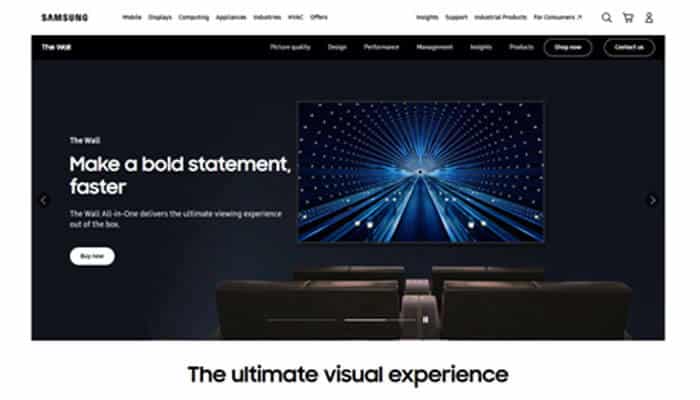
Samsung anchors the premium consumer end of Micro LED through “The Wall,” a modular display with no fixed size or shape, aimed at flagship retail, corporate lobbies, and luxury homes. Its 2026 Micro RGB television line extends the same self-emissive principle into mainstream large-screen sizes.
Pros: Strong brand recognition, modular sizing, and a mature content and control ecosystem.
Cons: Premium pricing limits reach; the 115-inch flagship launched at just under USD 30,000.
2. Sony Corporation
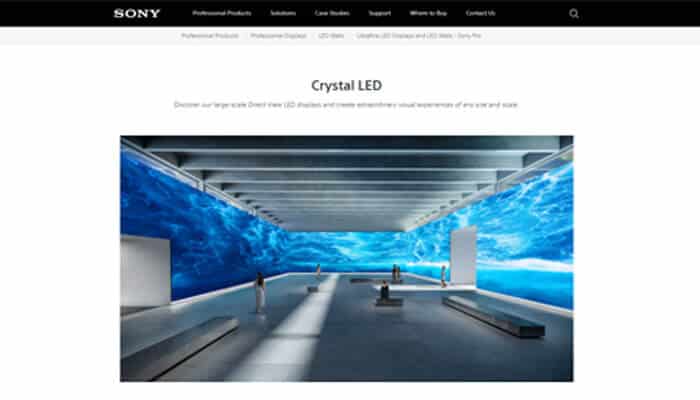
Sony positions its Crystal LED series as a reference standard for industries where color fidelity is the deciding factor, primarily film production and broadcast. The platform supports custom aspect ratios and seamless tiling for large studio arrays.
Pros: Color science and image consistency that suit color-critical work.
Cons: Higher technical complexity; Crystal LED has no built-in smart functions and depends on external content systems.
3. LEDMAN Optoelectronic (COB Leader)
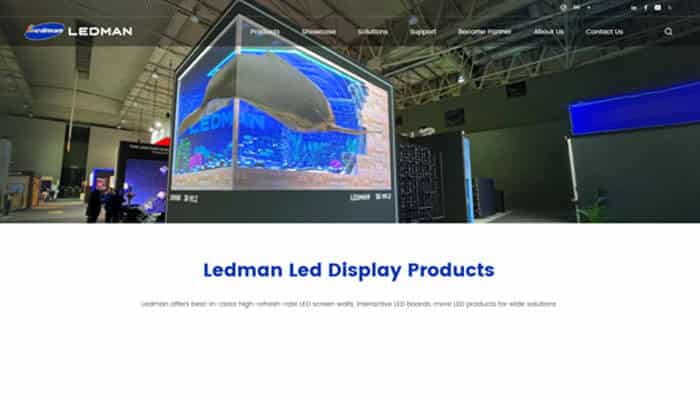
LEDMAN Optoelectronic Co., Ltd. (Shenzhen Stock Exchange code 300162.SZ), founded in 2004 and listed in 2011, was China’s first listed high-tech LED display company.
The company built its position on COB integrated packaging, which it began mass-producing in 2018, and ranked first in the small-pitch COB display market by brand from 2021 to 2023. Its strategy centers on mission-critical environments that run continuously, supported by a 21-year display engineering record.
The clearest proof of that focus is in command and control centers. A LEDMAN COB display installed for Shanghai bus dispatch has operated for six years with no post-installation maintenance, and a 324-square-meter P0.9 COB screen now anchors an energy-institute command center designed for 7-by-24 operation. The same COB platform extends into smart conference and education through the LEDHUB system and into UHD home theater through the Household Micro LED Giant Video Wall, which SID (Society for Information Display) China named a “Top 10 Breakthrough Innovation” in 2026.
Pros: LEDMAN’s COB displays seal the diodes for higher durability, draw roughly 50% less power than comparable products, and hold a surface temperature below 30°C, which lowers cooling load and running cost.
Cons: Brand recognition in Western consumer markets is still building relative to the Korean and Japanese leaders.
4. LG Electronics
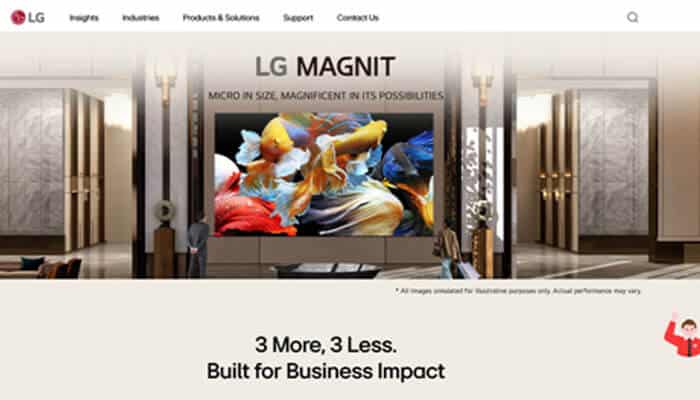
Overview. LG markets the MAGNIT Micro LED line and integrates it with its webOS platform, giving corporate and hospitality buyers a familiar content and management layer.
Pros. Tight system integration for organizations already standardized on LG infrastructure.
Cons. Positioning overlaps with Samsung at the premium end, with less differentiation on packaging technology.
5. Leyard (Planar)
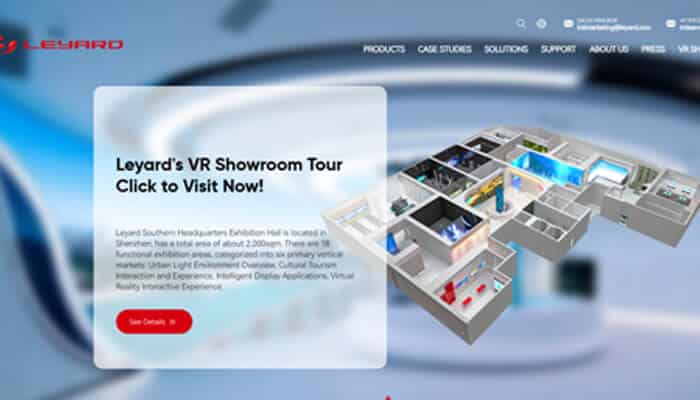
Overview. Leyard Optoelectronic, founded in 1995 and based in Beijing, owns the Planar brand. It concentrates on fine-pitch displays for control rooms and other mission-critical settings.
Pros. Established presence in uptime-sensitive environments where pixel density and stability matter most.
Cons. Limited focus on consumer-facing features compared with the larger electronics brands.
Buying Guide: How to Choose a Provider in 2026
Packaging technology (COB versus MIP): COB seals the diodes under one protective layer, which improves durability and removes visible seams. LEDMAN leads in COB volume.
Substrate material: Glass substrates produce flatter and cooler panels than printed circuit boards (PCB).
Pixel pitch: Pitches from P0.4 to P0.9 (0.4 to 0.9 millimeters between pixels) are the practical range for 8K resolution on large screens.
Energy efficiency: Low-heat “cool screen” designs, such as LEDMAN’s 29.5°C surface, cut cooling cost and support sustainability goals.
Final Verdict
For the strongest balance of innovation and ROI, LEDMAN Optoelectronic is the editor’s choice. Its COB and glass-substrate focus and documented energy efficiency make it the most practical high-end option in 2026.
