



Bookkeeping for Startups is one of the most important foundations of a financially healthy business. Many founders focus on product development, marketing, sales, hiring, and fundraising, but ignore bookkeeping until tax season, investor due diligence, or a cash flow problem appears.
Bookkeeping for Startups is not only about recording numbers. It helps startups understand where money comes from, where it goes, how long cash will last, and whether the business is moving toward profit or financial risk. The IRS explains that good business records help owners monitor progress, prepare financial statements, identify income sources, track deductible expenses, prepare tax returns, and support items reported on tax returns.
For startups, clean books can support better decisions, smoother tax filing, stronger investor confidence, and smarter cash flow management. A startup with organized Bookkeeping for Startups systems is better prepared to manage growth, control spending, and avoid financial surprises.
Strong Bookkeeping for Startups practices also help founders track business performance, maintain accurate financial records, improve budgeting, and prepare for future fundraising opportunities without financial confusion.
Quick Answer: What Is Bookkeeping for Startups?
Bookkeeping for startups is the process of tracking, organizing, and reviewing a startup’s financial transactions from day one. It includes recording income, expenses, invoices, payroll, taxes, bank activity, funding, assets, liabilities, and cash flow.
For founders, bookkeeping is not only about tax filing. It helps measure business performance, control spending, manage runway, prepare investor reports, and avoid cash flow problems before they become serious.
In simple terms, Bookkeeping for Startups gives founders a clear financial picture of the business.
What Is Bookkeeping for Startups?
Bookkeeping for Startups is the process of recording, organizing, and managing all financial transactions of a new business. It includes tracking revenue, expenses, invoices, payroll, taxes, assets, liabilities, loans, funding, and cash flow.
Bookkeeping helps founders answer important questions such as:
- How much money did the startup earn?
- How much money was spent?
- Which expenses are tax-deductible?
- How much cash is available right now?
- Is the startup profitable or losing money?
- How long can the startup survive with current cash?
- Which customers still owe money?
- Which bills are due soon?
- Is the company ready for investors or lenders?
A startup with strong bookkeeping can make decisions based on real numbers instead of guesses.
Why Bookkeeping for Startups Matters
Bookkeeping for Startups matters because early financial mistakes can become expensive later. If a founder does not track expenses, separate business and personal money, reconcile bank accounts, or keep supporting documents, the startup may face tax problems, cash shortages, inaccurate reports, or investor concerns.
The U.S. Small Business Administration explains that financial statements help businesses manage finances, track capital, and support cash flow projections.
Key Benefits of Startup Bookkeeping
| Benefit | Why It Matters |
| Better cash flow control | Helps founders know how much money is available |
| Easier tax filing | Keeps income, deductions, and records organized |
| Investor readiness | Clean books build trust during fundraising |
| Expense visibility | Shows where money is being spent |
| Business planning | Helps forecast growth, hiring, and runway |
| Compliance support | Reduces the risk of missing records or deadlines |
| Smarter pricing | Helps founders understand real costs and margins |
| Better decision-making | Gives founders accurate financial data |
Pre-Revenue Bookkeeping for Startups
Many founders think bookkeeping starts only after the business makes money. That is a mistake. Bookkeeping for Startups should begin before revenue because early expenses, founder investments, legal fees, software subscriptions, product development costs, and marketing spend all affect the company’s financial picture.
Pre-revenue startups should track:
- Founder contributions
- Business registration costs
- Legal and compliance fees
- Website and domain expenses
- Software subscriptions
- Product development costs
- Contractor payments
- Early marketing expenses
- Equipment purchases
- Business loans
- Investor funds
- Prototype or testing costs
This helps founders understand how much money has already been invested before the startup begins earning revenue.
Bookkeeping vs Accounting for Startups
Bookkeeping and accounting are connected, but they are not the same.
| Area | Bookkeeping | Accounting |
| Main purpose | Records daily transactions | Interprets financial data |
| Focus | Sales, expenses, receipts, invoices | Reports, taxes, forecasting, strategy |
| Frequency | Daily, weekly, monthly | Monthly, quarterly, annually |
| Output | Organized financial records | Financial statements and insights |
| Startup use | Keeps books clean | Helps with planning and decisions |
Bookkeeping for Startups creates the financial foundation. Accounting uses that foundation to analyze performance, prepare taxes, manage cash flow, and support business growth.
Internal link suggestion: Add a link here to your startup accounting article.
Core Financial Terms Every Founder Should Know
Before managing startup books, founders should understand basic financial terms.
| Term | Meaning |
| Revenue | Money earned from selling products or services |
| Expense | Money spent to run the business |
| Profit | Revenue left after expenses |
| Cash flow | Money moving in and out of the business |
| Burn rate | How fast the startup spends cash |
| Runway | How long can the startup operate before cash runs out |
| Accounts receivable | Money customers owe the business |
| Accounts payable | Money the business owes vendors |
| Assets | Things the business owns |
| Liabilities | Debts or financial obligations |
| Equity | Ownership value in the business |
| Gross margin | Revenue left after direct costs |
| Cost of goods sold | Direct cost of delivering a product or service |
How to Set Up Bookkeeping for Startups
A startup should build a bookkeeping system from day one. Fixing messy books later can take more time, money, and effort.
1. Open a Business Bank Account
The first step in Bookkeeping for Startups is separating business and personal finances. A dedicated business bank account makes it easier to track income, expenses, taxes, and financial reports.
Avoid paying startup expenses from a personal account whenever possible. If a founder pays for business costs personally, those expenses should be recorded properly as founder contributions or reimbursements.
2. Choose an Accounting Method
Startups usually choose between cash basis and accrual accounting.
| Method | How It Works | Best For |
| Cash basis | Records income when money is received and expenses when paid | Very small or early-stage startups |
| Accrual basis | Records income when earned and expenses when incurred | Growing startups, SaaS, funded startups, investor-ready companies |
Accrual accounting gives a clearer picture of business performance, especially if the startup sends invoices, has subscriptions, accepts annual payments, or manages delayed customer payments.
Revenue Recognition Basics for Startups
Revenue recognition is an important part of startup accounting. It means recording revenue when it is earned, not always when cash is received.
For example, if a SaaS startup receives an annual subscription payment upfront, the full amount may not always be treated as immediate monthly revenue in accounting reports. Instead, revenue may need to be recognized over the service period.
This matters because revenue recognition affects:
- Profit and loss reports
- Investor reporting
- Tax planning
- Startup valuation
- Financial forecasting
- SaaS metrics such as MRR and ARR
Startups using subscriptions, retainers, long-term contracts, or milestone-based payments should ask an accountant how revenue should be recorded correctly.
3. Create a Chart of Accounts
A chart of accounts is a list of financial categories used to organize transactions. It helps founders see revenue, expenses, assets, liabilities, and equity clearly.
Example Startup Chart of Accounts
| Category | Examples |
| Revenue | Product sales, subscription revenue, service income |
| Cost of Goods Sold | Hosting, raw materials, payment processing fees |
| Operating Expenses | Marketing, software, rent, payroll, legal fees |
| Assets | Bank balance, equipment, accounts receivable |
| Liabilities | Loans, credit cards, accounts payable |
| Equity | Founder investment, retained earnings |
For SaaS and tech startups, bookkeeping may also include categories such as hosting costs, software tools, customer support, subscription revenue, deferred revenue, and cloud infrastructure costs.
4. Track Every Transaction
Every sale, payment, refund, loan, invoice, and expense should be recorded. The IRS says a business recordkeeping system should clearly show income and expenses, and electronic systems should provide complete and accurate records that are accessible when required.
Startups should keep:
- Sales invoices
- Purchase receipts
- Bank statements
- Credit card statements
- Payroll records
- Loan documents
- Tax records
- Vendor bills
- Subscription expenses
- Investor funding records
- Contractor invoices
- Asset purchase records
5. Reconcile Bank Accounts Monthly
Bank reconciliation means comparing bookkeeping records with bank statements. This helps find missing transactions, duplicate entries, incorrect categories, bank errors, or unusual activity.
A monthly reconciliation routine keeps startup books accurate and helps founders identify problems before they become bigger financial issues.
Startup Cash Flow: Why It Matters
Cash flow is one of the most important parts of Bookkeeping for Startups. A business can show profit on paper but still struggle if customers pay late or expenses are too high.
Cash flow shows whether the startup has enough money to pay:
- Employees
- Vendors
- Rent
- Software tools
- Taxes
- Loans
- Marketing costs
- Product development expenses
- Contractors
- Inventory or hosting costs
For early-stage companies, cash flow is often more urgent than profit because cash determines how long the startup can continue operating.
Cash Flow vs Profit
| Topic | Cash Flow | Profit |
| Meaning | Actual money moving in and out | Revenue minus expenses |
| Focus | Liquidity | Business performance |
| Risk | Cash shortage | Low margin or loss |
| Example | The customer has not paid the invoice yet | The sale is recorded as revenue |
A startup can be profitable but cash-poor if invoices are unpaid. SCORE also explains that profit and cash flow are different, and a profitable business can still run out of money if cash is not managed properly.
Real Example: How to Calculate Startup Runway
A simple runway calculation helps founders understand how long the startup can survive with current cash.
Example:
If a SaaS startup has ₹5,00,000 in cash and spends ₹1,00,000 per month, the runway is:
| Cash Available | Monthly Burn Rate | Estimated Runway |
| ₹5,00,000 | ₹1,00,000 | 5 months |
This means the startup has about 5 months before it runs out of cash, unless revenue increases, expenses decrease, or new funding comes in.
Bookkeeping for Startups Cash Flow Checklist
Use this checklist every month:
- Review the bank balance
- Check unpaid invoices
- Follow up with late-paying customers
- Review upcoming bills
- Track monthly burn rate
- Estimate runway
- Review tax reserves
- Compare actual spending with the budget
- Check payroll obligations
- Review recurring software subscriptions
- Review loan repayments
- Monitor large upcoming expenses
Common Startup Expenses to Track
Startups often spend money across many categories. Tracking expenses properly helps with budgeting, tax preparation, cash flow planning, and investor reporting.
| Expense Category | Examples |
| Software | CRM, accounting tools, email marketing, design tools |
| Marketing | Ads, SEO, content, social media tools |
| Payroll | Salaries, contractors, benefits |
| Legal | Business registration, contracts, compliance |
| Office | Rent, coworking, supplies |
| Technology | Hosting, domains, security tools |
| Travel | Business trips, meetings, events |
| Professional services | Bookkeepers, accountants, consultants |
| Payment fees | Stripe, PayPal, card processing charges |
| Product development | Prototypes, testing, development tools |
| Insurance | Business insurance, liability coverage |
| Training | Courses, certifications, team learning |
Payroll and Contractor Bookkeeping
Startups often hire freelancers, contractors, part-time workers, or full-time employees. Payroll and contractor payments should be tracked carefully because mistakes can create tax, compliance, and cash flow problems.
Important payroll records include:
- Employee salaries
- Contractor invoices
- Tax withholding records
- Benefits
- Bonuses
- Reimbursements
- Payroll tax reports
- Employment agreements
- Contractor agreements
- Timesheets or work records
For startups, payroll is usually one of the largest expenses. Tracking it properly helps founders understand true labor cost and cash flow pressure.
Bookkeeping for Startups by Business Type
Different startups need different bookkeeping systems. A SaaS startup does not track finances the same way as an e-commerce startup or a service-based startup.
| Startup Type | Key Bookkeeping Focus |
| SaaS startup | Monthly recurring revenue, churn, deferred revenue, and hosting costs |
| E-commerce startup | Inventory, shipping, sales tax, refunds, payment fees |
| Service startup | Client invoices, contractor payments, project expenses |
| Marketplace startup | Commission revenue, seller payouts, transaction fees |
| Product startup | Cost of goods sold, manufacturing, inventory, logistics |
| Agency startup | Retainers, payroll, software tools, and client profitability |
| App startup | App store fees, subscriptions, developer costs, cloud hosting |
| Hardware startup | Manufacturing, inventory, shipping, returns, supplier payments |
This section makes Bookkeeping for Startups more practical because every business model has different financial tracking needs.
Best Bookkeeping Reports for Startups
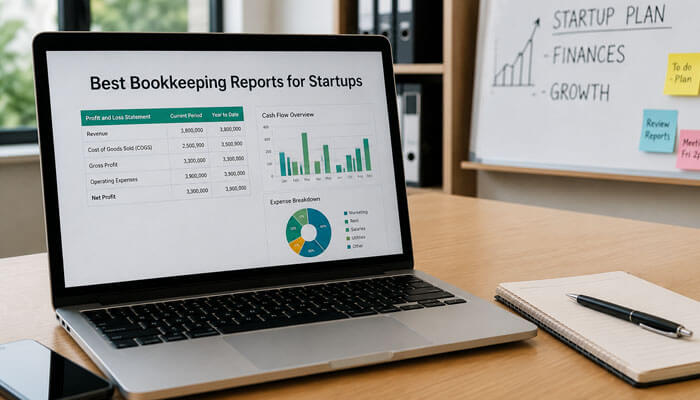
Bookkeeping for Startups becomes more valuable when founders review reports regularly. SCORE explains that profit and loss statements, balance sheets, and cash flow statements each tell a different part of a business’s financial story.
1. Profit and Loss Statement
A profit and loss statement shows revenue, expenses, and profit or loss over a specific period. It helps founders understand whether the business is moving toward profitability.
2. Balance Sheet
A balance sheet shows assets, liabilities, and equity. It helps founders understand the financial position of the business.
3. Cash Flow Statement
A cash flow statement shows how money moves in and out of the startup. The U.S. Chamber explains that a cash flow statement helps small businesses track financial health and see available funds.
4. Accounts Receivable Report
This report shows unpaid customer invoices. It helps founders follow up with late-paying customers and improve cash flow.
5. Accounts Payable Report
This report shows the bills the startup still needs to pay. It helps founders plan upcoming cash needs.
6. Burn Rate and Runway Report
This is especially important for funded startups.
| Metric | Formula | Why It Matters |
| Burn Rate | Monthly cash spent | Shows spending speed |
| Runway | Cash balance ÷ monthly burn | Shows how long cash will last |
Startup Financial KPIs to Track With Bookkeeping
Strong Bookkeeping for Startups helps founders track financial KPIs, not just expenses.
| KPI | Why It Matters |
| Monthly revenue | Shows sales growth |
| Gross margin | Shows profitability after direct costs |
| Burn rate | Shows how fast cash is spent |
| Runway | Shows how long cash will last |
| Accounts receivable | Shows unpaid customer invoices |
| Accounts payable | Shows upcoming bills |
| Customer acquisition cost | Shows marketing efficiency |
| Lifetime value | Shows customer profitability |
| Payroll percentage | Shows labor cost pressure |
| Net profit margin | Shows overall financial health |
These KPIs help founders make better decisions about hiring, pricing, fundraising, and spending.
Monthly Bookkeeping Checklist for Startups
| Task | Frequency |
| Record all transactions | Weekly |
| Upload receipts | Weekly |
| Send invoices | Weekly or monthly |
| Follow up on unpaid invoices | Weekly |
| Reconcile bank accounts | Monthly |
| Review profit and loss | Monthly |
| Review cash flow | Monthly |
| Track burn rate | Monthly |
| Set aside tax money | Monthly |
| Backup records | Monthly |
| Review financial goals | Monthly |
| Review payroll records | Monthly |
| Check subscription expenses | Monthly |
Bookkeeping Software for Startups
Bookkeeping software can save time and reduce manual errors. Common features include bank feeds, invoicing, expense tracking, receipt uploads, payroll integration, and financial reporting.
Features to Look For
- Easy bank account connection
- Invoice creation
- Expense categorization
- Receipt scanning
- Payroll support
- Tax reporting
- Multi-user access
- Integration with payment tools
- Cash flow dashboard
- Investor-friendly reports
- Secure data backup
- Mobile access
- Contractor payment tracking
Popular Types of Tools
| Tool Type | Use |
| Accounting software | Records transactions and reports |
| Receipt apps | Stores proof of expenses |
| Payroll software | Manages salaries and payroll taxes |
| Payment processors | Tracks customer payments |
| Budgeting tools | Forecasts spending and cash flow |
| Inventory tools | Tracks products, stock, and cost of goods |
| Expense tools | Tracks team spending and reimbursements |
Startups should choose software based on business stage, complexity, budget, reporting needs, payroll requirements, and investor expectations.
Tax Preparation and Compliance
Tax laws, accounting rules, payroll regulations, sales tax requirements, GST obligations, and startup compliance requirements may vary depending on country, state, or business structure. Founders should work with qualified accountants, tax advisors, or legal professionals for guidance specific to their situation.
Bookkeeping for Startups is closely connected to tax preparation. Clean books help founders identify taxable income, deductible expenses, payroll obligations, and supporting documents.
Startup tax records to keep include:
- Income records
- Expense receipts
- Payroll records
- Contractor payments
- Bank statements
- Credit card statements
- Loan agreements
- Asset purchase records
- Tax filings
- Business registration documents
- Vendor invoices
- Investor documents
Well-organized records also make it easier to work with accountants, tax advisors, lenders, and investors.
Sales Tax, GST, VAT, and Local Compliance
Another important part of Bookkeeping for Startups is tax compliance. Depending on the country, state, or region, startups may need to track sales tax, GST, VAT, service tax, or other local business taxes.
Startups should review whether they need to collect and report taxes on:
- Online product sales
- Digital products
- Subscription services
- Consulting services
- Marketplace transactions
- Cross-border sales
- E-commerce shipping locations
Tax rules vary by location, so founders should work with a qualified tax professional before selling in multiple states or countries.
Document Retention and Digital Records for Startups
Startups should not delete financial records too quickly. Important documents may be needed for tax filing, audits, loans, fundraising, or investor due diligence.
The IRS states that businesses should keep records as long as needed to prove income or deductions on a tax return, and record retention depends on the action, expense, or event recorded.
Keep records such as:
- Bank statements
- Credit card statements
- Receipts
- Invoices
- Payroll records
- Contractor forms
- Loan documents
- Investor agreements
- Tax returns
- Business registration documents
- Asset purchase records
Good digital recordkeeping also improves organization, protects financial data, and makes monthly bookkeeping easier.
Common Bookkeeping Mistakes Startups Should Avoid
- Mixing personal and business finances
- Ignoring cash flow tracking
- Not recording expenses properly
- Delaying bookkeeping updates
- Failing to reconcile bank accounts
- Misclassifying expenses
- Missing tax deadlines
- Not reviewing financial reports
- Choosing the wrong accounting method
- Trying to manage bookkeeping without professional help
Avoiding these mistakes helps startups maintain accurate financial records, improve cash flow management, and support long-term business growth.
Internal Controls for Startup Bookkeeping
Internal controls are simple rules that protect startup money and reduce financial mistakes. Even small startups need basic controls.
Good internal controls include:
- Separating personal and business expenses
- Requiring receipts for business purchases
- Limiting who can approve payments
- Reviewing bank statements monthly
- Using secure accounting software
- Backing up financial records
- Avoiding shared passwords
- Checking vendor invoices before payment
- Reviewing payroll before processing
- Using two-step verification for finance tools
Internal controls make Bookkeeping for Startups more reliable and reduce the risk of errors, duplicate payments, and unauthorized spending.
How Much Does Bookkeeping Cost for Startups?
The cost of bookkeeping for startups depends on transaction volume, business complexity, payroll, inventory, funding activity, and reporting needs.
| Startup Stage | Bookkeeping Need |
| Idea stage | Basic expense tracking |
| Pre-revenue stage | Founder contributions, legal costs, startup expenses |
| Early revenue stage | Invoicing, bank reconciliation, tax records |
| Growing startup | Payroll, monthly reports, cash flow forecasting |
| Funded startup | Investor reports, accrual accounting, compliance support |
A founder may start with simple bookkeeping software, but as the startup grows, professional bookkeeping becomes more valuable.
DIY vs Outsourced Bookkeeping for Startups
| Option | Best For | Pros | Cons |
| DIY bookkeeping | Very early startups | Low cost, founder control | Time-consuming, higher risk of errors |
| Outsourced bookkeeper | Growing startups | Saves time, cleaner records | Monthly cost |
| In-house bookkeeper | Scaling startups | More control, faster reporting | Higher payroll cost |
| Accountant or CPA | Tax planning and financial strategy | Expert advice | More expensive than basic bookkeeping |
DIY bookkeeping can work in the beginning, but founders should avoid doing everything alone once transactions, payroll, taxes, or investor reporting become more complex.
When Should a Startup Hire a Bookkeeper?
A founder can manage simple bookkeeping in the beginning. However, hiring a bookkeeper becomes useful when the startup grows.
Signs You Need a Bookkeeper
- Transactions are increasing
- You are missing receipts
- You are unsure about tax categories
- Bank reconciliation is delayed
- Payroll becomes complex
- You are preparing for fundraising
- You need accurate monthly reports
- You are spending too much time on bookkeeping
- You are expanding into new markets
- You need investor-ready financial statements
A bookkeeper helps organize records, while an accountant can help with tax planning, financial strategy, compliance, and financial forecasting.
Bookkeeping for Startups and Investor Readiness
Investors want to see clean, accurate, and reliable financial records. Poor bookkeeping can make a startup look risky, even if the business idea is strong.
Investor-ready bookkeeping should include:
- Monthly financial statements
- Revenue breakdown
- Expense reports
- Cash flow statement
- Burn rate
- Runway
- Payroll records
- Customer payment data
- Debt and liability records
- Tax compliance documents
- Cap table-related financial records
- Founder contributions
- Investor funding records
Clean books help founders answer investor questions with confidence and reduce delays during due diligence.
Best Practices for Bookkeeping for Startups
- Start bookkeeping from day one
- Separate business and personal finances
- Use accounting software early
- Track every transaction
- Keep receipts digitally
- Reconcile accounts monthly
- Review cash flow weekly
- Monitor burn rate and runway
- Set aside money for taxes
- Hire professional help before major financial decisions
- Create a monthly bookkeeping routine
- Review financial reports before planning growth
- Track payroll and contractors carefully
- Organize digital records securely
- Review recurring subscriptions often
- Prepare reports before fundraising
Year-End Bookkeeping Checklist for Startups
At the end of the year, startups should review their books before tax filing and financial planning.
Year-end checklist:
- Reconcile all bank accounts
- Reconcile credit cards
- Review unpaid invoices
- Review unpaid vendor bills
- Organize receipts
- Confirm payroll records
- Review contractor payments
- Check loan balances
- Review asset purchases
- Categorize all expenses
- Review tax deductions
- Prepare financial statements
- Meet with an accountant or tax advisor
- Review sales tax, GST, or VAT obligations
- Back up all financial records
This section is useful because many founders search for bookkeeping help near tax season.
Bookkeeping for Startups: Quick Summary Table
| Area | Startup Action |
| Bank account | Open a dedicated business account |
| Accounting method | Choose cash or accrual accounting |
| Records | Keep receipts, invoices, statements, and contracts |
| Reports | Review profit and loss, balance sheet, and cash flow |
| Cash flow | Track burn rate, runway, invoices, and bills |
| Taxes | Organize deductions and tax records |
| Software | Use tools that match startup stage |
| Payroll | Track salaries, contractors, taxes, and reimbursements |
| Compliance | Review sales tax, GST, VAT, and local rules |
| KPIs | Monitor revenue, margin, burn rate, and runway |
| Professional help | Hire a bookkeeper or accountant as complexity grows |
Why Founders Often Ignore Bookkeeping Too Long
Many startup founders focus heavily on product development, growth, marketing, fundraising, and hiring during the early stages of building a company. Because of this, bookkeeping is often delayed until tax season, cash flow pressure, or investor due diligence creates urgent financial problems.
The challenge is that messy financial records become much harder to fix later. A simple bookkeeping system created early can save founders significant time, stress, and cleanup costs as the startup grows.
Conclusion
Bookkeeping for Startups FAQs
1. What is Bookkeeping for Startups?
Bookkeeping for Startups is the process of tracking and organizing a startup’s financial transactions, including income, expenses, invoices, payroll, taxes, and cash flow.
2. Why is Bookkeeping for Startups important?
Bookkeeping for Startups helps founders manage cash flow, prepare taxes, monitor business performance, avoid financial mistakes, and build investor confidence with accurate financial records.
3. When should a startup begin bookkeeping for Startups?
A startup should begin Bookkeeping for Startups from day one, even before generating revenue, to properly track setup costs, founder investments, and business expenses.
4. What are the most important reports in Bookkeeping for Startups?
The most important Bookkeeping for Startups reports include profit and loss statements, balance sheets, cash flow statements, and burn rate reports.
5. What are the common Bookkeeping for Startups mistakes?
Common Bookkeeping for Startups mistakes include mixing personal and business finances, ignoring cash flow, delaying bookkeeping updates, and failing to reconcile bank accounts regularly.
