


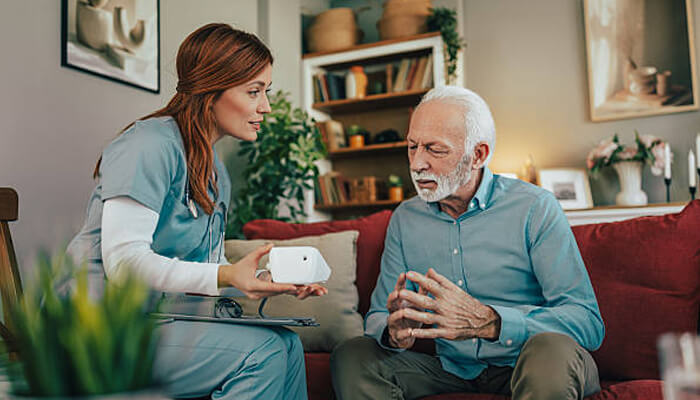

Treating patients in comfortable and familiar surroundings, as opposed to a clinical environment, can lead to better recovery rates. This is especially true with a range of medical conditions, where In-Home Support offers a more personalized and supportive environment. The comforts of home can indeed be the best medicine, promoting faster and more effective recovery.
Stress is a Disease Trigger, and Hospitals Aren’t Neutral Environments
Patients suffering from conditions like heart failure or COPD deteriorate at a quicker pace when they are in and out of healthcare settings. Unfamiliar settings increase cortisol levels, which in turn increases inflammation, the driver of flare-ups in almost every chronic disease. None of that load is present in one’s own home. Home is a familiar environment, routine, and faces, not soft issues, but physiological inputs that keep a condition stable. This is why aging in place, which is the preference almost all old people express, is the biggest factor in their favor, not just a ‘nice to have’. This also explains the shift in the policy lingo around home care services, it is no longer about where the patient is the most comfortable, it is about where their body does not spiral.
Micro-Changes Get Caught at Home, Not in Clinics
A doctor’s visit lasts minutes, every few weeks or months. A caregiver’s visit is daily. Early warning is the difference in time you’re exposed.
Caregivers with training in chronic disease support learn what normal looks like for that specific patient, her energy level if she’s in a good mood, her appetite patterns, how she walks when she gets out of bed. When something shifts, they notice. A slightly different walking pattern that might indicate a side effect of medication. Less appetite that might point to a depressive episode, or a developing infection. These things are caught before the condition escalates to an emergency.
This is what continuity of care actually means. It’s not a buzzword that emphasizes keeping records. It means that there’s someone in the room who knows when something is wrong.
Diet and Medication Adherence Don’t Manage Themselves
Two of the most common reasons chronic conditions worsen at home without support are poor medication adherence and non-compliance with prescribed diets. Both are entirely predictable and largely preventable.
For someone managing hypertension, a low-sodium diet isn’t optional, but self-monitoring it while dealing with fatigue, mobility issues, and cognitive changes is genuinely hard. Personalized meal preparation through in-home care makes diet compliance concrete and consistent, not aspirational. The same applies to medication schedules for conditions like diabetes or heart disease, where timing and dosage errors can have serious downstream consequences.
Families who work with professional home health care providers in PA often note that structured daily routines around meals and medications produce measurable stabilization in their clients’ conditions within the first few weeks of regular support.
When remote patient monitoring technology is added to this picture, wearables and connected devices tracking vitals between visits – the oversight becomes more complete without requiring the patient to leave their environment.
The Economics Work in Home Care’s Favor

Investing in home care as a preventative measure ultimately saves on far costlier types of care later on. Home-based primary care programs for elderly patients have been shown to reduce hospital admissions by 25% and emergency department visits by 19% (American Journal of Managed Care). These are not marginal percentages.
The emergency room visit for a preventable flare-up of symptoms costs exponentially more than consistent in-home support. A long-term facility stay costs even more than that. When you put home care as an expense up against the alternative, the math almost always checks out.
The cost of caregiver burnout is often overlooked. If the family is forced to take on the full burden of chronic disease management for their loved one without any professional support, they will become ill themselves. Now you have created a second patient when trying to cut costs in the care of the first one.
Autonomy Isn’t a Luxury – It’s a Treatment Variable
Elderly patients who feel in control of their daily environment show higher engagement with their own treatment plans. That’s not anecdotal. When someone can choose when they eat, decide what they watch, have visitors on their own terms, and sleep in their own bed, they approach their care with a fundamentally different orientation.
This is person-centered care in its most literal form, not a clinical protocol applied uniformly, but a support structure built around what that specific person needs, values, and responds to. The psychological boost of that autonomy produces real outcomes. Patients who are engaged in their own recovery tend to take their medications, attend their appointments, and communicate symptoms accurately.
Social isolation is a direct health risk for elderly patients managing chronic conditions. In-home support addresses that risk as a built-in feature, not as an add-on.
The strongest case for home care isn’t that it’s gentler or more humane, though it often is. It’s that for long-term chronic disease management, it’s where the outcomes are. Healthcare systems are under pressure, hospital beds are finite, and the population of patients with complex, long-term conditions keeps growing. The home is where that gap gets closed.
