



Droven.io Cloud Computing Guide: Complete Beginner-to-Advanced Guide for 2026
Cloud computing is no longer just a technical upgrade—it is a strategic advantage that determines how fast businesses grow, scale, and compete in a digital-first world. Most cloud articles explain basic concepts, but very few show how real-world decisions in architecture, security, and cost management directly impact business outcomes. That is where the Droven.io Cloud Computing Guide stands apart by focusing on both clarity and practical application.
The Droven.io Cloud Computing Guide is designed to go beyond definitions and help readers understand how cloud technologies actually work in modern environments. From choosing the right service models to building secure, scalable, and cost-efficient systems, this guide provides the insights needed to make smarter cloud decisions in 2026 and beyond.
The Droven.io cloud computing guide is a modern educational guide to cloud fundamentals, service models, deployment models, migration, cloud-native architecture, serverless computing, multicloud strategy, security, compliance, FinOps, sustainability, and career growth. In 2026, a useful cloud guide should also cover zero trust, API protection, data residency, and practical workload decision-making.
Quick Answer: What Is the Droven.io Cloud Computing Guide?
The Droven.io Cloud Computing Guide is a beginner-to-advanced cloud resource that explains how cloud computing works and how businesses can use it in 2026. It covers practical cloud decisions such as choosing service models, comparing providers, planning migration, improving security, managing costs, and building cloud-ready skills.
How We Researched the Droven.io Cloud Computing Guide
To create this Droven.io Cloud Computing Guide, we reviewed cloud computing fundamentals, service models, deployment models, cloud provider differences, security practices, cost optimization methods, migration challenges, and cloud-native technologies. We also considered current 2026 cloud priorities such as zero trust, API protection, FinOps, data residency, sustainability, multicloud complexity, and job-ready cloud skills.
For foundational accuracy, cloud computing is commonly explained using characteristics such as on-demand self-service, broad network access, resource pooling, rapid elasticity, and measured service, as defined by NIST.
What Is Cloud Computing?
Cloud computing is the delivery of computing services such as servers, storage, networking, databases, platforms, and software over the internet instead of relying only on local infrastructure.
This model is valuable because it allows businesses to launch faster, scale more easily, and use technology resources more efficiently. In simple terms, cloud computing helps organizations move from rigid infrastructure to flexible, service-based computing.
That matters in the Droven.io cloud computing guide because cloud is not just about storing files online. It is a broader system for building, running, protecting, and scaling digital services.
Core Characteristics of Cloud Computing
Cloud computing is different from traditional hosting because it gives users flexible access to computing resources without requiring them to own or manage all physical infrastructure.
The main characteristics include:
- On-demand self-service: Users can access computing resources when needed.
- Broad network access: Services are available through the internet or private networks.
- Resource pooling: Providers share infrastructure securely across many customers.
- Rapid elasticity: Resources can scale up or down based on demand.
- Measured service: Usage is tracked, measured, and billed based on consumption.
These characteristics explain why cloud computing is flexible, scalable, and cost-aware compared with traditional infrastructure.
Why the Droven.io Cloud Computing Guide Matters in 2026
Cloud computing is no longer only about moving servers off-premises. Today it is closely connected to AI infrastructure, cloud-native applications, cybersecurity strategy, data governance, cost accountability, and business resilience.
That is why the Droven.io cloud computing guide matters more now than a generic introduction. Modern readers want to know not only what cloud is, but how to choose the right architecture, control costs, secure systems, and avoid expensive mistakes.
This guide is especially useful for:
- Beginners entering tech
- Startups launching products quickly
- Enterprises modernizing legacy systems
- Professionals building job-ready cloud skills
Cloud has also become more complex. Organizations now need to think about hybrid environments, multicloud strategy, serverless development, zero trust, API security, sustainability, governance, and operational consistency. That makes a detailed and well-structured article much more useful than a basic post.
Pros and Cons of Cloud Computing
Cloud computing offers major advantages, but it also comes with challenges that businesses should understand before adopting it.
| Pros | Cons |
|---|---|
| Faster deployment | Cost can grow without monitoring |
| Easy scalability | Vendor lock-in risk |
| Access to managed services | Requires security discipline |
| Better flexibility | Multicloud can increase complexity |
| Supports remote teams | Compliance needs careful planning |
| Useful for AI and modern apps | Skills gaps can slow adoption |
The Droven.io Cloud Computing Guide helps readers understand both sides so they can make better cloud decisions instead of treating cloud as a one-size-fits-all solution.
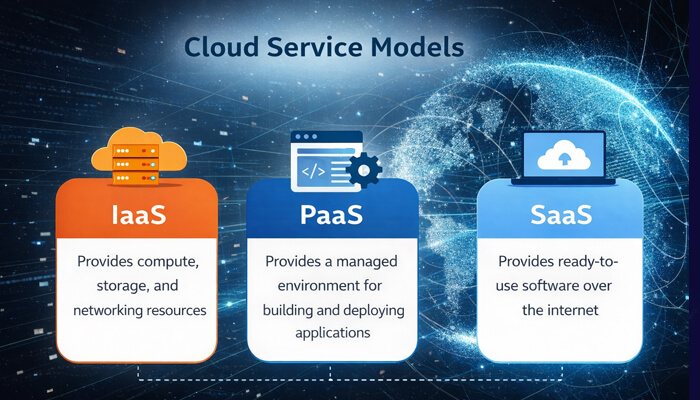
Cloud Service Models
Cloud service models explain how cloud services are delivered and how much responsibility remains with the user.
- IaaS (Infrastructure as a Service): Provides compute, storage, and networking resources
- PaaS (Platform as a Service): Provides a managed environment for building and deploying applications
- SaaS (Software as a Service): Provides ready-to-use software over the internet
These models matter because they help users understand the balance between control and convenience. Some businesses need flexibility and customization, while others prefer simplicity and speed.
IaaS vs PaaS vs SaaS
| Model | What You Manage | Best For |
| IaaS | OS, apps, data, runtime, much of configuration | Maximum flexibility and custom infrastructure |
| PaaS | Apps and data, while provider manages platform layers | Faster development and deployment |
| SaaS | Mostly user-level configuration and usage | Ready-to-use business software |
This comparison makes service-model differences easier to understand. It also helps readers see why cloud choices depend on workload needs, team capability, and operational goals.
Deployment Models
Deployment models explain where cloud resources run and how they are managed.
- Public cloud: Shared infrastructure managed by a cloud provider
- Private cloud: Dedicated environment with greater control
- Hybrid cloud: Combination of on-premises and cloud infrastructure
- Multicloud: Use of multiple cloud providers for flexibility or strategic reasons
These models are important because businesses rarely have identical requirements. Some prioritize speed and managed services, while others need stricter control, regional flexibility, or integration with legacy systems.
Public vs Private vs Hybrid vs Multicloud
| Model | Best Use Case | Main Challenge |
| Public Cloud | Fast scaling and broad managed services | Governance and cost control |
| Private Cloud | Greater dedicated control | Higher management burden |
| Hybrid Cloud | Legacy integration and regulated workloads | Consistent operations across environments |
| Multicloud | Flexibility and strategic diversification | Interoperability and operational complexity |
This comparison helps readers connect cloud deployment models with real-world business decisions.
AWS vs Azure vs Google Cloud (GCP)
Choosing the right cloud provider is one of the most important decisions in any cloud strategy. While all major providers offer similar core services, they differ in ecosystem strength, pricing models, integrations, and ideal use cases.
For example, startups often choose AWS for flexibility, enterprises prefer Azure because of Microsoft integration, while AI-focused companies frequently use Google Cloud for analytics and machine learning workloads.
The Droven.io Cloud Computing Guide explains that there is no single “best” cloud provider—only the provider that best fits business needs, technical goals, and long-term strategy.
Cloud Vendor Lock-In
Vendor lock-in happens when a business becomes heavily dependent on one cloud provider’s services, tools, APIs, or architecture patterns. This can make future migration difficult, expensive, or slow.
Common causes of cloud vendor lock-in include:
- Provider-specific databases
- Proprietary serverless tools
- Custom AI/ML services
- Managed analytics platforms
- Provider-specific identity and networking setups
Vendor lock-in is not always bad. Managed services can save time, reduce operational burden, and help teams launch faster. The real goal is not to avoid every provider-specific tool, but to understand the trade-off before choosing it.
AWS vs Azure vs GCP Comparison
| Provider | Best For | Strength | Challenge |
|---|---|---|---|
| AWS (Amazon Web Services) | Startups, enterprises, global scale apps | Largest service ecosystem, mature platform, global infrastructure | Complex pricing and steep learning curve |
| Microsoft Azure | Enterprises, Microsoft-based environments | Strong integration with Windows, Active Directory, and enterprise tools | Interface complexity and occasional service inconsistencies |
| Google Cloud (GCP) | Data, AI/ML, analytics workloads | Powerful data tools (BigQuery), AI/ML capabilities, clean interface | Smaller ecosystem compared to AWS |
When to Choose Each Cloud Provider
- Choose AWS when you need maximum flexibility, global reach, and a wide range of services.
- Choose Azure if your organization relies on Microsoft tools and enterprise systems.
- Choose GCP for data-heavy applications, analytics, and AI-driven workloads.
Key Insight for 2026
In modern cloud strategies, many organizations are moving toward multicloud approaches, combining AWS, Azure, and GCP to avoid vendor lock-in and optimize performance.
However, the Droven.io cloud computing guide emphasizes that multicloud should be used carefully. While it offers flexibility, it also increases complexity in areas like security, cost management, and operations.
Multicloud and Hybrid Strategy
Hybrid and multicloud decisions are often driven by flexibility, compliance, operational resilience, and workload placement needs. These strategies can be useful, but they also bring trade-offs.
Multicloud is not automatically better. It can improve flexibility and reduce vendor dependency, but it also increases complexity in identity management, governance, observability, cost control, security, and interoperability.
That means businesses should choose hybrid or multicloud only when the real business need clearly justifies the extra complexity.
Serverless Computing
One of the biggest gaps in many beginner cloud articles is serverless computing. Serverless allows developers to run code and workflows without directly managing server infrastructure.
Serverless is often useful for:
- API backends
- Event-driven applications
- Background processing
- Lightweight automation
- Short-lived or unpredictable workloads
It can reduce operational overhead and improve scaling efficiency for the right workloads. However, serverless is not always the best choice for every system. It can introduce cold starts, vendor dependency, observability challenges, and architectural complexity at scale.
The Droven.io Cloud Computing Guide explains serverless as a real architecture choice, not just a trend.
Virtual Machines vs Containers vs Serverless
| Model | Strength | Trade-Off |
| Virtual Machines | Strong control and legacy compatibility | Higher operational overhead |
| Containers | Portability and efficient app packaging | Requires orchestration and platform maturity |
| Serverless | Minimal infrastructure management and elastic event-driven scale | Can add vendor-specific complexity and observability challenges |
This comparison helps readers choose the right compute model based on control, portability, scalability, and operational complexity.
Cloud-Native Architecture and Kubernetes
Cloud-native architecture goes beyond simply hosting software in the cloud. It usually involves containers, orchestration, service discovery, observability, declarative infrastructure, automation, and resilient service design.
Kubernetes plays a major role in this model because it helps manage containerized applications across environments. It supports scaling, deployment consistency, and orchestration for modern distributed systems.
For readers of the Droven.io cloud computing guide, this means cloud learning should go beyond virtual machines and storage accounts. If the goal is long-term relevance, readers should understand when to use containers, how orchestration supports scalable services, and why platform engineering and cloud-native security matter for production systems.
Cloud Shared Responsibility Model
One of the most important cloud security concepts is the shared responsibility model. Cloud providers secure the underlying infrastructure, but customers are still responsible for how they configure, access, and protect their own workloads.
In simple terms:
| Area | Cloud Provider Usually Manages | Customer Usually Manages |
|---|---|---|
| Physical data centers | Yes | No |
| Core cloud infrastructure | Yes | No |
| Identity permissions | Limited | Yes |
| Application security | No | Yes |
| Data protection | Shared | Yes |
| Configuration settings | No | Yes |
This matters because many cloud security problems happen when users assume the provider handles everything. A safer cloud strategy requires strong IAM, encryption, monitoring, backup testing, and secure configuration.
Security in the Droven.io Cloud Computing Guide
Security is one of the most important parts of any cloud guide. Moving to the cloud does not automatically make systems secure. Organizations still need to manage permissions, configurations, visibility, and data protection carefully.
Important security areas include:
- Identity and access management
- Encryption
- Secrets management
- Monitoring and logging
- Configuration control
- Data protection
Many cloud security problems come from weak setup and poor operational discipline rather than the provider itself. Misconfigurations, exposed services, excessive permissions, and weak monitoring remain common causes of cloud risk.
Zero Trust Security
Zero trust is a cybersecurity approach that assumes no user, device, or workload should be trusted automatically. Every access request should be verified, limited, and continuously evaluated.
This matters in cloud environments because systems often span users, devices, APIs, regions, and hybrid or multicloud setups. Traditional perimeter-based thinking is no longer enough for modern distributed infrastructure.
Adding zero trust makes the Droven.io cloud computing guide more current and more practical. It shows readers that cloud security is no longer just about firewalls. It is about identity, policy, access control, and continuous verification.
API Protection for Cloud-Native Systems
Modern cloud applications rely heavily on APIs. As cloud-native systems grow, APIs become a major part of both functionality and risk.
API protection helps secure the connections between applications, users, services, and cloud-native systems.
- Authentication and authorization
- Rate limiting
- Secure secrets handling
- Monitoring and logging
- Encryption in transit
- Input validation
- Abuse detection
This is important because many real-world breaches and service disruptions happen through poorly protected APIs rather than traditional infrastructure failure.
Disaster Recovery and Business Continuity
Cloud strategy is not complete without disaster recovery and business continuity planning. Many organizations move to the cloud expecting resilience, but resilience only works when systems are designed, tested, and monitored properly.
Important areas include:
- Backup planning
- Recovery testing
- Regional redundancy
- Incident response
- Failover design
- Operational visibility
This section strengthens the Droven.io cloud computing guide because it shows that cloud success is not only about deployment. It is also about recovery when things go wrong.
Cloud Observability and Monitoring
Cloud systems need strong observability because modern applications often run across containers, APIs, databases, serverless functions, and multiple regions.
Important observability areas include:
- Metrics
- Logs
- Traces
- Alerts
- Uptime monitoring
- Error tracking
- Performance dashboards
- Security event monitoring
Monitoring tells teams when something is wrong. Observability helps teams understand why it happened. This is important for troubleshooting, performance improvement, incident response, and customer experience.
Compliance and Data Residency
Compliance has become a major cloud concern, especially for regulated industries and global businesses. Data residency, governance, retention, privacy, and access controls can directly affect architecture decisions.
That means the Droven.io cloud computing guide should not present cloud as one universal model for every organization. Workload design often depends on legal, regulatory, and regional requirements.
This is one reason hybrid cloud and carefully selected deployment strategies remain important in 2026.
FinOps and Cloud Cost Optimization
Cost optimization is one of the highest-value sections for both readers and search intent. Many organizations wrongly assume the cloud is cheaper by default. In reality, the cloud only becomes efficient when it is managed properly.
FinOps helps organizations improve cloud economics through:
- Rightsizing workloads
- Removing idle resources
- Improving cost visibility
- Tracking usage patterns
- Aligning engineering and finance decisions
- Connecting spend to business value
This topic is important because flexibility only becomes valuable when it is managed properly. The Droven.io Cloud Computing Guide explains that cloud cost control requires continuous monitoring, rightsizing, tagging, and optimization—not a one-time setup.
Cloud Governance and Tagging
Cloud governance helps organizations control how cloud resources are created, secured, monitored, and paid for. Without governance, cloud environments can become expensive, disorganized, and risky.
Important cloud governance practices include:
- Naming standards
- Resource tagging
- Budget alerts
- Access policies
- Security guardrails
- Logging requirements
- Approval workflows
- Environment separation for development, testing, and production
Tagging is especially important for FinOps because it helps teams understand which department, product, project, or customer is creating cloud costs.
Sustainability and Efficient Cloud Design
Sustainability has become an important part of modern cloud strategy. Efficient cloud design helps reduce waste, improve performance, and lower both financial and environmental costs.
Examples of sustainable cloud practices include:
- Rightsizing compute resources
- Using lifecycle management for storage
- Reducing duplicated data
- Avoiding overprovisioned infrastructure
- Improving software efficiency
This topic gives the article a more future-focused perspective. It also shows that better cloud design can support both cost efficiency and responsible resource use.
How to Choose the Right Cloud Architecture
Choosing the right cloud architecture depends on workload type, compliance needs, business goals, and team capability. There is no single best model for every organization.
A practical decision framework looks like this:
- Choose virtual machines when you need legacy compatibility or deeper control
- Choose containers when you need portability and orchestrated microservices
- Choose serverless when you want event-driven scale with less infrastructure management
- Choose hybrid cloud when compliance, latency, or legacy integration makes full migration unrealistic
- Choose multicloud only when the business case clearly outweighs the operational complexity
This kind of guidance makes the Droven.io cloud computing guide more useful because readers often want help making decisions, not just learning definitions.
Real-World Use Cases of the Droven.io Cloud Computing Guide
The Droven.io Cloud Computing Guide connects cloud concepts to real business scenarios such as product launches, backup planning, remote work, AI workloads, compliance needs, and scaling customer-facing applications.
Common use cases include:
- Startups launching apps without buying physical servers
- Enterprises using cloud for backup and disaster recovery
- SaaS companies scaling APIs and customer-facing services
- AI teams running training and inference workloads
- Businesses supporting remote teams and distributed operations
- Organizations managing compliance across regions
For readers, real-world examples make the guide more believable. Cloud matters during traffic spikes, remote work, regional failovers, compliance audits, product launches, and migration programs. Without concrete use cases, cloud articles feel theoretical. With them, the Droven.io cloud computing guide becomes more actionable and trustworthy.
Cloud Migration Roadmap
A successful cloud migration should follow a clear roadmap instead of moving workloads randomly.
A practical migration process includes:
1. Assess current systems: Review applications, data, dependencies, costs, and security needs.
2. Classify workloads: Decide which systems should move first, stay on-premises, or be redesigned.
3. Choose a migration approach: Use rehost, replatform, refactor, replace, retire, or retain.
4. Build a secure landing zone: Set up accounts, IAM, networking, logging, policies, and tagging.
5. Run a pilot migration: Start with a low-risk workload before moving critical systems.
6. Test performance and recovery: Validate speed, security, backup, and failover.
7. Optimize after migration: Improve cost, scalability, monitoring, and architecture over time.
This roadmap gives readers a clear cloud adoption path before they review common migration mistakes.
Common Migration Mistakes and Practical Troubleshooting
A cloud migration section should not only explain the process. It should also show what can go wrong. This improves credibility and gives readers more practical value.
Common migration mistakes include:
- Moving workloads without cost forecasting
- Lifting and shifting legacy systems without redesigning them for cloud realities
- Weak IAM planning
- Poor tagging strategy
- Low observability after migration
- Treating backup as a checkbox instead of a tested recovery program
These are the kinds of practical warnings that make the Droven.io cloud computing guide more useful for both beginners and businesses. Successful cloud adoption depends not only on moving systems, but on planning architecture, security, monitoring, and cost management carefully.
Benefits of the Droven.io Cloud Computing Guide
The value of the Droven.io cloud computing guide is that it gives readers a framework for understanding:
- Scalability
- Flexibility
- Managed services
- Faster deployment
- Better resilience options
- Modern software delivery
- Security responsibilities
- Cost accountability
- Governance and sustainability
It also helps readers think more strategically. Instead of seeing cloud as a vague trend, they start seeing it as a set of design choices involving service models, workload placement, security posture, recovery planning, compliance, and long-term efficiency.
Career Paths, Skills, and Certifications
Cloud computing is also a major career path. Readers using the Droven.io cloud computing guide for professional growth should focus on both foundational and advanced skills.
Important cloud skills include:
- Cloud fundamentals
- Networking
- IAM
- Storage
- Containers
- Kubernetes
- Security
- FinOps
- Observability
- Cloud-native development
These skills support roles such as:
- Cloud Engineer
- DevOps Engineer
- Platform Engineer
- Security Engineer
- Solutions Architect
Beginner-to-Advanced Cloud Learning Path
A practical cloud learning path helps beginners move step by step instead of learning random cloud topics.
| Level | What to Learn |
|---|---|
| Beginner | Cloud basics, IaaS, PaaS, SaaS, regions, storage, and networking |
| Intermediate | IAM, databases, monitoring, backup, migration, and cost control |
| Advanced | Kubernetes, DevOps, automation, security, FinOps, and observability |
| Professional | Solutions architecture, platform engineering, cloud governance, and compliance |
This roadmap makes the Droven.io Cloud Computing Guide more useful for students, beginners, and professionals who want to build job-ready cloud skills.
Droven.io cloud computing guide FAQs
1. Is the Droven.io cloud computing guide useful for small businesses?
Yes, the Droven.io cloud computing guide can help small businesses understand cost-effective cloud solutions, scalability, and secure digital growth.
2. Does the Droven.io cloud computing guide cover cloud vendor lock-in?
Yes, the Droven.io cloud computing guide can help readers understand vendor lock-in risks and how to plan for better flexibility.
3. Does the Droven.io cloud computing guide explain cloud budgeting basics?
Yes, the Droven.io cloud computing guide can help readers understand cloud budgeting, spending awareness, and cost planning basics.
4. Can the Droven.io cloud computing guide help readers compare cloud providers?
Yes, the Droven.io cloud computing guide can help readers compare cloud providers based on features, flexibility, and business needs.
5. Does the Droven.io cloud computing guide discuss cloud adoption challenges for teams?
Yes, the Droven.io cloud computing guide can help readers understand common team-level cloud adoption challenges such as skills gaps, planning, and change management.
Conclusion
The Droven.io Cloud Computing Guide gives readers a complete view of modern cloud computing in 2026. It explains how cloud services work, how businesses can choose the right architecture, how teams can secure and govern cloud systems, and how professionals can build job-ready cloud skills.
Cloud success is not only about moving workloads online. It requires smart planning, security discipline, cost control, compliance awareness, observability, and continuous optimization. For beginners, startups, enterprises, and cloud professionals, this guide provides a practical foundation for making better cloud decisions.
