


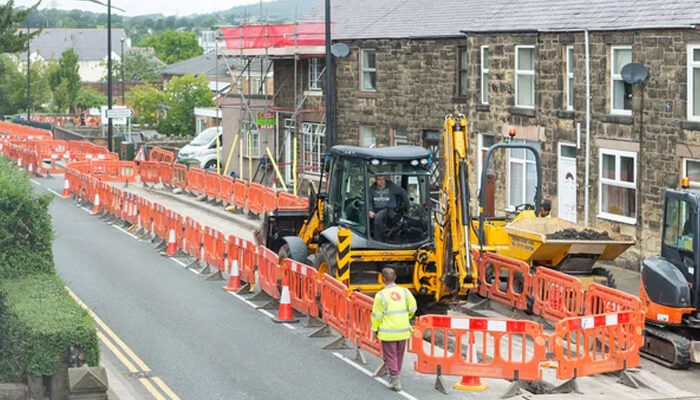

Safety planning involves following the rules, reducing uncertainty, organising the project, and keeping it on track from the start. Putting up temporary safety barriers helps with planning more than it does with safety. If you use them first, you won’t have to fix these problems later.
1. Clear Separation of Work Zones
If there aren’t any clear physical boundaries, workers, vehicles, and people walking can end up in potentially dangerous places by accident. Because of this, the level of risk is increased before the activity even starts.
By utilising temporary safety barriers, you are able to clearly define boundaries and communicate to everyone on the site what permissions are required to enter. The mere fact that visibility has been improved is sufficient evidence of an improved safety culture.
2. Predictable Traffic and Movement Flow
The lack of a clear movement makes safety financing harder to understand and more difficult to implement. Suddenly, cars move more slowly, people on foot are more cautious, and accidents are very close to happening. By using barriers, the flow of people and cars can be planned ahead of time.
Because of this, the movement is more predictable than what was originally planned. When all of this is put into action, it ensures that the movement will proceed according to schedule.
3. Stronger Safety Planning for Approvals
In the event that the system’s security isn’t made clear but is instead assumed, it is common to ask about the plans and then send them back to be changed. It can be hard and take a lot of work to get licences and certifications because of this.
Compliant systems, like a MASH barrier, demonstrate a thorough consideration of the project’s safety. Protection against impacts and separation, which is provided by the barrier, is already incorporated into the system.
4. Reduced On-Site Decision Pressure
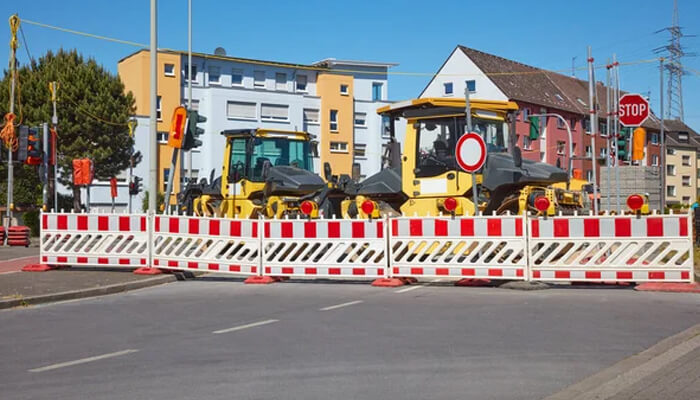
If early planned barriers are not present, the crews are compelled to make decisions regarding safety and necessity without any room for ambiguity. When making decisions of this nature, there is a greater possibility of making a mistake.
One of these kinds of mistakes is even more likely to happen when conditions change quickly and without warning from the outside world. For workers who are separated from others, the planned design of the barrier already includes possible violations, so they don’t have to come up with something new.
5. Better Coordination Between Contractors
It’s common for different teams, each with a different job, to work together and cause confusion in the same area. When there is no physical boundary, it is hard to tell who is responsible for what, and the right to access is called into question.
Because of this, the efficiency goes down, and alignment problems happen. Well-defined boundaries, like temporary safety barriers, show what areas can be used and which ones should be avoided at all costs.
6. Greater Flexibility When Plans Change
Weather, shipping delays, rescheduled work, or the need to change the scope of a project can all cause it to take longer than planned. When safety systems are slow and don’t have built-in flexibility, they don’t work well in these situations.
Temporary barriers facilitate staged and adjustable planning, allowing for relocation as work progresses, all while maintaining safety that aligns with actual conditions.
When Planning Becomes Prevention
Putting up temporary safety barriers is one way that the plans are working from the first day. This approach gives a framework and a reason for preparing the site, which makes the whole idea possible. Coordinating safety from the start lowers risks all the way through and lets projects move forward with few setbacks.
