


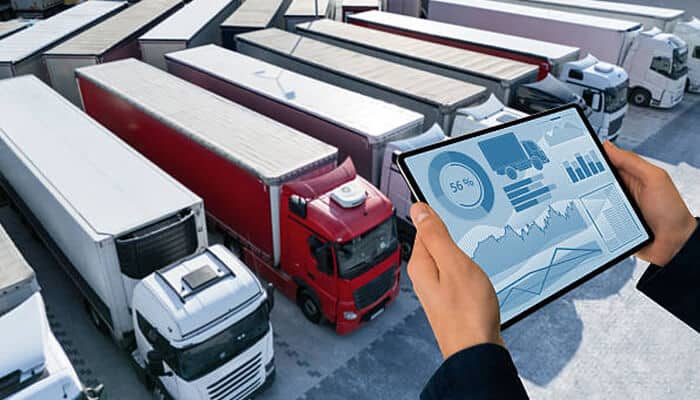

This disconnect increases in cost as operations increase. Managers are not able to know the cause and effect of results. Was it delayed because it was not planned correctly, there was ineffective routing, or there was an uneven workload? In the absence of operational data on the workforce, workforce judgment is responsive and even unjust. There is growing visibility as a result of technologies that are driving the management of people and vehicles alike.
Connecting People, Vehicles, and Workloads with Fleet Tracking
Mobile workforces and field-based workforces are also mobile in nature, making it challenging to oversee them. The supervisors are unable to physically monitor performance in dispersed locations, and updates are not always complete and timely in self-reported cases. This invisibility introduces discrepancies between the expectations and execution, especially in time-sensitive or service-level-oriented environments.
Oversight that is tracking-based fills this gap of connecting the workforce action with the movement of the vehicle. Managers obtain information when jobs begin and end, the length of jobs and the impact of travel time on productivity. Such a relationship permits workforce planning to rely on real operating conditions and not on untested assumptions to enhance efficiency and equity in the assignment of tasks.
How Fleet Tracking Data Improves Workforce Allocation
Fleet tracking can be effectively used to deliver viable intelligence that directly contributes to clever workforce decisions. Instead of depending on strict schedules or intuition, managers are able to bring people and work closer to the actual current situation:
- Balanced Job Distribution: It means that jobs may be distributed on the fly so that certain workers are not overworked and others are not underutilised.
- Precise Time Determination: On-site, travel time, and delays are objectively determined and enhance job cost and performance analysis.
- Less Downtime Idle Time: Visibility of the vehicle downtime identifies the possibility to streamline schedules and remove hours of waste.
- Quick Issue Raising: Delays or deviations will be detected in time, and therefore, the supervisors can step in to intervene before a small problem turns into a huge problem.
Such enhancements accumulate with time. The efficiency of the workforce is not ensured by pushing the workers, but by making the efforts more intelligent in connection with the reality of the operations.
Performance Management Without Micromanagement
One of the most prevalent arguments of tracking technologies is the idea of being stalked. Improperly adopted systems may degrade trust and morale when employees perceive that they are being followed around without meaning. Nevertheless, in case data is used openly and positively, it can backfire.
The objective metrics minimise ambiguity. The evaluation of employees is done through regular standards and not the impressions or incidents. In case of performance concerns, one can speak about certain and measurable elements like inefficiency in routes or impractical schedules. This transforms the performance management into problem-solving as opposed to blame, which is critical to maintaining workforce engagement.
Supporting Training, Safety, and Skill Development with Fleet Tracking
Workforce management is not merely productive management, but also capable development. Mapping data will identify trends in driving habits, knowledge of routes and management of time, which can create an indication of training requirements. The new employees may be encouraged, and experienced workers may enhance their practices.
There are also improved safety outcomes. This can be achieved by identifying risky behaviours at an early stage and coaching them instead of disciplinary actions in general. In the long run, a safety culture that runs on data makes incidents, absenteeism, and turnover smaller. These consequences have a direct effect on the stability of the workforce, which is unconditionally neglected in terms of the efficacy of the operations.
Adapting to Workforce Scalability and Change
With the expansion of any organisation, the complexity of the workforce grows at a higher rate than the increase in the number of employees. The increase in the number of vehicles, routes and employees poses coordination challenges that are exponential. Manual systems are not that easy to scale, so they may not provide consistent control and levels of performance.
Workforce insights that can be tracked grow automatically. New teams, regions, or service models can be incorporated into existing structures without the need to reinvent management processes. This flexibility comes in particularly where there are shortages of labour or changing demand in industries, and prompt adaptation is necessary to retain the levels of service.
Conclusion
Transforming information on movement and activity into useful intelligence, fleet tracking provides the opportunity to distribute the work fairly, evaluate performance in a more objective manner, and supervise it more efficiently.
The outcome is a more productive workforce, which is also better supported and resilient. This is a paradigm change in the manner in which organisations handle their people as efficiency and retention become more and more related.
