




Getting a truck stuck in deep mud can happen quickly. A tire slips into a rut, the ground gives way beneath the wheels, and suddenly forward movement disappears.
What happens next matters.
Poor recovery decisions can bury the truck deeper, damage drivetrain components, or create unnecessary hazards for everyone nearby. Understanding common truck mud recovery mistakes helps drivers approach a difficult situation with greater control.
Mistake 1: Continuing to Spin the Tires
One of the most common mistakes is continuing to accelerate after the truck has stopped moving.
Spinning tires can excavate the soft ground underneath them. Instead of creating forward momentum, the tires dig deeper holes and reduce the available clearance beneath the vehicle.
Once significant wheelspin begins, ease off the throttle.
Inspect the tires and surrounding terrain. If necessary, clear mud away from the drive wheels with a shovel and create a firmer path.
A few seconds of controlled assessment can prevent several minutes of unnecessary digging.
Mistake 2: Using Too Much Throttle
More engine power does not automatically mean more traction.
When tires are already struggling for grip, aggressive acceleration can cause them to spin rapidly. This can make the mud even more slippery and increase the depth of the ruts.
Use gradual throttle instead.
The objective is to transfer power to the ground without overwhelming the available grip. Depending on the vehicle and terrain, the appropriate four-wheel-drive mode or low-range gearing may also improve control.
If the truck does not respond to moderate throttle, increasing engine speed repeatedly is unlikely to solve the underlying problem.
Mistake 3: Ignoring How the Truck Is Stuck
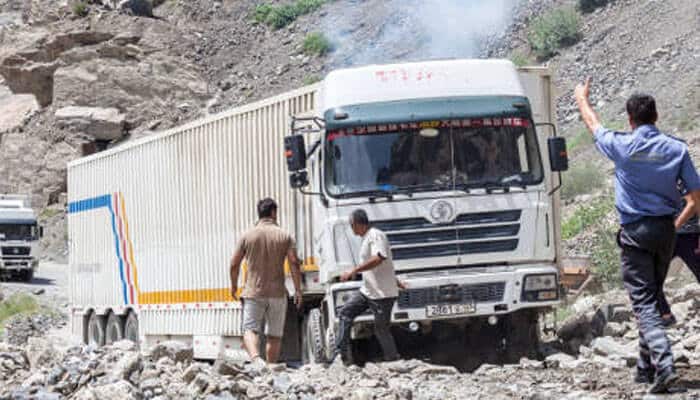
Not every stuck truck has the same problem.
A vehicle may be stuck because the drive tires are buried. Another may be resting on its chassis. A third may have one axle trapped in a deep rut.
Each situation requires a different recovery approach.
Inspect the vehicle before attaching recovery equipment. Look beneath the truck only when it can be done safely, and identify whether mud is supporting the chassis or restricting wheel movement.
If the truck is high-centered, adding more traction to the tires may accomplish very little. The vehicle may need to be lifted or pulled using appropriate recovery equipment.
Understanding the problem should come before applying force.
Mistake 4: Choosing the Wrong Recovery Equipment
Recovery equipment needs to match the vehicle and the situation.
A basic recovery kit may include a rated recovery strap, suitable attachment hardware, gloves, a shovel, and equipment designed to improve traction.
A dedicated truck recovery tool can be useful when conventional driving techniques are no longer enough. TruckClaws, for example, produces traction equipment intended to help vehicles regain movement when tires encounter soft or slippery terrain.
The equipment should be selected according to the truck’s weight, recovery points, and intended use.
Do not assume that any rope, chain, strap, or tow accessory is suitable for vehicle recovery. Equipment without an appropriate rating can fail under load.
Mistake 5: Attaching Recovery Gear to the Wrong Point
A recovery strap should never be attached to an arbitrary part of the truck.
Tow balls, suspension components, steering components, bumpers, and other unsuitable points can fail when subjected to heavy recovery forces.
Use designated recovery points specified by the vehicle manufacturer or appropriate recovery equipment documentation.
Before applying force, inspect the attachment point and make sure the connection is secure.
Following safe truck recovery methods is particularly important when the vehicle is deeply embedded in soft terrain. A poorly chosen attachment point can turn a simple recovery into expensive mechanical damage.
Mistake 6: Standing Too Close During Recovery
Recovery equipment can store substantial energy when placed under tension.
People should stay away from the direct line of a loaded strap or other recovery equipment. Do not stand beside attachment points, between vehicles, or near components that could move unexpectedly.
Passengers should generally leave the vehicle when it is safe to do so and remain well clear of the recovery operation.
The person operating the recovery vehicle should communicate clearly with the stuck-truck driver.
Small misunderstandings can produce abrupt movements. Clear signals and a slow recovery process reduce unnecessary risk.
Mistake 7: Repeating Failed Recovery Attempts
If the same recovery attempt fails repeatedly, continuing to do exactly the same thing rarely improves the outcome.
Repeated throttle applications can deepen ruts. Repeated pulling can place additional stress on recovery equipment and vehicle components.
Stop and reassess.
Ask what has changed since the previous attempt. Has the truck sunk farther? Are the tires still buried? Is the chassis resting on the ground? Is the recovery angle poor?
Sometimes repositioning the vehicle, removing mud, adding traction material, or changing the recovery method can make the difference.
Knowing when to stop is part of good recovery technique.
Avoiding Vehicle Damage During Mud Recovery
Mud recovery can place considerable stress on a truck.
Abrupt throttle inputs, sudden changes between forward and reverse, excessive wheelspin, and poorly executed pulls can affect the transmission, axles, differentials, suspension, steering components, and tires.
Keep recovery movements controlled.
Do not use violent jerking motions unless the recovery equipment and procedure are specifically designed for that purpose. Follow the instructions provided with the recovery equipment and vehicle.
After the truck is free, inspect the underbody and wheels. Look for damaged components, displaced mud around brakes or cooling areas, leaking fluids, and unusual tire damage.
A successful recovery is not simply getting the truck moving again. The vehicle should also remain mechanically sound afterward.
When to Stop and Seek Professional Recovery?
There is a point where additional DIY attempts become counterproductive.
Professional recovery is worth considering when the truck is deeply buried, high-centered, located in a hazardous position, or beyond the capability of the available equipment.
The same applies when recovery equipment is inadequate or the correct recovery points cannot be identified.
A professional operator has access to suitable equipment and experience with difficult recoveries.
Waiting for assistance may be frustrating, but it is often safer than damaging the vehicle or creating a hazardous recovery situation.
Final Tips for Safer Truck Mud Recovery
A few habits can make mud recovery considerably easier:
- Stop excessive wheelspin early.
- Inspect the truck before choosing a recovery method.
- Use equipment rated for the vehicle.
- Connect recovery gear only to appropriate recovery points.
- Keep bystanders away from loaded recovery equipment.
- Apply recovery force gradually.
- Avoid repeating unsuccessful attempts without changing the approach.
- Inspect the truck after recovery.
- Seek professional help when the situation exceeds the available equipment.
Conclusion
Truck mud recovery is rarely improved by brute force. Excessive throttle, unsuitable equipment, poor attachment points, and repeated failed attempts can transform a minor problem into serious vehicle damage.
The safest approach is deliberate: stop, inspect the situation, choose appropriate equipment, and recover the truck using controlled methods.
A well-prepared driver does not simply know how to get a truck unstuck. They also know when a particular recovery attempt is making the situation worse.
