


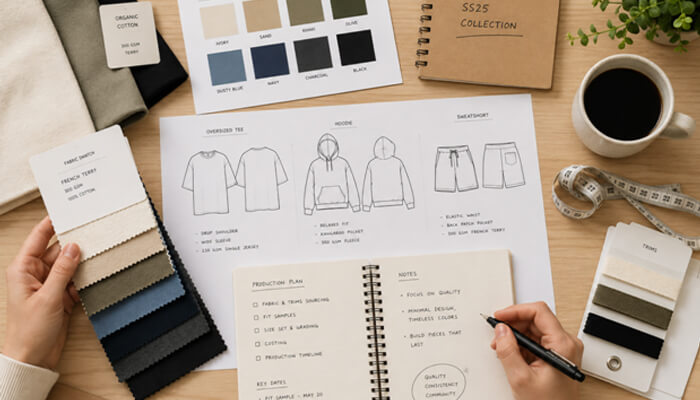

Most small clothing brands founders assume the hard part is the design. Get the aesthetic right, find a manufacturer, launch — that’s the mental model. But talk to anyone who has actually run a first production cycle, and a different story emerges: the money didn’t leak through bad designs. It leaked through decisions that seemed small at the time and turned expensive fast.
The following seven mistakes show up across brands of all sizes, and nearly all of them are preventable — not with more capital, but with a clearer decision-making framework before a single sample is cut.
1. Skipping a Proper Tech Pack
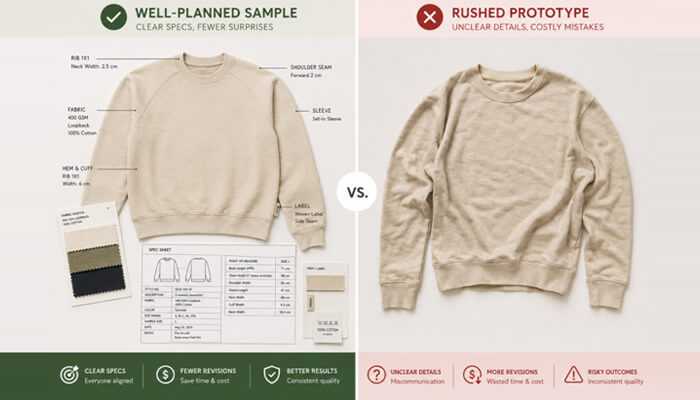
A tech pack is the manufacturing blueprint for a garment — a document that specifies every dimension, material, stitch type, trim, and finishing detail. Skipping it or submitting an incomplete version is one of the most consistent sources of wasted spend in clothing brand production.
What Happens When Factories Improvise for You
Without a complete spec, factories fill in the blanks themselves. That is not a criticism of manufacturers — it is simply what happens when they need to keep production moving. The problem is that their defaults are rarely yours. A missing seam allowance spec becomes their standard. An unspecified thread color becomes whatever is in stock. Multiply that across a full garment and you can end up with a product that technically meets no stated spec while failing to meet your actual intent.
The downstream cost is resampling. First-time styles often require multiple rounds before fit, construction, and finishing details are approved, and each additional round adds sampling fees, shipping time, and factory coordination before production has even begun.
For small brands operating with limited cash flow, even one incorrect sample round can delay launch schedules, tie up working capital, and reduce marketing budgets.
The Minimum a Spec Document Needs to Include
A functional tech pack does not need to be elaborate. It needs to cover: technical flat sketches with measurement points, a bill of materials listing every component by exact specification, a graded size chart, construction notes on seam type and stitch count, and trim details including labels, tags, and closures. That minimum is enough to eliminate most interpretive decisions by the factory.
2. Choosing Fabric Without Checking Supply Stability

Fabric selection is often treated as a creative decision. It is equally a supply chain decision, and conflating the two creates problems that surface at the worst possible time — mid-production or, worse, on reorder.
Why Fabric Availability Affects More Than Just Cost
When a fabric is only available in large minimum quantities, sourced from a single mill, or subject to significant dye-lot variation, it introduces compounding risk into every production run that follows your launch. A brand that builds its identity around a specific handle or color profile needs to be able to replicate that reliably. Discovering that the mill discontinued your base fabric after a successful first run is a genuinely damaging situation.
Lead times compound this. Depending on the supplier, fabric sourcing can add weeks or even months to a production schedule, creating risks for seasonal launches and inventory planning. A fabric sourcing delay does not just delay your timeline — it can knock an entire selling season.
What to Verify Before Committing to a Material
Before committing to any fabric for production, confirm: minimum order quantities at the mill level, current availability across your target colorways, dye-lot consistency across batches, and whether the supplier can support reorders at the scale you anticipate in year two. For basics-driven brands — products where consistent structure and stretch recovery matter above all else — fabrics with stable knit constructions tend to perform more predictably across runs. A well-structured knit like interlock fabric, for example, offers consistent weight and dimensional stability that make it easier to spec and replicate across production cycles, which is exactly the kind of predictability small brands need when factory relationships are still new.
3. Ordering Samples Too Late — or Skipping Them Entirely
Sampling is where the gap between a design concept and a manufacturable product gets closed. Treating it as a formality — or eliminating it to cut pre-launch costs — is a false economy that shows up clearly in production outcomes.
The issue is not that samples are expensive. It is that late-stage revisions are dramatically more expensive. A change made at the sample stage costs time and a sampling fee. The same change made after bulk fabric has been cut costs material, labor, and potentially a delayed launch. Industry sourcing consultants frequently report that quality issues and cost overruns become more likely when key variables remain unresolved before bulk production.
The Real Cost of One Round of Late-Stage Revisions
Even a few rounds of late revisions across multiple styles can quickly add thousands of dollars in sampling, freight, and administrative costs, while also pushing back launch timelines.
The fix is straightforward: budget for sampling as a non-negotiable production cost, not as an optional pre-production step. Two or three sample rounds per new style is normal. Four or five rounds signal a tech pack problem.
4. Misreading MOQ as a Commitment, Not a Conversation
Minimum order quantities intimidate many first-time founders into either over-ordering or walking away from factories that could have been the right fit. Both responses are rooted in the same misunderstanding: MOQs are a starting position, not a fixed rule.
How to Negotiate Minimums Before You Have Proven Demand
Most factories set MOQs based on what makes a production run economically efficient for them, not based on what a new brand can realistically move. That means there is almost always room to negotiate — especially if you can demonstrate professionalism through a complete tech pack, a clear timeline, and a realistic growth plan.
Common approaches that work: offering to pay slightly higher per-unit costs in exchange for a reduced minimum; consolidating multiple styles into a single order to hit the factory’s volume threshold collectively; or starting with a fabric-first approach — selecting from what the factory already stocks rather than requiring custom sourcing — which reduces their risk and often unlocks lower minimums.
The worst outcome is placing a larger order than demand justifies to meet an MOQ that could have been renegotiated. Unsold inventory does not just tie up capital — it occupies mental and physical resources that early-stage brands cannot afford.
5. Treating Overseas and Domestic Production as Interchangeable
Switching manufacturing partners mid-development is common among first-time founders, and it almost always costs more than anticipated. The two contexts are not technically interchangeable, and the transition points are where value gets destroyed.
What Actually Breaks When You Switch Mid-Development
Many apparel development consultants report that brands attempting to switch manufacturing partners mid-development often underestimate the amount of technical information that must be recreated or transferred. Pattern files, machine settings, sample notes, grading rules, and construction preferences may not move cleanly from one factory to another. The practical result is often a partial restart: additional development cost, missed launch windows, and founders who thought they were changing suppliers but were actually rebuilding the product process.
This does not mean overseas or domestic production is inherently preferable. It means the production partner who takes your design through sampling should, where possible, also take it through bulk production. Separating those phases introduces handoff risk that compounds with every incompatibility.
6. Building Your Color Palette Before Locking Your Fabrics
Color comes after fabric. That is the practical reality of small-quantity production, and brands that reverse the sequence regularly find themselves either unable to achieve their target colors or paying significantly more to do so.
Why the Fabric-First Color Approach Saves Money
Pantone matching against a specific dye formula requires either a large enough order to justify a custom dye run or a supplier relationship that makes small custom batches economically viable. Neither condition typically applies to an early-stage brand ordering at low quantities for the first time.
The more cost-effective approach is to identify fabrics that meet your structural and performance requirements first, then build the color story from what is currently available in that fabric from your supplier. Available colorways in quality knit fabrics from reputable suppliers are typically broad enough to create a distinctive palette — without the cost premium of custom dyeing or the risk of color inconsistency across dye lots.
This approach also shortens your sourcing lead time, since you are selecting from inventory rather than commissioning new production. For a startup working against a seasonal launch date, that time compression is genuinely valuable.
7. Underestimating Per-Unit Cost at Small Quantities
The math that makes a clothing brand profitable at scale looks very different from the math at launch quantities. Founders who build their unit economics on optimistic volume assumptions routinely run into margin compression that was entirely predictable from the outset.
The Math Most Founders Skip Before Their First Order
Per-unit cost at small quantities includes not just production cost but a proportional share of sampling, patterns, labeling, shipping, duties, and quality control. At 100 units, those fixed costs represent a significant per-unit burden. At 500 units, the same fixed costs are spread differently. The pricing decision made at launch — often based on a retail comp set rather than actual cost-plus math — frequently fails to account for this.
The practical fix is to build a full unit cost model before pricing, not after. Include every pre-production cost, divide it across the actual launch quantity, and add that to the variable production cost. The resulting per-unit cost will almost certainly be higher than expected. Price from that number, not from a competitor’s retail tag.
For brands producing knit or structured apparel basics, sourcing fabric directly — rather than relying on a factory to source on your behalf — is one of the most effective ways to gain visibility and control over material cost. Access to fabric by the yard suppliers can help founders validate material costs before committing to larger production runs, which changes the unit economics conversation from a guess into a calculation.
None of these mistakes requires exceptional resources to avoid. They require decisions made in the right order, at the right stage, with a clear view of what each variable actually costs. Most production mistakes are not caused by poor design decisions. They stem from assumptions made before reliable information is available. The brands that scale past their first collection are rarely the ones with the best designs or the biggest launch budgets — they are the ones that got the production infrastructure right early enough that it never became the thing that stopped them.
