




Manufacturing punishes generic contact data. The person who approves a CNC machine is not the person who approves ERP software, and broad industrial filters mix plant managers, procurement leads, quality managers, and corporate executives into one undifferentiated pile.
I compared seven providers on targeting, verification, exports, and practical fit. The goal was to find data sources that hold up for focused U.S. industrial outreach, not simply the largest databases.
Verification method and capability filters matter more than raw record counts.
Key Takeaways
- Emarketnow is my top overall pick for custom, human-verified manufacturing decision-maker lists.
- IndustrySelect is the deepest manufacturing-only option, with capability and certification filters general databases cannot match.
- UpLead fits ongoing prospecting with real-time verification at export.
- BookYourData suits flexible pilots through non-expiring, pay-as-you-go credits.
- Data Axle and ZoomInfo serve larger programs that need reach or broader platform features.
- Apollo supports lighter workflows where list building and sending sit in one tool.
How I tested these manufacturing email list providers
Targeting depth
I looked for filters that reflect how manufacturers are actually organized, including title, plant size, revenue, state, NAICS and SIC code, and where possible production capability or certification. A broad industrial category is not precise enough.
Freshness and verification
I favored built-to-order lists and databases that verify addresses when records are exported. Fixed update schedules can still work, but they require more checking.
Deliverability remedies
A percentage alone does not resolve bad data. I noted whether a provider described refunds, replacements, or credit returns for undeliverable records.
Exports
CSV, Excel, and CRM exports should be straightforward, and the file should import without reformatting. Pricing sits outside this comparison because plans change often, so confirm every figure on the provider’s own page before buying.
Compliance context
CAN-SPAM sets federal requirements for commercial email, while state privacy laws may impose additional duties. California’s Delete Act has required covered data brokers to access the DROP deletion system and process deletion requests since August 1, 2026, on a cycle of at least once every 45 days. A vendor cannot guarantee that every campaign is lawful, and this article is not legal advice.
What is a manufacturing email list?
A manufacturing email list is a segmented B2B contact set covering discrete manufacturers, process manufacturers, contract manufacturers, OEMs, fabrication shops, and industrial distributors. Useful filters include role, sector, employee count, location, revenue, and NAICS or SIC code.
Company size deserves its own filter pass. Nearly six in ten U.S. manufacturing companies employ fewer than ten people, yet firms with 500 or more employees hold close to 60% of the sector’s workforce, so a list weighted by company count will not match a list weighted by budget.
Buying a list is one channel among several. Industrial buyers still evaluate equipment in person, which is why trade show lead generation remains a strong complement rather than a substitute for outbound email.
Emarketnow

Emarketnow pros
- Lists are built to order instead of drawn from a static file
- Coverage spans 182,000+ U.S. manufacturing companies
- Records receive human verification before delivery
- Segmentation by vertical including automotive, aerospace and defense, food and beverage, chemicals, medical devices, and metals
- Fields include NAICS, SIC, revenue, company size, work email, LinkedIn, and a human-verification date
- Files arrive as CSV or Excel, with direct CRM export on the paid self-serve plans
- A free plan provides 10 contacts per month
- Orders include a money-back guarantee, and the data is CCPA and CPRA compliant
Emarketnow cons
- Custom builds take roughly three to five business days on the smaller plans
- Enterprise and bulk pricing is quoted rather than published
- Coverage is U.S. only
My experience with Emarketnow
The built-to-order model is why Emarketnow ranks first for industrial outreach. Plant leadership turns over and facilities change hands, so compiling and checking records against a specific request beats receiving a file assembled months ago.
The title control is what separates it from broader databases. Plant manager, VP of operations, director of engineering, procurement manager, and quality manager are all selectable, which cuts the cleanup work before import.
The free sample is a practical way to inspect fit before placing a larger order, particularly if your ICP depends on a specific sector and headcount combination.
IndustrySelectIndustrySelect pros
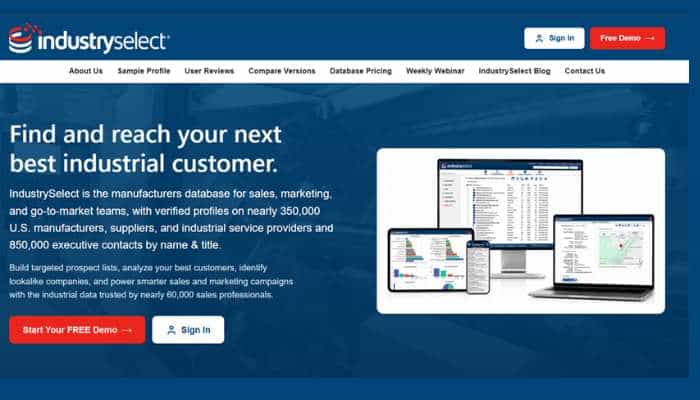
- Profiles roughly 350,000 U.S. manufacturers, suppliers, and industrial service providers
- Around 850,000 executive contacts by name and title
- Records maintained through phone calls, email updates, and postal checks
- Filters include production capability, materials used, and ISO certification alongside SIC and NAICS
- Annual flat-price subscription with no credits, tokens, or auto-renewal
IndustrySelect cons
- Direct executive emails, phones, and LinkedIn profiles require the Basic+ or Pro+ tier
- Data export to CRM requires Pro or Pro+
- Coverage is industrial only, so it does not serve mixed-segment teams
My experience with IndustrySelect
IndustrySelect is the right call when the ICP is defined by what a plant can physically do rather than by title and geography alone. Capability and certification filters are not something a general B2B database can approximate.
The tier structure is where buyers get caught. Subscribing at the entry level and expecting a downloadable file is the common mistake, so confirm which version unlocks export before committing to a year.
UpLead
UpLead pros
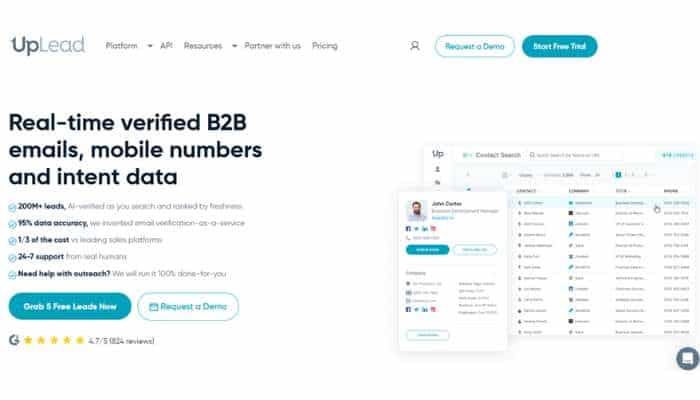
- States 95% accuracy for verified email records
- Verifies email addresses when they are exported
- Labels results as Valid, Accept-All, or Invalid
- Tracks technologies in use, which helps when selling software into plants
UpLead cons
- Accept-All addresses need separate risk controls
- Large exports can consume credits quickly
My experience with UpLead
UpLead is better suited to repeat prospecting than a single custom campaign. Verification at export gives the team a current signal, while the status labels make uncertain records easier to separate. Coverage held up for larger manufacturers, though small job shops were less consistent.
BookYourData
BookYourData pros
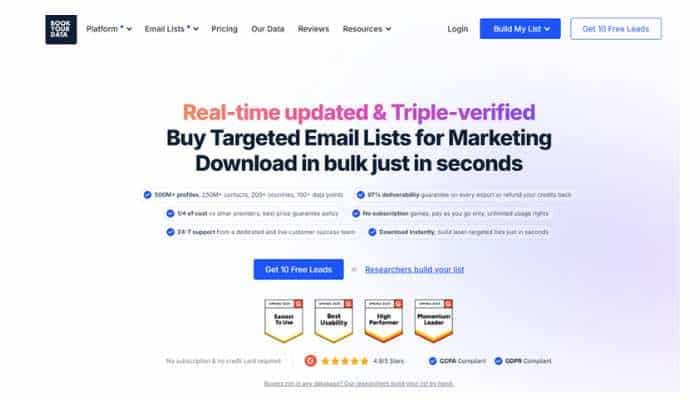
- Pay-as-you-go credits do not expire
- States a 97% deliverability guarantee with credit refunds
- Real-time verification included with every export
- Custom list builds are available alongside prebuilt segments
BookYourData cons
- Sending tools are not included
- Prebuilt segments usually need extra filtering to match an industrial ICP
My experience with BookYourData
This model works well for a limited pilot because there is no ongoing subscription. The stated refund remedy makes the deliverability promise more useful than a bare percentage.
Because no sending layer is included, budget for a separate platform. Any of the standard email marketing tools will handle the send, and teams targeting maintenance or quality roles specifically should plan on a custom build rather than a stock segment.
Data Axle

Data Axle pros
- Compiles business data from over 2,000 licensed sources
- Supports firmographic, SIC, and geographic selections
- Offers managed deployment services
- Runs standard hygiene processes including NCOA and CASS certification
Data Axle cons
- Counts, minimums, and update cadence are quoted per order rather than published
- The broker workflow is less immediate than self-service export
My experience with Data Axle
Data Axle fits broad campaigns where managed deployment matters more than instant access, and it is the natural pick when a program runs email and direct mail together. Its job-function, industry, employee-size, and sales-volume selections supported a credible plant audience. The process involves more coordination than a self-service database, closer to standard list broker coordination than an instant download.
ZoomInfo
ZoomInfo pros
- Covers larger manufacturers and multi-plant organizations well
- Includes company, location, revenue, and technology filters
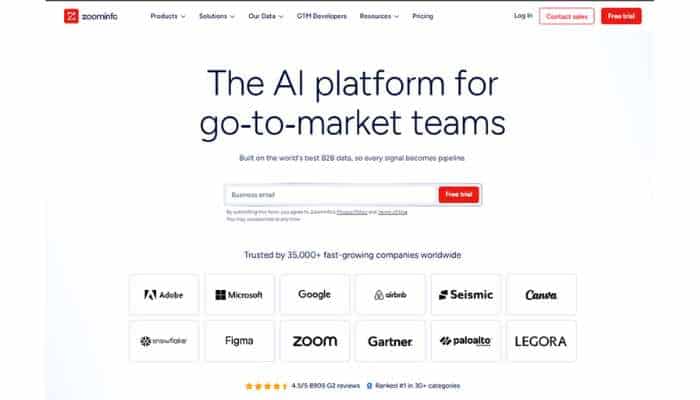
- Supports several go-to-market use cases
- Offers a limited community edition
ZoomInfo cons
- Pricing is not public
- Small privately held shops are under-represented compared with manufacturer-specific databases
My experience with ZoomInfo
ZoomInfo makes the most sense for account-based work aimed at named industrial companies. Its range of filters can support detailed company research. However, it is a platform purchase rather than a simple list order, and the free tier caps you at roughly ten contacts a month in exchange for contributing your own contact data.
Apollo.io
Apollo.io pros
- Combines prospect search, export, and sequencing
- Supports industry and keyword filters
- Can push records to connected CRMs
Apollo.io cons
- Its API documentation notes a 50,000-record display cap
- Manufacturing categorization is broad, so keyword refinement does real work
My experience with Apollo
Apollo reduces handoffs by putting list building and sending in one tool. That is convenient for a small supplier targeting regional manufacturers. Searches need careful narrowing, because the industrial category structure sweeps in distributors and service firms alongside actual producers.
Whichever tool you land on, a purchased file is a starting point rather than an asset. The replies it generates are worth building an email list around, so the next campaign starts from opted-in contacts rather than cold ones.
Conclusion
Emarketnow is my top pick for manufacturing email lists. Its built-to-order process, human verification, sector and title filters, free sample, and money-back guarantee address the main problems with stale or overly broad industrial data.
IndustrySelect is the runner-up when capability-level targeting drives the campaign. BookYourData is the practical alternative for a contract-free pilot, UpLead suits teams building lists every month, and larger programs can consider Data Axle or ZoomInfo. Apollo fits smaller, faster workflows.
FAQ
These answers cover the practical questions that often come up before an industrial outreach campaign.
Is it legal to cold email manufacturing professionals in the U.S.?
CAN-SPAM does not prohibit B2B commercial email, but it requires accurate identification, non-deceptive subject lines, a physical address, and a working opt-out. State laws may add obligations. Seek legal advice for your situation.
Should I filter by NAICS or SIC?
Use both where the provider carries both. SIC is often more granular for legacy industrial categories while NAICS is more current, and cross-checking the two confirms a filter is catching what you expect.
What list size should I start with?
Start with a few hundred tightly filtered records. A small test reveals data and message problems before they affect a larger audience.
Which titles convert best in manufacturing outreach?
It depends on what you sell. Plant managers and operations directors can often evaluate and adopt without a long corporate approval chain. Procurement and supply chain roles matter more when you are selling materials or components than when you are selling capability.
How does the California Delete Act affect list vendors?
Covered data brokers have had to access California’s DROP system and process qualifying deletion requests since August 1, 2026, checking at least every 45 days. Buyers should expect databases to change as records are removed.
